- Home
- Mobility Scooter Accessories and Power
- Mobility Scooter Battery Capacity
- Lithium Upgrade Decision Guide
Lithium Upgrade Decision Guide: What Capacity to Choose and What Else Must Change
Picture this: Your mobility scooter has served you faithfully for two years, but the battery is fading. You have heard that lithium batteries last longer, weigh less, and give you more range. You find a 24V 50Ah lithium battery online for a reasonable price. It looks like it will fit. But then you start reading about chargers, BMS ratings, voltage curves, and wiring modifications—and suddenly the simple battery swap feels like an engineering project. You close the browser tab, overwhelmed, and go back to your old battery.
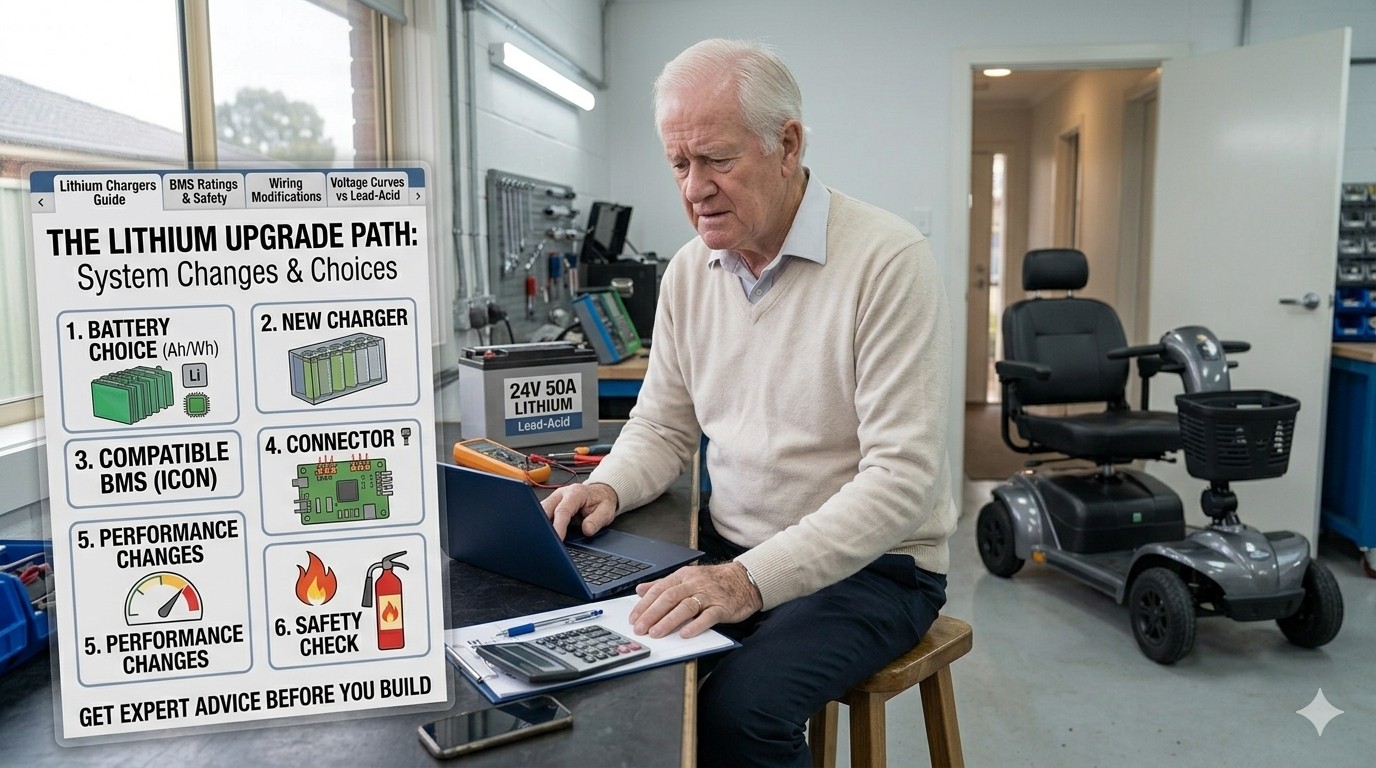
If that sounds familiar, take a breath. You are not alone, and you are not overreacting. A lithium upgrade is not just a battery swap—it is a system change. But it is also one of the most rewarding upgrades you can make, if you understand what you are getting into.
This lithium upgrade decision guide: what capacity to choose and what else must change will walk you through every decision, step by step. No jargon. No pressure. Just the honest, practical guidance you need to decide whether a lithium upgrade is right for you—and if it is, how to do it safely.
Why Consider a Lithium Upgrade at All?
Before we dive into the technical details, let us look at what you actually gain from switching to lithium.
Lithium batteries offer roughly 20–40% more usable range than lead-acid from the same battery box, because you can safely use more of their stored energy. A mid-size scooter on good lithium batteries might comfortably manage 29 to 40 kilometres, while the same model on lead-acid could sit closer to 19 to 29 kilometres, depending on weight, hills, and weather.
They also last significantly longer. Lithium batteries typically deliver 800–1,500 full charge cycles, compared with 300–600 cycles for lead-acid (AGM/gel) packs. Some premium LiFePO4 batteries claim up to 5,000 cycles at 80% depth of discharge.
And then there is the weight. Lithium batteries are roughly 50% lighter than equivalent lead-acid packs. For riders who lift their scooter into a car or struggle with heavy batteries, this alone can be life-changing.
But here is the catch: all of these benefits come with a catch. Lithium is not a drop-in replacement for lead-acid. Several things must change—and if you skip them, the upgrade can fail, damage your scooter, or create a safety risk.
What Capacity Should You Choose?
This is the first decision, and it is the one most people get wrong. The good news is that the process is simpler than it looks.
Start with Watt-Hours (Wh), Not Amp-Hours (Ah)
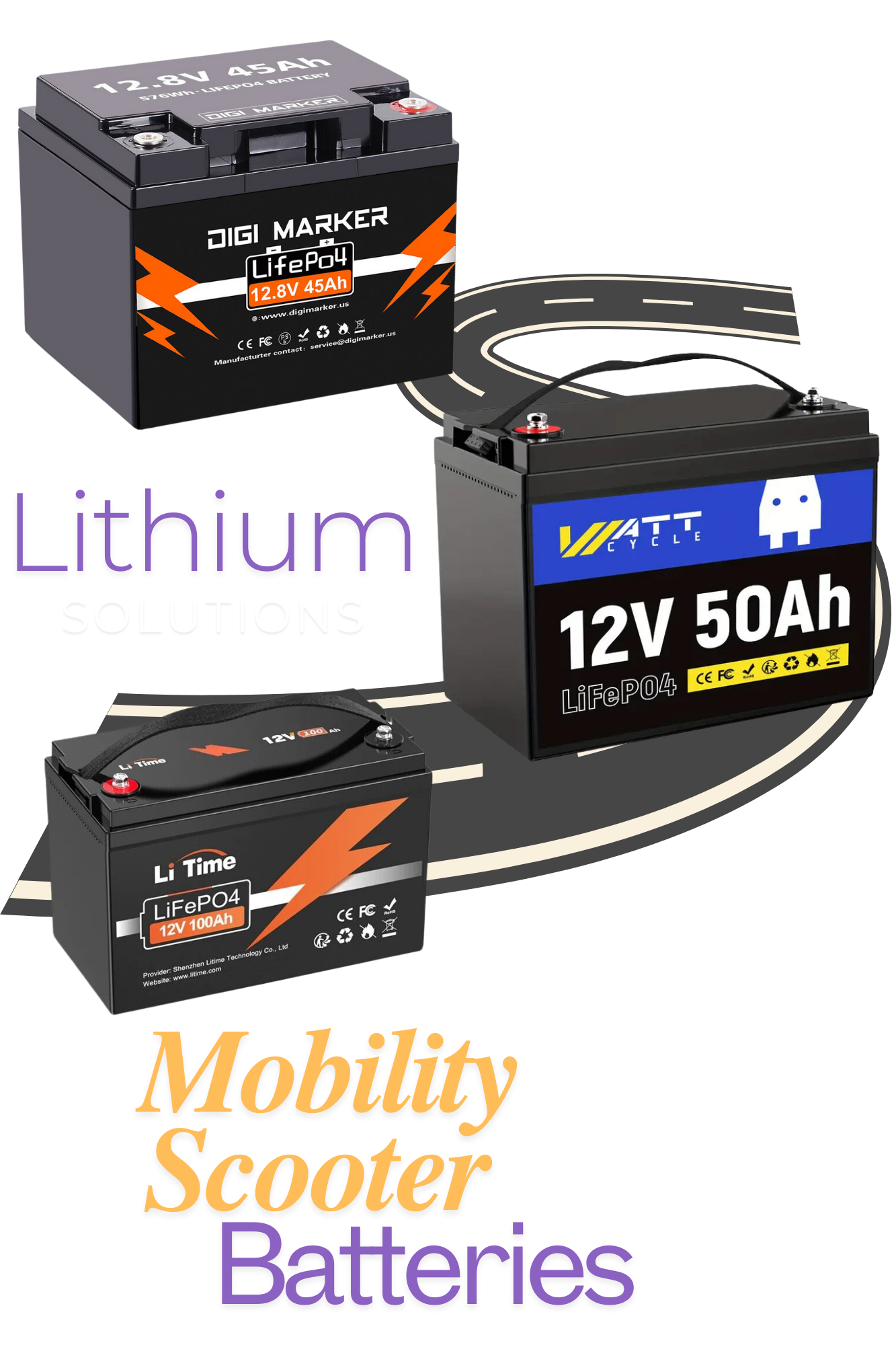
Ah alone cannot tell you how much energy a battery stores unless you also know the voltage. As we explain in our guide on Ah vs Wh for mobility scooters, the only fair way to compare batteries across different voltages is to calculate watt-hours:
Wh = Ah × Voltage
A 24V 35Ah battery stores 840Wh. A 24V 55Ah battery stores 1,320Wh. A 24V 75Ah battery stores 1,800Wh. Once you have your Wh figure, you can compare any two batteries fairly.
Match Capacity to Your Real-World Range
Use the following as a starting point for a 24V system:
- 35Ah (≈840Wh): roughly 23–32 kilometres (14–20 miles)
- 55Ah (≈1,320Wh): roughly 35–48 kilometres (22–30 miles)
- 75Ah (≈1,800Wh): roughly 48–64 kilometres (30–40 miles)
These figures assume moderate conditions. For a personalised estimate based on your own routes, see our guide on how to estimate the battery capacity you need from your typical weekly routine.
Can You Go Smaller Than Your Lead-Acid Rating?
Yes. Because lithium can be discharged more deeply—often to 80–90% of rated capacity, compared to 50% for lead-acid—a lithium battery with a lower Ah rating can deliver the same usable range as a larger lead-acid battery.
For example, replacing a 40Ah lead-acid battery with a 60Ah lithium battery may seem like an upgrade, but you might actually get similar usable energy from a 35Ah lithium pack. Always compare usable Wh, not just rated Ah.
Check Physical Dimensions Before You Buy
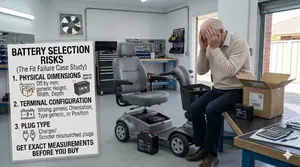
A higher-capacity battery is often physically larger than the original. Measure your battery compartment carefully and compare it to the dimensions of the new battery. A battery that is slightly too tall or wide will not fit.
For a full compatibility walkthrough, see our mobility scooter battery compatibility checklist. (Coming Soon!)
What Else Must Change? The Four Non-Negotiables
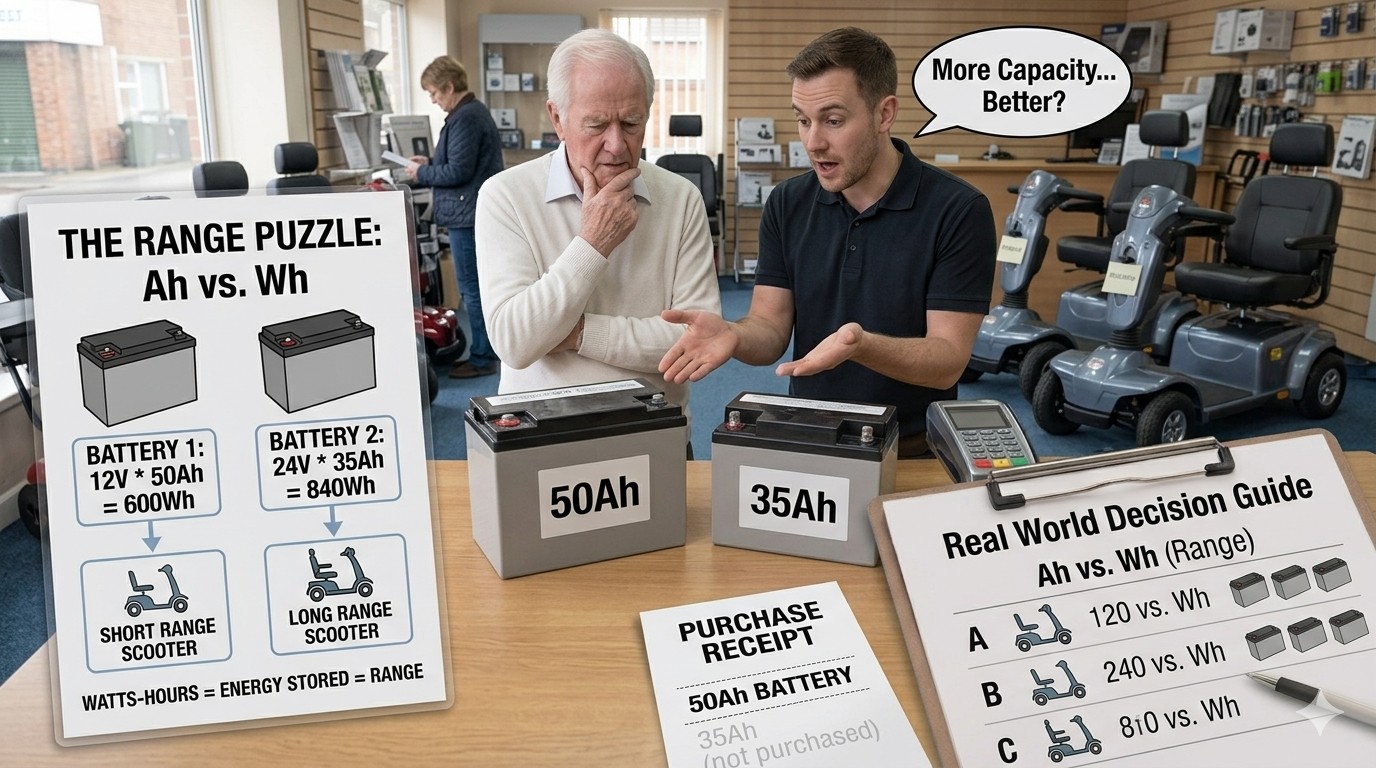
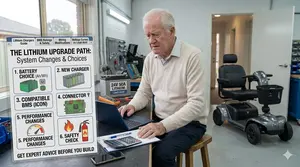
This is where most upgrades fail. A lithium battery is not a drop-in replacement for lead-acid. Four things must change, and skipping any one of them can lead to poor performance, damage, or safety risks.
1. The Charger
This is the most important change. A lead-acid charger will not safely charge a lithium battery. Lead-acid chargers use a "float" mode that keeps voltage too high, which can trigger thermal runaway—an uncontrollable fire or explosion—in lithium cells. A lithium battery requires a charger with a CC/CV (constant current/constant voltage) profile—no trickle charge.
Most lithium batteries also require a specific charge voltage. A 24V LiFePO4 battery, for example, typically charges at 29.2V. Your charger must match that specification exactly. Never use a lead-acid charger on a lithium battery.
For a full guide, see our article on choosing the right charger for your battery capacity and chemistry. (Coming Soon!)
2. The Battery Management System (BMS)
Most lithium batteries include a built-in BMS, which protects against overcharge, over-discharge, over-current, short circuits, and temperature extremes. But the BMS must be able to supply the current your scooter demands.
Check that the BMS continuous and peak ratings match your scooter's controller and motor requirements, especially for hill climbing. If the BMS cannot deliver enough current, the scooter will cut out under load.
3. Wiring and Terminals
Lithium batteries often use different connectors than lead-acid batteries. You may need to crimp new terminals or adapt your scooter's wiring harness. The cabling must also be sized appropriately for the current draw.
This is not a job for a novice—if you are unsure, consult a professional.
4. Controller Compatibility
The scooter's controller must be compatible with the lithium battery's voltage curve. Most 24V controllers will work with a 24V lithium battery, but some older controllers may have low-voltage cut-offs that are too high for lithium's discharge curve.
Check the controller's low-voltage cut-off setting before you buy.
What Can Go Wrong: The Real Risks
Now let us be honest about the risks. A badly executed lithium upgrade can cause serious problems.
Fire and thermal runaway. In Singapore, investigations found that the majority of active mobility device fires originated from charging devices with non-original parts, including modifications to batteries and electrical circuitry. Using the wrong charger or a poorly made battery without a proper BMS can lead to catastrophic fire.
Irreparable damage to your scooter. Using a battery with the wrong voltage, or an unregulated rebuilt power source, can fry your scooter's internal electronics and permanently destroy your mobility device.
Voided warranty. Using batteries with the wrong voltage or incompatible charging equipment can damage your mobility scooter and may void the manufacturer's warranty.
Performance problems. If the BMS cannot supply enough current, the scooter may cut out on hills. If the charger is incompatible, the battery may never reach full charge, or it may overcharge and degrade rapidly.
These risks are real, but they are also manageable. The key is to do your homework, use quality components, and consult a professional if you are unsure.
The Safer Alternative: A Higher-Capacity AGM Upgrade
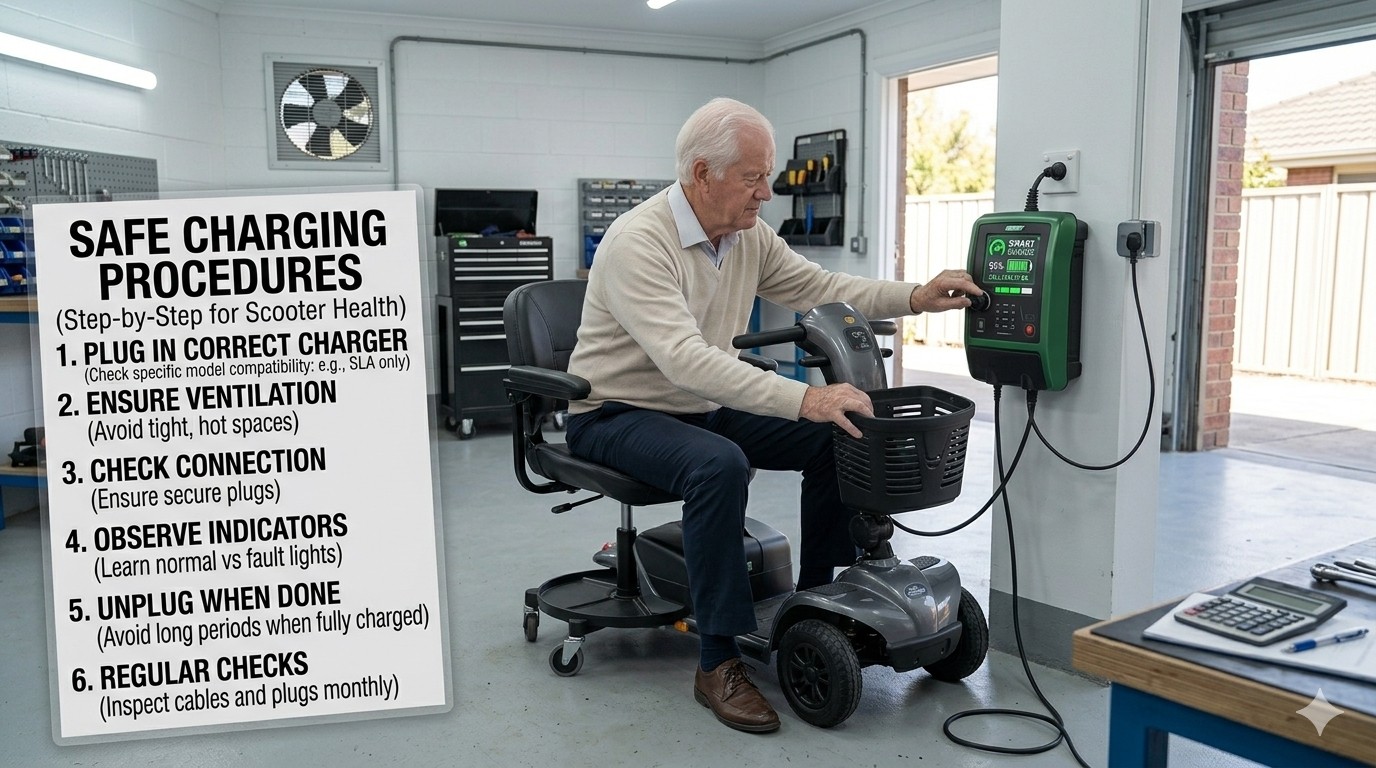
If all of this sounds like more complexity than you want, there is a simpler alternative: a higher-capacity AGM battery.
AGM (Absorbent Glass Mat) batteries are the most common type in mobility scooters. They are affordable, widely available, and—crucially—plug-and-play. If you stick with AGM chemistry, you can keep your original charger and factory wiring harness.
The easiest path is higher Ah AGM batteries. Swapping to a higher Amp-Hour rating—for example, moving from 18Ah to 21.4Ah—gives you more distance without needing new chargers or modified wiring. High-density AGM technology now packs more power into the same standard shapes, so a 21.4Ah battery can use the exact same outer footprint as a standard 18Ah battery.
This is the upgrade path most owners should consider first. It is simple, safe, and effective. You get more range, you keep your existing equipment, and you avoid the compatibility minefield of a chemistry change.
But if you are ready for the extra complexity—and the extra benefits—lithium is a rewarding upgrade. The next section will help you decide.
A Step-by-Step Decision Framework
Here is a simple process for deciding whether a lithium upgrade is right for you:
Step 1: Assess your goals. Are you looking for more range? Longer battery life? Lighter weight? If range is your only goal, a higher-capacity AGM upgrade may be sufficient.
Step 2: Check your scooter's compatibility. What voltage does it use? What is the controller's peak current rating? Does the battery compartment have space for a larger battery?
Step 3: Choose your capacity. Use Wh to compare batteries fairly. Match capacity to your real-world range needs.
Step 4: Budget for the full upgrade. A lithium upgrade is not just a battery. It is a battery plus a lithium-specific charger, plus any wiring or terminal modifications. Lithium batteries are around four times the price of gel batteries, plus the cost of a new charger.
Step 5: Decide who will install it. If you are confident with basic electrical work, you may be able to install it yourself. If not, consult a mobility scooter specialist or battery professional.
Step 6: Test carefully. After installation, test the scooter on flat ground first, then on hills. Monitor battery temperature and performance. If anything seems wrong, stop and consult a professional.
Frequently Asked Questions
Is a lithium upgrade worth it?
For daily riders who want more range, longer lifespan, and lighter weight, lithium usually pays off over time. For occasional riders, a higher-capacity AGM battery may be more cost-effective.
Can I use my existing charger with a lithium battery?
No. Lithium batteries require a lithium-specific charger with a CC/CV profile. Never use a lead-acid charger on a lithium battery.
What is a BMS, and why does it matter?
A Battery Management System (BMS) protects the battery from overcharge, over-discharge, over-current, and temperature extremes. It must be able to supply the current your scooter demands, especially on hills.
How much does a lithium upgrade cost?
Lithium batteries are around four times the price of gel batteries, plus the cost of a new charger. In Australia, replacement lithium batteries for mobility scooters range from roughly $700 to $1,400, depending on capacity and brand.
Can I upgrade to lithium if my scooter is still under warranty?
Check your warranty terms first. Using non-original parts may void your warranty. Consult the manufacturer before upgrading.
Do I need to change the wiring?
Often, yes. Lithium batteries may use different connectors, and the cabling must be sized appropriately for the current draw. If you are unsure, consult a professional.

Your Next Step
A lithium upgrade can transform your mobility scooter—more range, less weight, longer life. But it is not a simple battery swap. It is a system change that requires the right charger, the right BMS, the right wiring, and the right capacity.
You now have the knowledge to make an informed decision. You know the benefits, the risks, the costs, and the compatibility checks. You know that AGM is simpler and safer, while lithium offers more range at the cost of complexity. And you know that if you are ever unsure, the safest path is to ask a professional.
And that confidence? It means you can choose the upgrade that is right for you—not the one that sounds best in an advertisement. You deserve that confidence.
And now you have the tools to build it.
Ready to Go Deeper?
This guide is part of our complete series on choosing the right battery capacity for your mobility scooter. If you found this helpful, these related guides will take you further:
- Choosing the Right Battery Capacity for Your Mobility Scooter — The complete hub guide to capacity selection
- Ah vs Wh for Mobility Scooters: How to Compare Batteries the Right Way — The formula that changes everything
- How to Estimate the Battery Capacity You Need from Your Typical Weekly Routine — Put the numbers to work for your lifestyle
- Mobility Scooter Battery Compatibility Checklist: Size, Terminals, Voltage, Charger, and Fit — Make sure your chosen battery actually fits
- Can You Upgrade to Higher Ah Batteries on Your Mobility Scooter (and What Can Go Wrong)? — The upgrade decision, explained
- Battery Capacity vs Range Claims: How to Sanity-Check Manufacturer "Miles per Charge" Numbers — Why real-world range differs from the spec sheet
- Choosing Battery Capacity for Travel/Portable Mobility Scooters vs Mid-Size vs Heavy-Duty Models — Capacity recommendations by scooter type
- How Rider Weight, Terrain, and Stop-Start Driving Change the Capacity You Should Choose — Personalise your estimation
- Choosing the Right Charger for Your Battery Capacity and Chemistry — Don't overlook this critical companion purchase
- Mobility Scooter Battery Maintenance: How to Preserve Capacity and Extend Lifespan — Keep your battery healthy for years
Stay mobile, stay confident!
Sign up for our monthly Mobility Scooter Newsletter to receive practical guides, expert advice, and inspiring stories that help you make the most of your scooter and download our free "Mobility Scooter Guide for Beginners."
Don't worry — your e-mail address is totally secure.
I promise to use it only to send you our newsletter, "Mobility Matters."
Recent Articles


-
Choosing the Right Battery Capacity 101: (Ah vs Wh)
Oct 07, 26 08:54 AM
 Choosing the Right Battery Capacity Guide: Compare Ah vs Wh, estimate range, and pick the best battery for your routine.
 -
Stop! Check These 5 Things Before Buying a Battery (
Oct 07, 26 08:50 AM
 Mobility scooter battery compatibility checklist: size, terminals, voltage, charger, and fit explained simply. Avoid costly mistakes before you buy.
 -
Stop! Read This Before Your Lithium Battery Upgrade
Oct 07, 26 07:11 AM
Lithium upgrade decision guide: what capacity to choose and what else must change. Stop guessing. Get the honest facts before you spend your money.

Ready to Feel More Confident on Your Mobility Scooter?

My Ebook, The Ultimate Guide to Mobility Scooters, walks you through choosing the right scooter, using it safely, and keeping it in top condition — all explained in clear, friendly language.
Give yourself (or someone you love) the gift of independence.

