- Home
- Mobility Scooter Accessories and Power
- Mobility Scooter Battery Capacity
- Airline-Friendly Mobility Scooter Batteries
Airline-Friendly Mobility Scooter Batteries: Capacity Limits and Travel Rules
Picture this: You have booked a flight to visit family overseas. You have arranged assistance at the airport, packed your bags, and confirmed your travel mobility scooter is ready to go. But as you stand at the check-in desk, the agent looks at your battery and asks a question you cannot answer. "What is the watt-hour rating?" Your heart sinks. You have no idea. The agent explains that without this information, your scooter cannot fly. Your trip is suddenly in jeopardy..
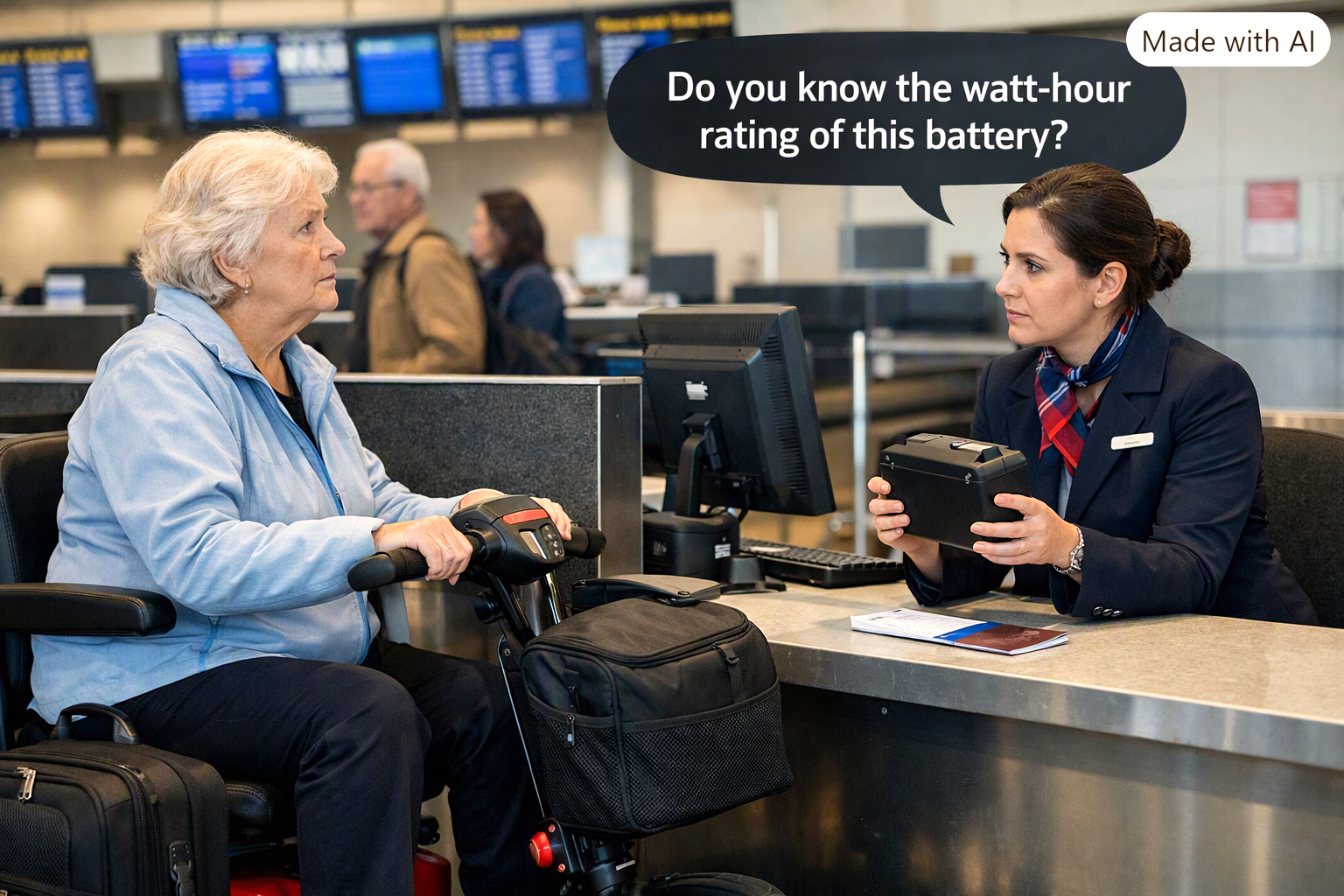
This scenario is more common than you might think. Understanding airline-friendly mobility scooter batteries: capacity limits and travel rules is not just about compliance—it is about protecting your independence when you travel.
The rules exist for good reason: lithium batteries can pose a fire risk if damaged or improperly handled. But they are also navigable, and with the right preparation, you can fly with confidence.
This guide will walk you through everything you need to know, from watt-hour limits to documentation, in plain language. No jargon. No pressure.Just the practical information you need to get you and your scooter to your destination safely.
Why Airlines Have Battery Rules (and Why They Matter)
Before we dive into the specifics, let us understand why these rules exist. Lithium batteries, in particular, store a tremendous amount of energy in a small space. If a lithium battery is damaged, short-circuited, or exposed to extreme heat, it can enter a state called "thermal runaway"—a chain reaction that produces intense heat and fire. In the confined space of an aircraft cabin or cargo hold, this is a serious safety concern.
Airline operators have expressed particular concern with the increase in energy storage capacity of lithium-ion batteries that often power mobility devices and the limited ability to manage a thermal runaway event involving those batteries. The loss of an airframe in Korea in 2025, where the source of fire was believed to be a lithium battery, underscored the urgency of these regulations.
This is why airlines regulate mobility scooter batteries so carefully. It is not about making travel difficult—it is about keeping everyone on board safe. And once you understand the rules, you will find they are manageable. The key is the watt-hour rating.
The Magic Number: Understanding the 300Wh Limit
If you remember nothing else from this guide, remember this: 300 watt-hours (Wh) is the single most important number for air travel with a mobility scooter.
Watt-hours measure the total energy stored in a battery. Unlike amp-hours (Ah), which only tell you part of the story, Wh takes voltage into account. The formula is simple: Wh = Ah × Voltage. A 24V 12Ah battery stores 288Wh. A 24V 15Ah battery stores 360Wh. You can see how quickly a battery exceeds the 300Wh threshold.
Under IATA regulations, the battery removed from a mobility aid must not exceed 300Wh, or for mobility aids fitted with two batteries, each battery must not exceed 160Wh. This is the standard that airlines around the world follow.

What If Your Battery Exceeds 300Wh?
If your lithium battery exceeds 300Wh, you have a few options:
- Check if the battery can remain installed in the scooter. If the battery stays attached to the mobility aid and is loaded in the cargo compartment, there is no watt-hour limit. The limit applies only to batteries removed from the device.
- Consider a smaller battery for travel. Many travel scooters are designed with airline-compliant batteries for exactly this reason.
- Check with your airline. Some airlines have their own policies that may differ slightly from the IATA standard.
What About Lead-Acid (AGM/Gel) Batteries?
Here is some good news for riders with lead-acid batteries: the watt-hour limit does not apply in the same way. Non-spillable, sealed lead-acid batteries (AGM, gel, SLA) are generally easier to travel with. The battery must remain securely attached to the mobility aid with the terminals protected, and the aid's free-wheel mode must be activated prior to loading. There is no watt-hour limit for lead-acid batteries in the same way there is for lithium.
This is one of the few situations where lead-acid chemistry actually makes travel easier. If you are a frequent flyer, it is worth considering.
Battery Chemistry: What You Need to Know Before You Fly
The rules for air travel differ depending on whether your scooter uses lithium or lead-acid batteries. Let us break down each type.
Lithium-Ion Batteries
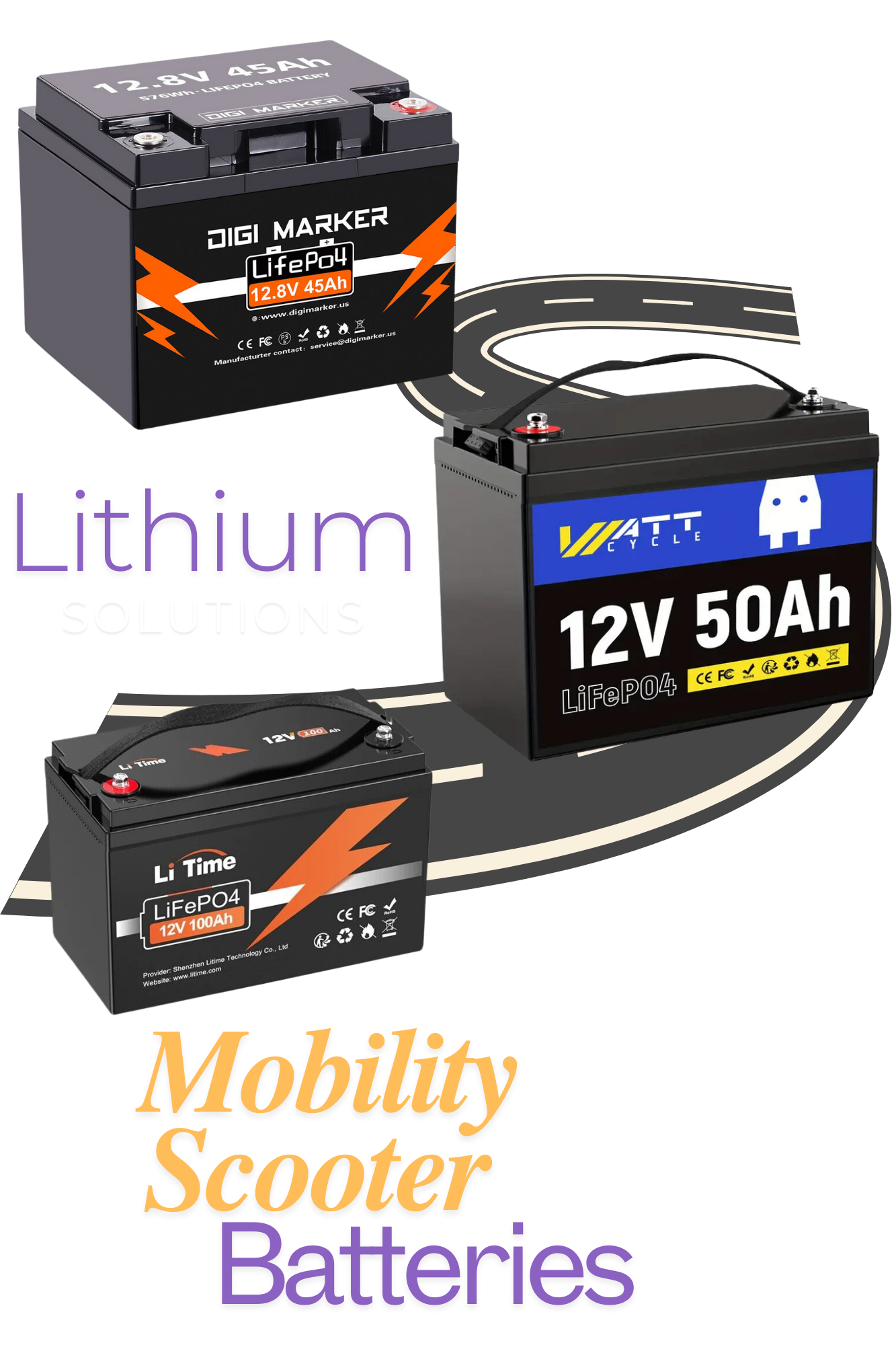
Lithium batteries are the most regulated because they pose the highest fire risk. If the battery is removed from the mobility aid, it must not exceed 300Wh. The removed battery must be carried in the cabin, not checked baggage. All terminals must be individually protected to prevent short circuiting, for example by taping them, and the battery must be protected from damage, such as in a protective bag or pouch.
If the battery cannot be removed from the mobility aid, it can travel in the cargo hold, but the battery must remain securely attached to the aid with the terminals protected, and the aid must be switched off.
Spare Lithium Batteries
You may carry one spare lithium battery not exceeding 300Wh, or two spare batteries each not exceeding 160Wh. Spare batteries must be in carry-on baggage only and must be protected from short circuiting.
Lead-Acid (AGM, Gel, SLA) Batteries

For non-spillable lead-acid batteries, the rules are simpler. If the battery is removed from the mobility aid, it must be packed in a strong, rigid container with terminals protected. If it remains installed, it must be securely attached with terminals protected, and the aid must be switched off and in free-wheel mode if available.
Nickel Metal Hydride (NiMH) and Dry Cell Batteries
These follow similar rules to lead-acid: the battery must be removed or secured, terminals protected, and spare batteries packed in a strong rigid container.
Your Step-by-Step Travel Checklist
Now that you understand the rules, here is a practical checklist to follow before you fly.
Step 1: Identify Your Battery's Watt-Hour Rating
Check your battery label or your scooter manual. The Wh rating should be clearly stated. If it is not, calculate it: multiply the voltage by the Ah rating. If your battery exceeds 300Wh and cannot remain installed in the scooter, you may need an alternative battery for travel.
Step 2: Contact Your Airline at Least 48 Hours in Advance
Most airlines require advance notification for battery-powered mobility aids. AirAsia, for example, requires guests to contact them at least 48 hours before departure to ensure the device is approved for carriage. Qantas requires airline approval and the aid must be declared during check-in.
Step 3: Gather Your Documentation
Travel with your scooter documents. Check-in staff are not experts in battery rules, and without user manuals and certificates, you can experience delays. Lithium batteries require UN38.3 Certification, which is likely detailed in the battery documents under a UN38.3 Test Summary. This certification confirms the battery has passed the UN Manual of Tests and Criteria, Part III, subsection 38.3.
Step 4: Prepare the Battery for Travel
For lithium batteries removed from the aid: tape the terminals individually, place the battery in a protective pouch or bag, and carry it in your cabin baggage. For lead-acid batteries removed from the aid: pack them in a strong, rigid container with terminals protected. For batteries remaining in the aid: ensure they are securely attached, terminals are protected, the aid is switched off, and free-wheel mode is activated if available.
Step 5: Label Everything Clearly
Ensure battery labels and user manuals are in English and clearly visible for staff to verify. If your documents are in another language, consider having a translated copy available.
Step 6: Arrive Early and Declare Your Aid at Check-In
Battery-powered mobility aids must be declared during check-in. Arrive at the airport with extra time to complete this process. You may be asked to demonstrate that the battery is removed and properly protected.

What Can Go Wrong (and How to Avoid It)
Even with the best preparation, things can go wrong. Here are the most common issues and how to prevent them.
Your Battery Exceeds the Limit
If your lithium battery exceeds 300Wh and cannot remain installed in the scooter, you will not be able to fly with it.
Solution: check whether your battery can remain installed, or consider purchasing an airline-compliant battery for travel.
Missing Documentation
Without the right documents, check-in staff may refuse carriage. Solution: carry your scooter manual, battery documentation, and UN38.3 certification if applicable.
Battery Not Properly Protected
Airlines will not accept batteries with unprotected terminals or those not in a protective container.
Solution: tape terminals individually and use a protective bag or rigid container.
Airline Policy Variations
Not all airlines interpret the rules in the same way. Qantas's policy says mobility aids are permitted with lithium batteries of up to 300Wh, as long as the batteries can be removed from the devices and taken into the cabin. But some airports do not accept lithium batteries exceeding 300Wh.
Solution: contact your airline directly and get approval in writing.
Incorrect Dimensions or Weight
Airlines require accurate dimensions and weight. Giving incorrect information can result in denied carriage or rejected insurance claims.
Solution: measure your scooter accurately and provide the correct specifications when booking.
Frequently Asked Questions
What is the 300Wh limit for mobility scooter batteries?
It is the maximum watt-hour rating allowed for a lithium battery removed from a mobility aid and carried in the cabin. Batteries exceeding this limit must remain installed in the scooter and be carried in the cargo hold.
Can I fly with a lead-acid battery?
Yes. Non-spillable lead-acid batteries (AGM, gel, SLA) are generally easier to travel with. They must be securely attached or packed in a rigid container with terminals protected.
Do I need to notify the airline in advance?
Yes. Most airlines require advance notification, typically at least 48 hours before departure. Contact your airline as soon as your trip is booked.
What documents do I need for lithium battery travel?
You need your scooter manual, battery documentation, and UN38.3 certification if applicable. Ensure all documents are in English.
Can I bring a spare battery?
Yes. You may carry one spare lithium battery not exceeding 300Wh, or two spare batteries each not exceeding 160Wh. Spare batteries must be in carry-on baggage only.
What happens if my battery is not airline-compliant?
If your battery exceeds the limit and cannot remain installed, you will not be able to fly with it. Consider purchasing a smaller, airline-compliant battery for travel.

Your Next Step
Flying with a mobility scooter does not have to be stressful. The rules are clear, the limits are knowable, and with the right preparation, you can travel with confidence. Identify your battery's watt-hour rating. Contact your airline in advance. Gather your documentation. Prepare your battery for travel. And arrive early.
You now have the knowledge to navigate airline regulations without fear. No more guessing. No more hoping for the best. Just clear, practical preparation that gets you and your scooter to your destination.
And that confidence? It means you can travel without worry, knowing you have done everything right. You deserve that confidence.
And now you have the tools to build it.
Ready to Go Deeper?
This guide is part of our complete series on choosing the right battery capacity for your mobility scooter. If you found this helpful, these related guides will take you further:
- Choosing the Right Battery Capacity for Your Mobility Scooter — The complete hub guide to capacity selection
- Ah vs Wh for Mobility Scooters: How to Compare Batteries the Right Way — The formula that changes everything
- How to Estimate the Battery Capacity You Need from Your Typical Weekly Routine — Put the numbers to work for your lifestyle
- Choosing Battery Capacity for Travel/Portable Mobility Scooters vs Mid-Size vs Heavy-Duty Models — Capacity recommendations by scooter type
- How Rider Weight, Terrain, and Stop-Start Driving Change the Capacity You Should Choose — Personalise your estimation
- Can You Upgrade to Higher Ah Batteries on Your Mobility Scooter (and What Can Go Wrong)? — The upgrade decision, explained
- Lithium Upgrade Decision Guide: What Capacity to Choose and What Else Must Change — Is lithium right for you?
- Mobility Scooter Battery Compatibility Checklist: Size, Terminals, Voltage, Charger, and Fit — Make sure your chosen battery actually fits
- Choosing the Right Charger for Your Battery Capacity and Chemistry — Don't overlook this critical companion purchase
- Battery Capacity vs Range Claims: How to Sanity-Check Manufacturer "Miles per Charge" Numbers — Why real-world range differs from the spec sheet
- Mobility Scooter Battery Maintenance: How to Preserve Capacity and Extend Lifespan — The mobility scooter maintenance guide
- What to Do When Your Mobility Scooter Battery Won't Hold a Charge — Everything you need to know about diagnosing and fixing battery problems
- How to Compare AGM, Gel, and Lithium Batteries for Mobility Scooters — A friendly guide to lifespan, cost, weight, and real-world performance.
- When "Extended Range" Battery Kits Make Sense (and When They Don't) — Stop wasting money. Get the honest facts before you upgrade your scooter.
Stay mobile, stay confident!
Sign up for our monthly Mobility Scooter Newsletter to receive practical guides, expert advice, and inspiring stories that help you make the most of your scooter and download our free "Mobility Scooter Guide for Beginners."
Don't worry — your e-mail address is totally secure.
I promise to use it only to send you our newsletter, "Mobility Matters."
Recent Articles


-
Ah vs Wh: The Battery Comparison That Changes Everything
Oct 09, 26 10:32 AM
 Ah vs Wh for mobility scooters: Stop overpaying for the wrong battery. Learn how watt-hours reveal the true energy a battery stores.
 -
Choosing the Right Battery Capacity 101: (Ah vs Wh)
Oct 09, 26 09:56 AM
Choosing the Right Battery Capacity Guide: Compare Ah vs Wh, estimate range, and pick the best battery for your routine. -
Stop! Check Your Battery Before You Fly
Oct 09, 26 09:44 AM
 Airline-friendly mobility scooter batteries: capacity limits and travel rules. Stop worrying about airport surprises. Get the facts before you book.



Ready to Feel More Confident on Your Mobility Scooter?

My Ebook, The Ultimate Guide to Mobility Scooters, walks you through choosing the right scooter, using it safely, and keeping it in top condition — all explained in clear, friendly language.
Give yourself (or someone you love) the gift of independence.




