- Home
- Mobility Scooter Accessories and Power
- Mobility Scooter Battery Capacity
- The Battery Compatibility Checklist You Actually Need
Mobility Scooter Battery Compatibility Checklist: Size, Terminals, Voltage, Charger, and Fit
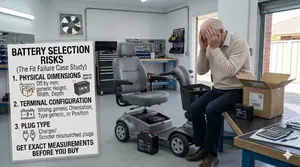
Picture this: Your mobility scooter battery has finally given up. You order a replacement online—the voltage matches, the Ah rating looks right, and the price is good. The battery arrives. You open the box, lift it into place, and... it does not fit. The terminals are in the wrong position. The height is a few millimetres too tall. The charger plug does not match. You have spent your money, waited for delivery, and now you are stuck with a battery you cannot use—and a scooter you cannot ride..
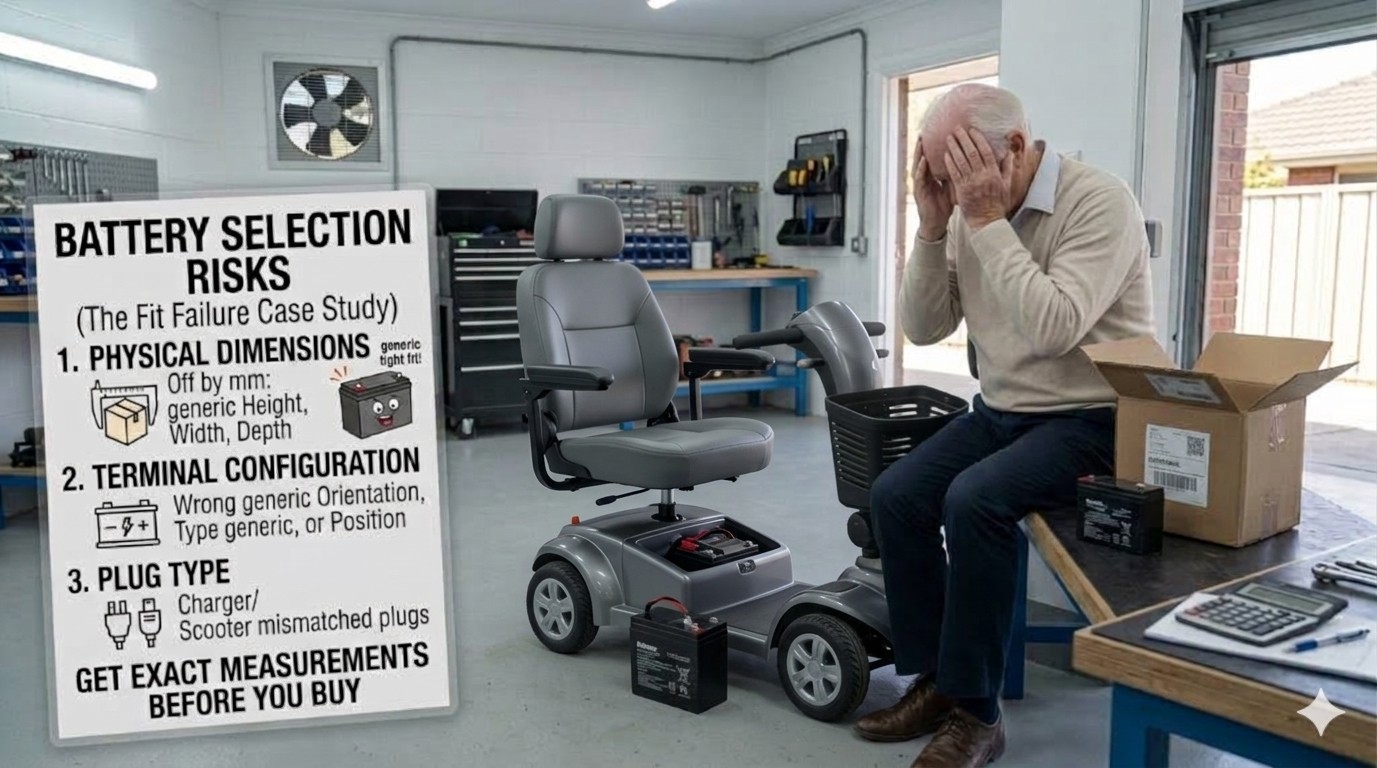
This scenario plays out every day, and it is entirely preventable. Most battery compatibility problems come down to five simple checks that take less than ten minutes to complete. Skip them, and you risk wasting money, damaging your scooter, or—worst of all—being left without your mobility when you need it most.
This mobility scooter battery compatibility checklist: size, terminals, voltage, charger, and fit will walk you through each check, step by step.
No jargon. No pressure. Just the practical guidance you need to get the right battery the first time.
Why Battery Compatibility Matters More Than You Think
A mobility scooter is not a generic appliance. It is a carefully engineered system where every component is matched to the others. The battery is not just a power source—it is part of that system. When you replace it, you need a battery that fits the system, not just one that "looks about right."
Get it wrong, and the consequences range from minor inconvenience to serious safety risk. Using batteries with the wrong voltage or incompatible charging equipment can damage your mobility scooter and may void the manufacturer's warranty. A battery that does not fit properly can shift during use, causing connection problems or even a tipping hazard.
The good news is that compatibility is not complicated once you know what to check. There are five factors, and each one has a straightforward answer. Let us walk through them together.
Check 1: Physical Size and Fit
This is the check that catches most people out. Even if every electrical specification matches, a battery that does not physically fit is useless.
What to Measure
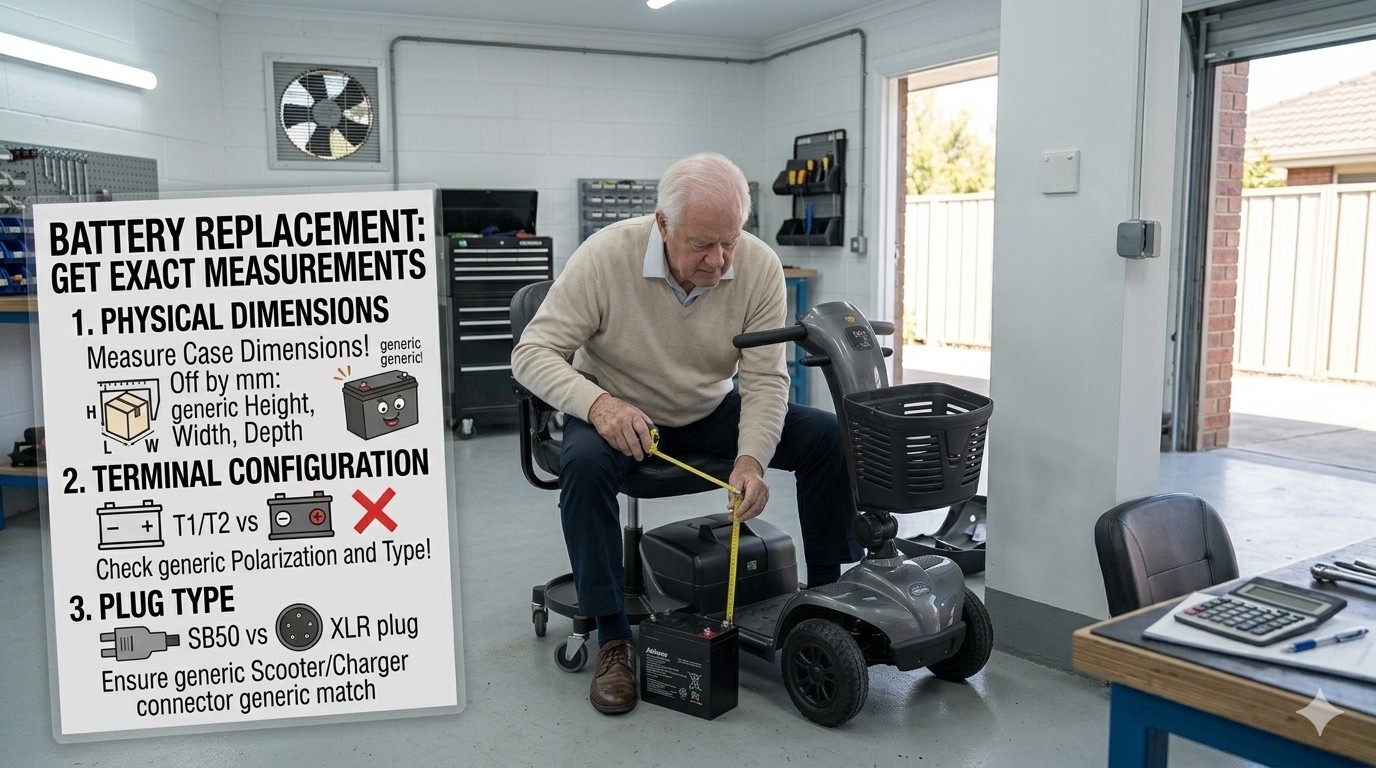
You need three measurements from your existing battery:
- Length — the longest dimension
- Width — the shorter horizontal dimension
- Height — including any raised terminals
Measure your current battery with a tape measure and write the numbers down. Then compare them to the dimensions listed for the replacement battery. Allow a few millimetres of tolerance for ease of installation, but do not assume a battery will fit just because the numbers are close.
Why Millimetres Matter
Batteries that look similar in photos can differ in height and width by just a few millimetres—enough to make them impossible to install. If the height is a few millimetres off, the battery may not sit properly in the compartment, or the lid may not close. Terminal orientation also matters: a battery with terminals on the "wrong" side may not reach your scooter's existing cables.
Measure twice. Order once. Your future self will thank you.
Check 2: Terminal Type and Orientation
Terminals are the metal connections on top of the battery where your scooter's cables attach. There are several common types, and they are not interchangeable.
Common Terminal Types
The most common terminal types in mobility scooter batteries are:
- F1 and F2 tabs — flat spade connectors, with F1 being narrower than F2
- Nut and Bolt (NB) — threaded posts that accept a nut and bolt
- Threaded Inserts (M5/M6) — threaded holes that accept a screw directly
Before buying, identify whether your battery uses F1/F2 tabs, Nut & Bolt, or Threaded Inserts to ensure a proper fit. The terminal type is usually printed on the battery label or listed in your scooter's manual.
Orientation Matters
Even if the terminal type matches, the orientation may not. Some batteries have both terminals on the same side; others have them at opposite ends. If your cables are short, a battery with terminals in the wrong position may not connect without modification. Check the layout of your existing battery and match it.
If the terminals do not match, you may need adapters or new cable ends. This is doable, but it adds complexity. It is far easier to buy a battery with the correct terminals from the start.
Check 3: Voltage — The Non-Negotiable Number
Voltage is the one specification you must match exactly. No exceptions.
Why Voltage Must Match
Most mobility scooters run on 24V systems, made by connecting two 12V batteries in series. The scooter's controller is built to handle exactly that voltage. Sending 36V or 48V into a 24V system is like hooking a fire hydrant up to a garden hose—the extreme pressure will overwhelm the system. It will burn out the controller, damage the motor, and may even affect the wiring and charging port.
A battery with a higher capacity (more Ah) will not damage your scooter. A battery with a higher voltage will almost certainly cause serious damage. This is the single most important rule in battery compatibility.
How to Check
Check your existing battery label. It will state the voltage clearly—usually 12V if you have a two-battery system. Your scooter manual will also list the system voltage. Match it exactly. If your scooter uses 24V, you need two 12V batteries or one 24V battery. Do not guess.
Check 4: Charger Compatibility
This is the check that causes the most problems—and the most danger.
Why Chargers Are Not Universal
A charger designed for lead-acid batteries will not safely charge a lithium battery. Lead-acid chargers use a "float" mode that keeps voltage too high, which can trigger thermal runaway—an uncontrollable fire or explosion—in lithium cells. A lithium battery requires a lithium-specific charger with a CC/CV (constant current/constant voltage) profile.
If you are staying with the same chemistry—for example, replacing AGM with AGM—your existing charger will usually work. But if you are changing chemistry, you need a new charger.
For a full guide, see our article on choosing the right charger for your battery capacity and chemistry. (Coming Soon!)
Check the Plug, Too
Even if the charger itself is compatible, the plug may not be. Mobility scooters use a variety of charging connectors, including XLR plugs in different configurations.
Check that your charger's plug matches your scooter's charging port. Adapters are available, but they add another potential point of failure.
Check 5: Controller and BMS Limits
This final check is the one most people never think about—until something goes wrong.
What the Controller Does
The controller is the brain of your scooter. It regulates how much power flows from the battery to the motor. Every controller has a peak current rating—the maximum current it can handle.
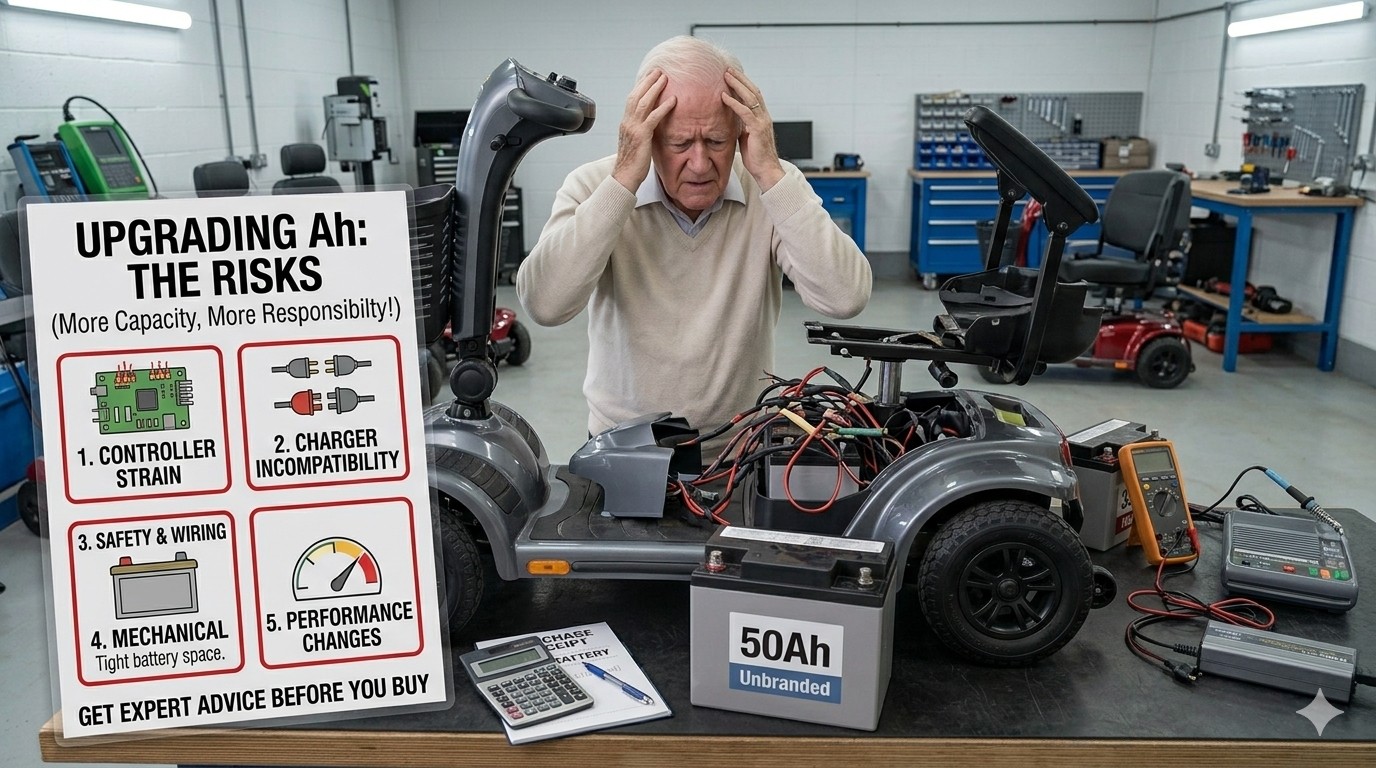
If your new battery can deliver more current than the controller can handle, the controller may overheat or fail.
What the BMS Does
If you are using a lithium battery, it will have a Battery Management System (BMS). The BMS protects the battery from overcharge, over-discharge, over-current, and temperature extremes. But the BMS must be able to supply the current your scooter demands, especially on hills.
Check that the BMS continuous and peak ratings match your scooter's requirements. If the BMS cannot deliver enough current, the scooter will cut out under load.
How to Check
Your scooter manual or the controller label will list the peak current rating. Your battery's BMS specifications will list the continuous and peak discharge ratings. The BMS peak rating should meet or exceed the controller's peak demand.
If you are unsure, consult the scooter manufacturer or a battery specialist.
The Compatibility Checklist at a Glance
Here is your quick-reference checklist. Print it, save it, or screenshot it before you shop.
|
Check |
What to Look For |
Why It Matters |
|
Size |
Length, width, height (including terminals) |
A battery that does not fit cannot be used |
|
Terminals |
F1/F2, Nut & Bolt, M5/M6, orientation |
Wrong terminals mean no connection |
|
Voltage |
Must match exactly (12V, 24V, etc.) |
Wrong voltage damages controller and motor |
|
Charger |
Chemistry match, plug type, charge profile |
Wrong charger can cause fire or battery damage |
|
Controller/BMS |
Peak current ratings match |
Mismatch causes cut-outs or damage |
Use this checklist every time you buy a battery. It takes ten minutes and saves hours of frustration.

Frequently Asked Questions
Can I use a different brand battery if the voltage and Ah match?
Yes, provided the chemistry, terminal type, and physical dimensions also match. Two different brands of 12V 35Ah AGM batteries that are both new will usually work together without issue.
Can I mix old and new batteries in the same scooter?
No. Always use two batteries of the same type, chemistry, capacity, and age. A new battery paired with an old one will be dragged down by its weaker partner, and you will end up replacing both again much sooner.
Should both batteries be replaced at the same time?
Yes. Most scooters use two batteries connected together. When the batteries do not match, they can discharge and charge unevenly, which reduces performance and shortens battery life.
Can I upgrade to a higher Ah battery?
Yes, in many cases. A higher Ah battery can provide longer driving range if it is compatible with your scooter. Always verify the battery dimensions, voltage, battery chemistry, and charger compatibility before upgrading.
What is the most important compatibility check?
Voltage. A battery with a higher capacity (more Ah) will not damage your scooter. A battery with a higher voltage will almost certainly cause serious damage to the controller and motor.
How do I know what battery my scooter uses?
Check your scooter's manual or the label on the existing battery. It will list the voltage, Ah rating, and often the terminal type. If you cannot find this information, consult the manufacturer or a mobility scooter specialist.
Your Next Step
Battery compatibility is not a mystery. It is a checklist. Five factors, five checks, and you are done. Size, terminals, voltage, charger, and fit—get these right, and your new battery will slot into place and serve you faithfully for years.
You now have the knowledge to walk into any shop, open any product page, and make a confident decision. No more guessing. No more hoping the battery will fit. Just clear, informed choice.
And that confidence? It means you can replace your battery without stress, without wasted money, and without the fear of being left without your mobility. You deserve that confidence.
And now you have the tools to build it.

Ready to Go Deeper?
This guide is part of our complete series on choosing the right battery capacity for your mobility scooter. If you found this helpful, these related guides will take you further:
- Choosing the Right Battery Capacity for Your Mobility Scooter — The complete hub guide to capacity selection
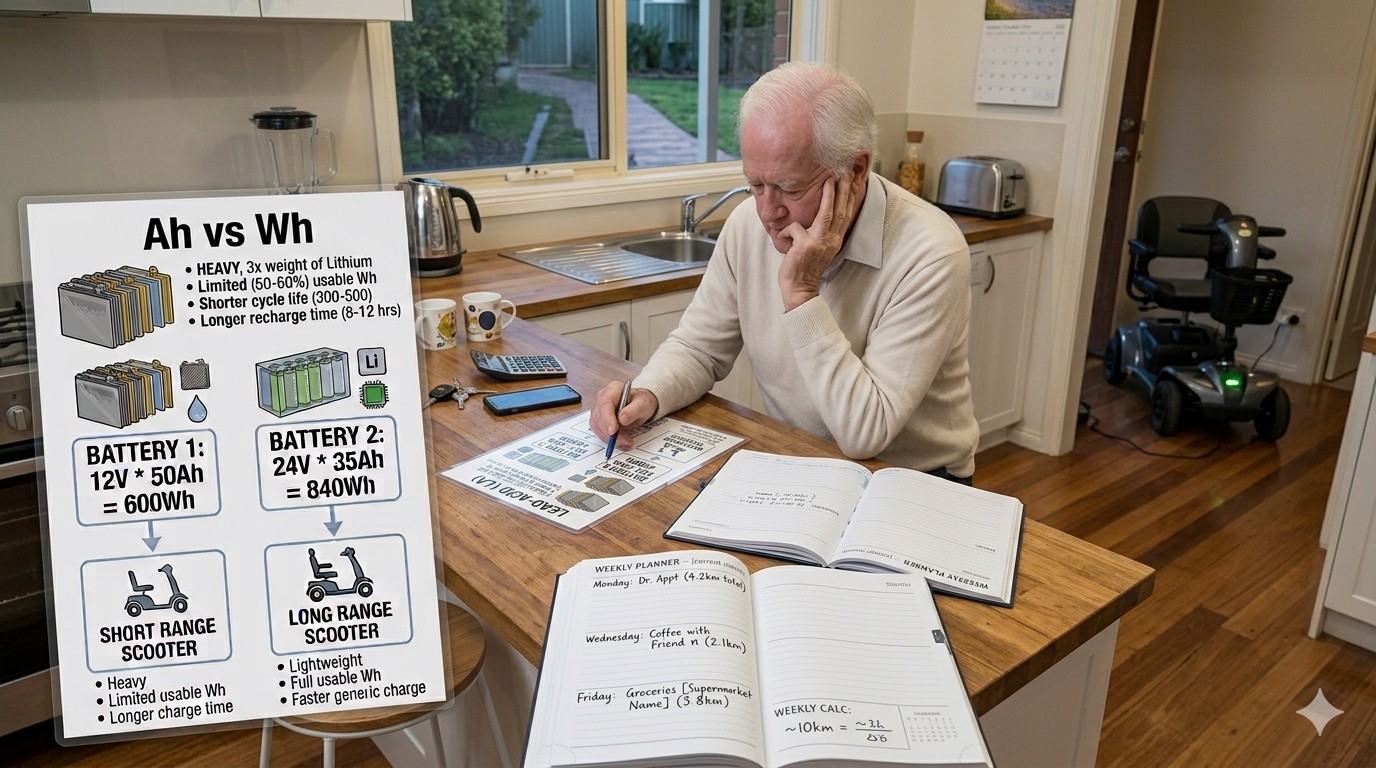
- Ah vs Wh for Mobility Scooters: How to Compare Batteries the Right Way — The formula that changes everything
- How to Estimate the Battery Capacity You Need from Your Typical Weekly Routine — Put the numbers to work for your lifestyle
- Can You Upgrade to Higher Ah Batteries on Your Mobility Scooter (and What Can Go Wrong)? — The upgrade decision, explained
- Lithium Upgrade Decision Guide: What Capacity to Choose and What Else Must Change — Is lithium right for you?
- Choosing the Right Charger for Your Battery Capacity and Chemistry — Don't overlook this critical companion purchase
- Battery Capacity vs Range Claims: How to Sanity-Check Manufacturer "Miles per Charge" Numbers — Why real-world range differs from the spec sheet
- Choosing Battery Capacity for Travel/Portable Mobility Scooters vs Mid-Size vs Heavy-Duty Models — Capacity recommendations by scooter type
- How Rider Weight, Terrain, and Stop-Start Driving Change the Capacity You Should Choose — Personalise your estimation
- Mobility Scooter Battery Maintenance: How to Preserve Capacity and Extend Lifespan — Keep your battery healthy for years
Stay mobile, stay confident!
Sign up for our monthly Mobility Scooter Newsletter to receive practical guides, expert advice, and inspiring stories that help you make the most of your scooter and download our free "Mobility Scooter Guide for Beginners."
Don't worry — your e-mail address is totally secure.
I promise to use it only to send you our newsletter, "Mobility Matters."
Recent Articles


-
Choosing the Right Battery Capacity 101: (Ah vs Wh)
Oct 07, 26 08:54 AM
 Choosing the Right Battery Capacity Guide: Compare Ah vs Wh, estimate range, and pick the best battery for your routine.
 -
Stop! Check These 5 Things Before Buying a Battery (
Oct 07, 26 08:50 AM
 Mobility scooter battery compatibility checklist: size, terminals, voltage, charger, and fit explained simply. Avoid costly mistakes before you buy.
 -
Stop! Read This Before Your Lithium Battery Upgrade
Oct 07, 26 07:11 AM
Lithium upgrade decision guide: what capacity to choose and what else must change. Stop guessing. Get the honest facts before you spend your money.


Ready to Feel More Confident on Your Mobility Scooter?

My Ebook, The Ultimate Guide to Mobility Scooters, walks you through choosing the right scooter, using it safely, and keeping it in top condition — all explained in clear, friendly language.
Give yourself (or someone you love) the gift of independence.

