- Home
- Mobility Scooter Accessories and Power
- Mobility Scooter Battery Capacity
- Extended Range Battery Kits: When They Make Sense
When "Extended Range" Battery Kits Make Sense (and When They Don't)
Picture this: You are planning a day out with your family—a trip to a garden centre, lunch at a café, maybe a wander around a market. You check your scooter's range. It is 20 kilometres. The round trip is 26 kilometres. You could risk it, but the thought of being stranded halfway home with a dying battery is enough to make you cancel the whole outing. So you start searching for a solution. And you find them: "extended range" battery kits, promising to double your distance and banish range anxiety forever.
But are they worth it? Do they actually work? And is there a better option you have not considered?
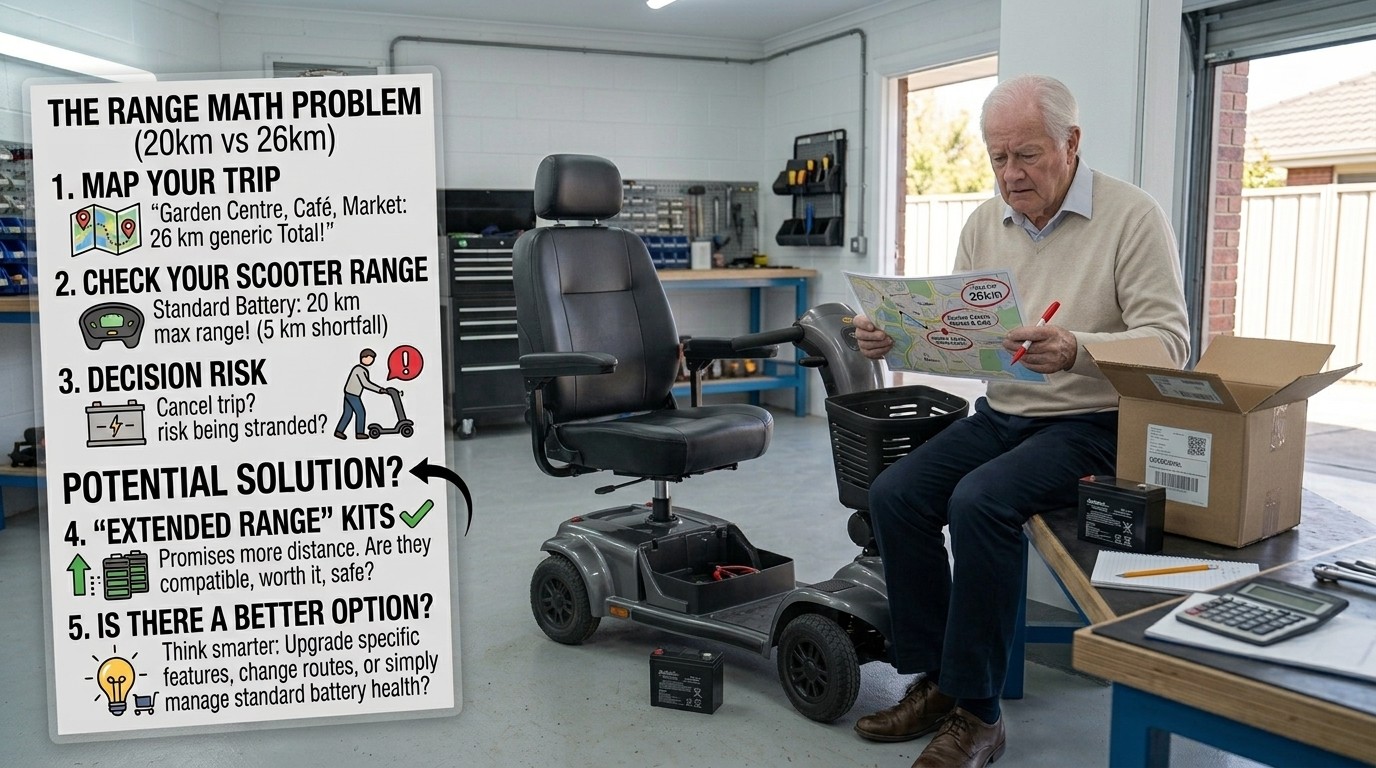
This guide is here to help you answer those questions honestly. When "extended range" battery kits make sense (and when they don't) is not always a straightforward call. It depends on your scooter, your budget, your riding habits, and what you are really trying to achieve.
By the end, you will have a clear framework for deciding whether a range kit is the right investment for you—or whether a simpler, cheaper alternative would serve you better.
What Is an "Extended Range" Battery Kit?
Let us start with the basics. An extended range battery kit is a product designed to increase the distance your mobility scooter can travel on a single charge. These kits come in several forms, and understanding the differences matters.
Manufacturer OEM (Original Equipment Manufacturer) packs. Many scooter manufacturers offer an official extended-range battery pack for specific models. For example, the Pride Mobility Go Go Endurance Li has a 16Ah lithium-ion battery box upgrade that delivers up to 23 kilometres, compared to the standard 8Ah battery. Golden Technologies offers an XR battery pack for the Buzzaround GB121 and GB124, containing two 12V 22Ah SLA batteries and providing up to 29 kilometres of range.
Aftermarket power boosters. Products like the BattBoost are add-on devices that connect to your existing batteries without replacing them. BattBoost uses lithium power technology to provide additional ampere-hour capacity, delivering an average additional range of up to 13–16 kilometres and reducing range anxiety. It fits in seconds without tools and maintains optimal charge of your existing batteries.
Spare battery packs. Some manufacturers offer a spare battery box that you can carry with you and swap in when your first battery depletes. The Easwe Spare Battery, for example, is designed to double your range by swapping a depleted battery mid-outing.
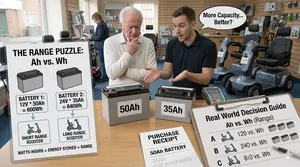
Dual-battery configurations. Some scooters, like the Pride Pursuit 2, offer a dual-battery configuration that uses two 50Ah lithium-ion batteries for approximately 100Ah of total capacity and up to 64 kilometres of range under manufacturer testing conditions.
Each of these options has different costs, compatibility requirements, and practical implications. The key is to figure out which one fits your situation.
When Extended Range Battery Kits Make Sense
Extended range kits are not for everyone. But for some riders, they are genuinely transformative. Here is when they make sense.
You Regularly Exceed Your Current Range
If your typical trips regularly push your scooter to its limits—or beyond—a range kit can be a practical solution. This is especially true if your daily routine involves longer journeys that you cannot easily break up with charging stops.
You Cannot Upgrade to a Higher-Capacity Battery
Sometimes, the simplest solution—buying a higher Ah battery—is not available. Your scooter's battery compartment may be too small for a larger battery, or the manufacturer may not offer a compatible upgrade.
In these cases, an add-on range kit or a spare battery may be your only option.
You Need a Portable Solution
If you travel with your scooter and need extra range on the go, a portable power booster like BattBoost can be a good fit. It is lightweight—under 2 kilograms—compact, and requires no tools to fit. A spare battery box is another portable option: you carry it with you and swap it in when needed.
Your Scooter Supports a Manufacturer-Approved Upgrade
If your scooter manufacturer offers an official extended-range pack for your model, that is usually the safest and most reliable option. OEM packs are designed specifically for your scooter, so compatibility is guaranteed. For example, the Pride Go Go Endurance Li's 16Ah lithium battery box is a direct OEM upgrade that restores full mobility and ensures your scooter operates with the power it was designed for.
You Want to Reduce Range Anxiety Without Replacing Your Scooter
For some riders, the goal is not just more range—it is more confidence. An extended range kit can provide peace of mind, allowing you to take trips you would otherwise avoid. As one product description puts it, an extended range lithium battery is "usually the strongest upgrade when the buyer wants more confidence, not just more capacity".
When Extended Range Battery Kits Don't Make Sense
Now for the other side of the coin. There are situations where a range kit is not the right choice—and recognising them can save you money and frustration.
A Higher-Capacity Battery Would Be Simpler and Cheaper
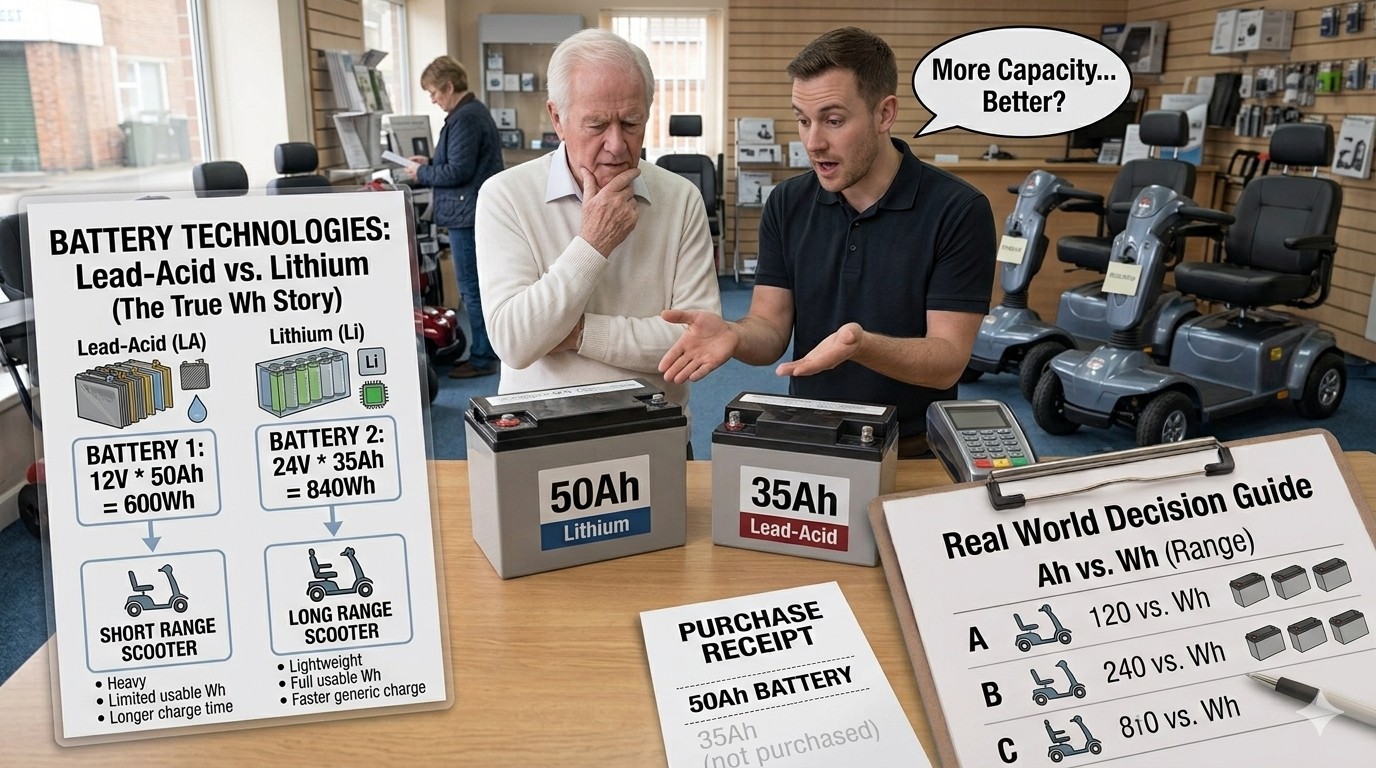
If your scooter can accept a higher Ah battery, that is often the better path. A higher-capacity AGM battery costs a fraction of a lithium conversion and does not require purchasing extra adapters or chargers. Many scooters support upgrades from 22Ah to 33Ah, or from 33Ah to 50Ah, and these upgrades are usually plug-and-play. Read the full guide: Can You Upgrade to Higher Ah Batteries on Your Mobility Scooter (and What Can Go Wrong)?
The easiest path is higher Ah AGM batteries. Swapping to a higher Amp-Hour rating gives you more distance without needing new chargers or modified wiring. High-density AGM technology now packs more power into the same standard shapes, so a 21.4Ah battery can use the exact same outer footprint as a standard 18Ah battery.
Your Scooter Is Not Compatible
Extended range kits are often model-specific. The XR Battery Pack for the Buzzaround, for example, is compatible with the GB121 and GB124 models but NOT compatible with last-generation Buzzaround scooters, including the GB117 and GB147. Before buying any kit, confirm compatibility with your exact model.
If you are unsure, contact the manufacturer or a mobility specialist.
You Only Occasionally Need Extra Range
If you only need extra range a few times a year, a spare battery may be more practical than a permanent range kit. A spare battery box can be carried with you and swapped in when needed—it doubles your total range for the outing without requiring any modifications to your scooter.
The Cost Approaches the Cost of a New Scooter
Extended range kits are not cheap. The Pride Go Go Endurance Li 16Ah battery box costs around $500. The Buzzaround XR battery pack is $258. Lithium upgrades can cost around four times the price of gel batteries, plus the cost of a new charger. If the total cost of the upgrade approaches the cost of a newer scooter with better range, it may be worth considering a replacement instead.
You Have Not Checked Your Charger and Controller
A larger capacity battery may require a higher-amperage charger to recharge in a reasonable time. If you are switching chemistry—say, from lead-acid to lithium—you need a charger specifically designed for that chemistry. You also need to confirm the controller and BMS can handle the current demands. Read the full guide: Lithium Upgrade Decision Guide: What Capacity to Choose and What Else Must Change
Skipping these checks can lead to poor performance or damage
The Alternatives You Should Consider First
Before you commit to an extended range kit, consider these alternatives. They may solve your problem more simply and affordably.
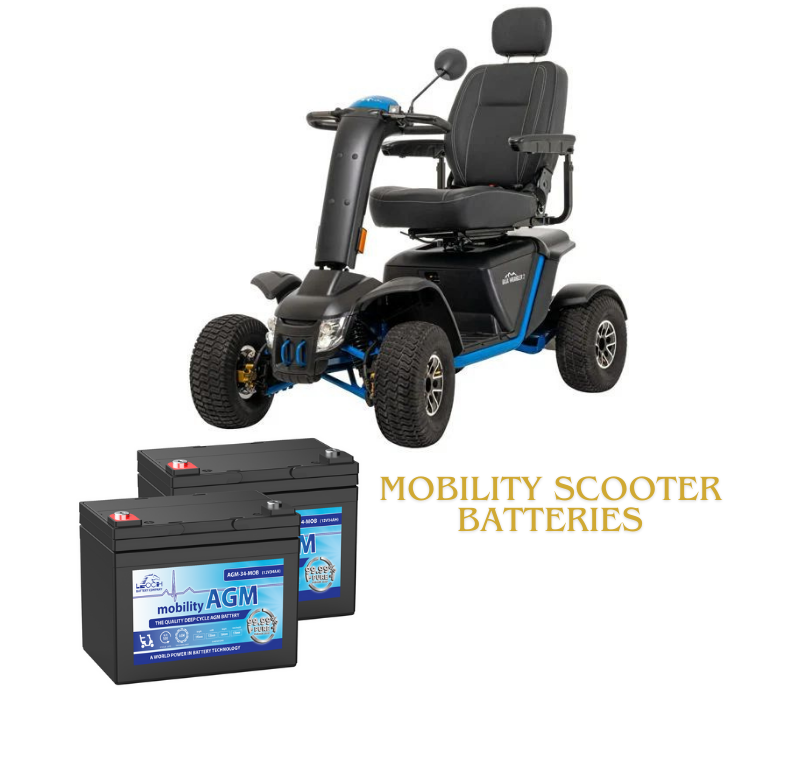
Higher-Capacity AGM Batteries
This is the simplest upgrade path for most riders. If your scooter can accept a higher Ah AGM battery that fits in the same space, you get more range without changing chargers, wiring, or chemistry. Common upgrades include 12Ah to 14Ah, 22Ah to 33Ah, and 33Ah to 50Ah.
Spare Battery Boxes
For travel scooters especially, a spare battery box is a practical solution. You carry it with you, and when your first battery depletes, you swap in the second. This doubles your range for the outing without any permanent modification to your scooter.
A Portable Power Booster
Products like BattBoost offer a plug-and-play solution that connects to your existing batteries without replacing them. It is lightweight, portable, and designed to be fitted in seconds without tools. This can be a good option if you want extra range without committing to a full battery replacement.
A More Efficient Riding Style
Sometimes, the simplest way to extend your range is to change how you ride. Moderate speeds, consistent cruising, and avoiding unnecessary stops can extend your range by 30–40% without spending a cent.
A Decision Framework: Should You Buy a Range Kit?
Here is a simple framework to help you decide:
Step 1: Can your scooter accept a higher-capacity battery? If yes, that is usually the simplest and most cost-effective solution. Check the battery compartment dimensions and confirm the charger and controller are compatible.
Step 2: Is there an OEM extended-range pack for your specific model? If yes, this is the safest option. It is designed for your scooter and will not void your warranty.
Step 3: Do you need extra range regularly or occasionally? If regularly, a permanent upgrade (higher Ah battery or OEM pack) makes sense. If occasionally, a spare battery or portable booster may be more practical.
Step 4: What is your budget? Extended range kits range from around $250 for an AGM pack to $500 or more for lithium upgrades. Compare this to the cost of a higher-capacity battery or a newer scooter.
Step 5: Have you checked compatibility? Confirm that the kit is compatible with your exact scooter model. Check voltage, terminal type, charger requirements, and controller limits.
Step 6: Are you prepared for the installation? Some kits are plug-and-play; others require wiring modifications or professional installation. Factor this into your decision.

Frequently Asked Questions
What is an extended range battery kit?
It is a product designed to increase the distance your mobility scooter can travel on a single charge. Kits include OEM battery packs, aftermarket power boosters, spare battery boxes, and dual-battery configurations.
Do extended range kits actually work?
Yes, they can significantly increase range—often by 50–100%—but only if they are compatible with your scooter and installed correctly.
How much do extended range kits cost?
Costs vary widely. OEM AGM packs range from around $250 to $500, while lithium upgrades can cost $700 to $1,400 or more, plus the cost of a new charger.
Can I install an extended range kit myself?
Some kits are plug-and-play and can be installed without tools. Others require wiring modifications or professional installation. Always check the manufacturer's instructions.
Will an extended range kit void my warranty?
Using non-original parts may void your manufacturer's warranty. Check your warranty terms before upgrading, and consider OEM options where available.
What is the best alternative to an extended range kit?
A higher-capacity AGM battery is often the simplest and most cost-effective alternative. It gives you more range without changing chargers, wiring, or chemistry.
Your Next Step
Extended range battery kits can be a powerful solution for riders who need more distance and more confidence. But they are not the right choice for everyone. Sometimes a higher-capacity battery is simpler and cheaper. Sometimes a spare battery box is more practical. And sometimes, the best upgrade is simply a more efficient riding style.
You now have a framework for making that decision. You know what to check, what to avoid, and what alternatives to consider. No more guessing. No more hoping a kit will solve a problem it was never designed for.
And that confidence? It means you can choose the right solution for your scooter, your budget, and your life. You deserve that confidence.
And now you have the tools to build it.
Ready to Go Deeper?
This guide is part of our complete series on choosing the right battery capacity for your mobility scooter. If you found this helpful, these related guides will take you further:
- Choosing the Right Battery Capacity for Your Mobility Scooter — The complete hub guide to capacity selection
- Ah vs Wh for Mobility Scooters: How to Compare Batteries the Right Way — The formula that changes everything
- How to Estimate the Battery Capacity You Need from Your Typical Weekly Routine — Put the numbers to work for your lifestyle
- Choosing Battery Capacity for Travel/Portable Mobility Scooters vs Mid-Size vs Heavy-Duty Models — Capacity recommendations by scooter type
- How Rider Weight, Terrain, and Stop-Start Driving Change the Capacity You Should Choose — Personalise your estimation
- Can You Upgrade to Higher Ah Batteries on Your Mobility Scooter (and What Can Go Wrong)? — The upgrade decision, explained
- Lithium Upgrade Decision Guide: What Capacity to Choose and What Else Must Change — Is lithium right for you?
- Mobility Scooter Battery Compatibility Checklist: Size, Terminals, Voltage, Charger, and Fit — Make sure your chosen battery actually fits
- Battery Capacity vs Range Claims: How to Sanity-Check Manufacturer "Miles per Charge" Numbers — Why real-world range differs from the spec sheet
- Choosing the Right Charger for Your Battery Capacity and Chemistry — Don't overlook this critical companion purchase
Stay mobile, stay confident!
Sign up for our monthly Mobility Scooter Newsletter to receive practical guides, expert advice, and inspiring stories that help you make the most of your scooter and download our free "Mobility Scooter Guide for Beginners."
Don't worry — your e-mail address is totally secure.
I promise to use it only to send you our newsletter, "Mobility Matters."
Recent Articles


-
Ah vs Wh: The Battery Comparison That Changes Everything
Oct 09, 26 10:32 AM
 Ah vs Wh for mobility scooters: Stop overpaying for the wrong battery. Learn how watt-hours reveal the true energy a battery stores.
 -
Choosing the Right Battery Capacity 101: (Ah vs Wh)
Oct 09, 26 09:56 AM
Choosing the Right Battery Capacity Guide: Compare Ah vs Wh, estimate range, and pick the best battery for your routine. -
Stop! Check Your Battery Before You Fly
Oct 09, 26 09:44 AM
 Airline-friendly mobility scooter batteries: capacity limits and travel rules. Stop worrying about airport surprises. Get the facts before you book.

Ready to Feel More Confident on Your Mobility Scooter?

My Ebook, The Ultimate Guide to Mobility Scooters, walks you through choosing the right scooter, using it safely, and keeping it in top condition — all explained in clear, friendly language.
Give yourself (or someone you love) the gift of independence.



