- Home
- Mobility Scooter Accessories and Power
- Mobility Scooter Battery Capacity
- Ah vs Wh for Mobility Scooters
Ah vs Wh for Mobility Scooters: How to Compare Batteries the Right Way
Picture this: You are standing in a mobility shop, staring at two batteries. One says 50Ah. The other says 35Ah. The salesperson tells you the 50Ah battery has "more capacity," so it must be better, right? You nod, hand over your money, and take it home. A few weeks later, you discover the 35Ah battery would have given you more range. How is that possible?
This is the exact moment where Ah vs Wh for mobility scooters stops being a technical footnote and becomes the difference between a confident purchase and an expensive mistake.
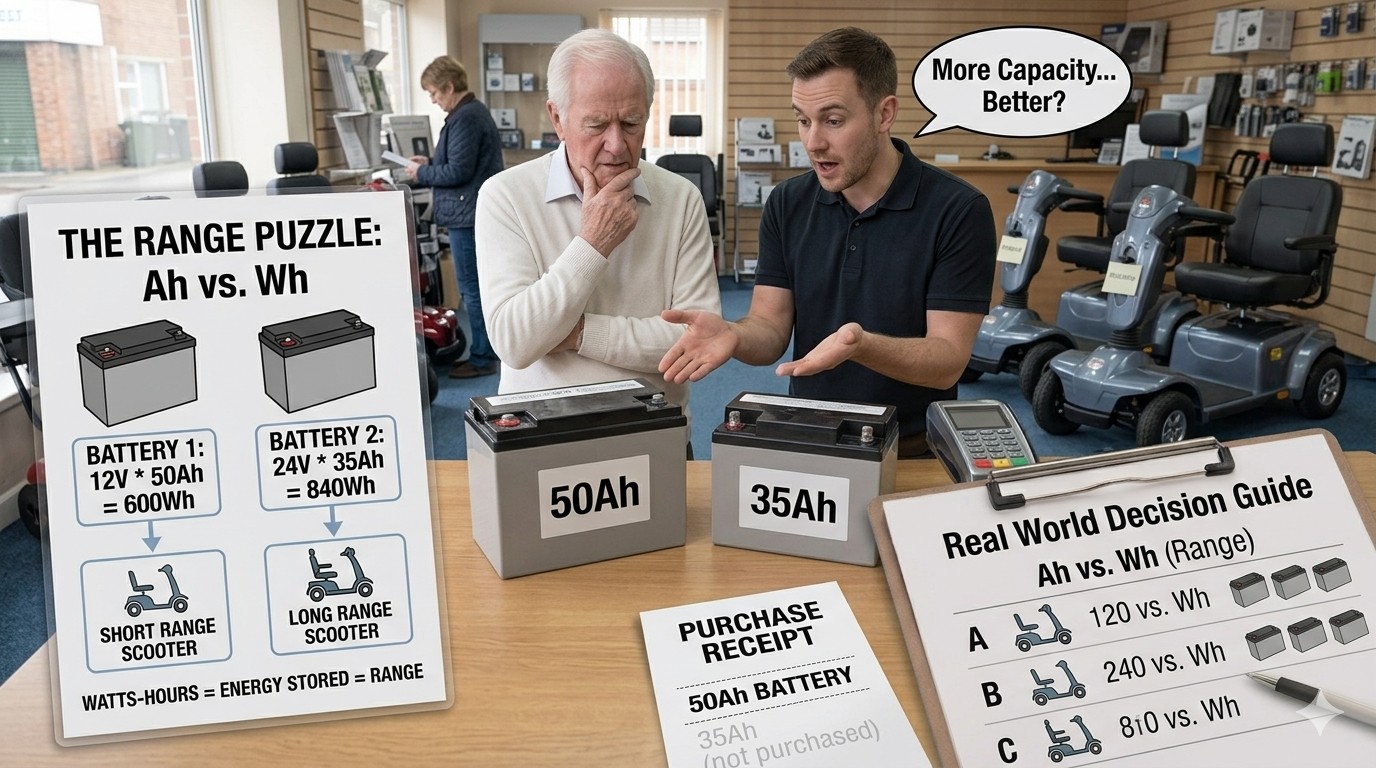
If you have ever felt your eyes glaze over at battery specifications, you are not alone. Most shoppers are told to look at amp-hours (Ah) and never question it. But Ah alone can be deeply misleading. The number that actually tells you how much energy a battery stores—and therefore how far you can go—is watt-hours (Wh). Understanding the difference between Ah and Wh for mobility scooters is the single most powerful thing you can do before buying a battery.
In this guide, we are going to walk through this together, step by step. No jargon. No judgement. Just clarity. And by the end, you will wonder why anyone ever told you to compare batteries by Ah alone.
What Ah Really Measures (And Why It's Not the Whole Story)
Amp-hours (Ah) measure how much electrical charge a battery can deliver over time. Think of it like the size of a fuel tank. A 50Ah battery holds more charge than a 20Ah battery, just as a larger fuel tank holds more petrol. That part is straightforward.
But here is where things get tricky. Ah does not include voltage. And without voltage, you cannot know how much actual energy the battery stores. A 12V 100Ah battery and a 24V 50Ah battery both store 1,200Wh of energy, yet their Ah ratings look completely different.
This is the core problem with comparing by Ah alone. It tells you how much charge the battery holds, but not how much work that charge can do. Imagine two water tanks: one is tall and narrow, the other is short and wide. They might hold the same volume of water, but the pressure at the outlet is different. Voltage is that pressure. Ah is the volume. Only together do they tell you the full story.
So if Ah alone cannot tell you which battery gives more range, what can? That is exactly what we are about to uncover.
What Wh Really Measures (And Why It's Your Best Friend)
Watt-hours (Wh) measure energy—the actual amount of electrical work a battery can perform. Unlike Ah, Wh takes voltage into account. This makes it a much more direct indicator of how much electricity a battery stores.
The formula is beautifully simple:
Wh = Ah × Voltage
That is it. Multiply the amp-hours by the voltage, and you have the total energy stored in the battery. A 24V 20Ah battery stores 480Wh. A 24V 35Ah battery stores 840Wh. A 24V 55Ah battery stores 1,320Wh.
Now, here is where the magic happens. Once you start thinking in Wh, comparing batteries across different voltages becomes effortless. A 12V 100Ah battery (1,200Wh) and a 24V 50Ah battery (1,200Wh) suddenly reveal themselves as equals. Without Wh, you would never know that.
For mobility scooter users, this matters enormously. Most scooters run on 24V systems, but some run on 12V or 36V. If you are comparing batteries for different scooters—or considering a voltage upgrade—Wh is the only fair metric. Ah will lead you astray.
So now you know what Wh is and why it is superior for comparison. But how do you actually use it in the real world? Let us walk through some examples.

The Ah vs Wh Formula in Action: Real-World Examples
Let us say you are choosing between two batteries for your 24V mobility scooter.
Battery A: 24V, 50Ah
Battery B: 24V, 35Ah
If you only look at Ah, Battery A seems clearly better. It has more amp-hours, so it must go further, right? Not necessarily. Let us calculate the Wh:
- Battery A: 24V × 50Ah = 1,200Wh
- Battery B: 24V × 35Ah = 840Wh
Battery A does store more energy. But now consider a third option:
Battery C: 12V, 100Ah
At first glance, Battery C has double the Ah of Battery A. Surely it must be superior? Let us check:
- Battery C: 12V × 100Ah = 1,200Wh
Battery C stores exactly the same energy as Battery A. The Ah rating was twice as high, but the actual energy was identical. This is why comparing batteries by Ah alone is meaningless when voltages differ.
Now, let us add a real-world twist. Suppose you are comparing a lithium battery to a lead-acid battery. Lithium batteries can be discharged more deeply—often to 80–90% of their rated capacity—while lead-acid batteries should not be discharged below 50%. This means a 35Ah lithium battery may deliver more usable energy than a 50Ah lead-acid battery, even though the Ah ratings suggest otherwise.
For example:
- 50Ah lead-acid at 50% DoD *= 25Ah usable
- 35Ah lithium at 85% DoD = 29.75Ah usable
The lithium battery wins, despite the lower Ah rating. If you had compared by Ah alone, you would have made the wrong choice.
*DOD (Depth of Discharge)- Essentially, it tells you how far down you can safely empty your "fuel tank" without harming the battery's health or lifespan. For instance, a DoD of 0% means the battery is entirely full, while a 50% DoD means it has been half-emptied
This is the power of thinking in Wh—and accounting for usable capacity. But there is one more layer to this that most guides never mention, and it could save you from a costly error.
Why Two Batteries with the Same Wh Can Still Perform Differently
You might be thinking: "Great, I will just compare Wh and I am done." Not so fast. Wh tells you how much energy a battery stores, but it does not tell you how efficiently that energy is delivered or how much is actually usable.
Several factors affect real-world performance:
Depth of Discharge (DoD). As we just saw, lead-acid batteries should only be discharged to about 50%, while lithium can go to 80–90%. A 1,200Wh lead-acid battery gives you roughly 600Wh of usable energy. A 1,200Wh lithium battery gives you roughly 1,020Wh. That is a 70% difference in usable range—from the same Wh rating.
Temperature. Cold weather reduces usable capacity. Lead-acid batteries lose 20–50% range at 0–10°C, while lithium loses 10–25%. A battery that performs well in summer may leave you anxious in winter.
Peukert's Law. This is a fancy way of saying that batteries deliver less energy when discharged quickly. If you are climbing hills or carrying heavy loads, your battery will deliver less total energy than its Wh rating suggests.
Battery age. Capacity declines over time. A battery that met your needs when new may not meet them two years later.
So Wh is the best starting point for comparison—but it is not the final word. You also need to consider chemistry, temperature, and how you actually ride.
And speaking of how you ride, there is one more comparison scenario that catches almost everyone off guard.

The Air Travel Trap: Why Wh Suddenly Becomes Critical
If you ever plan to travel with your mobility scooter, Wh is not just helpful—it is essential. Airlines regulate lithium batteries by watt-hours, not amp-hours. The magic number for mobility devices is 300Wh per battery if the battery must be removed for travel.
This means you need to know your battery's Wh rating before you book a flight. A 24V 12Ah battery is 288Wh—just under the limit. A 24V 15Ah battery is 360Wh—over the limit. Without the Wh calculation, you would have no idea whether your battery is airline-compliant.
And here is the part most people miss: the 100Wh and 160Wh limits you see everywhere apply to laptops and cameras, not mobility devices. For mobility aids, the rules are different. If your battery stays installed in the device, there may be no Wh limit at all, depending on the airline.
So if travel is part of your life, Wh is not optional. It is the number that determines whether your scooter flies with you or stays behind.
Now that you understand why Wh matters so much, let us put it all together into a simple decision framework you can use the next time you shop for a battery.
Your Ah vs Wh Cheat Sheet: How to Compare Batteries the Right Way
Here is a simple, step-by-step process for comparing any two mobility scooter batteries:
Step 1: Find the voltage and Ah rating on each battery.
Both numbers should be printed on the label or listed in the product specifications.
Step 2: Calculate Wh for each battery.
Multiply voltage by Ah. Write the result down.
Step 3: Account for usable capacity.
If comparing lead-acid to lithium, remember that lead-acid gives you about 50% usable capacity, while lithium gives you 80–90%. Adjust your comparison accordingly.
Step 4: Consider your real-world conditions.
Do you ride in cold weather? Do you tackle hills? Do you carry heavy loads? These factors reduce usable range. If any apply, size up.
Step 5: Check the physical fit.
Wh tells you how much energy a battery stores, but it does not tell you whether the battery will fit in your scooter. Always check dimensions, terminal type, and charger compatibility before buying.
Step 6: Make your decision based on Wh, not Ah.
When all else is equal, the battery with the higher usable Wh will give you more range. That is the number that matters.
And there you have it. The entire mystery of Ah vs Wh for mobility scooters comes down to one simple formula and a willingness to look beyond the number printed largest on the label.
The One Thing to Remember
If you take nothing else from this guide, take this: Ah tells you how much charge a battery holds. Wh tells you how much energy it actually stores. When comparing batteries with different voltages, Wh is the only fair metric.
You now have the knowledge to walk into any shop, look at any specification sheet, and make a confident decision. No more guesswork. No more relying on a salesperson's simplified explanation. Just clear, informed choice.
And that confidence? It changes everything. It means you can plan your outings without range anxiety. It means you can travel with your scooter without worrying about airline regulations. It means you can upgrade your battery knowing you are getting the best value for your money.
You deserve that confidence. And now you have it.

Ready to Go Deeper?
This guide is part of our complete series on choosing the right battery capacity for your mobility scooter. If you found this helpful, these related guides will take you further:
- Choosing the Right Battery Capacity for Your Mobility Scooter — The complete hub guide to capacity selection
- How to Estimate the Battery Capacity You Need from Your Typical Weekly Routine — Put the Wh formula to work for your lifestyle
- Mobility Scooter Battery Compatibility Checklist: Size, Terminals, Voltage, Charger, and Fit — Make sure your chosen battery actually fits
- Can You Upgrade to Higher Ah Batteries on Your Mobility Scooter (And What Can Go Wrong)? — The upgrade decision, explained
- Battery Capacity vs Range Claims: How to Sanity-Check Manufacturer "Miles per Charge" Numbers — Why real-world range differs from the spec sheet
- Lithium Upgrade Decision Guide: What Capacity to Choose and What Else Must Change — Is lithium right for you?
- Choosing the Right Charger for Your Battery Capacity and Chemistry — Don't overlook this critical companion purchase
Your journey to battery confidence starts here. And now, you are already ahead of most shoppers.
Stay mobile, stay confident!
Sign up for our monthly Mobility Scooter Newsletter to receive practical guides, expert advice, and inspiring stories that help you make the most of your scooter and download our free "Mobility Scooter Guide for Beginners."
Don't worry — your e-mail address is totally secure.
I promise to use it only to send you our newsletter, "Mobility Matters."
Recent Articles


-
Choosing the Right Battery Capacity 101: (Ah vs Wh)
Oct 04, 26 04:48 AM
 Choosing the Right Battery Capacity Guide: Compare Ah vs Wh, estimate range, and pick the best battery for your routine.
 -
Ah vs Wh: The Battery Comparison That Changes Everything
Oct 04, 26 04:47 AM
Ah vs Wh for mobility scooters: Stop overpaying for the wrong battery. Learn how watt-hours reveal the true energy a battery stores. -
NDIS Mobility Scooter Funding Checklist: Evidence That Gets Approved
Oct 01, 26 07:51 AM
NDIS mobility scooter funding checklist — from OT assessment to approval. Here's exactly what to include so your request isn't delayed.



Ready to Feel More Confident on Your Mobility Scooter?

My Ebook, The Ultimate Guide to Mobility Scooters, walks you through choosing the right scooter, using it safely, and keeping it in top condition — all explained in clear, friendly language.
Give yourself (or someone you love) the gift of independence.



