- Home
- Mobility Scooter Accessories and Power
- Mobility Scooter Battery Capacity
- Battery Capacity vs Range Claims
Battery Capacity vs Range Claims: How to Sanity-Check Manufacturer "Miles per Charge" Numbers Your Headline
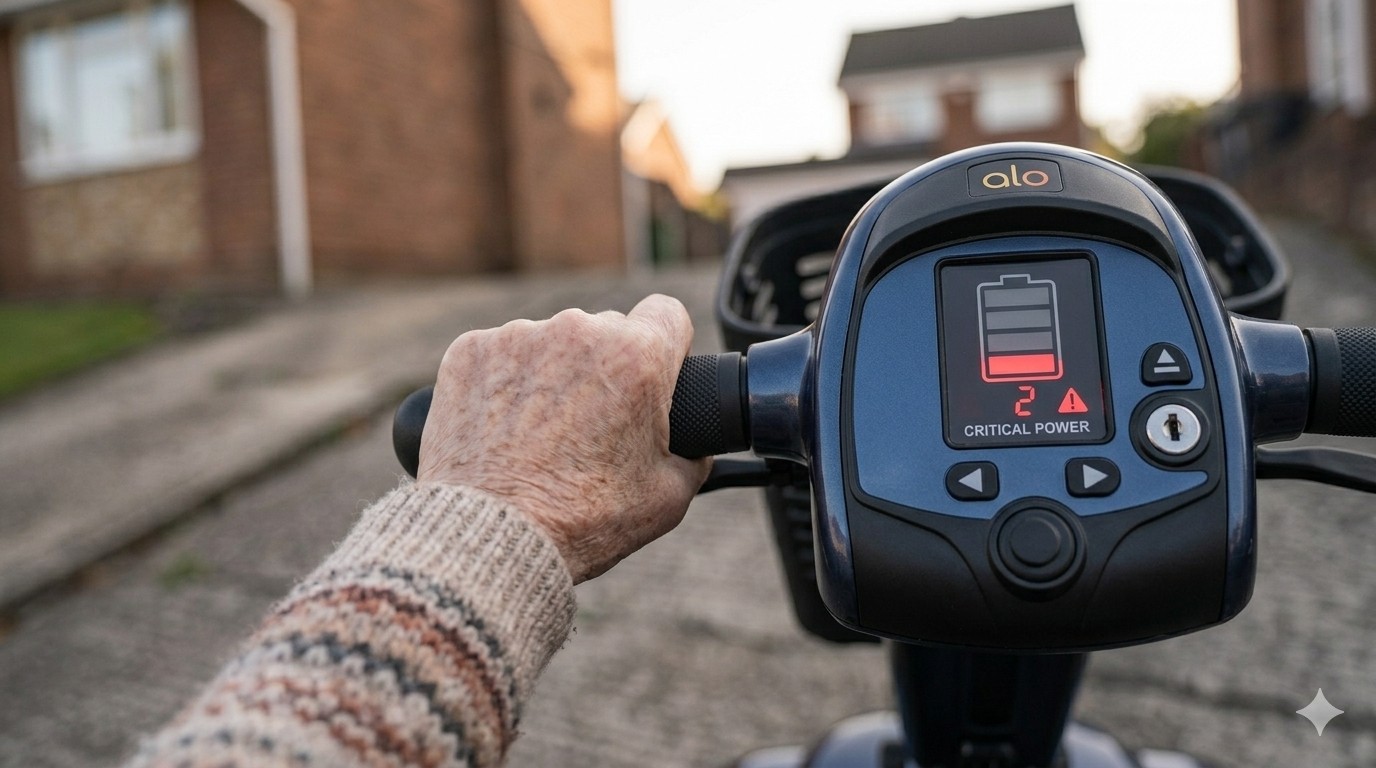
Picture this: You have just bought a mobility scooter advertised with a "52 km range." You charged it fully overnight, and you set off on a trip you have been looking forward to for weeks. But 32 kilometres in, the battery gauge starts flashing. The scooter slows to a crawl. You are far from home, and you have to stop at every intersection to let the battery "rebound" before you can cross. What was supposed to be a liberating outing turns into a stressful ordeal.
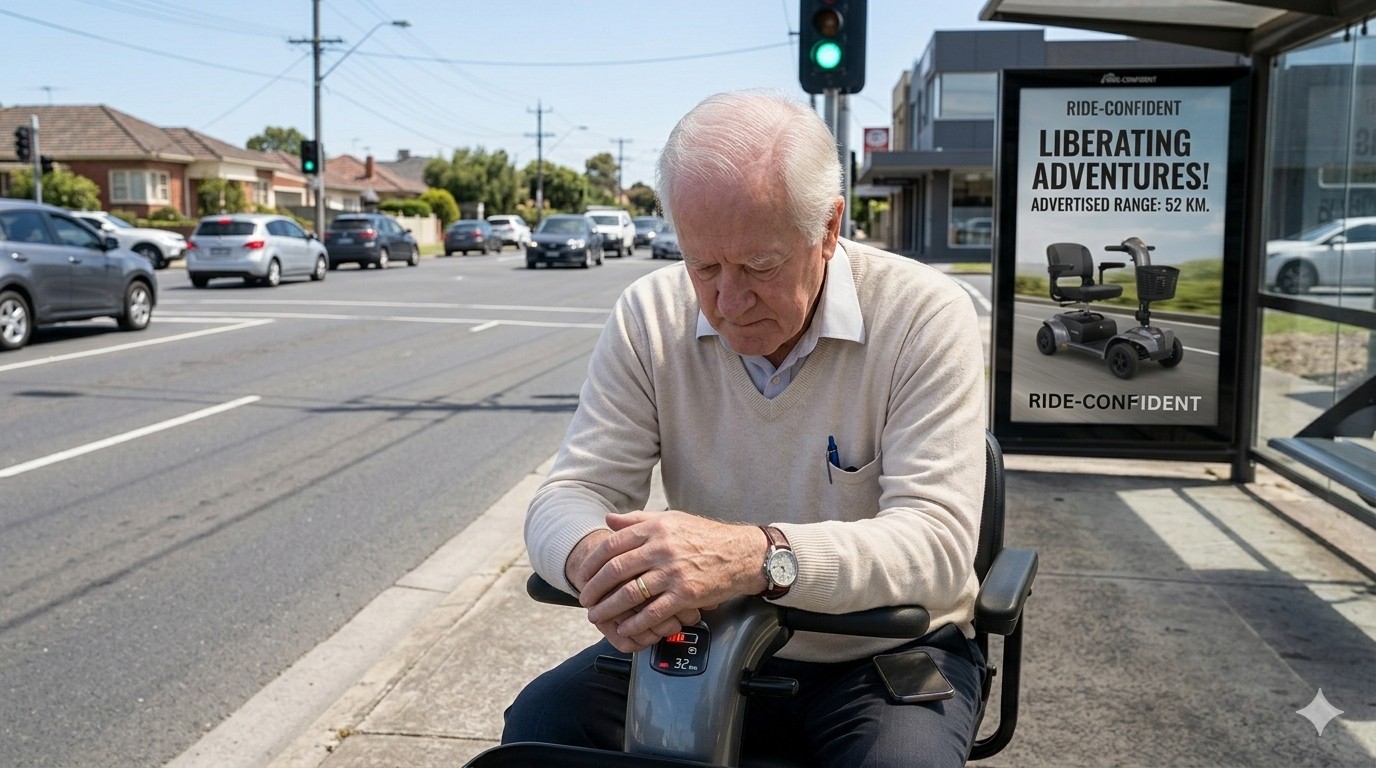
This is not a hypothetical scenario. It is exactly what happened to one family whose father purchased a brand new scooter based on its advertised 52 km range. Even with brand-new batteries, the scooter achieved approximately 32.5 km—a 38% shortfall from the advertised figure. The family described the anxiety of being stranded as "enormous" and said it "defeats the purpose of purchasing a long-range mobility scooter".
Understanding battery capacity vs range claims is not just an academic exercise. It is the difference between confident independence and the quiet fear of being stranded.
In this guide, we are going to pull back the curtain on how range claims are calculated, why they so often fall short in real life, and how you can sanity-check any "miles per charge" number before you spend your money.
No jargon. No judgement. Just the truth, explained kindly.
Why Advertised Range and Real-World Range Are Different
The gap between the range on the box and the range you actually experience is not a conspiracy. It is a difference in testing conditions.
Manufacturers test range under ideal conditions. That means a lightweight rider on flat, smooth pavement at a steady speed, with a fully charged set of batteries that are already broken in. It is essentially a best-case scenario.
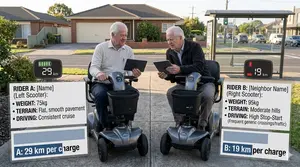
Now compare that to real life: you might be riding on grass, carpet, uneven sidewalks, or hills. You might be carrying a bag, pulling extra weight, or running the speed control higher than normal. All of that increases resistance and battery draw—so your range drops.
Most mobility scooter manufacturers test range in accordance with ISO 7176-4, an international standard that specifies methods for determining theoretical distance range using energy consumption measurements and battery capacity ratings. The word "theoretical" is doing a lot of work in that sentence. The standard produces a laboratory maximum, not a guaranteed real-world distance.
This is why the same scooter and battery can produce different real-world distances on different routes. The range number is a starting point, not a promise. But how far short does it typically fall? The next section reveals the numbers.
The Usable Capacity Problem: Where Your Range Really Goes
Before we look at real-world derating factors, we need to understand something more fundamental: usable capacity. This is the single biggest reason why advertised range figures are so misleading.
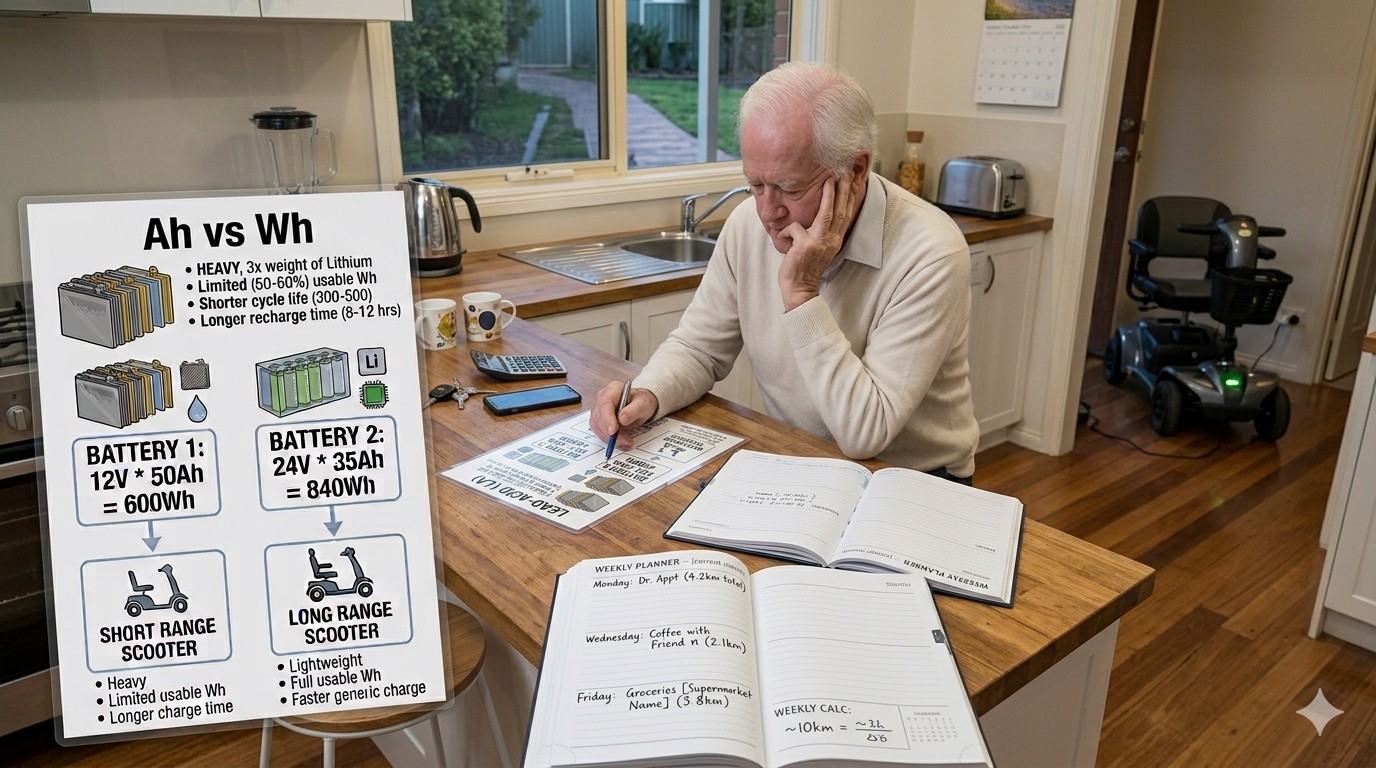
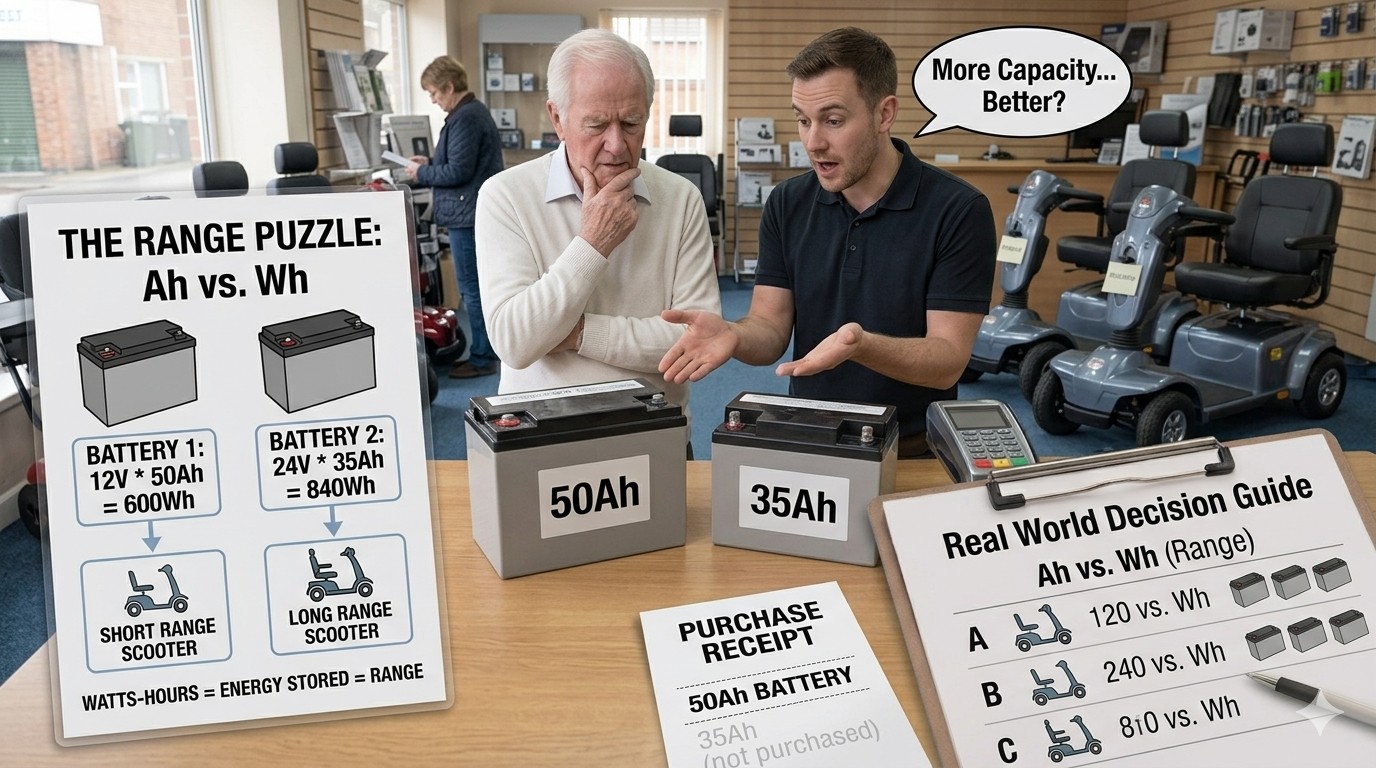
Battery capacity is rated in amp-hours (Ah), but not all of that capacity is usable. Lead-acid batteries—which still power most mobility scooters—should not be discharged below about 50% of their rated capacity. Doing so accelerates wear and shortens the battery's life. This means a 50Ah lead-acid battery gives you roughly 25Ah of usable energy.
But here is where it gets worse. Lead-acid batteries are often rated using a C20 discharge rate—the capacity you get if you discharge the battery over 20 hours. That rating is only useful for very low loads. A C20-rated battery might only deliver 75% or less of what you expect when discharged twice as fast, and they die rapidly towards the end when the voltage collapses.
The brand new mobility scooter that fell short of its range claim is specified with 2×12V 75Ah batteries, which works out to approximately 1,800Wh of rated energy. But for best performance, gel batteries should be limited to 50–60% discharge. Further discharging beyond 80% has a significant impact on battery life. So the usable energy is not 1,800Wh—it is closer to 900–1,080Wh. That is a massive difference.
Lithium batteries change this equation. They can be discharged to 80–90% of rated capacity and support heavy loads without significant loss of capacity. This is why a lithium battery with a lower Ah rating can often deliver more real-world range than a lead-acid battery with a higher rating.
So if usable capacity is already much lower than rated capacity, what happens when you add hills, weight, and cold weather? That is where the derating factors come in.
The Real-World Derating Factors That Shrink Your Range
Published range figures assume ideal conditions. Your life is not ideal. Here are the factors that will reduce your range, and how much they typically affect it.
Terrain. The terrain on which you ride has a major impact on range. Hills, gravel, grass, and uneven paths increase resistance and drain batteries faster than smooth pavement. A 10% hill can double your power consumption compared to flat ground. If your typical routes are hilly, you can expect significantly less range than the spec sheet suggests.
Rider weight. The weight of the rider influences range more than most people realise. Heavier riders consume more energy per mile. A scooter rated for 21.5 miles with a light rider may deliver far less at full rated capacity, and reviewers consistently report this shortfall.
Temperature. Extreme temperatures affect battery performance and, consequently, range. Cold conditions temporarily reduce available capacity. Lead-acid batteries lose 20–50% of their range at 0–10°C, while lithium loses 10–25%.
Speed and driving style. Riding at maximum speed depletes the battery much faster than a moderate pace. Frequent stops and starts also draw more power than steady cruising. If you tend to ride at full speed, expect lower range.
Tire pressure. Low pneumatic tire pressure increases rolling resistance, and cold air reduces PSI. This compounds the problem in winter.
Battery age. Capacity declines over time. A battery that met your needs when new may not meet them two years later.
When you combine these factors, it becomes clear why real-world range is often 70–90% of the advertised maximum. For a scooter rated at 24 kilometres, real-world use will often land in the 16-20 km range. And in hilly, cold conditions with a heavier rider, it can be even less.
So how do you turn this knowledge into a practical way to sanity-check a range claim before you buy? Let us walk through a method.
How to Sanity-Check Any "Miles per Charge" Claim
You do not need to be an engineer to evaluate a range claim. You just need to ask the right questions. Here is a simple framework.
Step 1: Look for the ISO 7176-4 reference. If the manufacturer cites this standard, you know the range is a theoretical maximum based on laboratory testing, not a guaranteed real-world figure. The range has been determined from the standard, but consumers are not at liberty to access the standard itself, and many may not be able to reliably comprehend what it says. Knowing this helps you set realistic expectations.
Step 2: Check the battery specification. What is the battery's Ah rating and chemistry? Is it lead-acid or lithium? If it is lead-acid, assume only about 50% of the rated capacity is usable. If it is lithium, assume 80–90%. Then calculate the usable Wh (watt-hours) by multiplying voltage by Ah and applying the usable capacity percentage.
Step 3: Apply a derating factor. If you ride on hills, add 30–40%. If you ride in cold weather, add another 20–30%. If you are heavier than average, add another 10–20%. These are rough estimates, but they will give you a much more realistic range figure than the one on the box.
Step 4: Check the fine print. Reputable manufacturers include footnotes. Pride Mobility, for example, notes that range "varies with user weight, terrain type, battery amp-hour (AH), battery charge, battery condition, and tire condition" and that the specification is subject to a variance of plus or minus 10%. If a manufacturer does not include this kind of qualification, that is a red flag.
Step 5: Look for independent reviews. Other riders have already done the real-world testing for you. Search for owner reviews and forum discussions about the specific model you are considering. If multiple users report that the range falls well short of the claim, believe them.
Step 6: Ask about the break-in period. New batteries often need a short break-in period to reach peak performance. It is common to see gradually improving performance over the first several rides. You might get 19 km on the first ride, 21 km on the second, and then 24-28 km after a few cycles. Do not judge a new scooter's range on day one.
These steps will not give you a perfect prediction, but they will protect you from the worst surprises. And that protection is worth far more than the time it takes.
Why Some Manufacturers Get Away With It
You might be wondering: if range claims are so misleading, why is this allowed?
The answer is partly legal and partly practical. Range claims are typically qualified as "up to" figures and tested under specific standards. As long as the manufacturer can point to a test that produced that number, they are generally within their rights to advertise it. One consumer noted that the quoted maximum is common across many products—EVs, fuel consumption figures, even battery life on electronics. It is unfortunate, but it is the reality.
However, there is growing pressure for change. Consumer advocacy groups argue that if a 38% deviation from the advertised range is not a minor deviation, then the advertising must clearly disclose that the range is a laboratory maximum, not an achievable real-world performance. Some manufacturers are responding by providing more detailed range information based on rider weight and battery capacity.
For example, Pride Mobility's Wrangler MV600 lists different range figures depending on rider weight and battery capacity: up to 30 km at 150 kg with 75Ah batteries, up to 36 km at 90 kg with 75Ah batteries, and up to 47 km at 90 lbs with 100Ah batteries. This is a much more honest and useful way to present range information. If more manufacturers followed this approach, the gap between expectation and reality would shrink dramatically.
Until that happens, the responsibility falls on you to read carefully, ask questions, and sanity-check every claim. And now you have the tools to do exactly that.
When Range Claims Matter Most
Range claims matter most when you are choosing a scooter for a specific purpose. If you only ever ride short distances close to home, a range shortfall is inconvenient but not devastating. But if you rely on your scooter for independence—for getting to appointments, visiting friends, or running errands across town—a range shortfall can be life-limiting.
This is particularly true for riders with severe mobility issues. As one family described it, the anxiety of being stranded with a failing battery is enormous. It has caused their father to curtail his scooter use and revert to taxis for a number of appointments, which defeats the purpose of purchasing a long-range mobility device.
If you are in this situation, consider a lithium battery. Lithium batteries are lighter, more tolerant of heavy discharge, and can support loads equivalent to a full discharge in one hour without significant loss of capacity. They cost more upfront, but they deliver more usable range and last longer. For riders who depend on their scooter daily, the investment often pays off.
Frequently Asked Questions
Why does my mobility scooter not reach its advertised range?
Advertised range is a theoretical maximum based on laboratory testing under ideal conditions. Real-world factors like hills, weight, temperature, and driving style reduce the achievable range.
What is ISO 7176-4?
It is an international standard that specifies methods for determining theoretical distance range for electric wheelchairs and scooters. It uses energy consumption measurements and battery capacity ratings to calculate a laboratory maximum.
How much less range should I expect in real life?
Most users get 70–90% of the advertised range. In hilly, cold conditions with a heavier rider, it can be even less.
Does battery chemistry affect range claims?
Yes. Lithium batteries can be discharged more deeply and support heavier loads without significant capacity loss. A lithium battery with a lower Ah rating may deliver more real-world range than a lead-acid battery with a higher rating.
Can I trust manufacturer range claims?
Treat them as a starting point, not a promise. Look for detailed specifications that account for rider weight and battery capacity, and check independent reviews before buying.
What should I do if my scooter falls short of its claimed range?
First, ensure the batteries are broken in and properly charged. If the shortfall persists, contact the retailer. If the issue is not resolved, consider escalating the matter or seeking advice from a consumer advocacy group.
Your Next Step
Sanity-checking manufacturer range claims is not about cynicism. It is about protecting your independence. When you understand how range figures are calculated, what factors reduce them, and how to estimate real-world performance, you can make a confident decision instead of hoping for the best.
You now have a method that works for any scooter, any battery type, and any claim. No more relying on "up to" promises. Just clarity.
And that clarity? It means you can plan your trips without the fear of being stranded. It means you can choose a scooter that genuinely meets your needs. You deserve that confidence. And now you have the tools to build it.

Ready to Go Deeper?
This guide is part of our complete series on choosing the right battery capacity for your mobility scooter. If you found this helpful, these related guides will take you further:
- Choosing the Right Battery Capacity for Your Mobility Scooter — The complete hub guide to capacity selection
- Ah vs Wh for Mobility Scooters: How to Compare Batteries the Right Way — The formula that changes everything
- How to Estimate the Battery Capacity You Need from Your Typical Weekly Routine — Put the numbers to work for your lifestyle
- Choosing Battery Capacity for Travel/Portable Mobility Scooters vs Mid-Size vs Heavy-Duty Models — Capacity recommendations by scooter type
- Mobility Scooter Battery Compatibility Checklist: Size, Terminals, Voltage, Charger, and Fit — Make sure your chosen battery actually fits
- Can You Upgrade to Higher Ah Batteries on Your Mobility Scooter (And What Can Go Wrong)? — The upgrade decision, explained
- How Rider Weight, Terrain, and Stop-Start Driving Change the Capacity You Should Choose — Personalise your estimation
- Lithium Upgrade Decision Guide: What Capacity to Choose and What Else Must Change — Is lithium right for you?
- Choosing the Right Charger for Your Battery Capacity and Chemistry — Don't overlook this critical companion purchase
- Mobility Scooter Battery Maintenance: How to Preserve Capacity and Extend Lifespan — Keep your battery healthy for years
Stay mobile, stay confident!
Sign up for our monthly Mobility Scooter Newsletter to receive practical guides, expert advice, and inspiring stories that help you make the most of your scooter and download our free "Mobility Scooter Guide for Beginners."
Don't worry — your e-mail address is totally secure.
I promise to use it only to send you our newsletter, "Mobility Matters."
Recent Articles


-
Choosing the Right Battery Capacity 101: (Ah vs Wh)
Oct 06, 26 07:10 AM
 Choosing the Right Battery Capacity Guide: Compare Ah vs Wh, estimate range, and pick the best battery for your routine.
 -
The Real-World Factors That Drain Your Battery
Oct 06, 26 07:01 AM
How rider weight, terrain, and stop-start driving change the capacity you should choose: Stop being stranded. Get the real-world numbers you need. -
Battery Capacity vs Range: The Truth About Range
Oct 06, 26 05:59 AM
Battery capacity vs range claims: Stop trusting inflated "miles per charge" figures. Here is how to verify range claims before you spend your money.

Ready to Feel More Confident on Your Mobility Scooter?

My Ebook, The Ultimate Guide to Mobility Scooters, walks you through choosing the right scooter, using it safely, and keeping it in top condition — all explained in clear, friendly language.
Give yourself (or someone you love) the gift of independence.




