- Home
- Health Needs Fit
Health Needs Fit – Your Complete Guide to Matching a Mobility Scooter to Your Body
Health needs fit – does a mobility scooter match your health?
Picture this: you're standing at the edge of your local park. A friend has invited you for a walk, and you desperately want to go. But you know what happens next — ten minutes in, your legs start to ache, your breathing gets heavy, and you're scanning the horizon for a bench that never seems close enough.
Or maybe you're sitting at home, watching the world go by through your window. You used to love visiting the shops, meeting friends for coffee, feeling the sun on your face. Now even a short trip to the grocery store feels like climbing a mountain. Someone mentioned a mobility scooter, and a voice inside your head whispered: "Am I really that bad off? Do I even qualify?"

That voice is loud, isn't it? It's also completely normal.
But here's what that voice doesn't tell you: using a mobility scooter isn't about giving up. It's about choosing to keep going. This Health Needs Fit guide is here to help you figure out, honestly and compassionately, whether a mobility scooter is the right tool for your body and your life.
No pressure. No judgment. Just clarity.
What Does "Health Needs Fit" Actually Mean?
Before we dive in, let's get one thing straight. "health needs fit" isn't about passing a test or proving you're "disabled enough." It's about matching your body's capabilities with the right equipment — and making sure that equipment actually helps you rather than creating new problems.
A mobility scooter is a tool. Like any tool, it's brilliant for some jobs and completely wrong for others. The key is figuring out whether your health needs and a mobility scooter are a good fit.
And that's exactly what this health needs fit guide will help you do.
When a Mobility Scooter Is a Great Fit for Your Health
You can walk around your home, but going further is a struggle.
This is the sweet spot for mobility scooters. If you're able to move safely inside your house — getting from the bedroom to the kitchen, using the bathroom without assistance — but find yourself exhausted or in pain when you try to go further, a scooter could be life-changing.
Think about it: you don't need to give up walking entirely. You need to save your energy for the things that matter. A scooter helps you do that.
You're recovering from injury or surgery.
A broken leg, hip replacement, or other surgery can temporarily limit your mobility. A lightweight, portable scooter can support you during healing, helping you attend medical appointments and run errands without overstraining yourself.
You have a condition that causes chronic fatigue or breathlessness.
This includes conditions like:
- COPD and other respiratory diseases
- Heart disease and severe heart failure
- Kidney failure
- Fibromyalgia
- Multiple sclerosis (MS)
- Cancer and cancer treatment-related fatigue
When walking becomes exhausting or painful, a scooter can help you conserve energy and stay active in your community.
You have a musculoskeletal condition.
Conditions like rheumatoid arthritis, muscular dystrophies, and osteoarthritis can make walking painful and difficult. A scooter reduces the strain on your joints while keeping you mobile and independent.
You're an older adult who wants to maintain independence.
About 40 percent of adults aged 65 and older have a mobility disability. If you find yourself avoiding activities you once loved because walking has become too hard, a mobility scooter could help you reclaim your freedom.

When a Mobility Scooter Might NOT Be a Good Fit
Honesty is important here. A mobility scooter isn't right for everyone, and that's okay. There are other options — powerchairs, walkers, rollators — that might serve you better.
You have difficulty walking inside your home.
If you struggle to move safely from room to room, a mobility aid like a walking frame or wheelchair may be a better option than a scooter. Scooters are designed for outdoor use and community mobility, not as primary indoor mobility devices.
You have poor vision.
Safe scooter operation requires good depth perception and awareness of your surroundings. If your vision is significantly impaired, operating a scooter can be hazardous.
You have memory loss or dementia.
Operating a scooter safely requires memory, spatial awareness, and quick reactions. If these are impaired, a scooter may not be safe for you.
You have a brain or nerve disorder.
Conditions that affect coordination, reaction time, or judgment can make scooter operation unsafe.
You lack sufficient upper body strength, core stability, or hand dexterity.
You need enough strength to hold the tiller (steering column), control speed, and maintain your posture. If this is a concern, a powerchair with joystick controls may be a better fit.
You have severe hearing impairment.
You need to be aware of your surroundings, including traffic and other path users. If your hearing is significantly impaired, operating a scooter in public spaces may be unsafe.
Your living space is very narrow or cluttered.
Mobility scooters are bulky — they take up space. A typical scooter is around 90–110 cm long, 50–60 cm wide, and 85–95 cm tall. If your home has narrow doorways, tight corners, or lots of clutter, manoeuvring a scooter indoors can be difficult or impossible.
The Professional Assessment — Why You Need One
Here's something every health needs fit guide should tell you: don't make this decision alone.
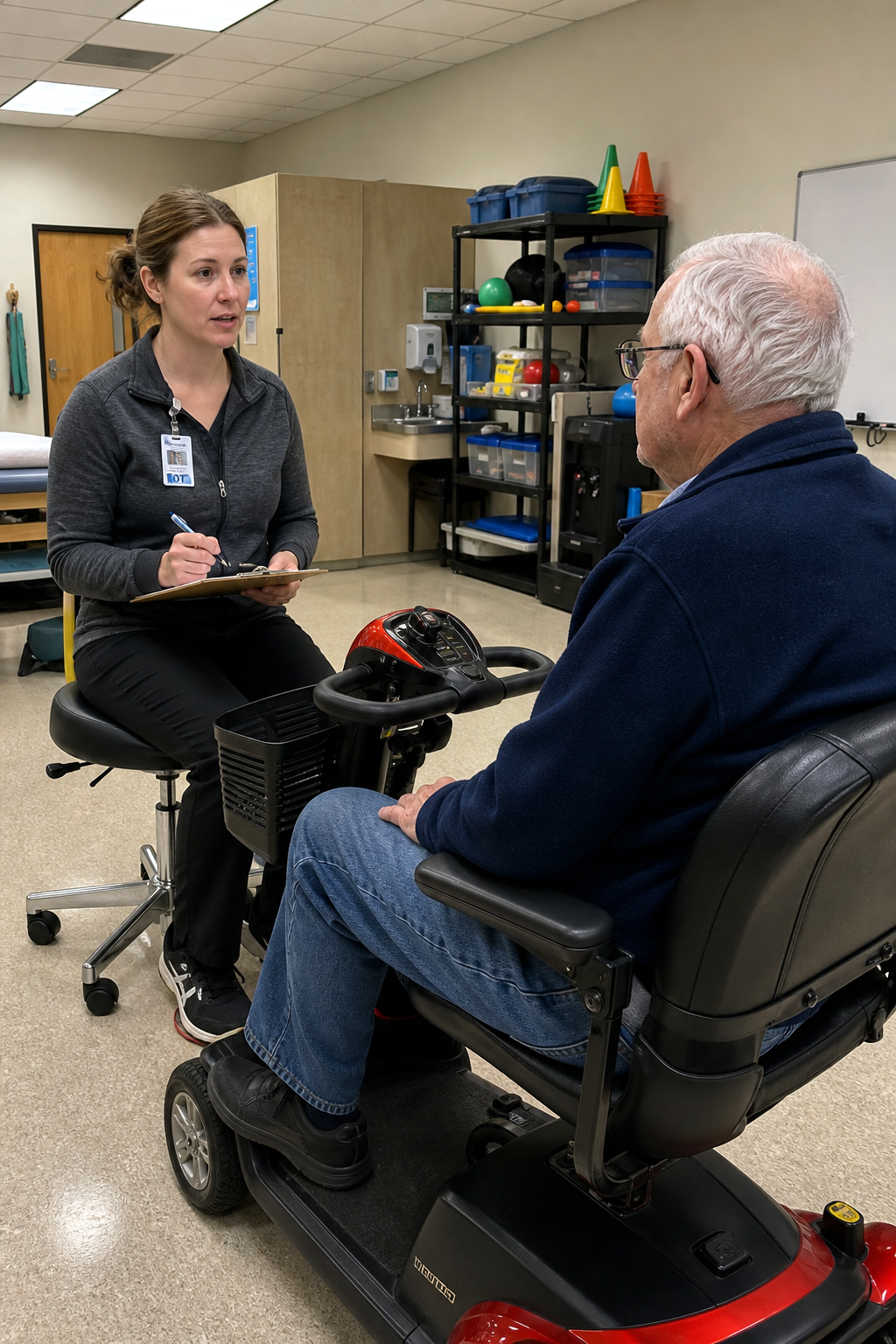
Getting an independent assessment from a healthcare professional — typically an occupational therapist or physiotherapist — is one of the most important steps you can take.
An occupational therapist can:
- Evaluate your specific physical capabilities and limitations
- Assess your home environment and typical travel routes
- Recommend the right type of scooter (or alternative) for your needs
- Train you on safe operation
- Help with modifications and adjustments
In some places, this assessment isn't just recommended — it's required.
Certificate of Medical Need: What You Need to Know
In Singapore, for example, from 1 June 2026, mobility scooter users must hold a valid Certificate of Medical Need to use their devices on public paths.
Who needs it? All users of mobility scooters, with some exemptions.
Who is exempt? Seniors aged 70 and above are automatically exempted. Beneficiaries of certain Government disability and mobility support schemes are also exempt.
How do you get it? You undergo the Assessment for Mobility Scooter (AMS) through your regular doctor, an occupational therapist, or participating general practitioners.
What conditions qualify? The Ministry of Health has issued guidelines for healthcare professionals, including a non-exhaustive list of possible conditions. Examples include cardiovascular diseases such as severe heart failure, and musculoskeletal disorders such as muscular dystrophies and rheumatoid arthritis.
More than 500 users had already obtained their Certificate of Medical Need as of April 2026.
Even if you're in a location without such requirements, a professional assessment is still a wise investment in your safety and confidence.
Matching Your Health Needs to Scooter Features
Now for the practical part. Once you've confirmed that a mobility scooter is right for you, how do you choose one that fits your specific health needs?
|
Your Health Need |
What to Look For |
|
Limited upper body strength |
Lightweight scooter (under 35 kg total weight). Check the weight of the heaviest piece if it dismantles. |
|
Back pain or need for support. |
Adjustable, well-padded seat with good lumbar support. Consider a suspension system |
|
Limited hand dexterity |
Simple, intuitive controls. Test the tiller and throttle before buying. |
|
Taller stature |
Look for adjustable seat height and tiller angle. Test for adequate legroom. |
|
Heavier build |
Check weight capacity carefully. Standard scooters: 100–115 kg. Mid-size: 136–150 kg. Heavy-duty: 181 kg or more. |
|
Indoor use |
Tight turning radius (under 120 cm). Three-wheel models are generally more manoeuvrable. |
|
Outdoor use |
Four wheels for stability on uneven terrain. Larger wheels, good ground clearance, and suspension. |
|
Transporting in a car |
Lightweight, foldable, or easily dismantled design. Check the weight of the heaviest piece. |
Typical Scooter Specifications (Metric Measurements)
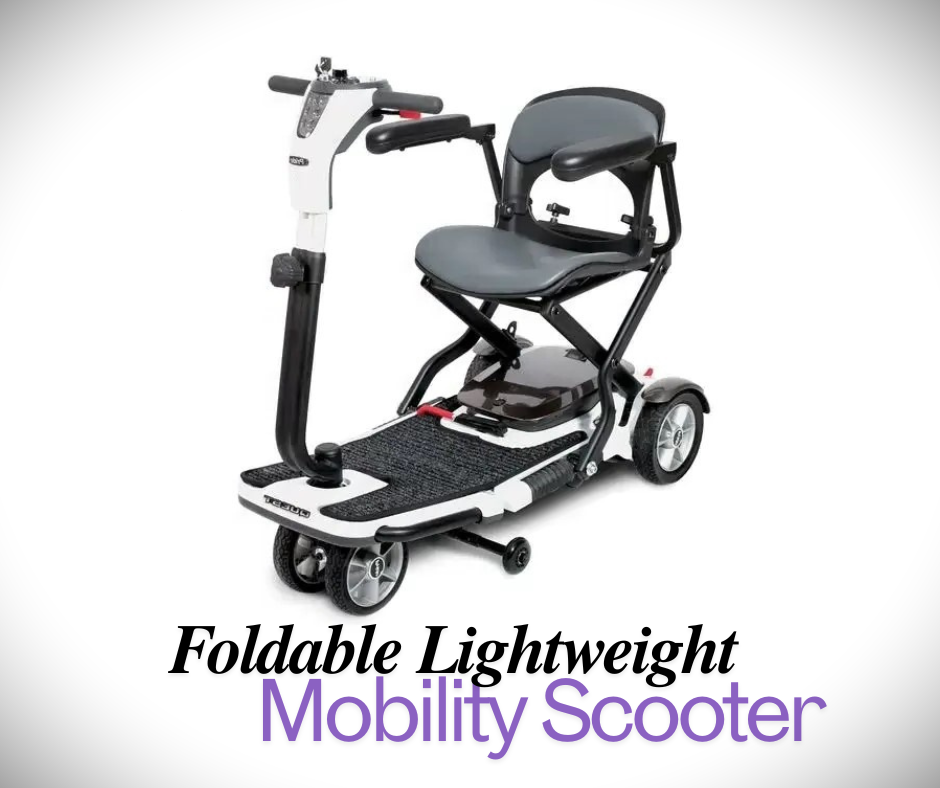
Here are some typical specifications to give you a sense of what's available. Always check the specific model you're considering.
Typical scooter dimensions:
- Length: 90–110 cm
- Width: 50–60 cm
- Height: 85–95 cm
Typical weights:
- Boot/travel scooters: 25–35 kg
- Standard scooters without batteries: 32–83 kg
Typical weight capacities:
- Standard: 100–115 kg
- Mid-range: 136–150 kg
- Heavy-duty: 181 kg or more
Typical turning radii:
- Compact models: 96–120 cm
- Standard models: 127–180 cm
- Larger models: up to 210 cm
New regulations (Singapore), from 1 June 2026): Personal Mobility Aid (PMA) larger than 120 cm (L) x 70 cm (W) x 150 cm (H), or with laden weight exceeding 300 kg, will not be allowed on public paths unless exempted.
Controls for Limited Grip Strength – Steering Without the Struggle
Here's a reality that most mobility scooter guides overlook: your hands matter as much as your legs.
If you have arthritis, reduced grip strength, or limited wrist movement, operating a standard scooter can feel like a battle. Modern scooters offer a range of control options designed specifically for people like you: delta tillers that allow palm steering rather than finger gripping, thumb lever controls that require less strength, joystick controls operated with a gentle finger nudge, soft-grip handles that reduce hand fatigue, and ergonomic control panels with extra-large buttons for limited dexterity.
When you're testing a scooter, pay close attention to the controls. Can you reach everything comfortably? Can you steer and drive easily, safely, and confidently without pain or discomfort?If the answer is no, keep looking.
Read our full guide to scooter controls for limited grip strength.
Read Full Guide→Controls for Limited Grip Strength (Coming Soon!)
Seat and Posture Comfort Setup – Because You'll Be Sitting for a While
Here's something else most guides skip: you're going to spend hours sitting on this thing. If it's uncomfortable, you won't use it.
Mobility scooter seat comfort depends on four key factors: seat width and depth, backrest height and lumbar support, adjustable or swivel armrests, and seat cushioning. Seat height adjustment allows you to position your knees at a comfortable angle — if your knees are too high or too low, you lose stability and control. Fore-and-aft adjustment lets you set the distance between the seat and the pedals based on your leg length. Tiller position adjustment ensures you're not overreaching, and armrest width and angle can be adjusted for posture and stability.
When you test a scooter, take the time to adjust everything. Sit in it for at least ten minutes. If something feels off, speak up. A good supplier will help you find the right fit. ]
Explore our complete guide to seat and posture comfort setup.
Read Full Guide→Seat and Posture Comfort Setup (Coming Soon!)

Scooter Stability for Balance Limits – Staying Safe on the Move
If balance is a concern — and for many of us, it is — stability becomes your top priority.
Four-wheel scooters offer superior stability compared to three-wheel models. They're the safer choice if you're worried about tipping, especially on uneven ground or when turning. Slow down on turns — mobility scooters stay balanced at safe speeds, so take every corner slowly and ease into your turns. Avoid steep slopes where possible, and if you must go up or down a slope, lean forward to shift your centre of gravity toward the front for improved stability.
Distribute weight evenly and never exceed the recommended weight capacity. If you feel you might tip over in a corner, reduce your speed and lessen the sharpness of the turn.
Find out more about scooter stability features and balance limits.
Read Full Guide→Scooter Stability for Balance Limits (Coming Soon!)
Fatigue Management with Scooter Features – Saving Energy for What Matters
One of the biggest benefits of a mobility scooter is reducing fatigue. But not all scooters are equally good at this.
Suspension systems are a game-changer. Scooters equipped with suspension are frequently recommended for users who experience pain or fatigue, as they reduce vibration transfer through the frame and support longer, more comfortable use.
Pneumatic tyres work together with suspension to smooth out the ride, absorbing bumps and providing better traction on uneven surfaces. Supportive seating helps reduce fatigue over time, and ergonomically designed seats made from high-quality materials offer comfort, durability, and shock absorption.
If you want to travel further, stay out longer, and still feel comfortable at the end of the ride, look for a scooter with suspension, pneumatic tyres, and supportive seating.
Read our full guide to fatigue management with scooter features.
Read Full Guide→Fatigue Management with Scooter Features (Coming Soon!)
Carer-Friendly Scooter Selection Tips – Making Life Easier for Everyone
If you're a caregiver researching on behalf of a loved one, this section is for you.
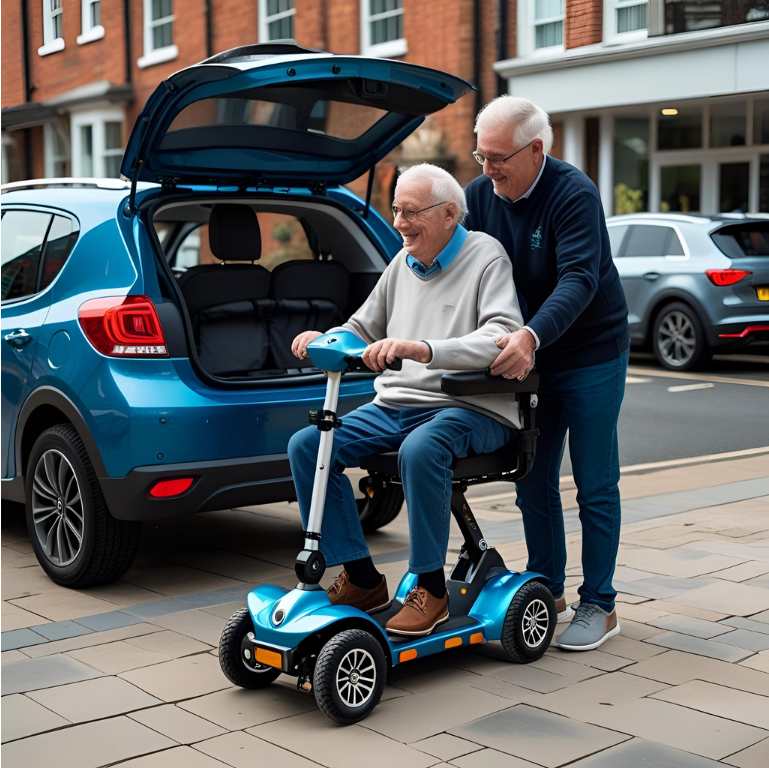
Weight matters — can you or your caregiver lift the scooter into a car? Check the total weight and the weight of the heaviest piece if it dismantles. Some scooters fold in one piece; others break into smaller parts. Think about which is easier for you to manage. Comfort is always important — make sure the seat offers enough cushion, that legs can rest comfortably, and note whether it's adjustable.
Consider physical capabilities: can your loved one safely control a joystick, throttle, or lever? Look for gradability, larger wheel size, and anti-tip wheels. When you're choosing a scooter, think about the whole picture — not just your loved one's needs, but your own as a caregiver.
Discover more carer-friendly scooter selection tips.
Read Full Guide→Carer-Friendly Scooter Selection Tips (Coming Soon!)
One-Handed Driving Control Options – Independence with Limitations
If you have use of only one hand — whether due to stroke, injury, or a condition — you can still drive a mobility scooter.
Delta-style controls can be operated with one hand, with a pressure-sensitive throttle that makes the scooter move slowly with a light pull and faster with more pressure. Wig-wag levers are linked so you can operate them using either one or both hands — pull the lever towards you to go forwards, or push it away to go backwards. Joystick controls are another excellent option, offering relaxed shoulders, light handling, and an active braking system without a steering column.
Control paddles are typically on the right-hand side for forward and the left for reverse, but this can usually be reversed if you're left-handed. Suppliers can sometimes arrange for adjustments, such as changing the setup of the accelerator lever.
Explore one-handed driving control options in our complete guide.
Read Full Guide→One-Handed Driving Control Options (Coming Soon!)
Post-Stroke Scooter Suitability Guide – Finding the Right Aid After Stroke
Recovering from a stroke is a journey, and finding the right mobility aid is a crucial part of it.
The choice between a powerchair and a mobility scooter depends on your specific abilities. A powerchair usually suits stroke survivors with poorer balance, one-sided weakness, or difficulty transferring, offering a joystick, supportive seating, and a tight turning circle. A mobility scooter usually suits those who can stand independently, transfer safely, and steer independently — primarily helpful for longer outdoor trips.
Lighter weight scooters are easier to lift into a car than powerchairs, though they often have to be dismantled for transport. Try before you buy is especially important after a stroke — many places have scooters that can be borrowed. Consider your standing balance, transfer ability, and daily distance when choosing between a scooter and a wheelchair.
Read our full post-stroke scooter suitability guide.
Read Full Guide→Post-Stroke Scooter Suitability Guide (Coming Soon!)
Low Vision Friendly Scooter Features – Staying Safe When Sight Is Limited
If you have low vision, you might wonder whether a mobility scooter is safe for you. The answer depends on the features and your specific vision.
Features that help include full lighting for outdoor visibility in low-light conditions, rear-view mirrors for added awareness, anti-tip wheels and anti-rollback systems, large clear displays with high contrast, audible alerts for turns or hazards, and safety turning sensors that slow down the scooter when turning at full speed.
People with severe visual impairments generally need reliable depth perception and awareness of surroundings to operate a scooter safely. However, some people who are "legally blind" can manage effective visual navigation while using a scooter, often demonstrating self-regulation of their use.
Discover more low vision friendly scooter features.
Read Full Guide→Low Vision Friendly Scooter Features (Coming Soon!)
Mobility Scooter for Arthritis Users – Easing the Pain of Every Journey
Arthritis affects millions of people, and it can make using a standard mobility scooter uncomfortable or even painful. But with the right features, a scooter can be a source of relief rather than strain.
Delta tillers provide a natural hand position, allowing you to steer with your palm rather than your fingers and reducing strain on arthritic joints. Easy-to-use controls include simple speed adjustments and thumb or joystick controls that require less grip strength. Soft-grip handles reduce hand fatigue, and ergonomic control panels with extra-large buttons are designed for limited dexterity.
The tiller design, throttle type, and armrest configuration matter far more than speed or colour when hand strength is limited. When you're testing a scooter, pay attention to how your hands and wrists feel. If something causes pain or discomfort, that's a sign to look elsewhere.
Explore our complete guide to mobility scooters for arthritis users.
Read Full Guide→Mobility Scooter for Arthritis Users (Coming Soon!)

Common Questions and Worries — Addressed
"Will using a scooter make me weaker?"
This is one of the most common fears, and it's understandable. But here's the truth: using a scooter doesn't mean you stop walking entirely. It means you choose when to walk — saving your energy for the moments that matter most. Many users find they actually walk more because they're not exhausted from the journey to get there.
"I can still walk. Am I 'allowed' to use a scooter?"
Yes. Mobility scooters aren't just for people who can't walk at all. They're for anyone who finds walking difficult, painful, or exhausting — whether that's due to chronic illness, injury, age, or fatigue.
"Won't people judge me?"
Some people might. But here's what matters more: you being able to visit friends, run errands, feel the sun on your face, and stay connected to the world you love. That's worth more than anyone else's opinion.
"What if I buy the wrong one?"
This is exactly why professional assessment and test-driving are so important. A good supplier will ask you lots of questions about your needs, your home environment, and where you want to go. Take your time. Test different models. Ask questions. You're making an investment in your independence — it deserves careful consideration
.
Your Health Needs Fit – Putting It All Together
You've made it through this Health Needs Fit guide — and that tells me you're serious about finding the right mobility solution.
Here's the thing: there's no "one size fits all" answer. Your health needs are unique, and your scooter should be too. But armed with the information in this guide, you now know:
- Which controls work best for limited grip strength
- How to set up your seat and posture for comfort
- What features enhance stability for balance concerns
- How to manage fatigue with suspension and supportive seating
- What to look for if you're a caregiver
- Your options for one-handed driving
- What to consider after a stroke
- Which features support low vision
- How to choose a scooter that works with arthritis
Your next steps:
- Reflect on your specific health needs. What are your biggest challenges? What would make the biggest difference in your daily life?
- Make a list of "must-have" features. Based on this guide, what features are non-negotiable for you?
- Book a professional assessment. Talk to an occupational therapist, physiotherapist, or your doctor.
- Test drive multiple models. Don't settle for the first one you try. Test different controls, different seats, different sizes.
- Ask questions. A good supplier will welcome your questions and help you find the right fit.
- Trust yourself. You know your body better than anyone. If something feels wrong, it probably is.
Remember: a mobility scooter isn't about giving up. It's about choosing to keep going — to stay connected, to stay active, to stay you.
You deserve that. And now, you have the tools to make it happen.
Stay mobile, stay confident!
Sign up for our monthly Mobility Scooter Newsletter to receive practical guides, expert advice, and inspiring stories that help you make the most of your scooter and download our free "Mobility Scooter Guide for Beginners."
Don't worry — your e-mail address is totally secure.
I promise to use it only to send you our newsletter, "Mobility Matters."
Recent Articles


-
Choosing the Right Battery Capacity 101: (Ah vs Wh)
Oct 08, 26 09:04 AM
 Choosing the Right Battery Capacity Guide: Compare Ah vs Wh, estimate range, and pick the best battery for your routine.
 -
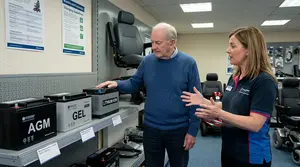
Stop! Compare AGM, Gel, and Lithium Before You Buy (
Oct 08, 26 08:59 AM
How to compare AGM, gel, and lithium batteries for mobility scooters: Stop guessing. Get the honest facts before you spend your money. -
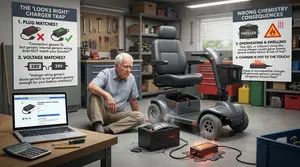
Stop! Your Charger Must Match Your Battery Chemistry
Oct 08, 26 07:08 AM
Choosing the right charger for your battery capacity and chemistry (AGM/gel vs lithium): Stop guessing. Get the facts before you buy a replacement charger.
Ready to Feel More Confident on Your Mobility Scooter?

My Ebook, The Ultimate Guide to Mobility Scooters, walks you through choosing the right scooter, using it safely, and keeping it in top condition — all explained in clear, friendly language.
Give yourself (or someone you love) the gift of independence.


