- Home
- Mobility Scooter Types
Mobility Scooter Types: Your Complete Guide to Finding Freedom That Fits
Have you typed "mobility scooter types" into Google more times than you’d like to admit, only to click away feeling more confused than before?
Let’s be honest for a moment. You’re probably here because you—or someone you love—is facing a change in mobility, and the whole "scooter thing" feels a bit overwhelming. Maybe you’ve been putting off this search because you don’t know where to start.
We get it. Truly.
Buying a mobility scooter isn't like buying a new phone or a pair of shoes. It’s personal. It’s about independence, about getting to the shops without relying on anyone else, about visiting a friend's house, or simply feeling the sun on your face as you roll through the park.
And with so many mobility scooter types out there, it’s easy to feel like you’re drowning in jargon and specs.

But here’s the good news: finding the right mobility scooter doesn’t have to be complicated.
In fact, once you understand the basic mobility scooter types, everything else starts to fall into place. Think of this guide as your friendly, no-nonsense roadmap. We’re going to walk you through every category, every feature, and every practical consideration—from turning radius to doorway widths, from suspension to storage. By the time you finish reading, you’ll know exactly which scooter is right for you.
And we promise: no confusing sales pitch. Just clear, honest advice from someone who genuinely wants to help.
So, take a deep breath. Grab a cuppa. And let’s figure this out together.
What Are the Main Mobility Scooter Types?
Before we dive into the nitty-gritty, let’s start with the big picture.
Mobility scooter types generally fall into two broad legal categories, and understanding this distinction is your first step toward making a confident choice.
Class 2 Mobility Scooters: Your Pavement Companion
Class 2 scooters are designed primarily for pavement and footpath use. They have a maximum speed of 6.4km/h (4mph) roughly the pace of a brisk walk—which is the legal limit for pavement travel. These are generally lighter, smaller, and easier to manoeuvre than their road-going cousins.
Many Class 2 scooters can be dismantled or folded for transportation and storage. You’ll often hear them referred to as "boot scooters" because they’re designed to fit in the boot of a car. They tend to have shorter battery life and are ideal for shorter, local trips—popping to the corner shop, visiting a nearby friend, or enjoying a leisurely ride around the neighbourhood.
If your world is mostly pavements, and you don’t need to venture onto roads, a Class 2 scooter might be your perfect match. But what if you need to go further?
Class 3 Mobility Scooters: Road-Ready Freedom
Class 3 mobility scooters are the larger, more powerful option. They can be used on both roads and pavements, with a maximum speed of 6km/h (4mph) on pavements and 12.8km/h ( 8mph) on roads.
These scooters come equipped with extra features required by law: headlights, indicators, a horn, rear-view mirrors, and hazard lights. They must be registered with the DVLA (in the UK), and you need to be at least 14 years old to drive one.
Class 3 scooters are heavier, more robust, and have longer battery life, making them perfect for longer journeys and more varied terrain. However, they typically cannot be dismantled easily and usually require a ramp or lift for vehicle transport.
So, the first big question to ask yourself is: “Will I need to use my scooter on the road?”
Your answer will point you toward one of these two main mobility scooter types.
Beyond the Basics: 3-Wheel vs 4-Wheel Mobility Scooters
Once you’ve decided between Class 2 and Class 3, you’ll face another important choice: three wheels or four?
Both Class 2 and Class 3 scooters come in 3-wheel and 4-wheel versions. But they serve very different purposes.
3-Wheel Scooters: The Maneuverability Kings
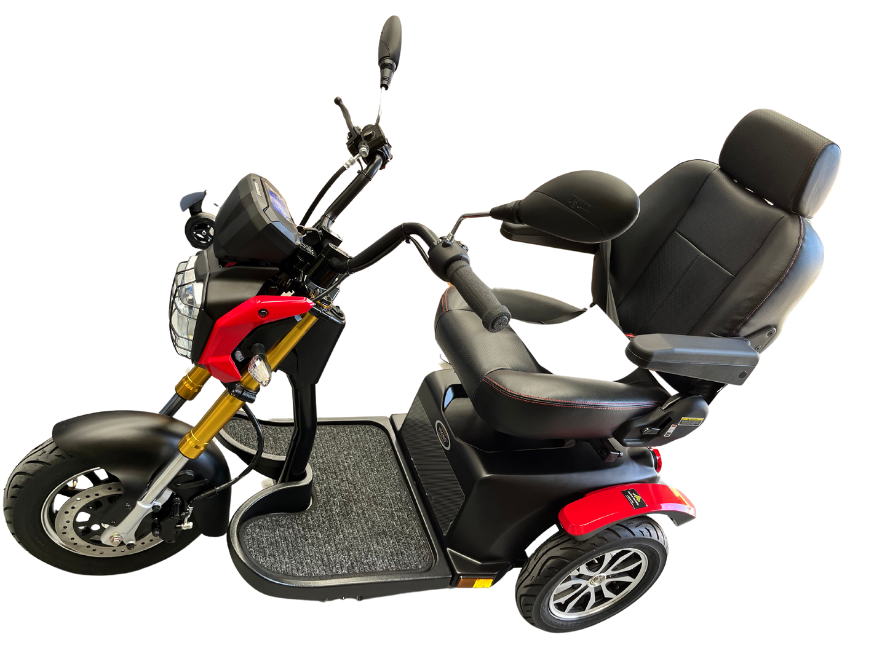
Three-wheel scooters have one front wheel and two rear wheels. Their standout feature is a tighter turning radius, making them significantly easier to navigate in tight spaces. If you plan to use your scooter primarily indoors—in your home, in shops, or in narrow corridors—a 3-wheel scooter is often the better choice.
They’re generally lighter and offer more legroom than their 4-wheel counterparts. However, they can feel less stable on uneven terrain.
4-Wheel Scooters: Stability and Outdoor Confidence
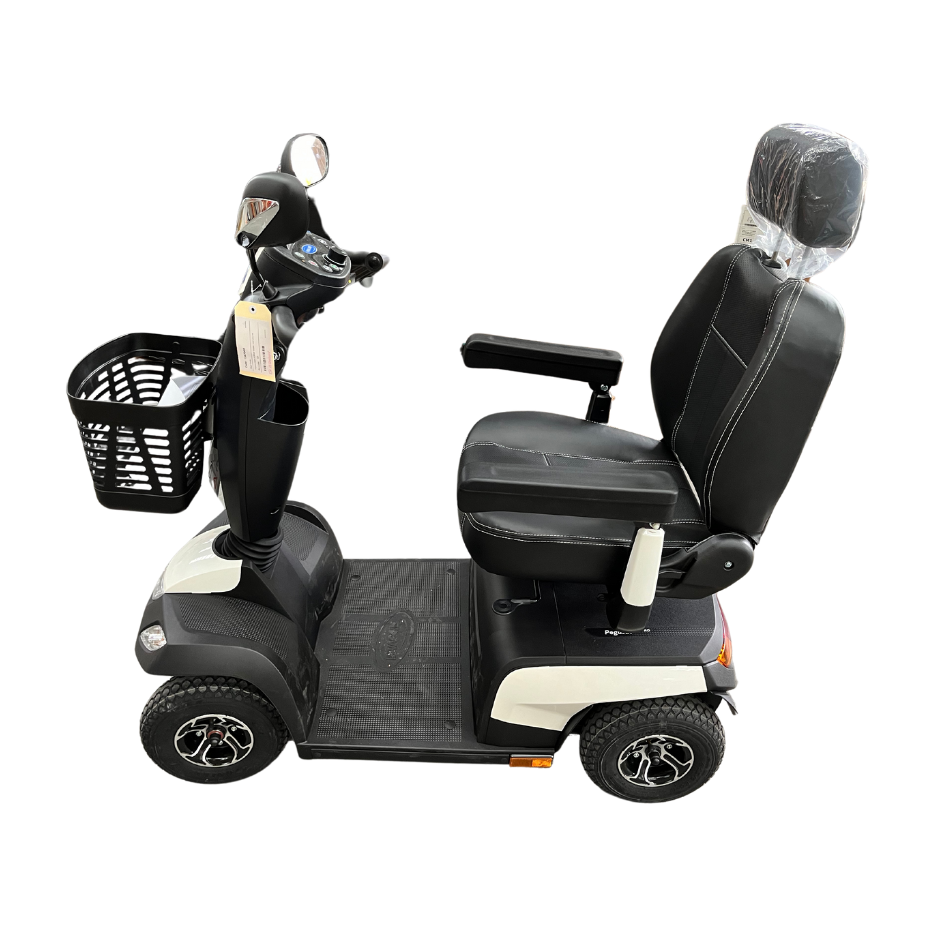
Four-wheel scooters have two front wheels and two rear wheels. This configuration provides enhanced stability, making them better suited for outdoor environments and uneven terrain.
They offer a wider wheelbase and are often more comfortable for longer journeys. If you’ll be spending most of your time outdoors, tackling bumpy paths or uneven pavements, a 4-wheel scooter will give you greater confidence.
The trade-off? A larger turning radius. You’ll need more space to turn around, which can be a challenge indoors.
The bottom line: If you’re mostly indoors or in tight spaces, go 3-wheel. If you’re mostly outdoors and value stability, go 4-wheel. We’ll dig deeper into turning radius shortly—because it really matters.
Mobility Scooter Size Categories: Finding Your Fit
Mobility scooter types aren't just about class and wheels—they also come in different sizes. Understanding these categories will help you match a scooter to your body, your home, and your lifestyle.
Here’s a quick breakdown of the typical size categories:
|
Scooter Type |
Length |
Width |
Weight |
Max User Weight |
Turning Radius |
|
Boot/Travel |
90–110 cm |
50–60 cm |
25–35 kg |
100–115 kg |
110–130 cm |
|
Mid-sized |
110–130 cm |
55–65 cm |
35–55 kg |
115–136 kg |
130–150 cm |
|
Full-sized (Road) |
130–160 cm |
60–70 cm |
55–85 kg |
136–160 kg |
150–180 cm |
|
Heavy-duty |
140–170 cm |
65–75 cm |
70–100 kg |
160–227 kg |
160–200 cm |
Boot/Travel Scooters: For the On-the-Go Lifestyle
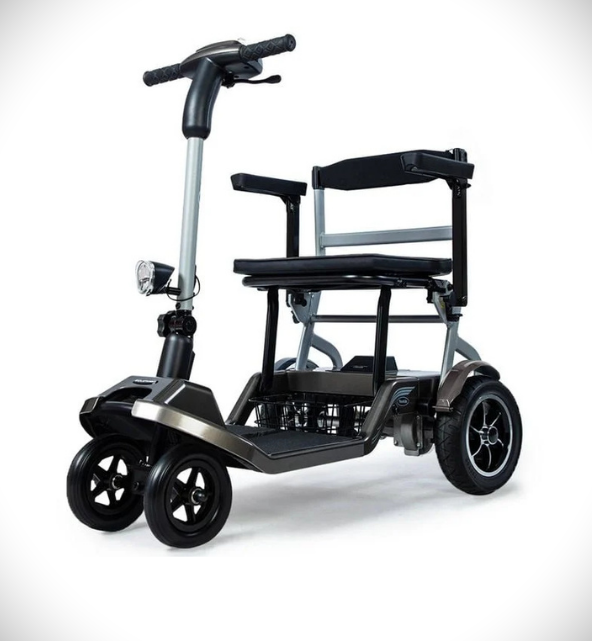
These are the lightest and most compact mobility scooter types. They’re designed for easy transport and storage. If you travel frequently, have limited storage space, or need to lift your scooter into a car, this category is your friend.
Many boot scooters can be dismantled into parts, with the heaviest component typically weighing just 15–20 kg. Some can even be folded down to fit in a cupboard.
Mid-Sized Scooters: The Versatile All-Rounder
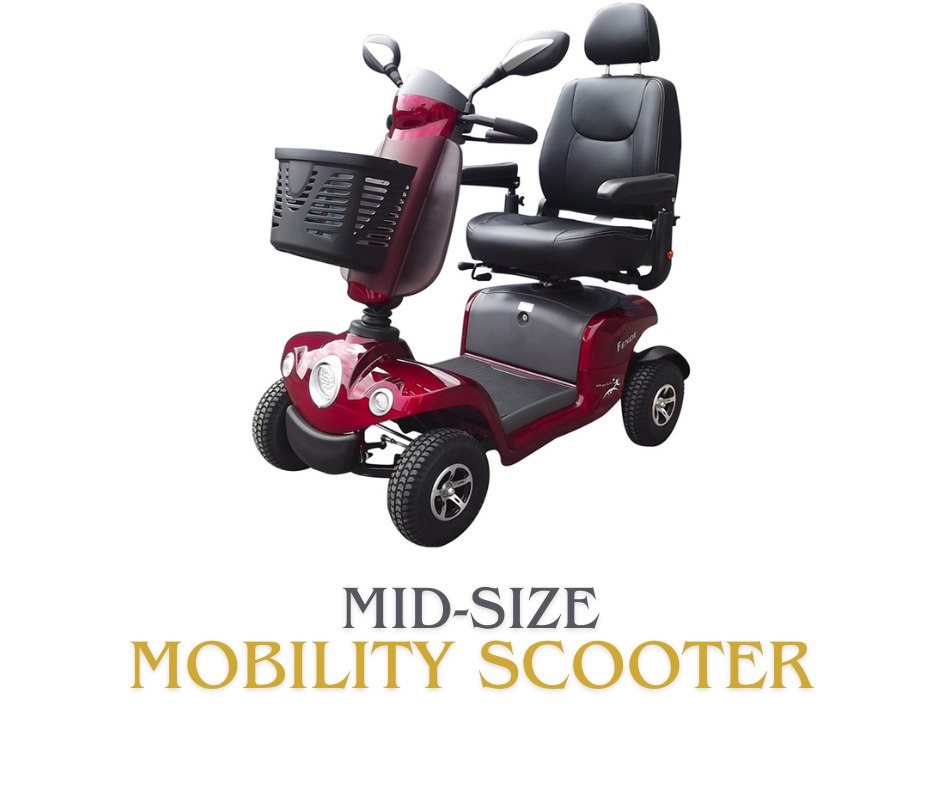
Mid-sized scooters strike a balance between portability and comfort.
They’re suitable for both indoor and outdoor use, offering more features than travel scooters without the bulk of full-sized models.
If you’re unsure which category you need, mid-sized is often a safe starting point.
Full-Sized and Heavy-Duty Scooters: Power and Performance
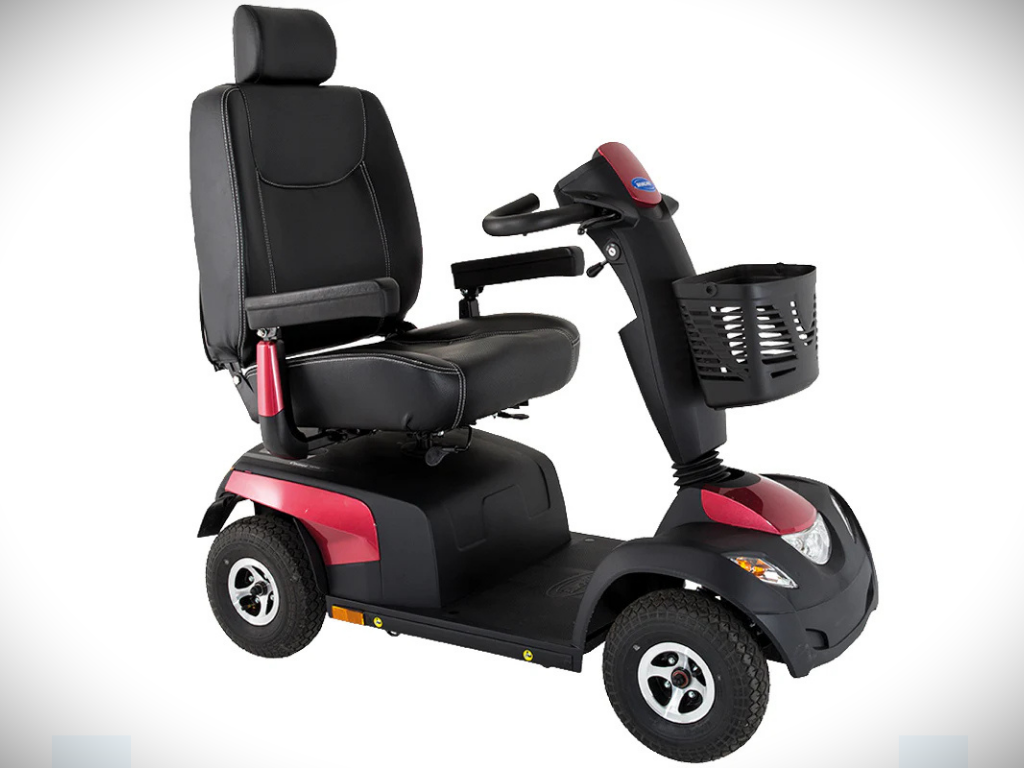
Full-sized road scooters and heavy-duty models are the largest and most powerful mobility scooter types.
They offer higher weight capacities (often over 350 pounds / 160 kg), longer range, larger tires, and superior suspension.
These are designed for serious outdoor use—long distances, rough terrain, and all-day comfort. But they require more storage space and are harder to transport.
Turning Radius and Maneuverability: The Space You Really Need
Turning radius is one of those technical terms that sounds boring but is actually crucial to your daily experience. Put simply: turning radius is the amount of space your scooter needs to turn around in a complete circle.
A smaller turning radius means you can manoeuvre in tighter spaces. This is essential if you’ll be using your scooter indoors, in shops, or in narrow hallways.
Here’s where the 3-wheel vs 4-wheel debate really comes alive. A 3-wheel scooter typically has a substantially tighter turning radius—sometimes by up to a foot or more. For example, on some models, the 3-wheel version might have a turning radius of around 100 cm (39 inches), while the 4-wheel version could be 132 cm (52 inches). That difference can mean the difference between gliding through your kitchen doorway and getting stuck.
Boot and travel scooters generally have the tightest turning radii—often under 130 cm. Full-sized road scooters need more room, with turning radii of 150–180 cm or more.
The practical takeaway: Before you buy, measure the spaces you’ll be navigating—your hallway, your kitchen, your local shop aisles. Compare those measurements against the scooter’s turning radius.
If the numbers don’t add up, you’ll be fighting your scooter every single day. And nobody wants that.
Suspension and Ride Comfort: Because Every Bump Matters
Let’s talk about something that can make or break your daily experience: suspension.
A good suspension system absorbs shocks and vibrations from uneven surfaces, making your ride smoother, more comfortable, and safer. If you’ll be travelling on pavements with cracks, tree roots, or potholes, suspension isn’t a luxury—it’s a necessity.
Many pavement scooters come with front and rear suspension to absorb bumps and vibrations on rough terrain. Higher-end models may feature independent suspension on each wheel for an even smoother ride.
Here’s the thing: A scooter without suspension might feel fine on a test drive around a smooth showroom floor. But take it out on a real pavement with uneven paving stones, and you’ll feel every single bump rattling through your spine. That’s not just uncomfortable—it can be exhausting and even painful over time.
If you have any back or joint issues, prioritise suspension. Your future self will thank you.
Ground Clearance and Curb Handling: Conquering Obstacles
Ground clearance is the distance between the lowest part of your scooter’s frame and the ground. Higher ground clearance makes it easier to traverse curbs, bumps, and thresholds.
Travel scooters often sit lower to the ground, which can cause scraping when crossing small curbs or driveway transitions. A scooter with 8-10 cm. 3–4 inches of ground clearance provides additional lift for better handling over cracks and bumps.
Some models can handle vertical obstacles up to 50 mm (about 2 inches) high. Others, especially heavy-duty outdoor models, offer ground clearance of 20 cm (8 inches) or more.
What does this mean for you? Think about your daily routes. Are there curbs to cross? Driveway lips? Uneven paving?
If so, ground clearance matters. A scooter that’s too low will scrape and struggle—or worse, get stuck. A scooter with adequate clearance will glide over obstacles with confidence.
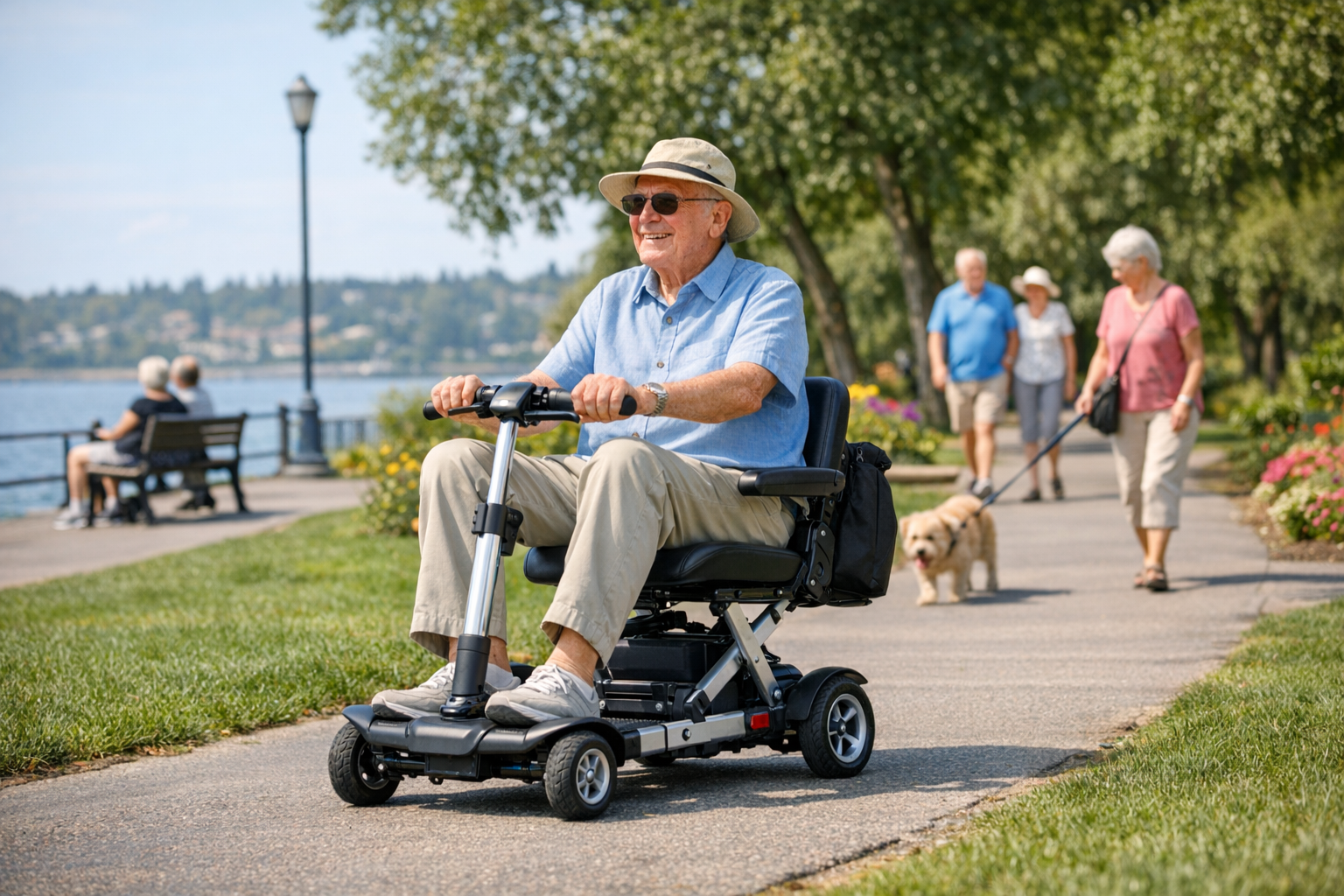
Doorway Width and Scooter Fit: Will It Get Through Your Front Door?
This is the question we hear most often: “Will it fit through my doorway?”
Standard Aussie doorways are typically 820 mm wide. To fit through comfortably, you need at least 100–150 mm of clearance beyond the scooter’s width. That means if your doorway is 820 mm wide, your scooter should be no more than about 670–720 mm wide.
But here’s the catch: The scooter’s overall width might be measured at the widest point, which could be the rear axle, the armrests, or the footplate. And don’t forget the tiller (steering column)—handlebars can extend wider than the body of the scooter.
Practical advice: Measure your narrowest doorway before you start shopping. Measure the clear opening (doorstop to doorstop), not the frame-to-frame distance. And always add a clearance margin—10 cm is the minimum; 15 cm is much more comfortable for everyday use.
Remember: getting through the door is one thing. Turning inside your hallway or living room is another. Check both the width and the turning radius against your actual home layout.
Small Home Storage Friendly Scooters: Making Every Inch Count
Living in a small home or flat doesn’t mean you can’t have a mobility scooter. It just means you need to be strategic about your choice.
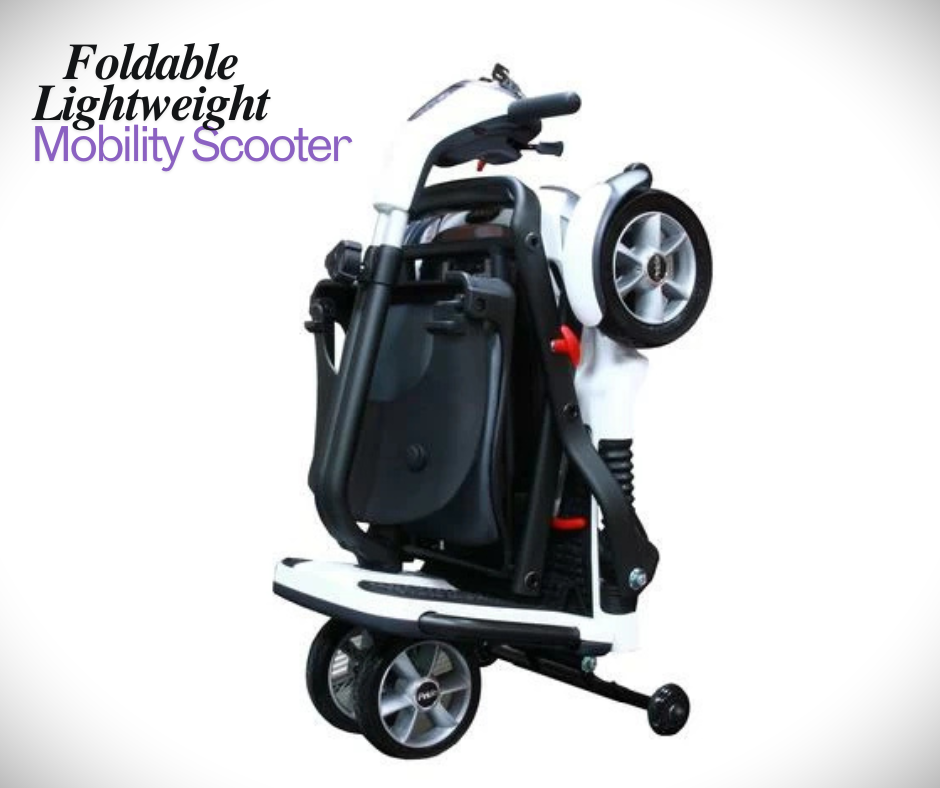
Foldable scooters are a game-changer for small spaces. Some models fold down to just 74 x 48 x43 cm. (29 x 19 x 17 inches) and can be stored upright to save even more space. Others disassemble into parts, with the heaviest component weighing as little as 10.5 kg for easy lifting and storage.
If you have a garage, consider wall-mounted racks to store your folded scooter off the floor. For flats, look for models that fit in a cupboard or under a bed when folded.
The key insight: Don’t just look at the scooter’s unfolded size. Check the folded or disassembled dimensions. And always consider not just the scooter’s footprint but also the space needed for manoeuvring—add 20–30 cm to each dimension for comfortable storage and access.
Terrain Matching for Daily Routes: Your Journey, Your Scooter
Finally, let’s talk about where you’ll actually be riding. This is perhaps the most personal factor in choosing between mobility scooter types.
Flat, Smooth Pavements
If your daily routes are mostly flat, smooth pavements, and you rarely venture onto roads, a Class 2 scooter with 3 wheels might be perfect. It’s lightweight, manoeuvrable, and easy to store.
Uneven Pavements and Occasional Curbs
If your routes include cracked paving, tree roots, or small curbs, look for a scooter with good suspension, adequate ground clearance (at least 3–4 inches), and larger wheels.
A 4-wheel scooter will offer more stability.
Roads and Longer Distances
If you need to travel on roads or cover longer distances, you’ll need a Class 3 scooter.
Look for full-sized or heavy-duty models with long battery range, robust suspension, and full lighting
Mixed Use (Indoors and Outdoors)
If you’ll be using your scooter both indoors and outdoors, a mid-sized scooter with a tight turning radius and good stability is your best bet.
Consider a 3-wheel model for better indoor manoeuvrability, but make sure it has enough ground clearance and suspension for outdoor use.
Rough Terrain and Off-Road
For forest trails, countryside paths, or gravel tracks, you’ll need a heavy-duty off-road scooter.
These have large pneumatic tyres, high ground clearance (often 10 cm. or more), powerful suspension, and high torque motors.
Making Your Decision: Putting It All Together
Whew! That’s a lot of information. But here’s the beautiful thing: you now have everything you need to make a confident decision.
Let’s quickly recap the key questions you should ask yourself:
- Where will I use it? Pavement only, or roads too? (Class 2 vs Class 3)
- Where will I store it? Do I have space, or do I need a foldable model?
- Will I transport it? Do I need to fit it in a car boot?
- What’s my daily route like? Smooth pavements, or rough terrain?
- Do I have narrow doorways? What’s the width of my narrowest door?
- Do I need a tight turning radius? Will I be navigating tight indoor spaces?
- Do I value comfort? Is suspension a priority for my joints and back?
Answer these questions honestly, and the right mobility scooter types will practically reveal themselves.

Final Thoughts: Your Freedom Awaits
Choosing a mobility scooter is a big decision. It’s an investment in your independence, your confidence, and your quality of life. And yes, it can feel overwhelming at first.
But here’s what we want you to remember: you’ve got this.
You’re not alone in this journey. Thousands of people have navigated these same questions and found electric scooters that transformed their daily lives. And now, armed with this guide, you’re better prepared than most.
Take your time. Visit a reputable dealer and test drive different models for at least 30 minutes. Get a feel for the controls, the comfort, and the handling. Ask questions. Trust your instincts.
And when you finally find that perfect scooter—the one that fits through your door, glides over your routes, and puts a smile on your face—you’ll know it was worth every moment of research.
Your freedom is waiting. Go find it.
Stay mobile, stay confident!
Sign up for our monthly Mobility Scooter Newsletter to receive practical guides, expert advice, and inspiring stories that help you make the most of your scooter and download our free "Mobility Scooter Guide for Beginners."
Don't worry — your e-mail address is totally secure.
I promise to use it only to send you our newsletter, "Mobility Matters."
Recent Articles


-
Portable vs Travel vs Folding Mobility Scooters Buyer's Guide
Sep 15, 26 11:01 AM
 Confused by "portable," "travel," and "folding" mobility scooter listings? This guide explains what Australian sellers actually mean, with real weight comparisons and a decision framework.
 -
Mobility Scooter Types Overview: No More Confusion
Sep 15, 26 10:54 AM
 Mobility scooter types explained in plain English. Includes Australian footpath rules, airline battery limits, and the one mistake most first-time buyers make.
 -
How to Choose a Mobility Scooter in Australia Guide (2026)
Sep 15, 26 07:29 AM
 Choosing a mobility scooter in Australia? This guide covers registration requirements by state, public transport dimensions, NDIS funding steps, and practical testing advice.


Ready to Feel More Confident on Your Mobility Scooter?

My Ebook, The Ultimate Guide to Mobility Scooters, walks you through choosing the right scooter, using it safely, and keeping it in top condition — all explained in clear, friendly language.
Give yourself (or someone you love) the gift of independence.




