- Home
- Mobility Scooter Accessories and Power
- Mobility Scooter Battery Capacity
- How Rider Weight & Terrain Change Battery Capacity
How Rider Weight, Terrain, and Stop-Start Driving Change the Capacity You Should Choose
Picture this: You and your neighbour buy the exact same mobility scooter on the exact same day. Same model, same battery, same everything. Three months later, you are both comparing notes. You are getting roughly 29 kilometres per charge. Your neighbour is getting barely 19. Same scooter. Same battery. Completely different results. What is going on?
This is not a manufacturing defect or a one-off fluke. It is the reality of how rider weight, terrain, and stop-start driving change the capacity you should choose—and it is the single most important lesson in buying the right battery.
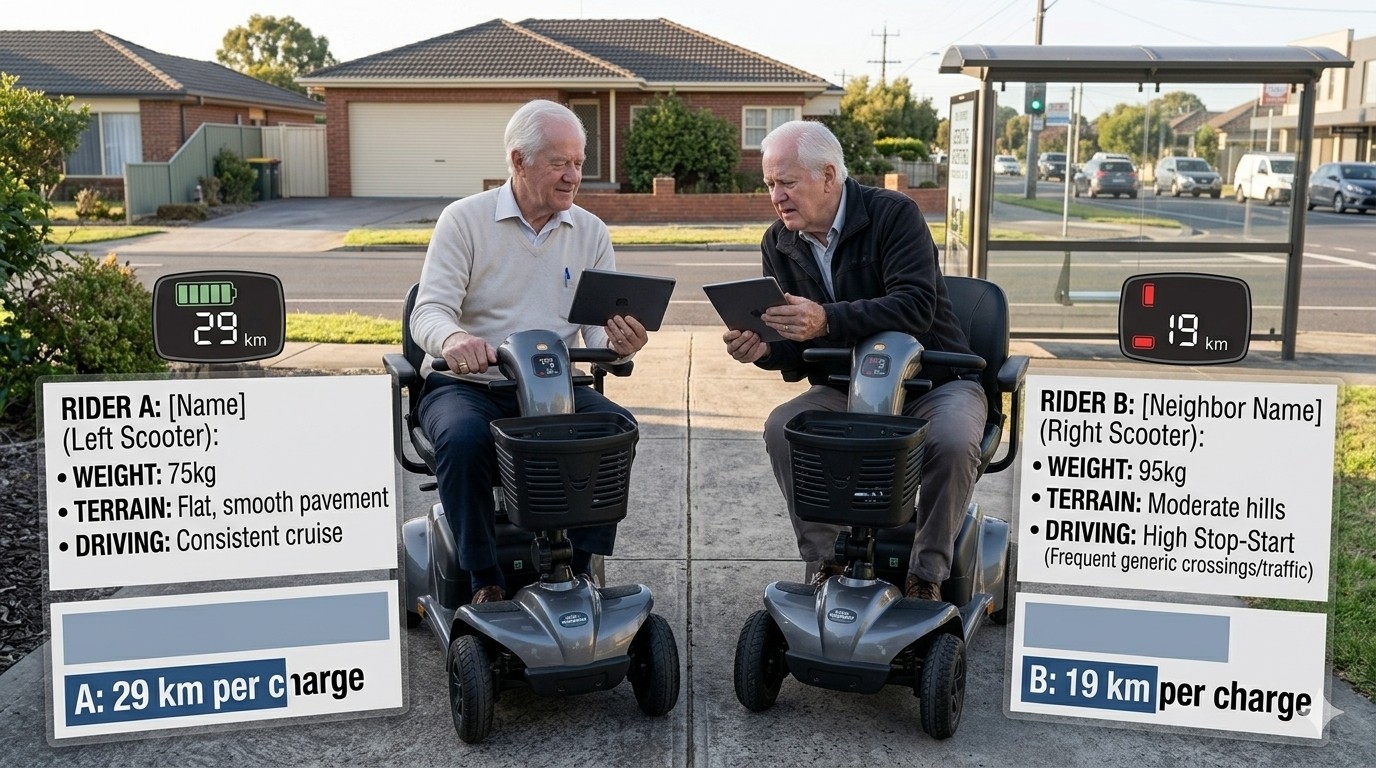
If you have ever felt frustrated by range figures that never seem to match your experience, take heart. You are not doing anything wrong. You are simply living in the real world, where batteries face demands that laboratory tests never account for.
In this guide, we are going to walk through each of these three factors—weight, terrain, and stop-start driving—and show you exactly how much they affect your usable range.
By the end, you will know how to size your battery for the life you actually live, not the one on the specification sheet.
The Lab vs. Your Life: Why Range Figures Fall Short
Before we dive into the three factors, let us briefly understand why published range figures are often so far from reality. Manufacturers test their scooters under controlled conditions: flat, smooth ground, mild weather, a steady speed, a lighter rider, and a new, fully charged battery with no stopping and starting. That is not your Tuesday morning.
In the real world, most users get somewhere around 70–90% of the quoted range. In the UK, real-world conditions can reduce usable range by 25–40% because of hills, kerbs, stop-start journeys, and cold weather. So a scooter advertised at 32 kilometres might realistically deliver 19–24 kilometres for many riders.
Your scooter is not underperforming. It is simply dealing with conditions that the lab test never included. And the three biggest of those conditions are the ones we are about to explore.
How Rider Weight Changes the Capacity You Should Choose
Let us start with the factor that is closest to home: you.
The weight of the rider has a substantial effect on battery performance. The heavier the user, the harder the electric motor has to work to get the scooter moving, and the heavier the drain on the batteries. It is simple physics: more mass means more energy required to accelerate, climb, and maintain speed.
But how much difference does it actually make? Let us look at some real numbers.
Pride Mobility publishes range figures for their scooters at different rider weights. One model lists up to 13 kilometres at 91 kg, but only up to 11 kilometres at 136 kg. That is a roughly 12.5% reduction for a 50% increase in rider weight. For larger scooters, the gap is even more dramatic: the Pride Wrangler MV600 is rated at up to 30 kilometres at 159 kg, but up to 47 kilometres at 91 kg with the same 100Ah battery. That is a 37% difference in range, purely from rider weight.
Now, think about what this means for your battery capacity choice. If you weigh more than the "average" rider used in the manufacturer's testing, you need to size up. Products are tested with an average weight, and if you weigh more than that average—or if you carry heavy accessories or shopping—your mileage range will decrease.
How much should you size up? As a rough guide, if you are 20–30% heavier than the test weight, add 20–30% to your required capacity. If you carry shopping or other loads regularly, add another 10–15%. This is not an exact science, but it will get you much closer to a battery that genuinely meets your needs.
But weight is only the first factor. The ground beneath your wheels matters just as much, and it might surprise you.
How Terrain Changes the Capacity You Should Choose
Terrain is the biggest single factor that eats into your range, and it is the one most riders underestimate.
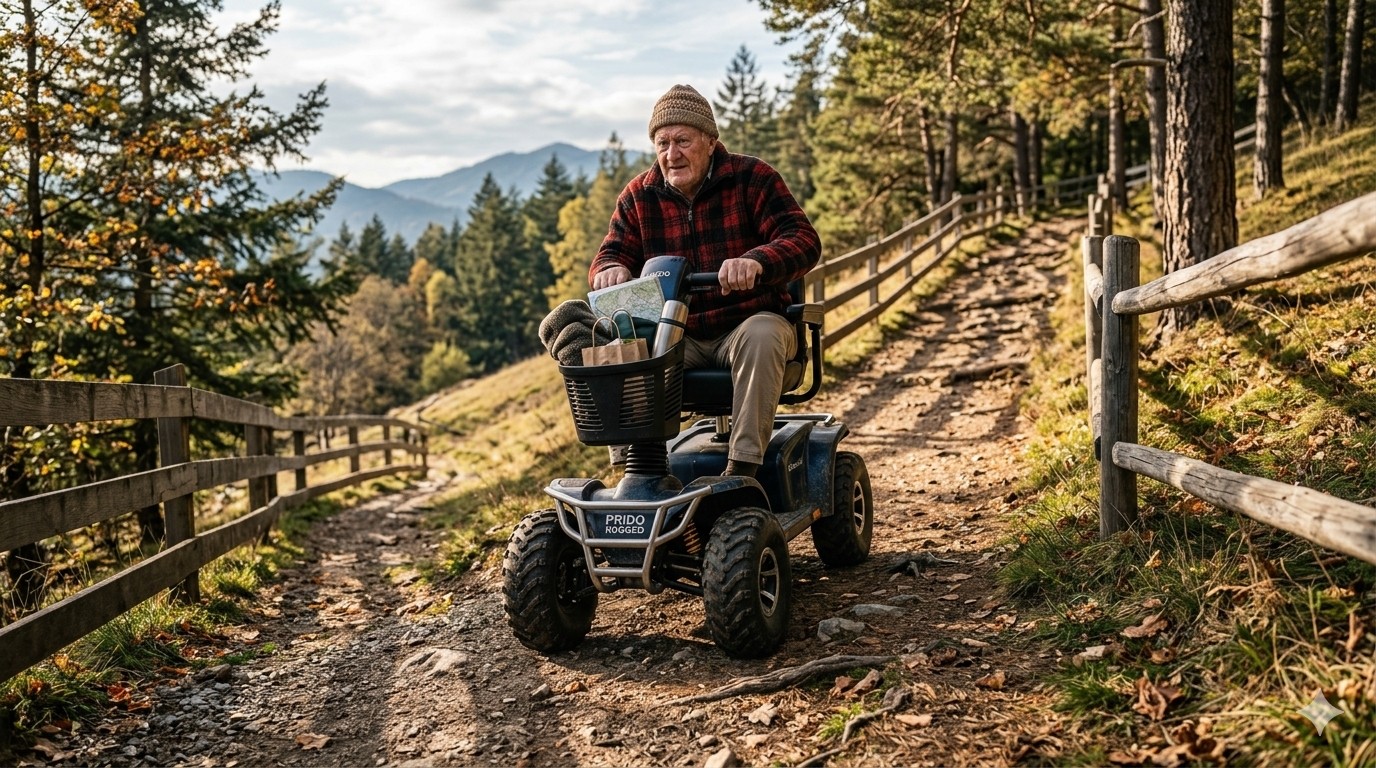
Hills, rough paths, grass, gravel, and uneven surfaces require more power than smooth pavements or shop floors. The steeper the incline, the harder the electric motor has to work, and the heavier the drain on the batteries. A hilly route can cut range dramatically—not by a few percent, but by a third or more.
Think about it this way: riding on flat ground is like pushing a shopping trolley on a smooth supermarket floor. Riding up a hill is like pushing that same trolley up a ramp. Riding on grass or gravel is like pushing it through sand. The motor has to work harder in every one of those scenarios, and harder work means faster battery drain.
Soft ground like grass in parks or sandy paths adds resistance that cuts distance significantly. Gravel, broken pavement, and even wet leaves can all increase rolling resistance and reduce efficiency.
So how do you account for terrain when choosing battery capacity? Start by honestly assessing the routes you ride most often. If your typical journeys are on flat, smooth pavements, you can stay close to your calculated capacity needs. But if your routes include hills, gravel, grass, or uneven surfaces, you need to size up.
A reasonable rule of thumb is to add 30–40% to your required capacity if your typical routes are hilly or include significant rough terrain. If you occasionally encounter hills but mostly ride on smooth surfaces, a 15–20% buffer is more appropriate.
But there is one more factor that many riders never consider, and it might be the most surprising of all.
How Stop-Start Driving Changes the Capacity You Should Choose
Here is something that catches almost everyone off guard: pulling away from a stop uses far more energy than cruising at a steady speed.
Think about a town trip with twenty kerbs, crossings, and traffic lights. Every time you stop and start again, the motor has to draw a surge of power to get the scooter moving. Cruising, by contrast, requires much less energy because the scooter already has momentum. A town trip with twenty kerbs and crossings costs more battery than an open path of the same length.
This is why stop-start driving is such a significant factor. Frequent stopping and starting consumes more energy than smooth, consistent driving. The motor draws more power when starting from a full stop.
If your typical routes involve a lot of stopping and starting—navigating busy pavements, crossing roads, weaving through pedestrian areas—you need to account for this in your battery capacity. A rider who cruises along a canal path at a steady speed will get significantly more range than a rider who covers the same distance through a town centre with constant stops.
How much extra capacity should you allow? If your typical routes involve frequent stops, add 15–25% to your required capacity. If you ride mostly on open paths with few interruptions, you can stay closer to your baseline.
And this factor compounds with the others. A heavier rider on hilly terrain with frequent stops faces a triple drain on their battery. That is why the same scooter can deliver wildly different range figures for different riders, even when the battery is identical.
Putting It All Together: A Practical Example
Let us walk through a realistic scenario to show how these three factors combine.
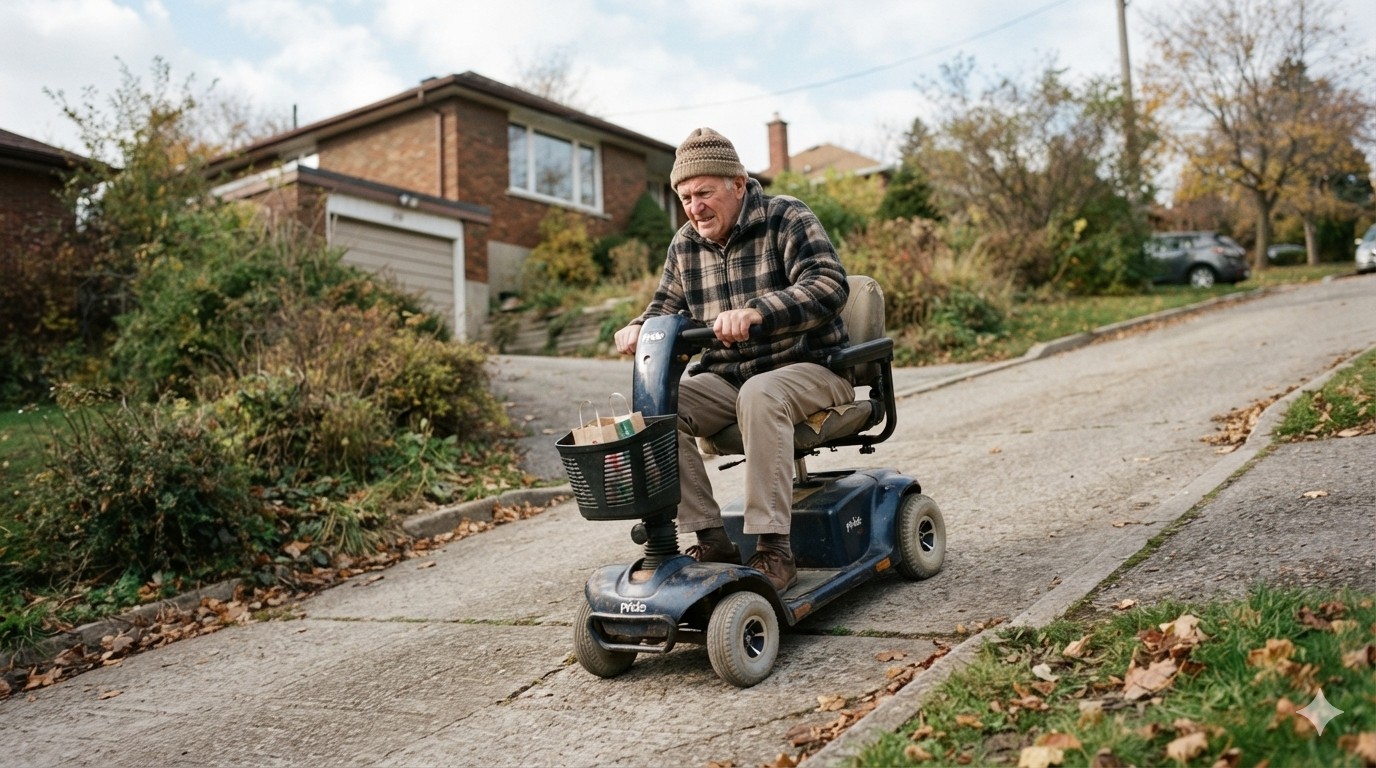
The rider: David, 68, weighs 105 kg. He lives in a hilly town and uses his mid-size mobility scooter for daily errands. His typical routes involve navigating pavements, crossing roads, and climbing a few moderate hills. He does a lot of stop-start riding.
His baseline need: David estimates his longest single trip is 13 kilometres round-trip.
Applying the factors:
- Rider weight: David is heavier than the average test rider, so we add 25%.
- Terrain: His routes are hilly, so we add 35%.
- Stop-start driving: His town routes involve frequent stops, so we add 20%.
Combined derating: 1.25 × 1.35 × 1.20 = 2.025. That means David needs roughly double the baseline capacity.
His target capacity: 13 kilometres × 2.025 = 26 kilometres of real-world range needed.
If David chooses a battery based on the advertised 13-kilometre figure, he will be stranded regularly. He needs a battery that delivers at least 26 kilometres of real-world range, and ideally more for a safety margin.
This is why understanding how rider weight, terrain, and stop-start driving change the capacity you should choose is not an academic exercise. It is the difference between a scooter that supports your independence and one that leaves you anxious every time you leave the house.
Your Capacity Sizing Cheat Sheet
Here is a simple reference to help you apply these factors to your own situation
|
Factor |
How It Affects Range |
Capacity Adjustment |
|
Rider weight |
Heavier riders drain the battery faster |
Add 20–30% if above average weight |
|
Hilly terrain |
Hills can cut range by a third or more |
Add 30–40% for hilly routes |
|
Rough surfaces |
Grass, gravel, and broken pavement increase resistance |
Add 20–30% for rough terrain |
|
Stop-start driving |
Pulling away uses far more power than cruising |
Add 15–25% for frequent stops |
|
Cold weather |
Batteries lose capacity in cold temperatures |
Add 20–50% for winter riding |
|
Cargo and loads |
Extra weight means extra drain |
Add 10–15% if carrying shopping |
Use this as a starting point, then adjust based on your own experience. The key is to be honest about your real-world conditions, not the idealised version on the specification sheet.

Frequently Asked Questions
How much does rider weight actually affect mobility scooter range?
Real-world data shows a 12–37% range reduction as rider weight increases, depending on the scooter and battery configuration.
Is terrain really that important for battery capacity?
Yes. Hills and rough surfaces can reduce range by a third or more. A hilly route is the single biggest factor that eats into usable range.
Why does stop-start driving drain the battery so much?
Every time you accelerate from a stop, the motor draws a surge of power. Frequent stops mean frequent surges, which adds up over a journey.
Should I size my battery for my worst-case routes or my typical routes?
Size for your typical routes, then add a 20–30% margin for unexpected conditions. If your worst-case routes are common, size for those instead.
Can I just buy the biggest battery available to avoid these issues?
A larger battery adds weight, cost, and charging time. Size for your actual needs plus a sensible margin, not for hypothetical trips you never take.
Does battery chemistry affect how much these factors matter?
Yes. Lithium batteries handle heavy loads and deep discharges better than lead-acid, so the real-world gap between advertised and actual range is often smaller with lithium.
Your Next Step
The same scooter and the same battery can deliver very different range figures for different riders. That is not a flaw—it is physics. Rider weight, terrain, and stop-start driving all change the capacity you should choose, and ignoring them is the fastest route to range anxiety.
You now have a practical framework for accounting for these factors in your own battery decision. No more guessing. No more relying on laboratory figures that bear no resemblance to your daily life. Just clarity.
And that clarity? It means you can choose a battery that genuinely meets your needs, not the needs of a hypothetical test rider on a flat, smooth track. You deserve that confidence.
And now you have the tools to build it.

Ready to Go Deeper?
This guide is part of our complete series on choosing the right battery capacity for your mobility scooter. If you found this helpful, these related guides will take you further:
- Choosing the Right Battery Capacity for Your Mobility Scooter — The complete hub guide to capacity selection
- Ah vs Wh for Mobility Scooters: How to Compare Batteries the Right Way — The formula that changes everything
- How to Estimate the Battery Capacity You Need from Your Typical Weekly Routine — Put the numbers to work for your lifestyle
- Choosing Battery Capacity for Travel/Portable Mobility Scooters vs Mid-Size vs Heavy-Duty Models — Capacity recommendations by scooter type
- Battery Capacity vs Range Claims: How to Sanity-Check Manufacturer "Miles per Charge" Numbers — Why real-world range differs from the spec sheet
- Mobility Scooter Battery Compatibility Checklist: Size, Terminals, Voltage, Charger, and Fit — Make sure your chosen battery actually fits
- Can You Upgrade to Higher Ah Batteries on Your Mobility Scooter (And What Can Go Wrong)? — The upgrade decision, explained
- Lithium Upgrade Decision Guide: What Capacity to Choose and What Else Must Change — Is lithium right for you?
- Choosing the Right Charger for Your Battery Capacity and Chemistry — Don't overlook this critical companion purchase
- Mobility Scooter Battery Maintenance: How to Preserve Capacity and Extend Lifespan — Keep your battery healthy for years
Stay mobile, stay confident!
Sign up for our monthly Mobility Scooter Newsletter to receive practical guides, expert advice, and inspiring stories that help you make the most of your scooter and download our free "Mobility Scooter Guide for Beginners."
Don't worry — your e-mail address is totally secure.
I promise to use it only to send you our newsletter, "Mobility Matters."
Recent Articles


-
Choosing the Right Battery Capacity 101: (Ah vs Wh)
Oct 06, 26 07:10 AM
 Choosing the Right Battery Capacity Guide: Compare Ah vs Wh, estimate range, and pick the best battery for your routine.
 -
The Real-World Factors That Drain Your Battery
Oct 06, 26 07:01 AM
How rider weight, terrain, and stop-start driving change the capacity you should choose: Stop being stranded. Get the real-world numbers you need. -
Battery Capacity vs Range: The Truth About Range
Oct 06, 26 05:59 AM
Battery capacity vs range claims: Stop trusting inflated "miles per charge" figures. Here is how to verify range claims before you spend your money.


Ready to Feel More Confident on Your Mobility Scooter?

My Ebook, The Ultimate Guide to Mobility Scooters, walks you through choosing the right scooter, using it safely, and keeping it in top condition — all explained in clear, friendly language.
Give yourself (or someone you love) the gift of independence.


