The Mobility Scooter Guide for Therapists, NDIS and DVA Professionals: Clinical Reasoning, Funding Pathways & Best Practice
Welcome to your Mobility Scooter Guide for Therapists, NDIS and DVA Professionals.
Whether you're an occupational therapist conducting assessments, a NDIS planner reviewing applications, or a DVA provider navigating the Rehabilitation Appliances Program (RAP), this guide is designed for you.
We know the pressure you're under. We know the paperwork is overwhelming. And we know you want to get this right—for your clients, for your professional reputation, and for your peace of mind.
Stick with us, because by the end of this guide, you'll have a practical framework to assess, prescribe, and fund mobility scooters with clarity and confidence.
Picture this: You're sitting across from a client who's struggling to leave their home. Their mobility is declining, their social connections are fraying, and they're looking at you with hope in their eyes.
They've heard about mobility scooters, but they don't know where to start—and frankly, neither do you.
The paperwork is daunting. The funding pathways are confusing. And the weight of getting this decision right feels enormous.
What if you had a clear, step-by-step roadmap to guide you through every stage—from assessment to funding approval?
Why Mobility Scooter Guide for Therapists, NDIS and DVA Professionals Exists
Most mobility scooter content is written for end users—seniors and their families. But you're not the one sitting in the seat. You're the one doing the assessments, writing the justifications, navigating the funding bureaucracy, and ultimately carrying the responsibility for whether that scooter improves someone's life or gathers dust in a garage.
Your needs are different, and they matter.
Occupational therapists are often considered the experts in mobility scooter assessment, tasked with assessing suitability and completing applications to funding bodies. Yet many clinicians report feeling unsure how to assess whether a scooter is safe and suitable for community mobility. One study found that novices or those new to mobility scooter prescription need supervision and support to improve outcomes.
If that sounds familiar, you're not alone—and you're in exactly the right place.
This Mobility Scooter Guide for Therapists, NDIS and DVA Professionals speaks to your challenges: the clinical reasoning dilemmas, the funding application headaches, and the weight of responsibility that comes with every prescription.
Understanding the Professional's Pain Points
Let's be honest about what keeps you up at night.
The Assessment Dilemma: How do you confidently determine whether a client is safe to operate a scooter? What if their cognition is borderline? What if they have vision issues? What if they've never driven anything before?
The Funding Maze: NDIS. DVA. SWEP (State-wide Equipment Program). Each has different forms, different criteria, and different timelines. Getting it wrong means delays for your client—and more work for you.
The Clinical Reasoning Gap: Scooter vs powered wheelchair? Three wheels vs four? Folding vs rigid? The options are overwhelming, and the consequences of a poor choice are significant.
The Documentation Burden: Justifying a scooter as "reasonable and necessary" requires evidence, clinical reasoning, and a whole lot of paperwork. One gap in your justification can mean a funding rejection.
The Time Pressure: Your caseload is already stretched. Adding complex scooter assessments to the mix can feel like one more thing you don't have time for.
Sound familiar? Keep reading—because we're about to tackle each of these challenges head-on.

The Professional's Role in Mobility Scooter Prescription
Before we dive into the specifics of NDIS and DVA, let's clarify the professional's role in the mobility scooter journey.
Occupational Therapists: The Clinical Gatekeepers
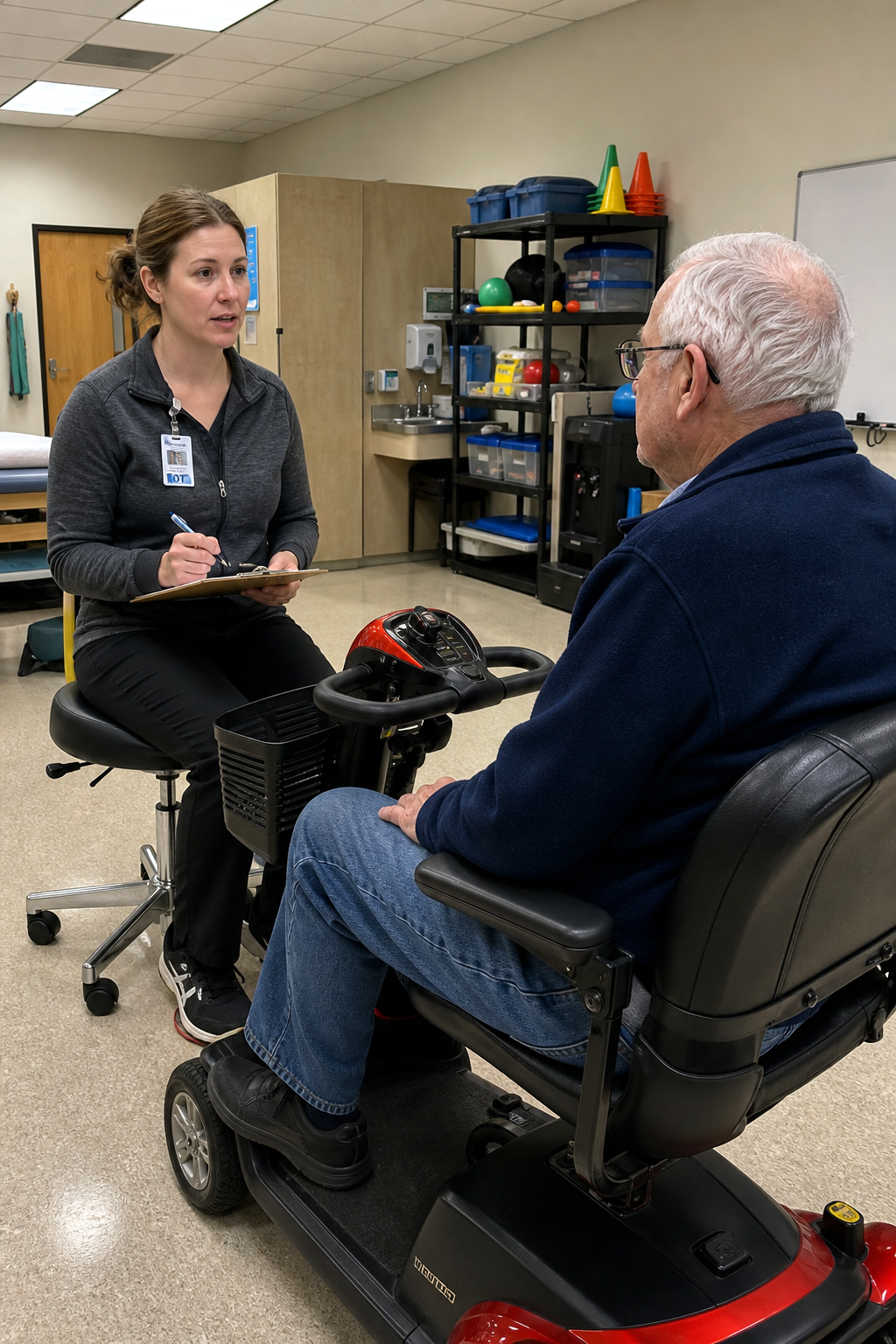
OTs are central to the mobility scooter assessment and prescription process. Your responsibilities include:
- Clinical Assessment: Evaluating the client's physical, cognitive, and functional capacity
- Environmental Evaluation: Assessing home layout, community access, and transport options
- Device Recommendation: Matching client needs with the most suitable scooter
- Trial Coordination: Facilitating scooter trials in real-world environments
- Funding Justification: Completing applications for NDIS, DVA, or other funding bodies
- Training and Monitoring: Educating clients on safe use and conducting ongoing reviews
NDIS Planners and Support Coordinators
Your role involves understanding how mobility scooters fit within a participant's NDIS plan. Key considerations include:
- Ensuring the scooter is "reasonable and necessary" and directly related to the participant's disability
- Linking the scooter to specific NDIS goals around mobility, independence, and community participation
- Understanding the Assistive Technology funding pathway and cost tiers
DVA Providers and Assessors
For veterans and their families, the Rehabilitation Appliances Program (RAP) provides funding for mobility aids. Your role involves:
- Completing the D9300 (Part 1 - Medical Assessment) and D1325 (Part 2 - OT Assessment) forms
- Determining clinical need and eligibility (Gold or White Card holders)
- Understanding that DVA only funds one electric mobility aid per person
NDIS Funding for Mobility Scooters: A Professional's Guide
Let's start with the NDIS, as this is where many professionals feel the most uncertainty.
Is a Mobility Scooter NDIS-Fundable?
Yes. Mobility scooters can be funded through your NDIS plan under Assistive Technology (Capital Supports). However, the NDIS must determine that the scooter is necessary, safe, and appropriate for the participant's situation.
The "Reasonable and Necessary" Test
For NDIS funding approval, the scooter must:
- Be directly related to the participant's disability
- Help the participant achieve their NDIS plan goals
- Represent value for money
- Not be available through other funding sources
Recent legal developments have clarified these criteria.
In March 2026, the Federal Court ordered the NDIA to fund a mobility scooter for a participant, overturning a 2022 denial. The decision clarified that personal mobility equipment supports or replaces a participant's capacity to move, and "capacity" refers to capacity diminished by a qualifying impairment.
What does this mean for you? When writing your justification, be explicit about how the scooter directly addresses mobility limitations caused by the participant's impairment.
The Assessment Requirement
For equipment over $1,500—which includes most mobility scooters—you'll need a formal Assistive Technology assessment from an Occupational Therapist or Physiotherapist.
Your assessment should include:
- Functional capacity and endurance
- Cognitive and perceptual safety
- Home layout and environmental access
- Community mobility requirements
- Transport and storage options
The Step-by-Step NDIS Process
Step 1: Include Mobility in NDIS Goals
Before
the planning meeting, help your client articulate specific mobility
goals. Instead of "I want to move around better," try "I want to travel
independently to medical appointments" or "I want to participate in
community activities and see friends without relying on others".
Step 2: Conduct the OT Assessment
Complete a comprehensive clinical assessment. This is where your clinical reasoning really matters.
Step 3: Trial the Equipment
Hiring a scooter for a trial period allows evidence-based decision-making in real-life environments. Trials help strengthen justification reports for NDIS-approved mobility scooters.
Step 4: Complete the Funding Application
Submit
your assessment, trial results, and equipment quote to the NDIS. Be
thorough—gaps in your justification can mean rejection.
Step 5: Post-Approval Training and Monitoring
Once
the scooter is funded, provide training and schedule regular reviews.
One clinician noted the importance of a "6 monthly review" to ensure
ongoing safety and suitability.
DVA Funding for Mobility Scooters: What Professionals Need to Know
For eligible veterans and their families, the Rehabilitation Appliances Program (RAP) provides funding for mobility aids
Eligibility Criteria
A veteran is eligible for an electric scooter if they hold a:
- Veteran Gold Card with a clinically assessed need for the item due to a condition impacting mobility; or
- Veteran White Card with a clinically assessed need arising from a war-caused or service-related injury or disease
War widows/widowers and dependants are not eligible for electric scooters or electric wheelchairs.
DVA's Definition of an Electric Scooter
DVA defines an electric scooter as "an electrically powered device with four wheels intended for use by persons with impaired outdoor mobility".
Important: DVA does not supply pull-apart or automatic folding/collapsible electric scooters. This is a critical distinction when recommending equipment for DVA clients.
The DVA Assessment Process
DVA requires a comprehensive assessment process, and each item needs prior approval.
The process involves three parts:
- Part 1 - Medical Assessment (Form D9300): Completed by the client's GP or medical specialist
- Part 2 - OT Assessment (Form D1325): Completed by an Occupational Therapist
- Part 3 - Technical Review: A technical assessment of the proposed equipment
Key DVA Considerations
- One per person: DVA only funds one electric mobility aid per person. Additional aids are only considered in exceptional circumstances
- No insurance: DVA does not fund insurance for electric mobility aids—clients must arrange their own
- Replacement: Replacement of a scooter is considered after a minimum of seven years or subject to reassessment
The Clinical Assessment: A Step-by-Step Framework
Now let's get into the heart of clinical practice—the assessment itself. This is where your expertise truly shines.
Step 1: Medical and Functional Assessment
Begin with a thorough understanding of the client's medical history and current function. Consider:
- Diagnosis and prognosis: What conditions affect mobility? Are they progressive or stable?
- Physical function: Can the client sit upright? Do they have sufficient grip strength to operate the tiller?
- Endurance: How far can they walk before experiencing pain or fatigue?
- Upper body strength: Can they steer, brake, and manoeuvre the scooter?
- Transfer ability: Can they get on and off the scooter safely?
Step 2: Cognitive and Perceptual Assessment
Safety is paramount. Assess:
- Attention and concentration: Can the client sustain focus during a trip?
- Judgment and decision-making: Can they assess risks and make safe choices?
- Reaction time: Can they respond quickly to unexpected situations?
- Spatial awareness: Can they judge distances and navigate around obstacles?
- Memory: Will they remember the route and how to operate the scooter?
One clinician wisely noted: "A diagnosis or a poor off-road assessment result should not automatically fail the client—it's always good to give them a chance to see how they perform on road given they have medical clearance".

Step 3: Environmental Assessment
The client's environment will determine what type of scooter is suitable.
Home environment:
- Doorway widths and hallway dimensions
- Storage space for the scooter
- Accessibility of charging points
- Indoor vs outdoor use patterns
Community environment:
- Types of terrain (pavement, grass, uneven surfaces)
- Distance to regular destinations
- Availability of accessible paths and crossings
- Weather considerations
Transport and storage:
- Will the scooter need to be transported in a vehicle?
- Who will lift and assemble it?
- Is there secure storage at home and at destinations?
Step 4: Scooter vs Powered Wheelchair Decision
This is one of the most common clinical dilemmas. Here's how to differentiate:
Mobility scooters are typically suitable for clients who:
- Can walk short distances but struggle with longer trips
- Have good upper body strength and hand function (needed to operate handlebars)
- Need equipment primarily for outdoor use and community access
- Want to travel longer distances—most scooters cover 25km or more on a single charge
Powered wheelchairs are better suited for clients who:
- Need support for both indoor and outdoor mobility
- Have limited upper body strength or dexterity (operated with a joystick)
- Require equipment they can sit in comfortably for extended periods
- Need a tighter turning circle for navigating narrow spaces at home
Some NDIS participants end up with both—a wheelchair for indoor use and daily activities, and a scooter for community outings.
Step 5: Trial and Real-World Testing
Purchasing equipment without proper assessment can lead to unsuitable prescriptions, wasted funding, or limited functional outcomes. Trials remove this risk.
When conducting a trial, assess:
- Postural alignment and seat support
- Control interface accessibility
- Turning radius and spatial awareness
- Transfer technique and stability
- Fatigue levels during extended use
Foldable mobility scooters with adjustable seating and intuitive controls allow you to evaluate how well the client can operate the scooter independently and safely

Matching Clients to the Right Scooter: Key Considerations
Once your assessment is complete, it's time to match the client to the right scooter. Here are the key features to consider:
Portability and Weight
If the scooter will be transported regularly, weight is critical.
Lightweight foldable scooters offer several clinical advantages: easy transport between appointments, compact storage, safe manoeuvrability inside homes, and simplified demonstration during assessments.
Stability
For most clients, four-wheel scooters offer superior stability and a lower centre of gravity. This is particularly important for anyone with balance concerns.
Comfort
Look for:
- Adjustable seating (height, angle, and sometimes swivel)
- Padded armrests that raise and lower
- Adequate legroom
- Suspension for bumpy surfaces
Battery Life
Real-world range is always less than the manufacturer claims. Consider the client's typical daily travel distance and add a buffer.
Lithium-ion batteries offer significant weight savings compared to lead-acid.
Safety Features
Ease of Controls
Simplicity matters.
Ensure the throttle is light and responsive, controls are clearly labelled, speed adjustment is intuitive, and braking is automatic and smooth.
Strengthening Your Funding Justification
A well-written justification is the difference between approval and rejection. Here's how to strengthen yours:
Be specific about the disability link: Explicitly state how the scooter addresses mobility limitations directly caused by the client's impairment.
Link to NDIS goals: If you're applying through the NDIS, clearly connect the scooter to specific goals around mobility, independence, and community participation.
Include trial evidence: Document the results of any trials. Real-world performance data strengthens your case.
Address value for money: Justify the cost by demonstrating how the scooter will reduce reliance on other supports and improve quality of life.
Anticipate questions: Address potential concerns about safety, suitability, and ongoing support before they're raised.
Training and Ongoing Monitoring
Your responsibility doesn't end when the scooter is delivered. Training and monitoring are essential for safe, successful outcomes.
Training should include:
- Basic operation (starting, stopping, steering)
- Safe mounting and dismounting
- Navigating different terrains
- Battery charging and maintenance
- Road rules and safety awareness
Ongoing monitoring should include:
- Regular reviews (consider a 6-monthly schedule)
- Reassessment if the client's condition changes
- Monitoring for signs of declining cognitive or physical function
- Ensuring the scooter remains appropriate as needs evolve
Resources to Support Your Practice
You don't have to do this alone. Here are some resources to support your clinical practice:
VicRoads Motorised Mobility Devices Guide: An easy-to-use guide for OTs that steps through the main considerations for matching client mobility needs with a suitable device.
OT Assessment Templates: Available for GP referral, assessment documentation, and discharge letters.
Verve OT Learning: Workshops on mobility scooter prescription, assessment, and clinical reasoning.
Assistive Tech Hub: Scooter hire services for OT assessments and trials.
DVA Forms: D9300 (Part 1 - Medical Assessment) and D1325 (Part 2 - OT Assessment)
A Final Word From Your Friendly Guide
Mobility scooter prescription is both an art and a science. It requires clinical reasoning, technical knowledge, and a deep understanding of your client's unique needs and circumstances. But you don't have to be an expert overnight.
Start with the fundamentals. Use the frameworks and resources in this Mobility Scooter Guide for Therapists, NDIS and DVA Professionals to build your confidence. Seek supervision and support when you need it. And remember: every successful prescription changes someone's life.
As one clinician reflected: "The key takeaway for me is that a diagnosis or a poor off-road assessment result should not automatically fail the client—it's always good to give them a chance to see how they perform on road".
You've got this. And we've got your back.
Take This Guide With You—And Let's Make Your Next Prescription Easier
You've done the reading. Now let's tackle the specifics—together.
This Mobility Scooter Guide for Therapists, NDIS and DVA Professionals is packed with information—but we know that every client is different. That's why we've turned this guide into a comprehensive PDF you can download, print, and reference during assessments.
But we're not stopping there.
We're offering a free, no-obligation Clinical Support Call for allied health professionals. Think of it as a peer consultation where we can discuss your specific client scenarios, answer your funding questions, and help you navigate tricky assessments.
Here's what you get:
📄 The Complete PDF Guide: Download, print, and keep it in your assessment kit.
📞 A 1-on-1 Clinical Support Call: Speak directly to a mobility specialist who understands the NDIS, DVA, and clinical pathways.
No pressure. No sales pitch. Just honest, expert support from people who genuinely care about getting it right.
Email Request Box:
YES! Send Me the PDF & Book My Support Call
We respect your time and your expertise. This is a genuine support call—not a sales pitch.
Stay mobile, stay confident!
Sign up for our monthly Mobility Scooter Newsletter to receive practical guides, expert advice, and inspiring stories that help you make the most of your scooter and download our free "Mobility Scooter Guide for Beginners."
Don't worry — your e-mail address is totally secure.
I promise to use it only to send you our newsletter, "Mobility Matters."
Recent Articles


-
Choosing the Right Battery Capacity 101: (Ah vs Wh)
Oct 08, 26 09:04 AM
 Choosing the Right Battery Capacity Guide: Compare Ah vs Wh, estimate range, and pick the best battery for your routine.
 -
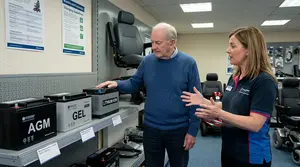
Stop! Compare AGM, Gel, and Lithium Before You Buy (
Oct 08, 26 08:59 AM
How to compare AGM, gel, and lithium batteries for mobility scooters: Stop guessing. Get the honest facts before you spend your money. -
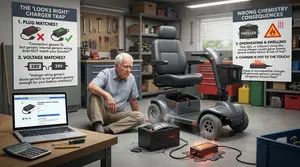
Stop! Your Charger Must Match Your Battery Chemistry
Oct 08, 26 07:08 AM
Choosing the right charger for your battery capacity and chemistry (AGM/gel vs lithium): Stop guessing. Get the facts before you buy a replacement charger.
Ready to Feel More Confident on Your Mobility Scooter?

My Ebook, The Ultimate Guide to Mobility Scooters, walks you through choosing the right scooter, using it safely, and keeping it in top condition — all explained in clear, friendly language.
Give yourself (or someone you love) the gift of independence.

