- Home
- Buying Guides
- Avoiding Mobility Scooter Sales Pressure
- Mobility Scooter Comparison Sheet
- Mobility Scooter Quotes Decision Matrix
The Weighted Decision Matrix for Mobility Quotes: Let the Numbers Decide (Without Losing the Human Touch)
Picture this. You have two quotes in front of you, both written, both complete. You have done everything the comparison sheet asked of you. But now you are staring at a grid of numbers—range, warranty, servicing costs, turning radius—and you feel exactly as stuck as you did before. The cheaper quote is better on price but worse on warranty. The dearer quote has the longer battery coverage but a bigger deposit. You know that one of these scooters is the right choice, but you cannot quite see which one.
This is where a weighted decision matrix for mobility scooter quotes earns its place. It is not a spreadsheet for the sake of a spreadsheet. It is a calm, structured way to decide what matters most to you, score each option against those priorities, and let the arithmetic reveal the answer your tired brain has been struggling to find.

This is the companion guide to the mobility scooter comparison sheet. The comparison sheet gives you the facts; the weighted decision matrix gives you the decision. You do not need to be a mathematician or an Excel wizard. You need a one-page grid, a simple scoring scale, and a willingness to be honest with yourself about what you actually need.
What a Weighted Decision Matrix Actually Is (and Why It Beats a Gut Feeling)
A weighted decision matrix—sometimes called a scoring matrix or a weighted scoring model—is a tool for comparing multiple options against a set of criteria that matter to you. Instead of relying on a vague sense that "this one feels better," you assign a numerical score to each option for each criterion, multiply that score by the weight you have given the criterion, and add up the totals. The option with the highest weighted score is the one that best matches your priorities.
The "weighted" part is what makes it powerful. Not all criteria are created equal. For one buyer, range might be the single most important factor; for another, the warranty period or the turning radius might matter far more. Weighting lets you reflect those priorities in the final calculation. A simple unweighted comparison treats every factor as equally important—which is rarely true. The weighted version lets the numbers reflect your life, not a generic average buyer's life.
For mobility scooter buyers, this matters enormously. The factors that matter most are not the ones a salesperson will emphasise. A dealer might push the headline price; you might care more about whether the scooter fits through your hallway. A dealer might talk up the top speed; you might care more about the battery warranty. The weighted matrix puts your priorities at the centre of the decision, where they belong.
Deeper dive: If you have not yet built your comparison sheet, start there first. The mobility scooter comparison sheet: how to compare two quotes apples-to-apples gives you the raw facts you need to feed into this matrix
.
Step 1: Choose Your Criteria (and Resist the Urge to Include Everything)
The first step is to list the criteria that genuinely matter to your decision. A good list is short—typically five to seven criteria—because a long list dilutes the weighting and makes the matrix harder to use. The criteria should come directly from your comparison sheet, which means they are already based on the written quotes, not on a salesperson's assurances.
For most mobility scooter buyers, the core criteria fall into four clusters:
Price and total cost of ownership. This is not just the headline price. It is the total upfront cost (including delivery and assembly) plus the estimated first-year running cost (including servicing). Australian servicing costs typically range from around $129 to $160 for a basic annual service, with collection and return adding up to $120. If one quote includes the first service and the other does not, that difference belongs in the matrix.
See the full: Mobility Scooter Service Options
Specification and fit. This includes range (in kilometres), the scooter's weight and heaviest transport piece (in kilograms), the turning radius (in centimetres), and the maximum user weight capacity. These are not abstract numbers. A scooter with a turning radius of 94 cm will navigate a tight hallway that a scooter with a 158 cm turning radius cannot. A scooter that weighs 30.6 kg with the battery will be far harder to lift into a car boot than one that weighs 14 kg. The specification criteria should reflect your home, your car, and your daily routes—not a generic ideal.
See the full: Mobility Scooter Buying Guide.
Warranty and aftercare. The warranty is where value often hides. In Australia, warranty periods vary widely: one scooter might offer a two-year frame warranty and a six-month battery warranty, while another might offer a five-year frame warranty and a one-year battery warranty. The matrix should capture the warranty periods for the frame, motor, and battery separately, because a longer frame warranty is not the same as a longer battery warranty. Aftercare—whether servicing is included, and at what cost—belongs here too.
Terms and flexibility. This includes the deposit amount and whether it is refundable, the return window, and any restocking fee. These are not minor details. A quote that requires a large, non-refundable deposit is a very different proposition from one that allows a 14-day change-of-mind return. The terms criteria capture the flexibility you are buying—or giving up.
Deeper dive: For the full list of documents and terms to demand before you compare, see the: What to ask for in writing before buying a mobility scooter (quote, warranty, returns, servicing).

Step 2: Assign Weights (and Make Them Add Up to 100%)
Once you have your criteria, you need to decide how important each one is relative to the others. The simplest approach is to assign a percentage weight to each criterion, with all the weights adding up to 100%. This forces you to make trade-offs explicit: if you give price a weight of 40%, you are saying that price matters more than any other single factor. If you give warranty a weight of 30%, you are saying that long-term protection is nearly as important.
There is no "correct" set of weights. The weights are a statement of your priorities, and they should reflect the things you would regret compromising on. A useful exercise is to ask yourself: "If two scooters were identical except for this one factor, how much would I pay to get the better version of that factor?" The answer gives you a sense of the weight it deserves.
A common mistake is to give price too much weight. Price is important, but the headline price is not the same as the total cost of ownership, and a cheaper scooter that requires more frequent servicing or has a shorter warranty may cost more over time. Give price a weight that reflects its true importance—not the weight a salesperson wants you to give it.
Deeper dive: If you are still deciding what to prioritise, the planning-stage hub—Avoiding Mobility Scooter Sales Pressure —walks you through the questions that help you clarify your needs before you look at a single quote.
Step 3: Score Each Option on a Consistent Scale
With your criteria and weights in place, the next step is to score each quote on each criterion. A simple 1-to-5 scale works well: 1 means "poor," 3 means "acceptable," and 5 means "excellent". The key is to use the same scale for every option and to define what each number means before you start scoring, so that you are not unconsciously adjusting the scale to favour one quote.
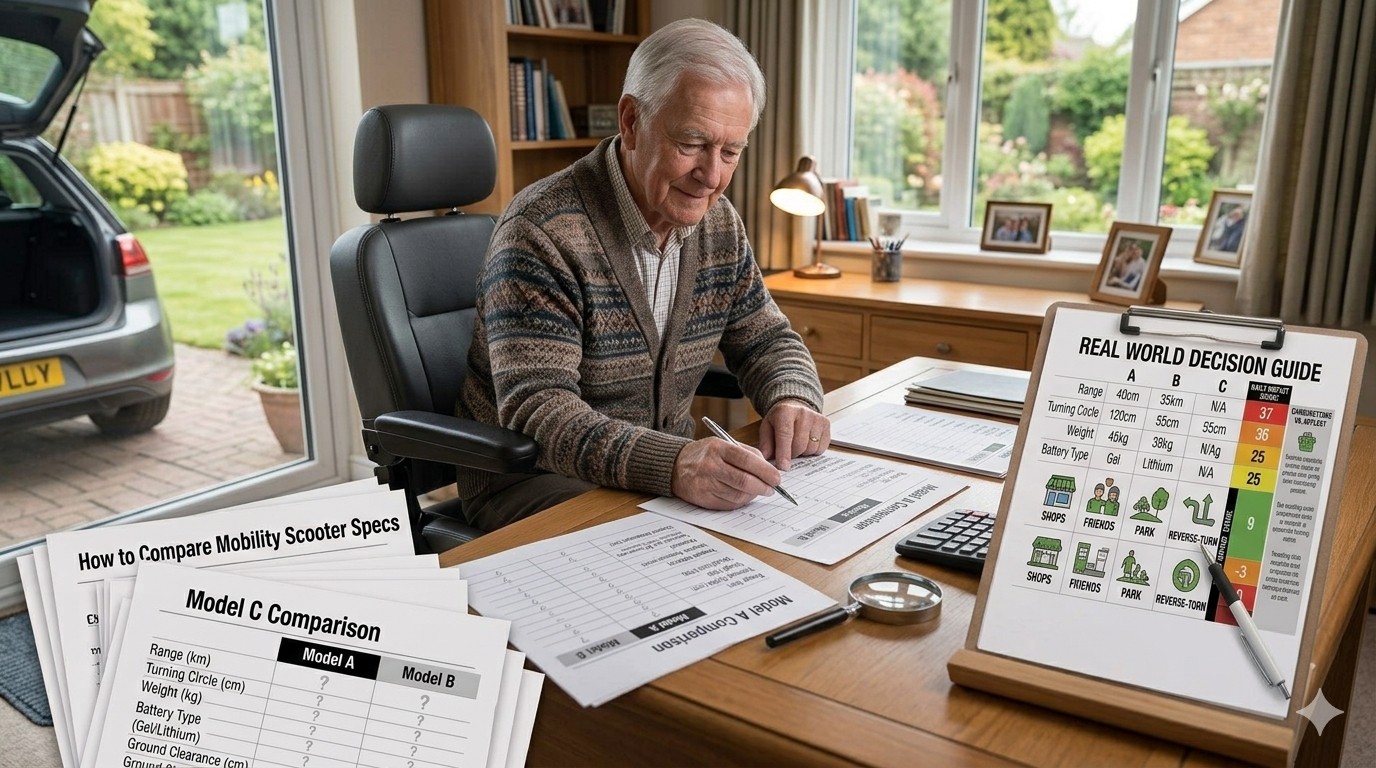
Here is what the scores might look like in practice. Imagine you are comparing two scooters:
|
Criterion |
Weight |
Scooter A (Score) |
Scooter A (Weighted) |
Scooter B (Score) |
Scooter B (Weighted) |
|
Total upfront cost |
25% |
4 |
1.00 |
3 |
0.75 |
|
Range (km) |
20% |
3 |
0.60 |
5 |
1.00 |
|
Weight / portability |
15% |
5 |
0.75 |
3 |
0.45 |
|
Turning radius |
10% |
4 |
0.40 |
3 |
0.30 |
|
Warranty (frame/motor/battery) |
20% |
3 |
0.60 |
5 |
1.00 |
|
Terms (deposit, returns) |
10% |
3 |
0.30 |
4 |
0.40 |
|
Total |
100% |
|
3.65 |
3.90 |
To calculate the weighted score, multiply each score by its weight (expressed as a decimal). For example, a score of 4 on a criterion weighted at 25% contributes 4 × 0.25 = 1.00. Add the weighted scores across all criteria to get the total.
In this example, Scooter B has the higher weighted total (3.90 versus 3.65), even though Scooter A scored better on upfront cost and portability. Scooter B wins because it performs better on the criteria that were weighted most heavily: range and warranty. This is the matrix doing its job—revealing that the "cheaper" option is not necessarily the better choice once your priorities are taken into account.
The arithmetic is deliberately simple: multiply each rating by its weight, then add the results. You can do it on paper, in a spreadsheet, or even on your phone. The point is not the precision of the decimal places; the point is the discipline of scoring each option against the same criteria and seeing the pattern that emerges.
Step 4: Interpret the Result (and Know When to Override It)
The weighted score is a guide, not a verdict. A small difference between two totals—say, 3.90 versus 3.65—does not automatically mean the higher-scoring option is the right one. The matrix is only as good as the criteria and weights you chose, and those choices are inherently subjective. If the result feels wrong, that is useful information. It may mean that you missed a criterion, or that you weighted something too heavily or too lightly.
There are also criteria that cannot be easily scored. How do you score "the salesperson made me feel comfortable" or "the dealer answered my questions without pressure"? These are not trivial factors—they are often the best predictors of how a dealer will behave after the sale. If one dealer was transparent, patient, and willing to put everything in writing, and the other was evasive or pushy, that difference matters, even if it does not fit neatly into a 1-to-5 scale.
The matrix is a tool for clarifying your thinking, not a replacement for it. Use it to see the trade-offs clearly, then make the decision that feels right in light of everything you know—including the things that do not fit in a grid.

A Quick Word on Staying Calm
The weighted decision matrix is, at its heart, a tool for staying calm. Pressure selling relies on urgency and confusion; the matrix replaces both with structure and evidence. When a salesperson tells you that a "today-only" deal is about to expire, you can return to your matrix and ask: "Does this offer actually score better on the criteria that matter to me?" Sometimes it will. Often it will not. Either way, you are answering the question on your own terms, in your own time, with your own priorities at the centre.
The ACCC recognises that pressuring and harassing consumers is against the law, and that high-pressure selling practices remain a feature of unsolicited selling, often causing psychological and financial harm. A weighted matrix is a small but meaningful act of resistance against that pressure. It is a way of saying: I will decide what matters, I will score the options fairly, and I will not be rushed.
Deeper dive: For word-for-word scripts to handle the sales conversation itself, see: Mobility scooter salesperson scripts: what to say to slow things down and keep control. (Coming Soon!)

Frequently Asked Questions
What is a weighted decision matrix, in simple terms?
It is a grid that helps you compare options by scoring each one against the criteria that matter to you, then multiplying each score by a weight that reflects how important that criterion is. The option with the highest total weighted score is the one that best matches your priorities.
How many criteria should I include?
Aim for five to seven. A shorter list keeps the matrix usable and prevents any single factor from being diluted. The criteria should come directly from your written quotes, not from a salesperson's suggestions.
Do the weights have to add up to 100%?
Yes, for the maths to work cleanly. If you are using a spreadsheet, you can use any scale you like, but percentages are the simplest way to make the weights meaningful and comparable.
What scoring scale should I use?
A 1-to-5 scale is simple and intuitive: 1 for poor, 3 for acceptable, 5 for excellent. The important thing is to define what each number means before you start scoring, and to use the same scale for every option.
What if the matrix result feels wrong?
That is useful information. It may mean you missed a criterion, or that a qualitative factor—like how the dealer treated you—deserves more weight than the numbers suggest. Use the matrix as a guide, not a verdict, and trust your judgement when the two diverge.
Can I use this for more than two quotes?
Absolutely. The matrix works for any number of options. Just add another column for each quote and score it against the same criteria and weights.
Where can I get the raw data for the scores?
From your written quotes and the comparison sheet.
The guide: Mobility scooter comparison sheet: how to compare two quotes apples-to-apples gives you the structured information you need to score each option fairly.
Stay mobile, stay confident!
Sign up for our monthly Mobility Scooter Newsletter to receive practical guides, expert advice, and inspiring stories that help you make the most of your scooter and download our free "Mobility Scooter Guide for Beginners."
Don't worry — your e-mail address is totally secure.
I promise to use it only to send you our newsletter, "Mobility Matters."
Recent Articles


-
Mobility Scooter Weighted Decision Matrix: A Step-by-Step Guide
Nov 22, 26 10:42 AM
 Weighted decision matrix for mobility scooter quotes: a calm, step-by-step framework to score two offers fairly and see which one truly fits your life.
-
Avoiding Mobility Scooter Sales Pressure Before You Buy
Nov 22, 26 08:08 AM
Avoiding mobility scooter sales pressure begins with knowledge. This friendly hub walks you through every step—calmly and clearly. -
How to Compare Mobility Scooter Quotes Apples-to-Apples
Nov 22, 26 08:07 AM
 Mobility scooter comparison sheet: how to compare two quotes apples-to-apples, including price, warranty, servicing, and the red flags that matter.



Ready to Feel More Confident on Your Mobility Scooter?

My Ebook, The Ultimate Guide to Mobility Scooters, walks you through choosing the right scooter, using it safely, and keeping it in top condition — all explained in clear, friendly language.
Give yourself (or someone you love) the gift of independence.




