- Home
- Mobility Scooter Safety and Daily Use
- Shopping Centre Navigation Strategies for Mobility Scooters
- Turn Around or Reverse Safely in a Narrow Aisle
How Do I Turn Around or Reverse Safely in a Narrow Shopping-Centre Aisle on a Mobility Scooter?
Picture this: You are halfway down a supermarket aisle, scanning the shelves for your usual brand of tea. You spot it—just behind you. You need to reverse a metre or two, or turn the scooter around completely. But behind you, a trolley is already edging past. To your left, a display stand juts out. To your right, a family with a pram is waiting. Suddenly, the aisle feels a lot narrower than it did when you entered it. Your hands tighten on the tiller, and a familiar thought creeps in: What if I clip something? What if I get stuck? What if I block everyone?
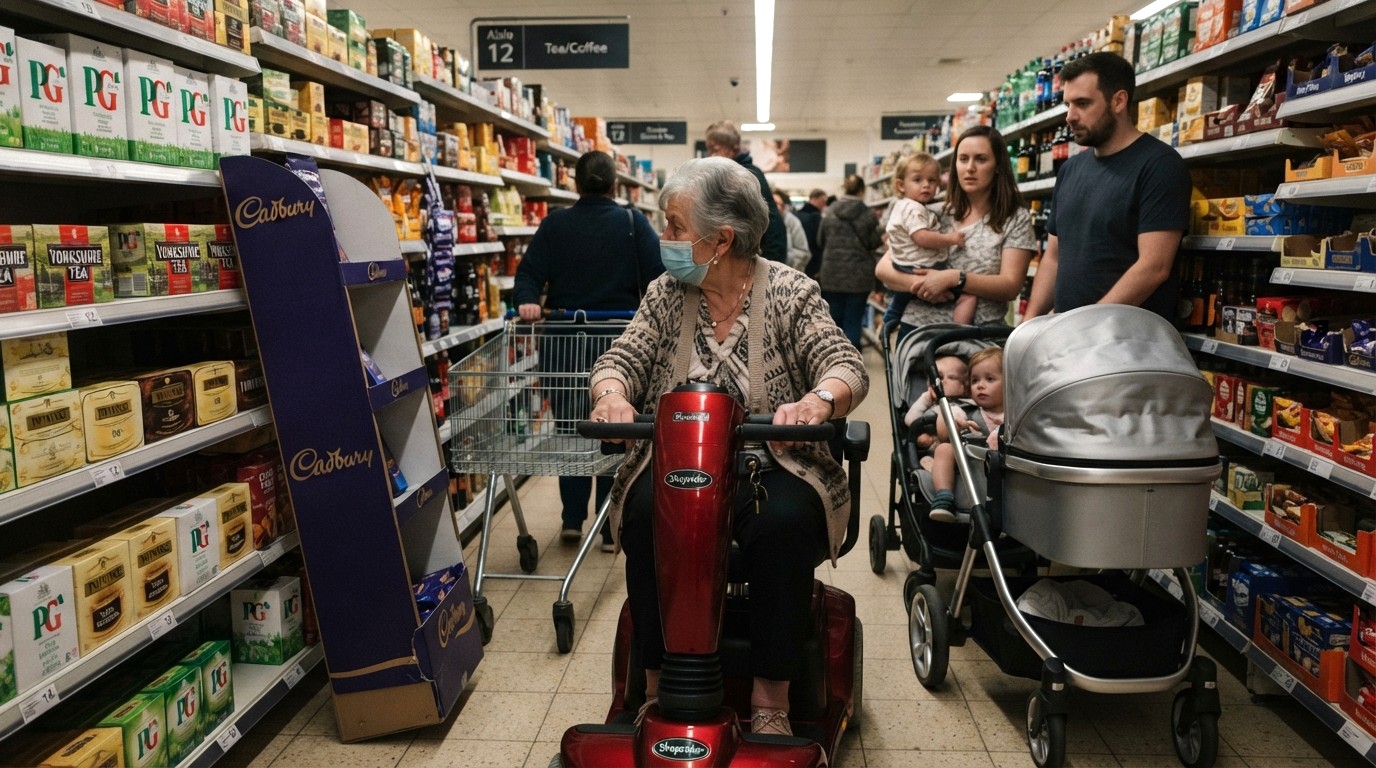
If that scene makes your shoulders tense, you are in good company. Narrow-aisle manoeuvring is one of the most common sources of anxiety for mobility scooter users in shopping centres, and it is the question behind the search: How do I turn around or reverse safely in a narrow shopping-centre aisle on a mobility scooter? The good news is that this is a skill, not a personality trait. It can be learned, practised, and refined—and once you have it, a tight aisle stops being a threat and becomes just another part of your shopping trip.
This guide is your patient, practical companion for exactly those moments. We will walk through the physics of tight spaces, the technique of the three-point turn, the art of safe reversing, and the small habits that turn anxiety into quiet confidence.
You do not need to be a naturally confident driver. You just need a plan.
Why Narrow Aisles Feel Hard (and Why That Is Not Your Fault)
Before we talk technique, let's clear something up: narrow aisles are genuinely harder for scooters than for almost any other shopper. This is not a reflection of your driving ability. It is a design reality.
Mobility scooters are generally longer than powered wheelchairs and require more space to turn around a corner or complete a U-turn, which means they can be harder to manoeuvre indoors. Australian accessibility standards have historically been built around wheelchair dimensions, not scooter dimensions. The minimum standard for a wheelchair turning space is 2070mm by 1540mm, but scooters cannot achieve the same "turn on the spot" performance as most manual wheelchairs, and larger scooters cannot even turn within the "enhanced standard" circulation space of 2250mm by 2250mm.
In plain terms: the aisle was not designed with your scooter's turning circle in mind. That is a frustrating truth, but it is also a liberating one. It means the difficulty you feel is not a personal failing—it is a mismatch between the environment and the vehicle. And mismatches can be managed with strategy.
The first strategy is understanding how much space you actually need. A standard three-point turn for a four-wheeled scooter requires less room than a full circle, but still more space than many tight retail aisles allow.
Knowing this helps you choose your battles: you do not need to turn around in every aisle. Sometimes, reversing a short distance is the smarter, safer option. And that is exactly where we turn next.

The Three-Point Turn: Your Most Reliable Narrow-Aisle Tool
When you genuinely need to change direction in a tight space, the three-point turn is your best friend. It is the same manoeuvre you may remember from driving lessons, adapted for a scooter. It is slower, gentler, and far more dignified than a panicked multi-point shuffle.
Here is how to do it safely.
Step 1: Stop completely and reset your speed. Bring the scooter to a full stop before you begin. Set your speed control to its lowest setting. This is not a moment for momentum. The Golden Technologies Companion user manual puts it clearly: when steering in a tight spot, bring the scooter to a full stop, set the speed at a low level, turn the tiller in the direction you wish to go, and press gently on the thumb lever.
Step 2: Turn forward into the space you have. Turn the tiller and move forward slowly, aiming to bring the front of the scooter as close as is safe to the opposite side of the aisle or the opening you are using. Do not rush. You are creating room for the next movement.
Step 3: Reverse gently, turning the tiller the other way. Now reverse. Remember that when you reverse, you steer in the opposite direction of the way you want to go: turn the tiller left to reverse to the left, and right to reverse to the right. Keep your speed low. Reverse only as far as you need to create the angle for your final forward turn.
Step 4: Complete the turn forward. Turn the tiller back toward your intended direction and move forward gently. In most narrow aisles, three movements—forward, back, forward—are enough to complete the turn.
What if the aisle is so narrow that even a three-point turn feels impossible? That is your cue to use an opening. A doorway, a gap between displays, or the mouth of a cross-aisle can serve as the extra space you need. A three-point turn can be carried out by making the first turn into the opening while moving forward, followed by a backward turn in the opposite direction. You are not forcing the turn in the middle of the aisle; you are borrowing space from the environment around you.
And if no opening exists? Then reversing is often the better choice—and reversing has its own set of skills worth mastering.

Reversing Safely: The Skill Nobody Taught You
Reversing a mobility scooter is not the same as reversing a car, but it demands the same respect. Your visibility is limited, your speed should be minimal, and your awareness needs to be high. The good news is that reversing is often safer than turning when space is tight, because you are moving in a straight line rather than pivoting a long vehicle in a confined area.
Set your speed to slow before you move. This is non-negotiable. Reversing speed on most scooters is already limited—often to fifty percent of the maximum set on the speed dial—but you should still consciously set the dial to its lowest setting. A slow reverse gives you time to react, and it gives the people around you time to notice you.
Use your mirrors, but do not trust them alone. Mirrors are useful, but they provide a restricted view. The OT Australia safe skills fact sheet is blunt about this: mirrors give a limited picture, so it is important to keep turning your head to look around and behind you. A shoulder check is still your most reliable tool. If you have difficulty turning your neck, consider a wider rear-view mirror or a rear-view camera attachment—but even then, a slow speed and a head check are your first line of defence.
Reverse in a straight line whenever possible. Turning while reversing is harder to control and easier to misjudge. If you only need to back up a metre or two to reach a shelf or clear a space, keep the tiller steady and move straight back. Save the turning for when you are moving forward.
Listen as well as look. Shopping centres are noisy, but you can often hear a trolley wheel or a conversation approaching before you see it. Reversing slowly gives you the auditory warning you need. If you hear someone close behind you, stop. There is no shame in pausing.
The Habits That Make Tight Spaces Feel Safe
Technique matters, but habits matter more. The scooter users who navigate narrow aisles with calm confidence are not doing anything magical. They have simply built a few small habits into every shopping trip.
Know your scooter's footprint. Before you shop, take a moment to measure or look up your scooter's width and turning circle. Compact scooters may have turning circles under 100 cm, while larger models can require 150 cm or more. Knowing your number helps you judge whether an aisle is genuinely too tight before you commit to entering it. A scooter that is 48 cm wide, for example, can navigate spaces that a 65 cm model cannot. This is not about buying a new scooter; it is about knowing the one you have.
Approach tight spots at an angle, not head-on. When entering a narrow gap or passing a protruding display, a slight angle gives your rear wheels more clearance and reduces the risk of clipping the obstacle with your side. The Golden Technologies manual warns that turning too sharply at too high a speed can cause a rear wheel to leave the ground, so a wide, gentle arc is always safer than a sharp pivot.
Use a spotter when you have one. If you shop with a companion, ask them to walk ahead or stand at the far end of the tight space. A simple hand signal—or just a calm "you're clear"—removes the guesswork. This is not a loss of independence. It is teamwork, and it makes the whole trip smoother for both of you.
Give yourself permission to wait. If an aisle is crowded, you do not have to enter it. Wait at the end, browse a nearby display, or come back later. A busy aisle is not a challenge to be conquered; it is a temporary condition that will pass.
For more strategies on managing busy periods, see our guide on how to shop at peak times on a mobility scooter without getting boxed in by crowds. (Coming Soon!)
When Things Go Wrong: Recovering with Grace
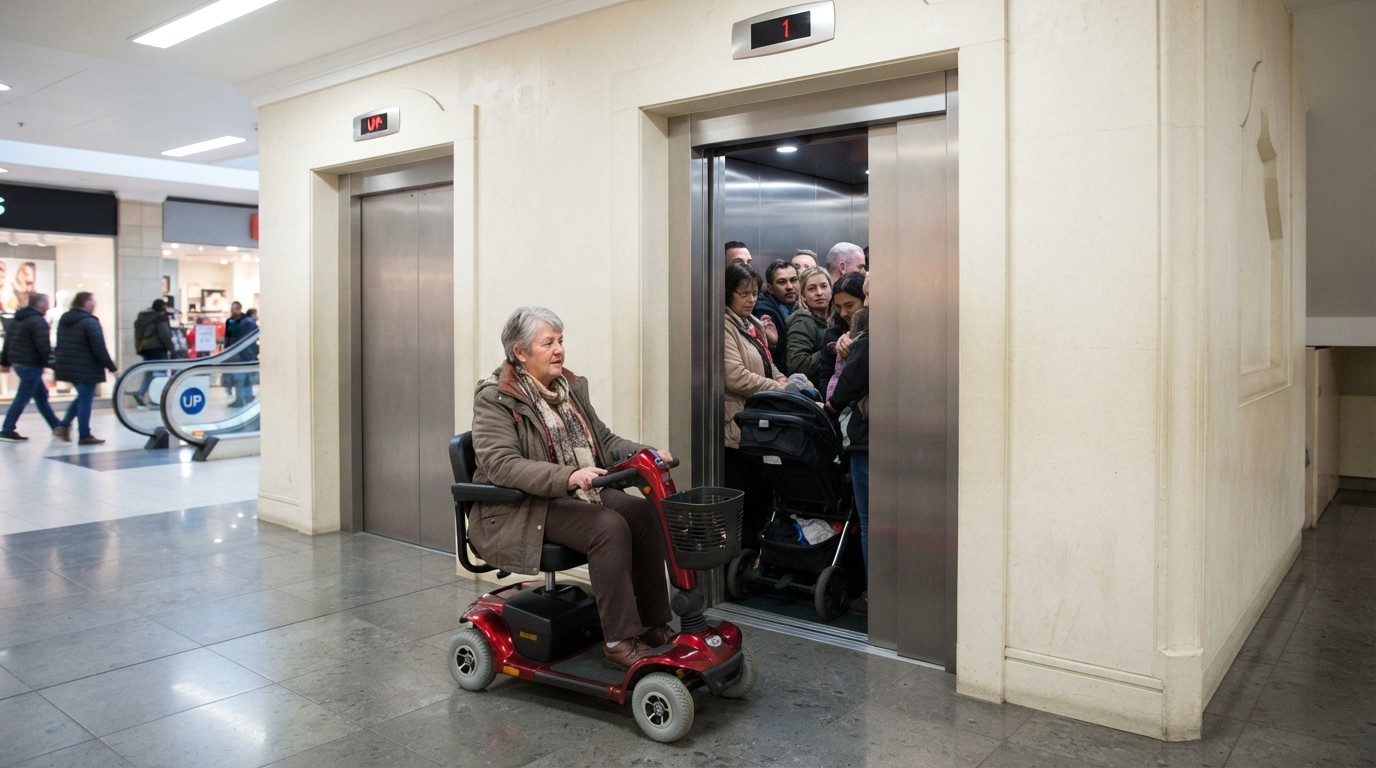
Even with the best technique, things happen. You misjudge a gap. A display moves. Someone steps behind you without looking. The key is not to avoid every mistake—it is to recover calmly.
If you clip something, stop immediately. Do not try to power through. Stop, check that you and the scooter are okay, and assess the obstacle. Most clips are minor, and a calm response prevents a small bump from becoming a bigger problem.
If you feel stuck, do not force it. Forcing a turn in a space that is too small is how scooters tip and how displays topple. Stop, breathe, and reassess. Can you reverse out? Can you wait for a passer-by to move an obstacle? Can you ask a staff member for help? There is always a way out that does not involve force.
If someone is impatient, let it go. You may encounter a shopper who sighs, tuts, or tries to squeeze past you while you are manoeuvring. Their impatience is not your emergency. You have the right to take the time you need to move safely. A polite "I'll be out of your way in just a moment" is usually enough. And if it is not? That is their problem, not yours.
Building Confidence, One Aisle at a Time
The journey from aisle anxiety to aisle confidence is not a giant leap. It is a series of small wins. The first time you complete a three-point turn without panic. The first time you reverse out of a tight spot and feel in control. The first time you enter a narrow aisle and think, I know how to handle this.
Every shopping centre is different, and every scooter is different. But the principles are the same: slow down, use your space wisely, check behind you, and give yourself permission to take your time. You are not a nuisance in the aisle. You are a shopper with every right to be there, and you are building a skill that will serve you for years.
For a broader look at navigating the whole shopping centre—from lifts to food courts to emergency plans—see our hub guide: Shopping Centre Navigation Strategies
And if you are planning a route through a new centre, our guide on how do I plan the easiest route through a shopping centre using the centre map will help you identify the wide aisles and open spaces before you even arrive.
You have got this. One aisle at a time.
Stay mobile, stay confident!
Sign up for our monthly Mobility Scooter Newsletter to receive practical guides, expert advice, and inspiring stories that help you make the most of your scooter and download our free "Mobility Scooter Guide for Beginners."
Don't worry — your e-mail address is totally secure.
I promise to use it only to send you our newsletter, "Mobility Matters."
Recent Articles


-
Shopping Centre Navigation Strategies Made Simple & Stress-Free
Oct 19, 26 06:57 AM
 Shopping centre navigation strategies that actually work. Master lifts, tight aisles & crowded malls with practical, carer-friendly advice.
-
How Can I Shop at Peak Times on a Mobility Scooter
Oct 19, 26 06:55 AM
 How can I shop at peak times on a mobility scooter without getting boxed in by crowds? Smart tactics for busy centres, from entrance to checkout.
-
How Do I Turn Around or Reverse Safely in a Narrow Aisle?
Oct 19, 26 05:51 AM
How do I turn around or reverse safely in a narrow shopping-centre aisle on a mobility scooter? Practical techniques for confident manoeuvring.


Ready to Feel More Confident on Your Mobility Scooter?

My Ebook, The Ultimate Guide to Mobility Scooters, walks you through choosing the right scooter, using it safely, and keeping it in top condition — all explained in clear, friendly language.
Give yourself (or someone you love) the gift of independence.



