- Home
- Mobility Scooter Safety and Daily Use
- Shopping Centre Navigation Strategies for Mobility Scooters
- Load and Unload Your Mobility Scooter Safely
What Is the Safest Way to Load and Unload My Scooter in the Car Park Before Entering the Centre?
Picture this: You've arrived at the shopping centre. Your scooter is in the boot, your list is in your pocket, and you're ready to go. You open the boot, look at the scooter, and feel that familiar twinge of hesitation. Lifting it out alone feels risky. Manoeuvring it around parked cars feels daunting. And the last thing you want is to strain your back before you've even set foot inside.
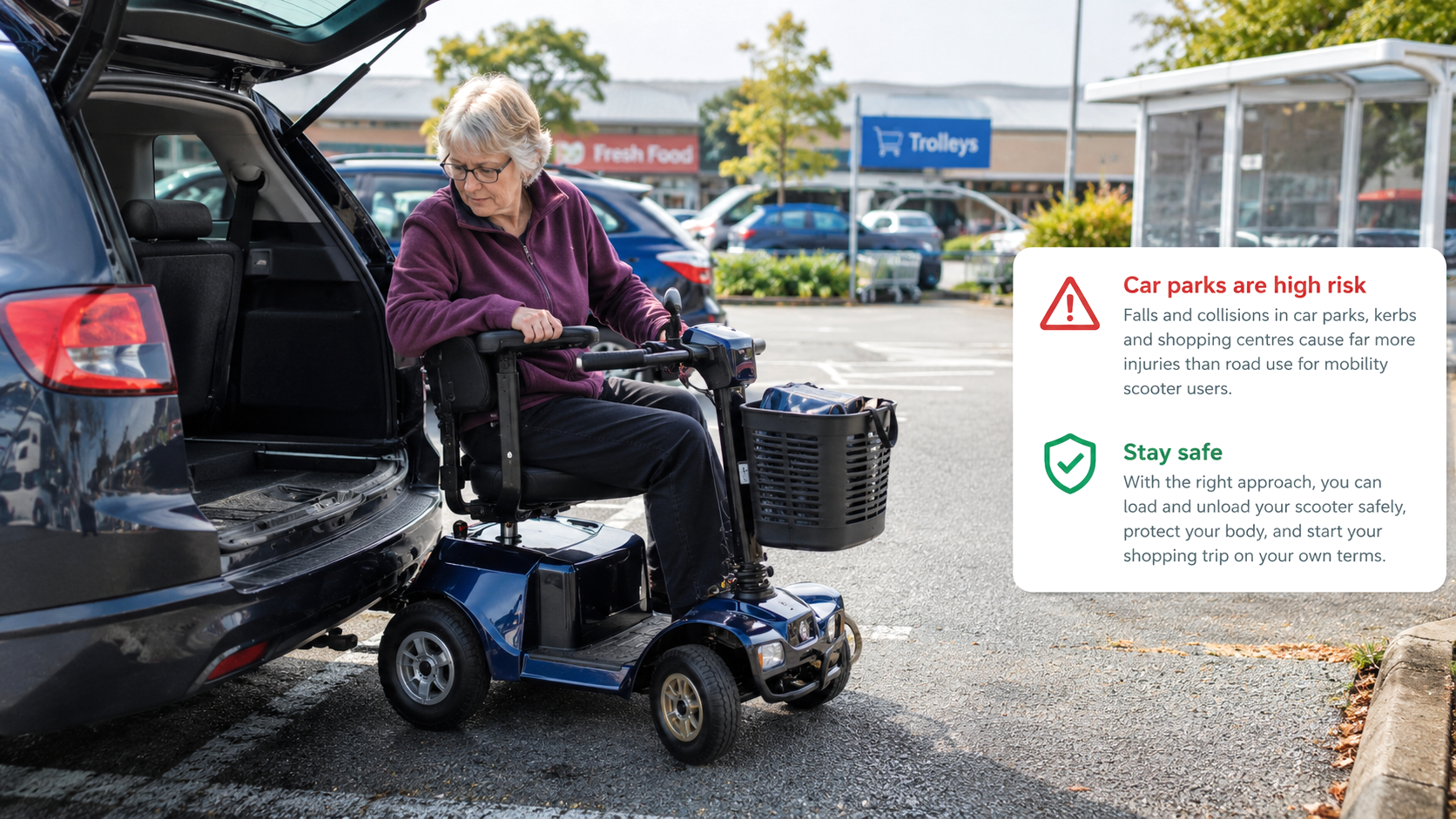
Here's the truth that few people talk about: the car park is statistically one of the most dangerous places for mobility scooter users. Falls and collisions in car parks, kerbs, and shopping centres cause far more injuries than road use. Most of these happen in everyday environments like car parks, driveways, and shopping centres — not on the open road. And the car park, with its uneven surfaces, reversing vehicles, and tight spaces, is where many of those incidents begin.
But with the right approach, you can load and unload your scooter safely, protect your body, and start your shopping trip on your own terms.
This guide will walk you through every step — from choosing the right equipment to the exact lifting technique that keeps your back safe — so you can turn the riskiest part of your trip into a routine you barely think about.
Why the Car Park Deserves Your Full Attention
Car parks are busy, unpredictable places. Drivers are reversing, pedestrians are distracted, and the ground is often uneven. For scooter users, the risks are amplified. ACROD (Australian Council for the Rehabilitation of Disabled) parking bays are sometimes not wide enough to allow for the safe removal of a mobility scooter from a vehicle, and many users report that getting the scooter out of the car is the hardest part of the trip.
The statistics back this up. In Australia, 4,613 people were admitted to hospital for a possible mobility scooter-related injury, and 97% of those were fall-related. Fall injuries most likely from a mobility scooter rose for older Australians from about 200 to about 500 per year compared with a decade earlier. These aren't meant to scare you — they're meant to show you that the car park isn't a place to rush. It's a place to be deliberate.
Some shopping centres are starting to address this. There are calls for more widespread assistance options, such as being able to phone ahead to get help removing a mobility scooter from the car. If your centre offers this, use it. There is no prize for struggling alone — and asking for help is a sign of good judgment, not weakness.
Before You Leave Home: Set Yourself Up for Success
The safest loading and unloading routine starts long before you pull into the car park. The first step is knowing your scooter — its weight, whether it dismantles, and what kind of equipment you'll need to move it safely.
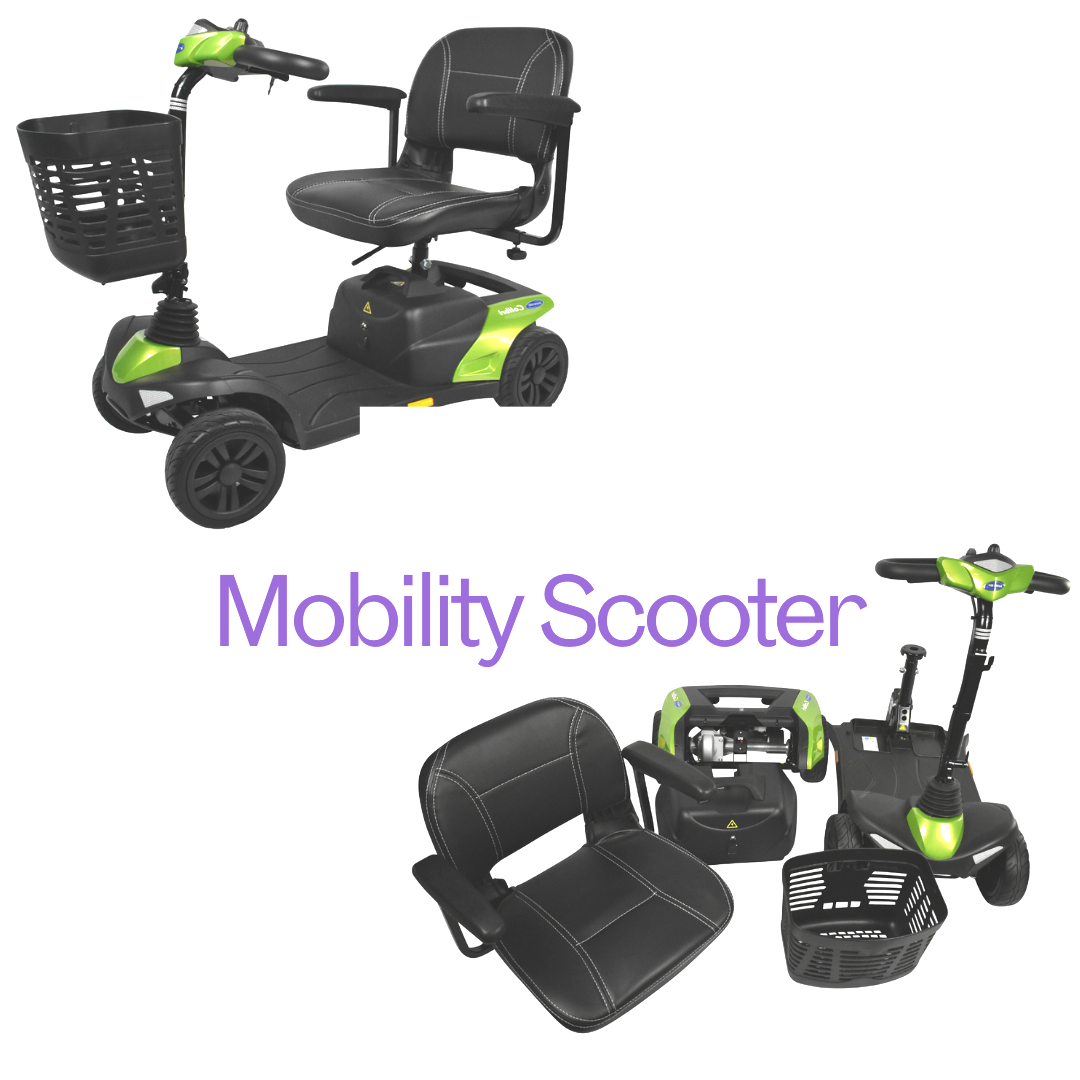
Know your scooter's weight and type. The weight will determine whether it can be lifted manually or if you'll need some kind of mobility scooter lift or ramp system. Folding and portable scooters are designed for easy transport — they're usually lighter and sometimes even foldable, which makes them easier to fit into your car boot. Full-sized scooters and powerchairs, on the other hand, may require more advanced lifting options like a hoist or platform lift.
Practise dismantling and reassembling your scooter in a safe, quiet space before you attempt it in a busy car park. Many scooters break down into lighter, manageable pieces. Knowing how to do this smoothly — without fumbling — makes the car park process far less stressful.
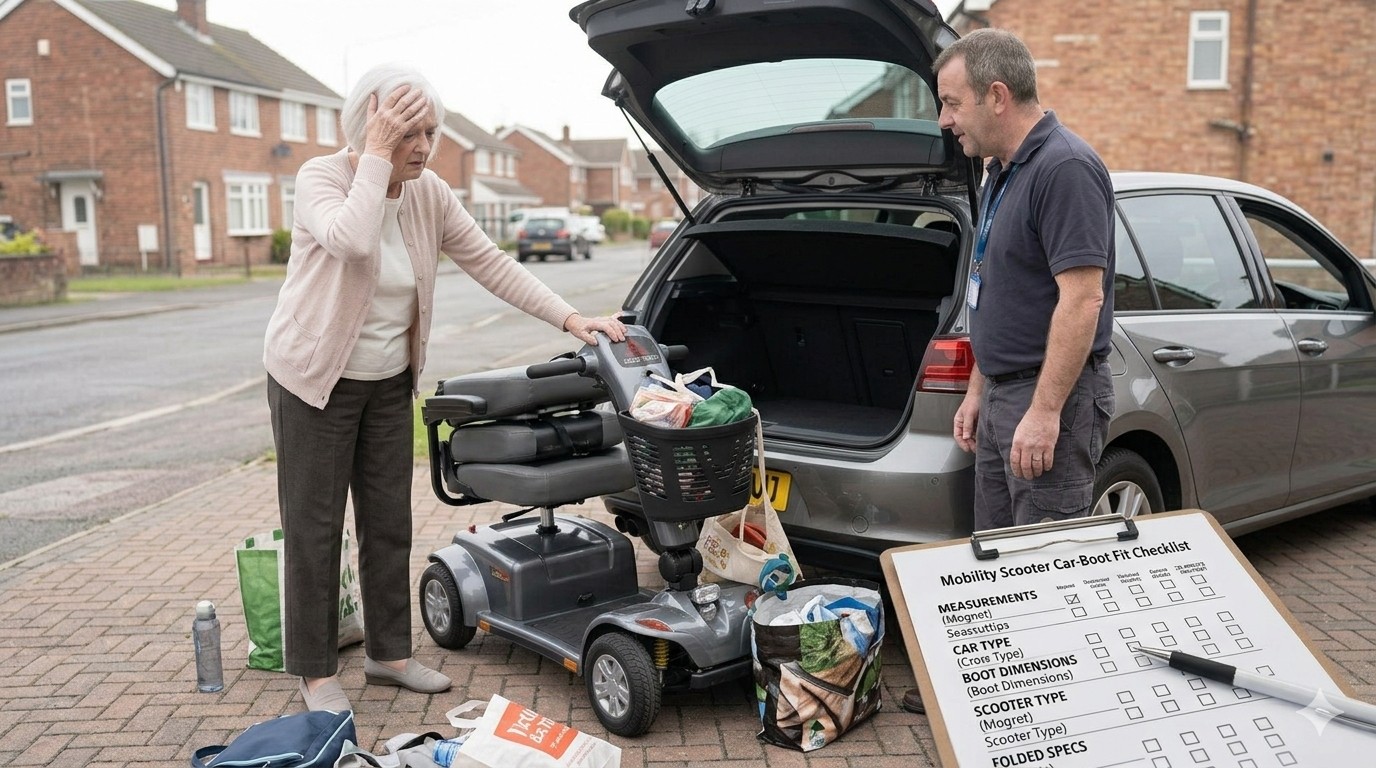
Clear out and prepare your car boot. A cluttered boot makes everything harder. Remove anything that doesn't need to be there and fold down any back seats if your car allows it. This gives you the maximum amount of space to work with and minimises the chance of damaging either your vehicle or your scooter. You'll also want to double-check your vehicle's payload limits — lifting a heavy scooter into a boot that's already packed with shopping or golf clubs is a recipe for strain.
Cover the boot opening with a rug or sheet. This protects your vehicle and allows the mobility device to slide into the boot more easily, reducing friction and effort. Commercial "boot sliders" are also available, using slippery nylon sheets to help slide a wheelchair or scooter into a vehicle boot with minimal lifting. It's a small trick that makes a big difference, especially if you're lifting the scooter alone.
Consider whether you need a loading aid. If lifting your scooter directly is a strain, a portable hoist or ramp is a worthwhile investment in your long-term health and independence. We'll look at your options in the next section.
Choosing the Right Equipment: Hoists, Ramps, and Lifts
The right equipment turns a back-breaking task into a manageable one. Here's what's available in Australia — and how to choose.
Boot-mounted Hoists
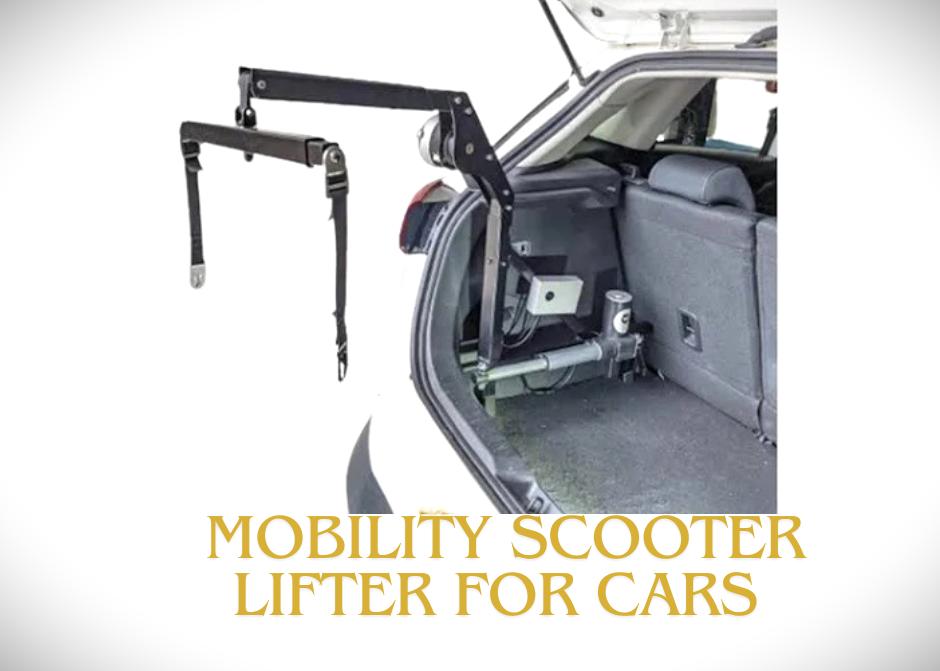
These are usually fixed to the floor of your vehicle's boot and may be powered by the vehicle battery. A push-button control activates a boom or lifting arm that extends out from the vehicle, attaches to the scooter via a hook or strap mechanism, and lifts and swings it into the boot.
Hoists require less manual handling than ramps but are usually more expensive. Portable options like the Atlas 60 Portable Car Boot Hoist (60kg capacity, $3,990) are available in Australia, and it doesn't require drilling or permanent installation — you can move it between vehicles without tools. Larger hoists like the Auto Chair Smart Lifter LP range from $6,304 to $7,440, while the Wheelchair Boot Hoist BT-80 (80kg capacity) is around $9,500.
Ramps
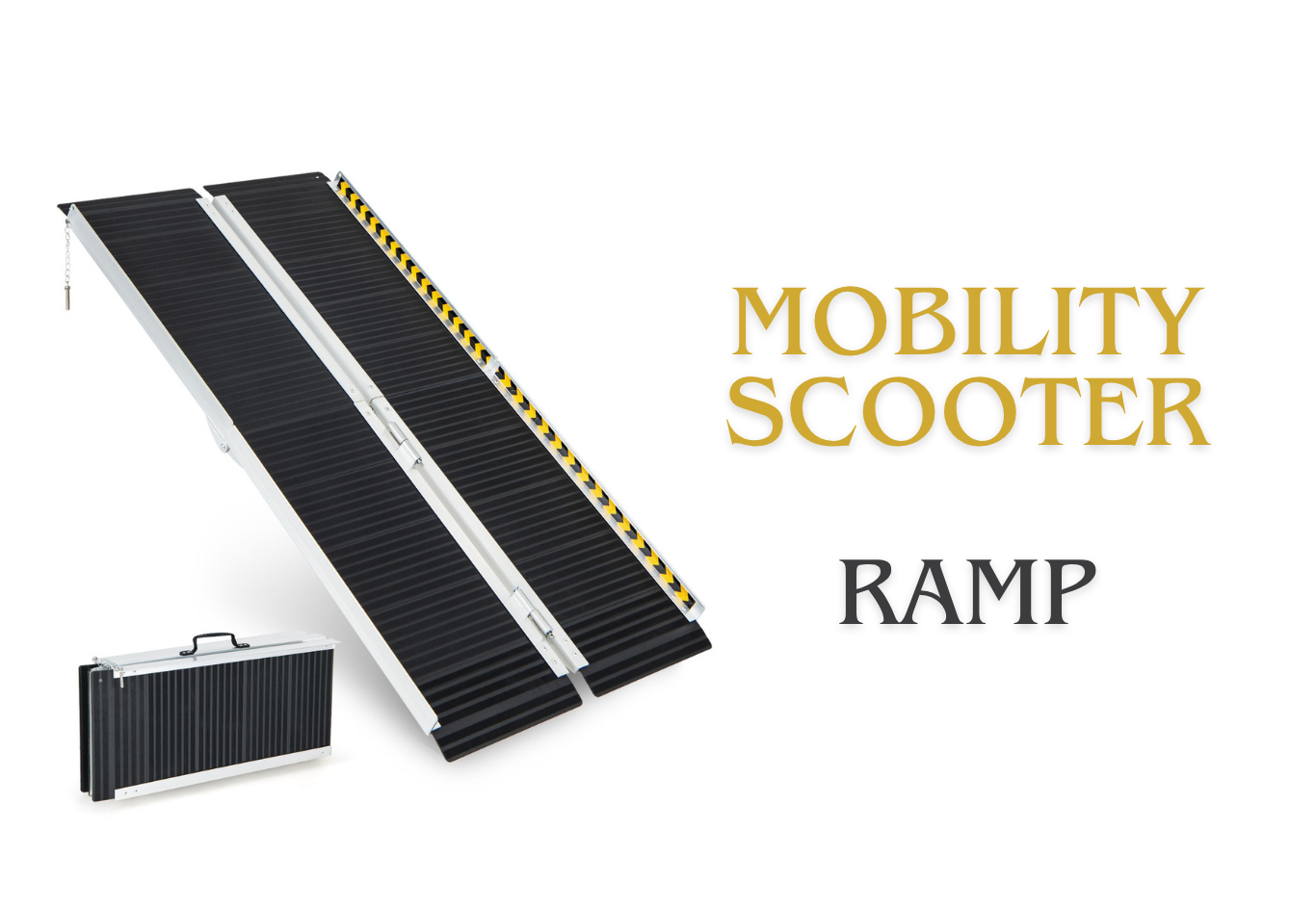
Ramps may assist with loading and unloading scooters into the boot, reducing the need for excessive bending or lifting. When choosing a ramp, consider the style (platform or track), the weight and ease of use, the load capacity, the required length for a manageable slope, and whether edge barriers are needed for safety. Track-style ramps are easier to store but can be more difficult to negotiate when loading, and they aren't suitable for three-wheeled scooters. Platform-style ramps suit a variety of scooters but can be heavy to lift. A telescoping ramp can bridge the gap if your car boot has a high lip, making loading easier. For gradient, the Australian Standard AS1428.1 recommends 1:14 for independent use, while a steeper gradient such as 1:10 is often acceptable for assisted use or mobility scooters. Always place the ramp on a stable, level surface and ensure it is securely positioned before use. For safety, it is advised to have one person either side of the mobility device when transferring into a car boot up a ramp.

Platform lifts. These are fully automatic options that work at the touch of a button. You bring the platform out of the boot under power, push or drive the scooter on and secure it, then use the control to transfer the platform back into the boot. Platform lifts are best fitted into a boot at least 120cm wide and at least 70cm deep, and sometimes back seats need to be removed.
Whatever equipment you choose, make sure it's rated for the weight of your scooter and compatible with your vehicle. And practise using it at home before you rely on it in a busy car park.
Step One: Park Smart
When you arrive at the centre, choose your parking spot carefully. ACROD bays are your first choice, but not all ACROD bays are created equal.
Australian Standards specify that ACROD parking bays must be at least 2.4 metres wide and 5.4 metres long, with a shared unloading area of the same width alongside. This extra width exists specifically to enable people with mobility restrictions to open their car door to its full extent and to have room to unload a wheelchair or scooter. The path from the bay to the nearest accessible entrance must be at least 1000mm wide, and the surface of the bay and unloading area must be firm, slip-resistant, and with a fall gradient no steeper than 1:40. There must also be 2500mm of height clearance in the area above the ACROD bay and adjacent shared area to allow for the use of a car top hoist.
But here's the reality: not every ACROD bay meets these standards in practice, and some are still too tight for comfortable scooter removal. If the designated bay doesn't give you enough room, it's okay to use a standard bay that offers more space on the side where you'll be unloading — provided you're not obstructing traffic or blocking access. Look for a bay with extra space on the side where your boot opens, and ideally one near a kerb ramp or level path to the entrance.
Before you open your door, check your mirrors and look over your shoulder. Car parks are high-risk zones for low-profile scooters, and drivers reversing are least likely to spot you. A visibility flag attached to your scooter makes a real difference here — consider attaching one before you start your journey.
Step Two: Unload with Care
If your scooter dismantles, remove the heaviest piece first, using your legs to lift rather than your back. Keep the piece close to your body and avoid twisting. If your scooter is a single unit and you're using a ramp, position the ramp securely on flat, level ground and engage your vehicle's handbrake before you begin.
If you're using a hoist, deploy it over the scooter, connect the lifting straps, and guide the scooter gently to the ground. Never stand on the hoist itself, and never allow anyone to ride on the scooter while it's being lifted or lowered.
Once the scooter is on the ground, check that it's stable before you mount. Apply the brake, sit down carefully, and turn the speed dial to its lowest setting. You're now ready to move toward the entrance.
Step Three: The Reverse Process (and Why It's Trickier)
Loading the scooter back into the car at the end of your trip is often harder than unloading it. You're tired, you might be carrying shopping bags, and the car park may be busier than when you arrived. Take your time. There is no rush worth risking an injury.
If you're using a ramp, drive the scooter up slowly and steadily, keeping it centred. If you're lifting it manually, ask for help if you need it — centre staff, a fellow shopper, or a carer can make all the difference. And if your centre offers assistance with loading, use it. That's what it's there for.
Once the scooter is loaded, secure it properly. The scooter should be secured to the vehicle by at least four tie-down straps, attached to the designated tie-down points on the scooter. If there are no attachment points, ensure it is behind a cargo barrier so it is isolated from passengers. Avoid using ropes or bungee cords as your primary restraint — they are not reliable for heavy equipment and could lead to accidents or damage. Place soft padding around painted areas to protect both the scooter and your vehicle, and ensure the scooter does not press against glass.
When to Ask for Help (and Why It's Not a Weakness)
Asking for help is not a sign of failure. It's a sign of good judgment. If you're unsure whether you can lift your scooter safely, or if the car park feels chaotic, ask a staff member at the concierge desk. Many Westfield centres, for example, offer mobility equipment hire and concierge assistance — you can call ahead to book equipment or ask for help on arrival. Pacific Fair and other centres similarly offer concierge teams who can assist guests with mobility needs.
You can also talk to your occupational therapist about your loading and unloading technique. OTs can assess your ability, recommend equipment, and help you find solutions that protect your body and your independence. An OT assessment is particularly valuable if you're considering a ramp or hoist, as they can match the equipment to your specific vehicle, scooter, and physical capacity.
The car park doesn't have to be the part of your trip you dread. With the right preparation, the right equipment, and the confidence to ask for help when you need it, you can load and unload your scooter safely — and start your shopping trip on your own terms.
Once you're safely inside, the next challenge is navigating the centre itself. If you're planning a longer trip, our guide on what to do if your battery runs low mid-trip (Coming Soon!) will help you avoid a stressful end to your day, and our guide on planning your route using the centre map shows you how to make every step of your journey smoother.
Stay mobile, stay confident!
Sign up for our monthly Mobility Scooter Newsletter to receive practical guides, expert advice, and inspiring stories that help you make the most of your scooter and download our free "Mobility Scooter Guide for Beginners."
Don't worry — your e-mail address is totally secure.
I promise to use it only to send you our newsletter, "Mobility Matters."
Recent Articles


-
Store Refused My Mobility Scooter: What Are My Rights?
Oct 21, 26 09:26 AM
 What should I do if a store asks me not to bring my scooter inside? Handle it with confidence and dignity.
-
Shopping Centre Navigation Strategies Made Simple & Stress-Free
Oct 21, 26 09:02 AM
 Shopping centre navigation strategies that actually work. Master lifts, tight aisles & crowded malls with practical, carer-friendly advice.
-
What to Do If Your Scooter Battery Dies at the Centre
Oct 21, 26 08:59 AM
 What should I do if my battery runs low while I am at the centre? Recharge options and backup plans that work.


Ready to Feel More Confident on Your Mobility Scooter?

My Ebook, The Ultimate Guide to Mobility Scooters, walks you through choosing the right scooter, using it safely, and keeping it in top condition — all explained in clear, friendly language.
Give yourself (or someone you love) the gift of independence.




