- Home
- Mobility Scooter Safety and Daily Use
- Shopping Centre Navigation Strategies for Mobility Scooters
- How to Handle a Busy or Broken Lift on a Mobility Scooter
What Do I Do If the Lift Is Busy or Out of Order When I’m Using a Mobility Scooter at a Shopping Centre?
Picture this: You have navigated the car park, found the accessible entrance, and made it to the lift lobby on level one. You press the button. The doors open—and the lift is packed. A sea of faces looks back at you, a pram is wedged in the corner, and there is simply no room. The doors slide shut. You press the button again. The next lift arrives, also full. A small knot tightens in your stomach. You are using a mobility scooter, you cannot take the escalator, and suddenly the simple act of getting to the next floor feels like an impossible puzzle. You wonder: What do I do if the lift is busy or out of order when I’m using a mobility scooter at a shopping centre?
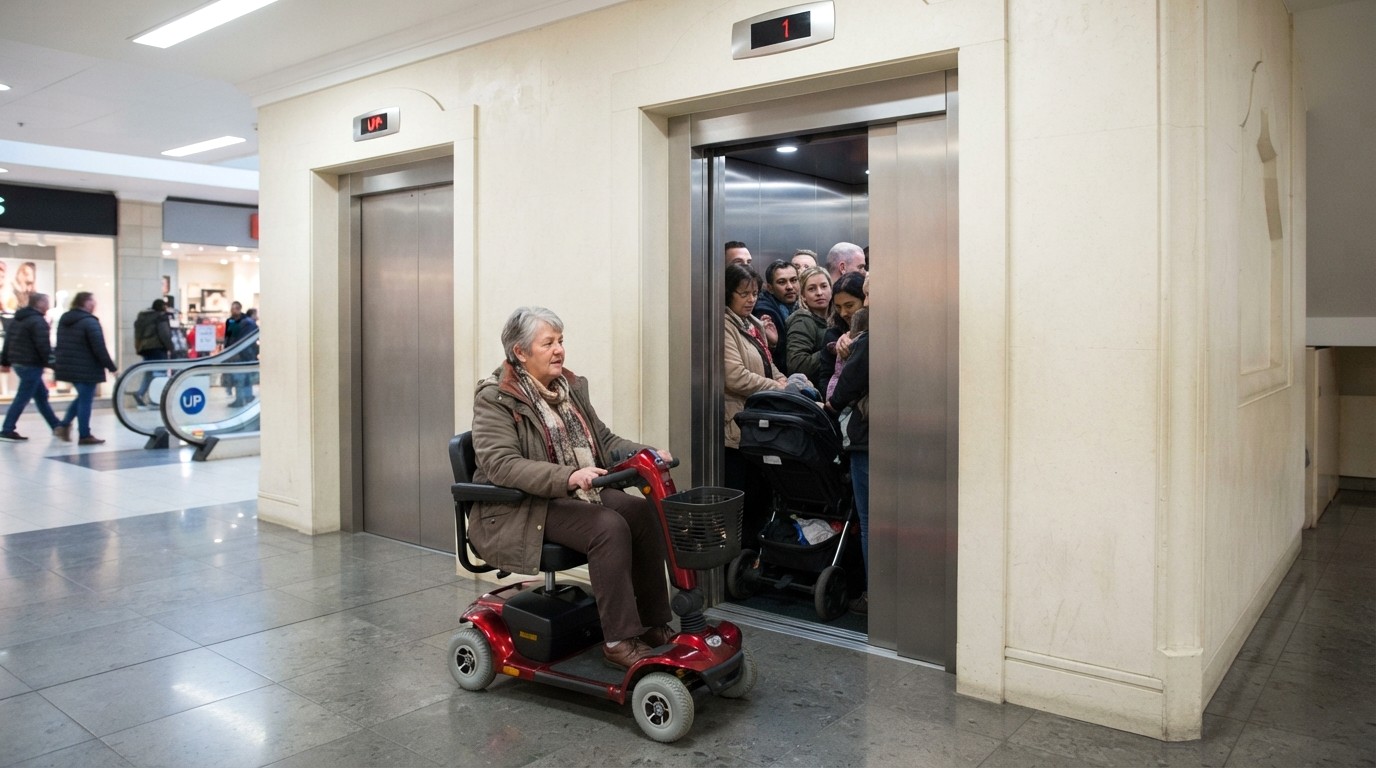
If that scenario feels familiar, take a breath. You are not stuck, and you are certainly not a burden. Every shopping centre in Australia has a legal obligation to provide reasonable access, and there is always a way forward—even when the lifts are working against you.
This guide is your calm, practical companion for exactly these moments. We will walk through what to do when the lift is crowded, what to do when it is broken, and how to prepare so that a busy lift never derails your day again.
Before You Leave Home: The 10-Minute Planning That Prevents Lift Stress
The most effective way to handle a busy or broken lift is to reduce the chance of being caught off guard in the first place. A little preparation goes a surprisingly long way.
Check the centre’s accessibility information online. Most major Australian shopping centres publish an access statement or accessibility guide on their website. These documents often list the locations of all lifts, identify alternative accessible routes, and provide a concierge contact number.
Pacific Fair on the Gold Coast, for example, publishes a detailed access statement confirming that lifts are located throughout the centre for access to both levels, and that concierge staff can meet guests and provide mobility scooters free of charge. Spending five minutes reading this before you leave home gives you a mental map of your options.
Call the concierge before you travel. This is the single most underused strategy available to you. A quick phone call to the customer service desk can answer the exact question that matters most: “Is the lift near [your target store] working today?”
One accessibility guide for Roselands Shopping Centre puts it plainly: if you have a specific question like “Is the elevator near Target working today?”, a quick call to the customer service desk can save you a huge headache. Concierge teams also know which lifts are quieter, which entrances are least crowded, and whether any maintenance works are scheduled. They are there to help—use them.
Identify alternative lift locations on the centre map. Do not assume there is only one lift. Most multi-level centres have multiple lift banks, and some have service lifts that are not always signposted for public use but can be accessed with staff assistance. Save a screenshot of the centre map to your phone and mark every lift you can find. If one is busy or out of order, you already know where to head next.
You have a plan. Now let’s talk about what to do when you are standing in front of a lift that is simply too full.
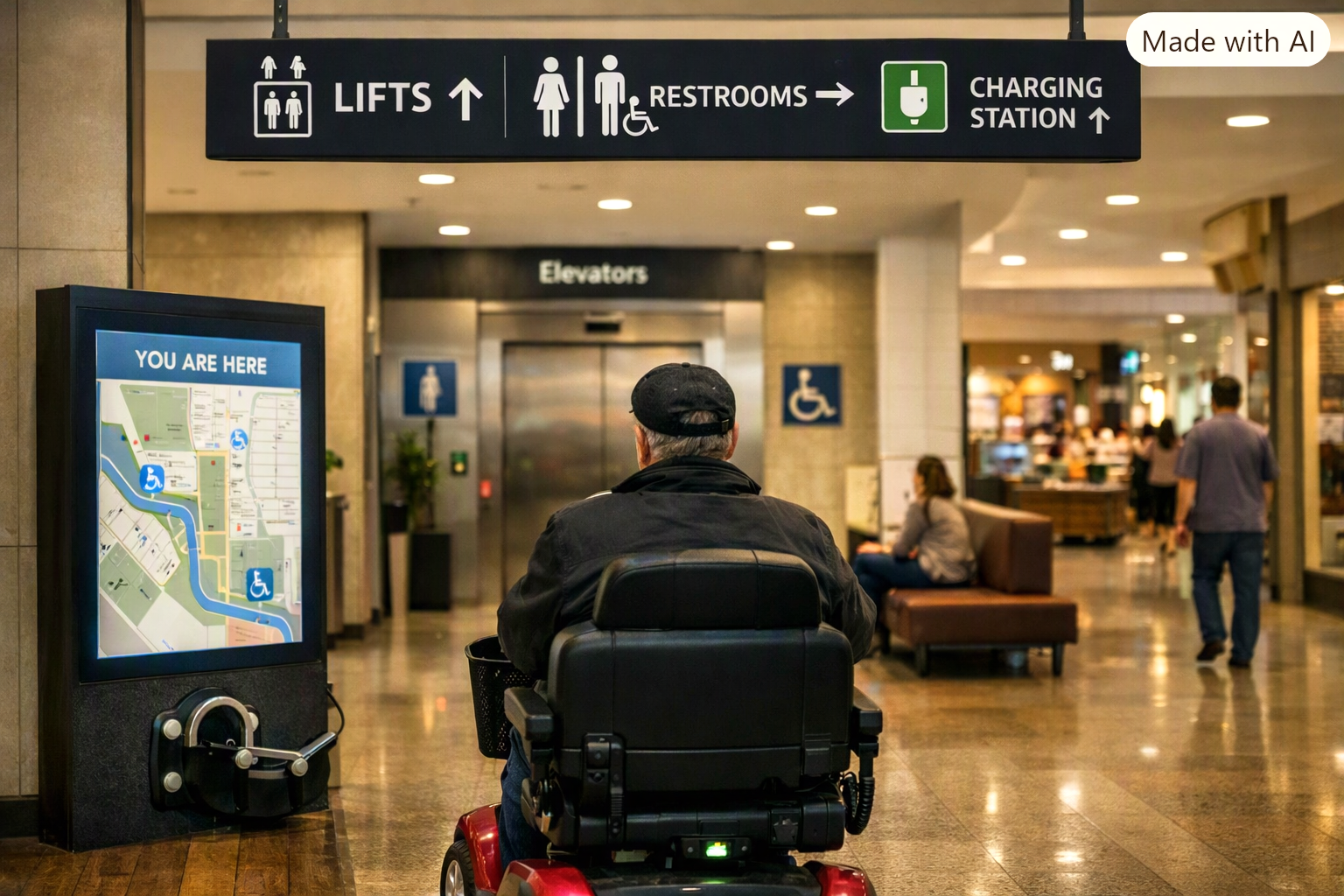
When the Lift Is Busy: Waiting Without the Stress
A crowded lift is not a crisis. It is an inconvenience, and it is one you can manage with dignity and patience.
Wait for the next available lift rather than squeezing in. This is the simplest and safest rule. Attempting to wedge a mobility scooter into a lift that is already at capacity creates discomfort for everyone and increases the risk of damaging the scooter, the lift doors, or someone’s toes. Accessibility guidance is clear on this point: if a lift is crowded, wait for the next available one rather than squeezing in, ensuring comfort and safety for both yourself and other passengers.
Use the “wrong direction” trick. If repeated lifts travelling in your intended direction are full, a clever strategy is to get on a less-full lift going in the opposite direction. Ride it to the end of the line, stay on board, and then travel back up or down to your desired floor. It sounds counterintuitive, but it often works when every upward lift is packed.
Position yourself to be first in line. When a lift arrives and empties, move forward confidently but courteously. Stand slightly to the side of the door so that exiting passengers have clear space, then enter once the way is clear. This small positioning trick makes you visible to other waiting passengers and signals that you are ready to board.
Ask for priority with a smile. Most lifts have signage asking passengers to prioritise people with disabilities and prams. If a lift arrives and able-bodied shoppers surge forward, a polite “Would you mind letting me through? I need the lift for my scooter” is usually met with understanding. You are not asking for a favour. You are asking for access that is already recognised as a priority.
Use quieter times to your advantage. If your schedule allows, shop during the “golden hours” of Tuesday to Thursday mornings, between 9:30 AM and 11:30 AM. The centre is significantly less crowded, lifts are emptier, and the whole experience is calmer.
For more strategies on managing busy periods, see our guide on [how to shop at peak times on a mobility scooter without getting boxed in by crowds]. (Coming Soon!)
Waiting for a lift is frustrating, but it is manageable. A broken lift, however, requires a different set of tools—and that is where we turn next.

When the Lift Is Out of Order: Your Step-by-Step Backup Plan
A lift that is out of service can feel like a dead end. It is not. Here is exactly what to do, in order.
Step 1: Do not panic, and do not try the escalator. Escalators are never safe for mobility scooters. They are designed for foot traffic, and attempting to use one can cause serious injury and damage. The lift is the only vertical transport option designed for you, and if it is broken, you need an alternative route—not a risky shortcut.
Step 2: Look for signage. Shopping centres are required to provide alternative access when lifts are out of service. Westfield Carindale, for example, published clear guidance during a lift upgrade: alternative centre access is available while works are underway, and shoppers with mobility aids are advised to follow signage in the car park for alternative lift access to the centre. Look for temporary signs near the broken lift, in the car park, or at the centre entrance. These signs will often direct you to the nearest working lift or ramp.
Step 3: Head to the concierge or customer service desk. If there is no signage, or if the signage is unclear, the concierge team is your best resource. They know the building’s hidden routes, the location of service lifts, and which entrances have level access. Staff at information points can guide you to the nearest ramp or alternative lift when a lift is out of service. If you cannot physically get to the desk, call them—their number should be on the centre’s website or on a nearby directory board.
Step 4: Ask about service lifts and staff-assisted routes. Many centres have service or freight lifts that are not open to the general public but can be used by people with mobility aids when the main passenger lifts are unavailable. These are often accessed with a staff escort or a key. It is always worth asking: “Is there a service lift I could use while the main lift is being repaired?” The worst that can happen is that the answer is no—but often, it is yes.
Step 5: Use ramp access if it exists. Some centres have ramps connecting different levels, particularly between car parks and retail floors. When a car park lift was temporarily out of order at Strathfield Plaza, visitors could use the available ramp access between parking levels and the shopping centre. Ramps are not always available, and they may be longer or steeper than a lift ride, but they are a reliable backup when they exist.
Step 6: If you cannot reach your destination, ask for assistance. You are not expected to solve this alone. Centre staff can escort you to an alternative route, help you carry shopping bags, or arrange for a staff member to meet you at a different entrance. You have the right to reasonable adjustments under the Disability Discrimination Act 1992, and a broken lift does not remove that right.
If the lift outage is part of planned maintenance, it should be communicated in advance on the centre’s website. Check before you travel, and if you arrive to find an unexpected outage, remember: you have options.
For a deeper dive into planning your route around obstacles, see our guide on how do I plan the easiest route through a shopping centre using the centre map.

What If You Get Stuck Inside a Lift?
This is rare, but it is worth knowing what to do. If the lift doors close and the lift does not move, or if the doors repeatedly open and close while you are partway in, stay calm.
If the door encounters an obstacle like a scooter, it will usually reopen. If you become stuck in the opening with the door repeatedly closing and opening, ask someone to hold the “open door” button. If you are alone and can reach it, the emergency stop button may be activated until you are able to reposition yourself or until help arrives. Every lift has an emergency call button or intercom. Press it and speak clearly: tell the operator which centre you are in, which lift you are in, and that you use a mobility scooter. Help will be sent.
After the Lift: Keeping Your Cool and Carrying On
Once you have navigated the lift challenge, the rest of your trip does not have to be shadowed by stress. Take a moment to reset. Find a quiet spot, check your battery, and give yourself credit for handling a difficult situation with grace.
If a lift outage has caused a significant delay or distress, you can provide feedback to centre management. Shopper feedback is one of the most effective ways to push for better accessibility. You can also raise concerns with your state’s anti-discrimination commission if you believe your rights under the DDA have been violated. Your voice matters, and it makes the next person’s trip a little easier.

Frequently Asked Questions
Can I use the escalator if the lift is broken?
No. Escalators are not designed for mobility scooters and using one is extremely dangerous. Always wait for an alternative lift, ramp, or staff-assisted route.
Am I allowed to ask other shoppers to make room in the lift?
Yes. Lifts in Australian shopping centres are expected to prioritise people with disabilities and prams. A polite request is entirely reasonable, and most people will happily make space.
What if the centre has no working lift and no ramp?
This is a serious accessibility failure. Speak to centre management immediately. Under the DDA, they have an obligation to provide reasonable access. If they cannot resolve the issue on the spot, ask for a complaint form and consider contacting the centre’s head office or your state anti-discrimination body.
Should I bring a companion when I shop?
A companion can be enormously helpful in lift situations—they can hold doors, ask staff for assistance, and keep you company while you wait. But you are also entitled to shop independently. The choice is yours.
For more on shopping with a carer, see our guide on [what carers and family members should know when shopping with someone on a mobility scooter]. (Coming Soon!)
How can I find out about lift maintenance before I travel?
Check the centre’s website and social media pages, or call the concierge. Planned lift upgrades are usually advertised in advance, and a quick call can save you a wasted trip.
You Can Do This
You are not defined by a broken lift or a crowded lobby. You are a shopper with every right to be there, and with the strategies in this guide, you are ready for whatever the centre throws at you.
Charge your scooter, check the map, and go with confidence.
You have got this.
Stay mobile, stay confident!
Sign up for our monthly Mobility Scooter Newsletter to receive practical guides, expert advice, and inspiring stories that help you make the most of your scooter and download our free "Mobility Scooter Guide for Beginners."
Don't worry — your e-mail address is totally secure.
I promise to use it only to send you our newsletter, "Mobility Matters."
Recent Articles


-
Shopping Centre Navigation Strategies Made Simple & Stress-Free
Oct 18, 26 05:06 AM
 Shopping centre navigation strategies that actually work. Master lifts, tight aisles & crowded malls with practical, carer-friendly advice.
 -
What to Do If the Lift Is Busy or Out of Order on Your Scooter
Oct 18, 26 04:59 AM
 What do I do if the lift is busy or out of order when I’m using a mobility scooter at a shopping centre? Your calm, practical plan for every scenario.
 -
How to Plan Your Shopping Centre Route with the Centre Map
Oct 17, 26 05:51 AM
how do I plan the easiest route through a shopping centre using the centre map entrances lifts and accessible toilets

Ready to Feel More Confident on Your Mobility Scooter?

My Ebook, The Ultimate Guide to Mobility Scooters, walks you through choosing the right scooter, using it safely, and keeping it in top condition — all explained in clear, friendly language.
Give yourself (or someone you love) the gift of independence.




