- Home
- Mobility Scooter Safety and Daily Use
- Shopping Centre Navigation Strategies for Mobility Scooters
- Battery Runs Low at the Shopping Centre
What Should I Do If My Battery Runs Low While I am at the Centre?
Picture this: You're halfway through your shopping trip. You've visited three stores, your bags are filling up, and you're feeling good. Then you glance down at your battery gauge and see it — the red light. Your stomach drops. You're not close to the car, and you're not sure if you'll make it back. The confidence you felt moments ago evaporates, replaced by a familiar wave of anxiety.

Battery anxiety is real, and it's one of the most common fears for mobility scooter users. It's the worry that a flat battery could leave you stranded, embarrassed, or dependent on the kindness of strangers.
But here's the reassuring truth: a low battery is almost always manageable. With the right preparation, a few backup plans, and the knowledge of what to do in the moment, you can handle it calmly — and get home safely.
This guide will walk you through exactly what to do, step by step, so you're never caught off guard again.
First, Understand Your Range
The first step to preventing battery panic is knowing what your scooter can actually do. Mobility scooter ranges vary enormously depending on the model, battery type, and how you use it. Smaller, lightweight scooters might manage around 13–16 km on a single charge . Mid-range models often reach 22–28 km . Larger, full-sized scooters can travel 32 km, 36 km, or even up to 40 km on a full charge . Some heavy-duty models claim ranges of up to 50 km .
Your actual range is affected by terrain, your weight, the load you're carrying, and even the temperature. Rough ground, hills, and frequent stopping and starting all drain power faster than smooth, flat paths. Cold weather slows the chemical reactions inside the battery, temporarily reducing capacity . So if your trip involves lots of walking and browsing, it's wise to assume you'll get a little less than the maximum range.
The rule of thumb for charging is simple: for every hour of use, the scooter should be on charge for double that time. And if your battery level was already low when you started, don't attempt a long trip without recharging first.
Knowing this helps you plan, but what happens when the unexpected occurs?
The RECHARGE Scheme: Your Best Friend
Before you leave home, it's worth checking whether your local shopping centre participates in the RECHARGE Scheme™. This is a national initiative that provides designated power points for recharging mobility scooters and electric wheelchairs at participating locations — including shopping centres, libraries, pharmacies, and council offices .
The cost of recharging for up to an hour is typically under 30 cents — a small price for peace of mind . The scheme was designed specifically to address the anxiety of a flat battery. People using the RECHARGE Scheme report feeling increased safety, social connection, and improved general wellbeing. They no longer isolate themselves through fear of being stranded .
If your scooter has an off-board charger, you'll need to bring it with you to use the scheme. Never borrow a charger that isn't the same model as yours — using an incompatible charger can cause serious damage. You can find participating locations on the RECHARGE Scheme website, or simply call the shopping centre's concierge and ask.
Many centres also offer charging independently of the scheme. Armadale Shopping City, for example, welcomes visitors to use free power outlets in the common mall areas — no fuss, no cost . If you're unsure whether your centre has a charging point, it's always worth asking.

If Your Battery Runs Low: A Step-by-Step Plan
Step 1: Don't panic. You have options. Turn off any unnecessary features — lights, a radio, anything that draws power — to conserve what's left. If your scooter has a speed dial, drop it to the lowest setting. Riding at a slower, steady pace uses power more efficiently than sudden acceleration or constant top speed.
Step 2: Head to the concierge. Centre staff are there to help. Many centres offer mobility equipment hire and concierge assistance, and they can direct you to the nearest power point or advise on recharge locations. If you need a hand finding an outlet, centre teams are generally happy to help .
Step 3: Recharge for an hour. An hour at a RECHARGE point can give you enough power to get home. As a rough guide, if your battery gauge reaches halfway, you should be able to travel another 10–15 km safely.
Step 4: If you can't recharge, call for backup. Roadside assistance services across Australia can help. In Queensland, RACQ assists with wheelchairs and mobility scooters as a community service — you don't need to be a member, and the scooter doesn't need to be registered.
For flat batteries, RACQ will test the battery, connect it to your charging facility if recharging is required, and advise on replacement if needed. Contact RACQ on 13 19 05 . In New South Wales, NRMA provides a service for members with non-registered mobility scooters or wheelchairs, and can be reached on 13 11 22 . In Victoria, RACV offers emergency wheelchair and scooter assistance. A technician will attempt minor on-site repairs, and if they can't fix the issue, they'll organise a wheelchair-accessible taxi to take you home (up to $60 per call-out). Contact RACV on 13 72 28 .
If you have a carer or family member nearby, call them. And if all else fails, ask centre staff to call a taxi or a friend.
How to Avoid Battery Anxiety in the First Place
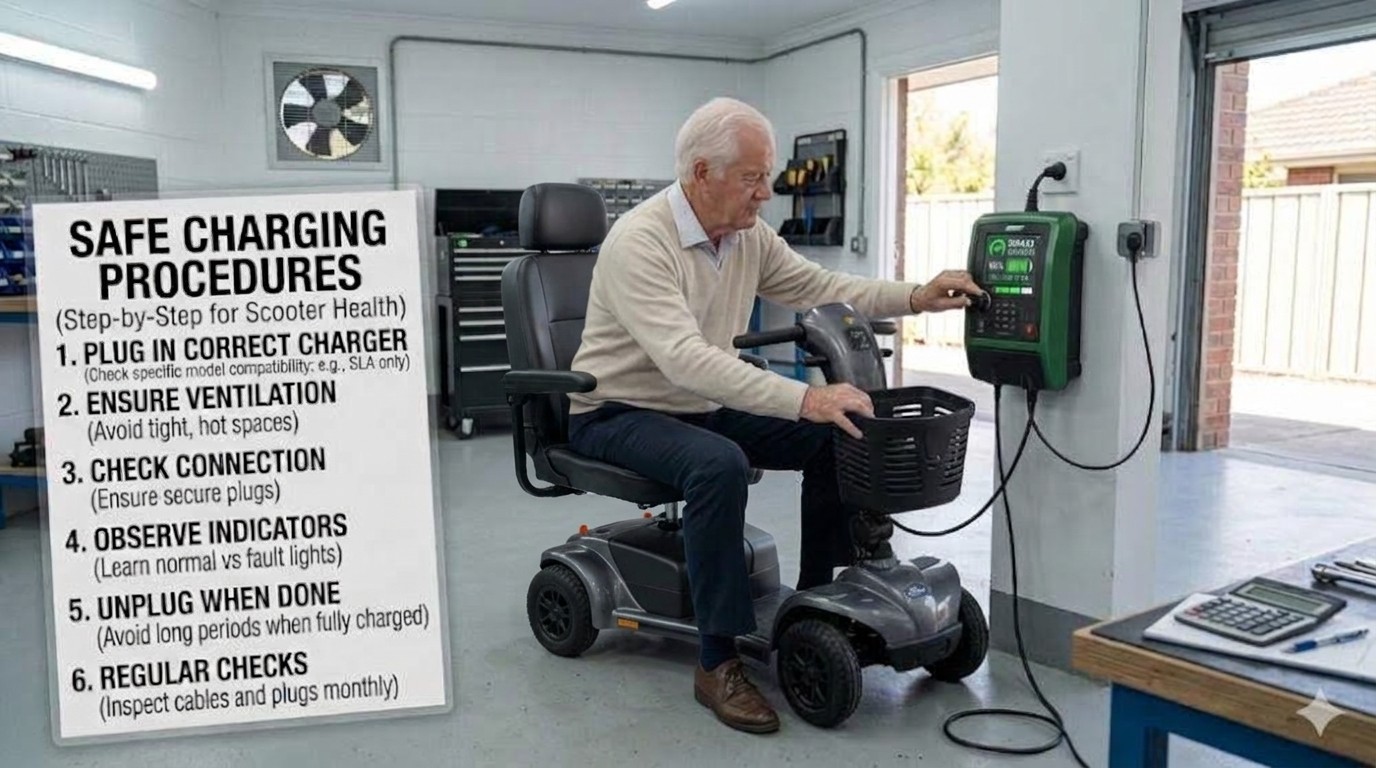
The best defence is preparation. Charge your scooter fully the night before your trip, and avoid letting the battery drain completely, as this can weaken it over time . Use the right charger, keep it cool while charging, and give it enough time to reach full capacity.
Plan your route to minimise unnecessary detours. A direct route on smooth, flat paths saves power compared to a longer route over hills or rough ground. And if you're visiting a large centre, consider whether you'll need a mid-trip top-up, and locate the recharge point on the centre map before you go.
Our guide on planning your route using the centre map shows you how to build recharge stops into your journey, so you're never caught off guard. And if you want to know more about how charging works at shopping centres, our guide on can I charge my scooter at a shopping centre explains exactly what to expect.
You're Not Stranded — You're Prepared
A low battery is an inconvenience, not a catastrophe. With the RECHARGE Scheme, a charged phone, and a backup plan, you can handle it calmly and get home safely. The key is to know your range, plan ahead, and remember that help is never far away — whether it's a friendly concierge, a roadside assistance patrol, or a simple power point that costs less than a cup of coffee.
So next time you see that red light, take a breath. You've got this. And if you want to make every step of your trip even smoother, from the car park to the checkout, explore our other shopping centre navigation strategies guides — because confidence comes from knowing exactly what to do, no matter what happens.
If you are ready to go deeper, these guides will help you with the next decisions:
1. Pre-Visit Planning & Route Mapping
2. Arrival, Parking & Entry
3. Navigating the Centre — Movement & Crowds
- What Do I Do If the Lift Is Busy or Out of Order When I’m Using a Mobility Scooter at a Shopping Centre?
- How Do I Turn Around or Reverse Safely in a Narrow Shopping-Centre Aisle on a Mobility Scooter?
- How Can I Shop at Peak Times on a Mobility Scooter Without Getting Boxed In by Crowds?
4. Stopping, Shopping & Securing
- How Do I Secure My Mobility Scooter While I’m in a Shop or Seated in a Food Court?
- How Do I Handle Queues (Checkout Lines) on a Mobility Scooter Without Blocking Others?
- What Should I Do If a Store Asks Me Not to Bring My Scooter Inside?
5. Battery & Power Management
- What Should I Do If My Battery Runs Low While I am at the Centre?
6. Emergency Preparedness
Stay mobile, stay confident!
Sign up for our monthly Mobility Scooter Newsletter to receive practical guides, expert advice, and inspiring stories that help you make the most of your scooter and download our free "Mobility Scooter Guide for Beginners."
Don't worry — your e-mail address is totally secure.
I promise to use it only to send you our newsletter, "Mobility Matters."
Recent Articles


-
Store Refused My Mobility Scooter: What Are My Rights?
Oct 21, 26 09:26 AM
 What should I do if a store asks me not to bring my scooter inside? Handle it with confidence and dignity.
-
Shopping Centre Navigation Strategies Made Simple & Stress-Free
Oct 21, 26 09:02 AM
 Shopping centre navigation strategies that actually work. Master lifts, tight aisles & crowded malls with practical, carer-friendly advice.
-
What to Do If Your Scooter Battery Dies at the Centre
Oct 21, 26 08:59 AM
 What should I do if my battery runs low while I am at the centre? Recharge options and backup plans that work.


Ready to Feel More Confident on Your Mobility Scooter?

My Ebook, The Ultimate Guide to Mobility Scooters, walks you through choosing the right scooter, using it safely, and keeping it in top condition — all explained in clear, friendly language.
Give yourself (or someone you love) the gift of independence.




