- Home
- Mobility Scooter Safety and Daily Use
- Shopping Centre Navigation Strategies for Mobility Scooters
- Shopping Centre Emergency on a Mobility Scooter
What Should I Do in a Shopping-Centre Emergency (Evacuation/Alarm) If I’m on a Mobility Scooter?
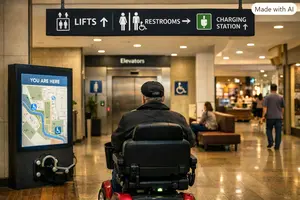
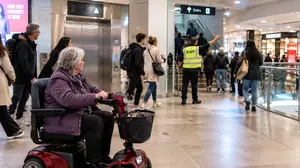
Picture this: You are browsing on level two of a busy shopping centre when a shrill alarm cuts through the noise. Shoppers stop, look at each other, and then start moving—some quickly, some unsure. A staff member in a high-vis vest waves people toward the stairs. You are on your mobility scooter. The lifts are right there, but a voice in your head says you shouldn’t use them. The stairs are not an option. For a moment, you feel frozen, invisible, and unsure whether anyone has noticed you at all.
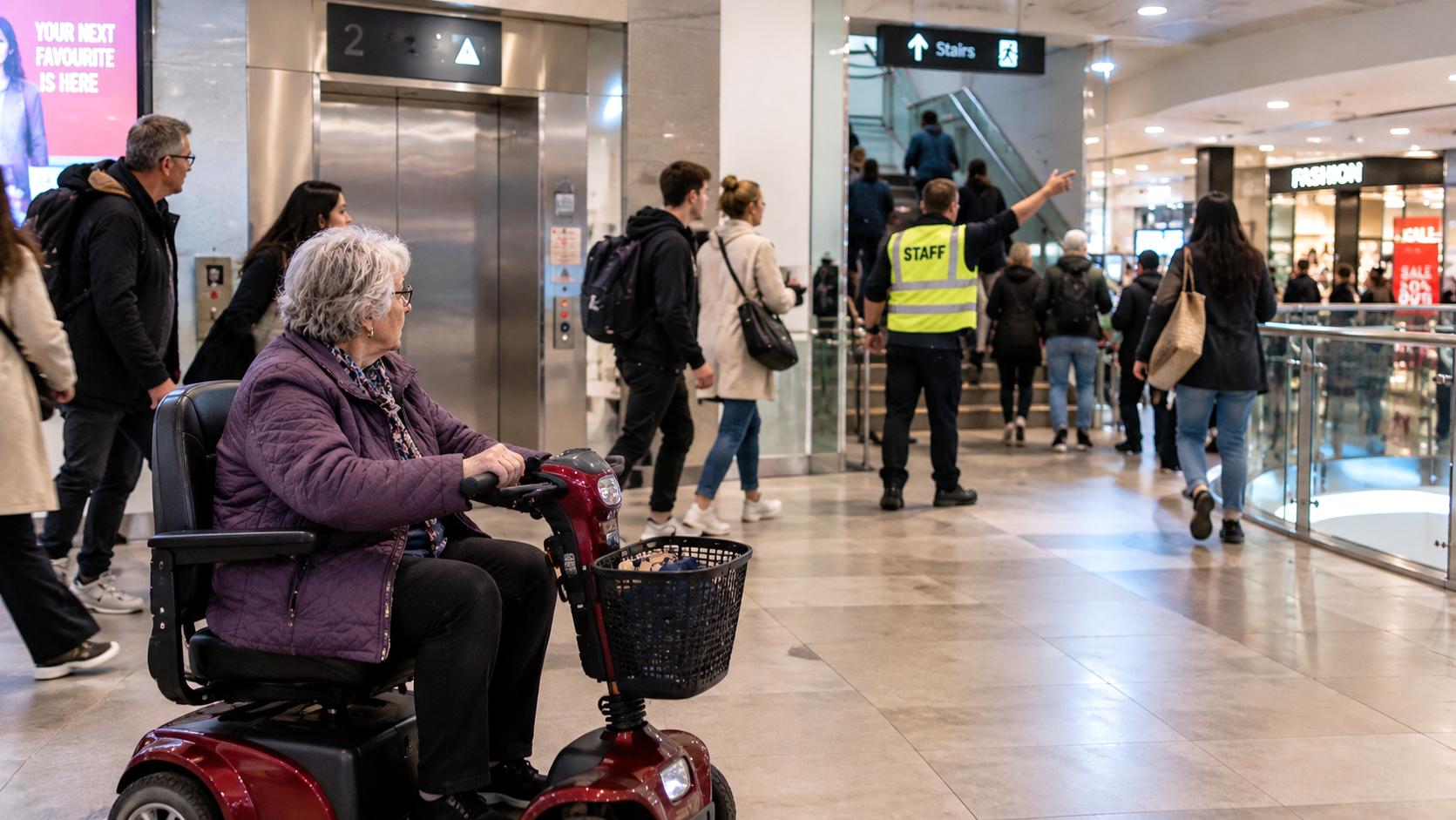
If that scenario makes your heart race, you are not alone. The question “What should I do in a shopping-centre emergency (evacuation/alarm) if I’m on a mobility scooter?” is one of the most important—and most overlooked—questions a scooter user can ask.
It is also a question that deserves a calm, practical, step-by-step answer, not a vague reassurance. You have the right to know exactly what to do, where to go, and who will help you.
This guide is that answer.
Why This Moment Feels So Overwhelming (and Why You Are Not Overreacting)
A shopping-centre emergency is loud, confusing, and fast-moving. For anyone, it is stressful. For a mobility scooter user, it can feel genuinely frightening, because the usual routes out—lifts and escalators—are suddenly off-limits, and the building’s design may not have been built with your wheels in mind.
Here is the good news: Australian emergency planning standards recognise this exact challenge. Australian Standard 3745-2010, Planning for emergencies in facilities, explicitly requires that evacuation arrangements for people with a disability be considered in the development of emergency response procedures. Shopping centres are required to plan for occupants and visitors who use a “wheeled mobility appliance, including wheelchair or scooter”. You are not an afterthought in the system. You are part of the plan—even if nobody has ever explained it to you.
That said, the plan only works if you know your part in it. The next few sections walk you through exactly what to do, in order, from the moment the alarm sounds to the moment you reach safety.
Step One: Stop, Breathe, and Do Not Use the Lift
The first thing to do in a shopping-centre emergency is also the hardest: stop moving and take one deliberate breath. Panic makes decisions faster but worse. A single breath gives your brain a chance to catch up.
Then, follow the golden rule of fire evacuation: do not use the lift. Fire and Rescue NSW is unambiguous on this point: “If you hear the fire alarm, leave immediately. Use the stairs—never use a lift/elevator during a fire”. Lifts can lose power, fill with smoke, or open onto a fire-affected floor. In an evacuation, the lift is not your friend.
This is the moment where scooter users often feel a flash of despair, because the stairs are not an option either. But you are not out of options. You are simply at the start of a different route—one that leads to a refuge area.

Step Two: Head to a Refuge Area (This Is Your Safe Space)
A refuge area is exactly what it sounds like: a protected space on a floor or in a stairwell where people who cannot use stairs can wait safely for assistance. It is designed to protect you from heat, smoke, and toxic gases, and it provides direct access to an exit. In Australian buildings, refuges are typically located on the landings of fire-isolated stairwells, with enough space for a wheelchair or scooter to wait outside the main flow of evacuating foot traffic.
If you are on an upper level when the alarm sounds, make your way toward the nearest stairwell and look for the refuge area signage. These signs are usually near the lifts and stairwell entrances.
If you cannot find a refuge area, look for a staff member in a high-vis vest or a fire warden—they are trained to guide you. A warden’s role includes guiding a person with a disability to the refuge or to a warden intercommunication phone, and then notifying the chief warden of your location so that priority evacuation can be arranged with emergency services.
You are not being left behind. You are being positioned in the safest possible place while the people trained to help you do their job.
Step Three: Get Noticed, and Stay in Contact
Once you are at a refuge area, the next step is making sure the right people know you are there. If a warden or staff member is with you, they will handle this. If you are alone, use any communication point available—a warden intercom phone, a emergency call point, or your mobile phone.
If you have a phone, call 000 and tell the operator clearly: “I am in a shopping centre at [centre name and address]. I use a mobility scooter. I am in a refuge area on level [number] near [landmark or stairwell].” This information helps emergency services prioritise your evacuation. You are not wasting their time. You are giving them exactly what they need.
If you are with a companion, ask them to stay with you. Australian guidance is clear that occupants with a disability should be accompanied in the refuge by another person. If you are alone, do not leave the refuge to search for help. Stay put, keep the door to the stairwell clear, and wait for trained responders.
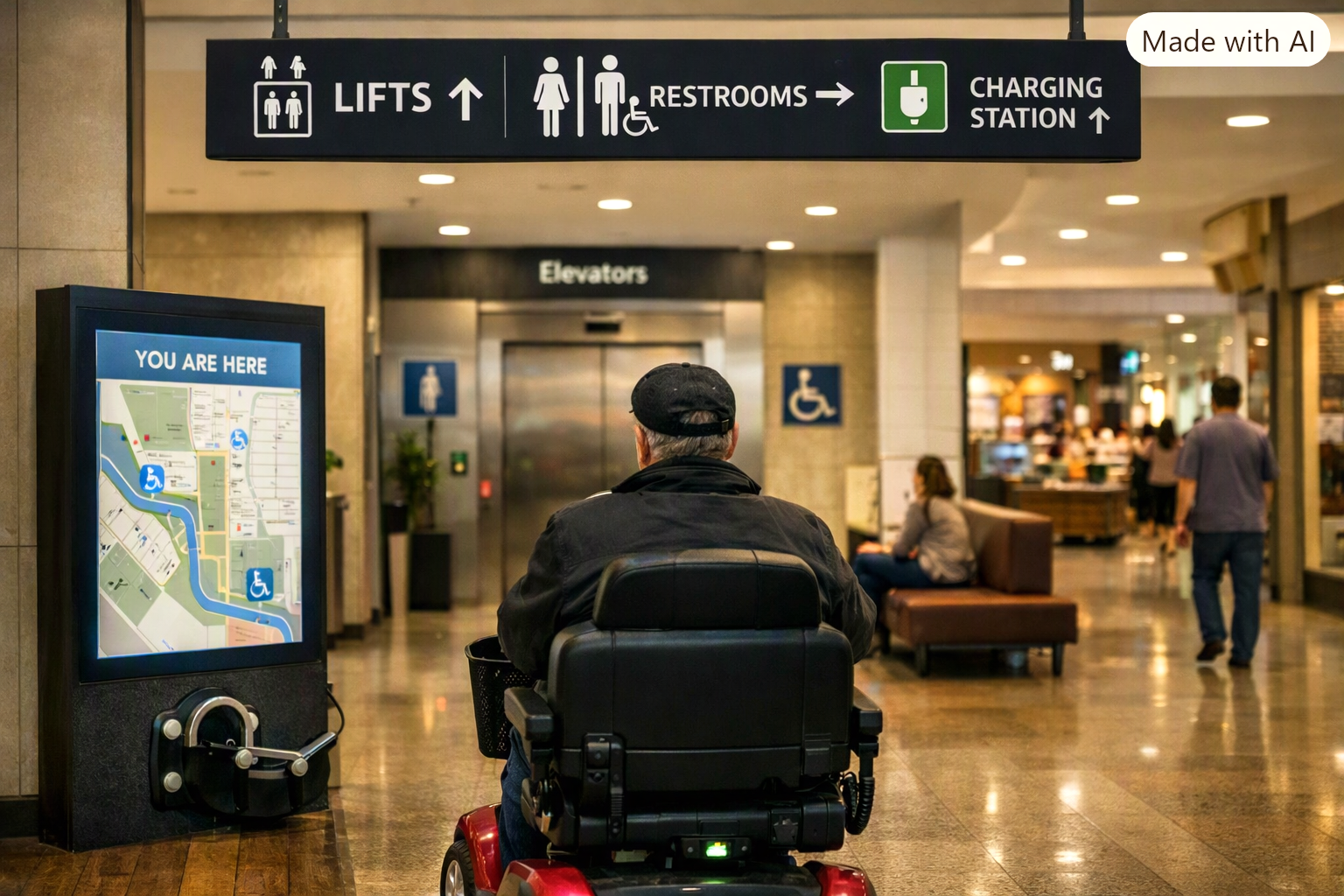
Step Four: Understand How You Will Get Out (Evacuation Chairs and Lifts)
You may be wondering: If I can’t use the stairs and I can’t use the lift, how do I actually get out? There are two main answers, and both are part of the building’s emergency plan.
The first is an evacuation chair. This is a specially designed chair that allows a person with limited mobility to be transported down stairs safely, without requiring the operator to lift or carry them. Evacuation chairs are stored in multi-level buildings, and staff are trained to use them. If you are in a refuge area, a warden or emergency responder will bring an evacuation chair to you and assist you into it. You do not need to know how to operate it; that is their job.
The second is an evacuation lift (also called an emergency lift). These are specialised lifts designed for use during an emergency, particularly for people with mobility impairments. Not every shopping centre has one, and they are not a substitute for the standard evacuation plan—but if your centre has one, a warden will direct you to it. Never assume a standard passenger lift is safe to use in a fire unless emergency services explicitly tell you it is.
In Western Australia, fire and rescue guidance notes that unless an individual is in immediate danger from smoke or fire, wardens may await the arrival of emergency services personnel, who will coordinate the evacuation of the individual in their own wheelchair or mobility device.
This reinforces the core message: your job is to get to a refuge, stay calm, and let the trained people come to you.
Step Five: What About Your Scooter? Leave It Behind
This is a hard one, emotionally. Your scooter is your independence, and leaving it feels wrong. But in an emergency, your scooter is equipment, not a priority. If you are transferred to an evacuation chair, your scooter will be left in the refuge or stairwell. That is okay. Emergency responders are focused on getting people out, not on preserving property. You can replace a scooter. You cannot replace yourself.
If you are able to evacuate on your scooter—for example, if the emergency is on the ground floor and there is a level, accessible exit—follow the directions of wardens and emergency services. Do not try to navigate stairs or escalators on your scooter under any circumstances. And do not block the exit route for others while you manoeuvre. Move steadily, keep to the side, and let foot traffic flow around you.
Step Six: Once You Are Out, Go to the Assembly Point
If you are evacuated from the building, your next task is simple: go to the designated assembly point. This is where emergency services can check that everyone is safe and keep access routes clear for fire trucks and ambulances. Wardens will direct you. If you are on your scooter and the assembly point is some distance away, follow the crowd at a safe speed and do not overtake emergency vehicles or responders.
If you are separated from your companion or carer, tell a warden at the assembly point. They can help you reconnect. And if you are feeling shaken—which is completely normal—say so. Emergency responders are trained to support people in distress, and there is no shame in asking for a blanket, a seat, or a calm voice.
What If You Are on the Ground Floor When the Alarm Sounds?
If you are on the ground floor and there is a clear, level exit nearby, you may be able to evacuate directly on your scooter. Follow the illuminated exit signs, keep to the side of the flow of people, and move at a controlled speed. Do not stop in a doorway or exit path to check your phone or adjust your scooter. Once you are outside, move clear of the building and head to the assembly point.
If the ground floor is smoke-filled or the exit is blocked, do not attempt to push through. Turn around and head for a refuge area or a safe section of the building, and call 000. Your safety matters more than your shopping, your scooter, or your schedule.
Frequently Asked Questions
Can I use the lift if I’m on a scooter and the alarm is sounding?
No—not unless a fire warden or emergency services officer explicitly tells you to. Standard lifts are not safe during a fire. Head to a refuge area instead.
How do I find the refuge area?
Look for signage near the lifts and stairwells. Refuge areas are typically on stairwell landings. If you cannot find one, ask a staff member or warden.
Will someone come to help me if I wait in a refuge?
Yes. Wardens are trained to notify the chief warden of your location, and emergency services will prioritise your evacuation. Stay in the refuge and keep the communication line open if you can.
What if I’m alone and no one knows I’m there?
Call 000 and give your exact location. Use any intercom or emergency phone nearby. Do not leave the refuge to search for help—staying put makes you easier to find.
What happens to my scooter if I’m evacuated in a chair?
It stays behind. Your safety is the priority. Emergency responders will not delay an evacuation to retrieve a scooter.
A Final Word: You Are Part of the Plan
A shopping-centre emergency is frightening, but it is not a situation where you are powerless. You have a role: get to a refuge, make yourself known, and let trained people help you. You have rights: Australian standards require that your needs are considered in the evacuation plan. And you have time: the alarm is a warning, not a countdown. Use it to move calmly and deliberately.
If you want to feel even more prepared, take five minutes on your next shopping trip to look for the refuge signage near the lifts and stairwells. Knowing where to go before you need to go there is the simplest, most powerful thing you can do.
For more on navigating every part of the shopping centre with confidence, return to our hub guide on Shopping Centre Navigation Strategies.
You are not an afterthought in an emergency. You are a person with a plan—and that plan starts with one calm breath.
Stay mobile, stay confident!
Sign up for our monthly Mobility Scooter Newsletter to receive practical guides, expert advice, and inspiring stories that help you make the most of your scooter and download our free "Mobility Scooter Guide for Beginners."
Don't worry — your e-mail address is totally secure.
I promise to use it only to send you our newsletter, "Mobility Matters."
Recent Articles


-
Shopping Centre Navigation Strategies Made Simple & Stress-Free
Oct 20, 26 08:48 AM
 Shopping centre navigation strategies that actually work. Master lifts, tight aisles & crowded malls with practical, carer-friendly advice.
-
What Should I Do in a Shopping-Centre Emergency on a Scooter?
Oct 20, 26 07:26 AM
 What should I do in a shopping-centre emergency (evacuation/alarm) if I’m on a mobility scooter? Practical advice for a frightening moment.
-
How Do I Secure My Mobility Scooter While I’m in a Shop or Food Court?
Oct 20, 26 06:15 AM
How do I secure my mobility scooter while I’m in a shop or seated in a food court? Learn parking, locking and theft-prevention tips.

Ready to Feel More Confident on Your Mobility Scooter?

My Ebook, The Ultimate Guide to Mobility Scooters, walks you through choosing the right scooter, using it safely, and keeping it in top condition — all explained in clear, friendly language.
Give yourself (or someone you love) the gift of independence.


