- Home
- Buying Guides
- Mobility Scooter Buying Guide
- Mobility Scooter Test-Drive Checklist
Mobility Scooter Test-Drive Checklist (Australia): What to Check Before You Buy
Picture this: You have done the research. You have read the guides. You have measured your hallway and your car boot. You walk into the showroom feeling prepared. And then the salesperson points to a row of scooters and says, "Which one would you like to try?"
Your mind goes blank. You sit on the first one, and it feels fine. But is "fine" good enough? Will it still feel fine after twenty minutes? Will it get up the slight slope near your local shops? Will you be able to turn it around in your kitchen?
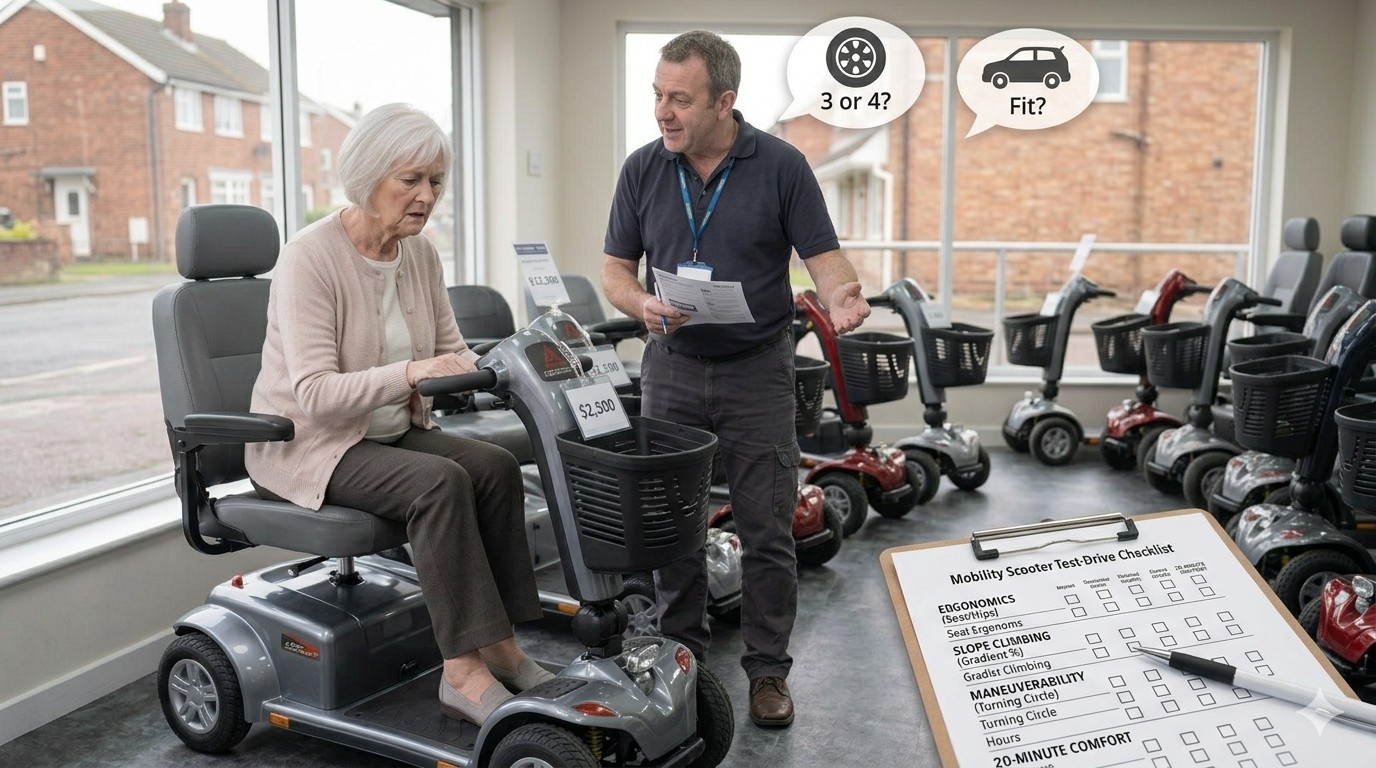
This mobility scooter test-drive checklist exists to make sure you never leave a showroom wondering whether you asked the right questions.
By the end of this guide, you will know exactly what to look for, what to feel for, and what to walk away from. You will test with purpose, not hope.
Why a Test Drive Is Non-Negotiable
Buying a mobility scooter without testing it first is like buying shoes online without knowing your size. You might get lucky. But you are far more likely to end up with something that does not quite fit, and that is a costly mistake when the "shoe" costs thousands of dollars and becomes part of your daily life.
Specification sheets cannot tell you how a seat feels after twenty minutes. They cannot tell you whether the throttle is smooth or jerky under your thumb. They cannot tell you whether the turning circle works in your actual hallway. Only a mobility scooter test-drive checklist approach, where you methodically assess each feature, can reveal these things.
And here is the part most buyers overlook: the test drive is not just about the scooter. It is about you.
Your body, your strength, your confidence, and your daily routines are the real specifications that matter. The scooter is just the tool that needs to fit them.
Before You Sit Down: Prepare Like a Pro
Arrive ready to test, not just ready to look. Wear the shoes you normally wear for outings, because footwear affects how you reach the floor plate and operate the controls. Bring your walking aid if you use one, and check where it will be stored on the scooter without interfering with steering.
Bring a family member or friend who understands your daily routine. They will notice details you miss while concentrating on driving, such as whether your shoulders are tense or whether you are gripping the tiller too tightly.
And most importantly, arrive with questions written down. A mobility scooter test-drive checklist only works if you actually check the things on it.

The Checklist, Part 1: Fit and Comfort Before You Move
Sit on the scooter before you drive it. This is where the real assessment begins.
Is the seat wide enough, and does it feel supportive? A seat that feels adequate while stationary may press uncomfortably against your thighs after ten minutes of movement. Check that the backrest supports your shoulders, not just your lower back.
Do the armrests adjust to your size? Armrests positioned too high force your shoulders upward, creating tension in your neck and upper back. Armrests that are too low offer no support at all. Adjust them and notice the difference.
Can you reach the controls comfortably? The tiller should adjust to your height, and the speed dial, throttle, and brake should fall naturally under your hands. If you have arthritis or limited grip strength, test whether the thumb lever works for you or whether you need an alternative control.
Can you get on and off safely? A swivel seat makes a huge difference. So does a footplate that is low enough to step onto without a struggle.
If getting on and off feels awkward now, it will feel worse when you are tired or in a hurry.
The Checklist, Part 2: Controls and Operation
Once you are comfortable, it is time to test how the scooter responds.
Does it accelerate smoothly or jerk forward? Some scooters move gently from a standstill; others lurch unpredictably. You want a scooter that feels predictable and controlled, especially if you will be navigating crowded spaces.
How responsive are the brakes? Test them at low speed first, then at a slightly higher speed. They should stop the scooter promptly without throwing you forward.
Is the speed dial easy to see and reach? You should be able to adjust your speed without taking your eyes off your path for more than a moment.
Can you reverse confidently? Reversing is often overlooked in test drives, but it matters every time you leave a shop aisle or back out of a tight corner. Check that you can see behind you and that the reverse speed feels manageable.
The Checklist, Part 3: The Driving Experience
Now, drive. But do not just drive in a straight line around the showroom floor. Ask to test the scooter in conditions that resemble your real life.
Indoor manoeuvrability. Ask to drive through a narrow doorway or around a tight corner. A tighter turning circle navigates supermarket aisles and hallways without requiring multiple-point turns. If the showroom cannot replicate this, ask whether you can measure the turning radius and compare it to your home's narrowest space.
Outdoor surfaces. If possible, test on a footpath or a slightly uneven surface. Cracked pavement, gravel, or grass require higher ground clearance and better suspension. A scooter that feels smooth indoors may rattle your teeth outdoors.
Slopes. If you live in a hilly area, test the scooter on a ramp or incline. Check that the motor has enough power to climb without straining, and that the brakes hold you steady when you stop on the slope. This is a safety issue, not a comfort one.
Transport fit. If you need to transport the scooter in a car, this is the moment to test it. Ask the supplier to demonstrate dismantling or folding, and then try lifting the heaviest piece yourself.
A scooter that is perfect in every other way is useless if you cannot load it.
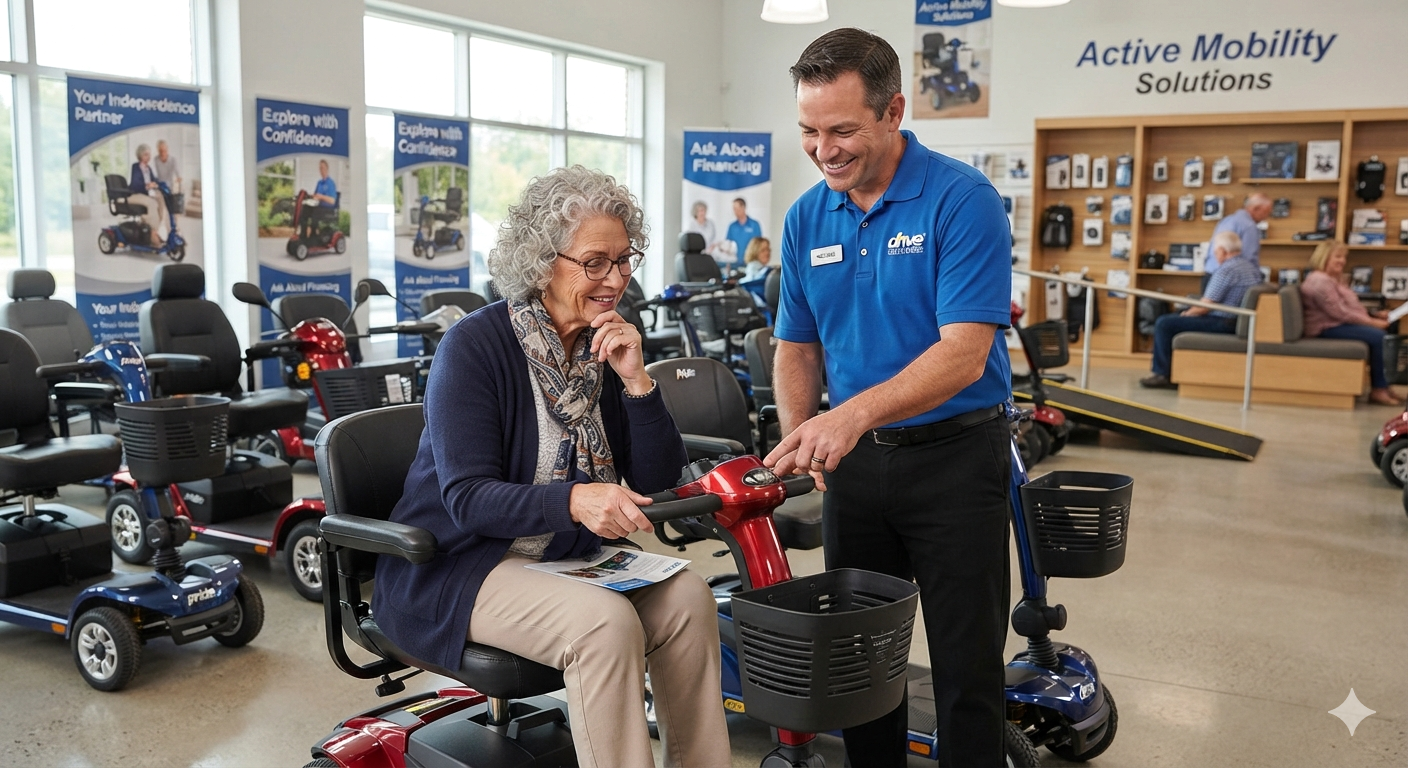
The Checklist, Part 4: Questions to Ask After the Drive
The test drive is over, but your mobility scooter test-drive checklist is not complete until you have asked the practical questions.
What is the warranty, and what does it actually cover? Batteries often have a shorter warranty than the frame and motor. Wear items like tyres and seat upholstery are usually excluded. Ask for the fine print.
What are the ongoing costs? Battery replacement every two to four years, annual servicing, and tyre replacement all add up. Ask for realistic figures.
Can I trial this at home? Many Australian suppliers offer home trials, and for NDIS participants, trialling equipment is often expected before purchase. A home trial lets you test the scooter on your own footpaths, in your own hallway, and with your own furniture layout. If a supplier does not offer this, ask why.
How does servicing work? Is there a local technician? How long does a service take? What happens if something goes wrong?
A Note for NDIS and Aged Care Buyers
If you are purchasing through the NDIS, My Aged Care, or a Home Care Package, your test drive serves an extra purpose. It provides evidence that you have trialled the equipment and that it meets your needs. Occupational therapists often require trial data to complete reports, and the NDIS expects you to trial equipment valued over $15,000 before purchase.
This means your mobility scooter test-drive checklist should be documented. Take notes. Ask the supplier for a written summary of what you tested. This is not bureaucracy for its own sake; it is how you ensure the funding is approved and the scooter is the right one.

Your Next Step
You now have a mobility scooter test-drive checklist that covers everything from seat comfort to NDIS evidence. The next step is simple: book a test drive, bring this checklist, and take your time. A good supplier will never rush you.
If they do, that is your first red flag.
The right scooter will feel like an extension of your body, not a machine you have to fight. It will give you back the distances that matter: the walk to the park, the trip to the shops, the afternoon with your grandchildren. You deserve that. And with this checklist in hand, you can absolutely find it.
For more guidance on every stage of the buying process, return to our Mobility Scooter Buying Guide hub, where you will find deep dives on car boot fit, real-world range, turning radius, warranty, and buying used.
Stay mobile, stay confident!
Sign up for our monthly Mobility Scooter Newsletter to receive practical guides, expert advice, and inspiring stories that help you make the most of your scooter and download our free "Mobility Scooter Guide for Beginners."
Don't worry — your e-mail address is totally secure.
I promise to use it only to send you our newsletter, "Mobility Matters."
Recent Articles


-
Mobility Scooter Buying Guide: Don't Buy Until You Read This
Sep 19, 26 09:38 AM
 Mobility Scooter Buying Guide: Confused by choices? We walk you through types, costs, test drives and car boot fit so you buy with total confidence.
 -
Mobility Scooter Car-Boot Fit Checklist: Measure Before You Buy
Sep 19, 26 09:30 AM
Mobility Scooter Car-Boot Fit Checklist: From boot opening height to heaviest piece, this practical guide saves you from a costly mistake. -
Mobility Scooter Test-Drive Checklist: Don't Buy Blind
Sep 19, 26 08:28 AM
Mobility Scooter Test-Drive Checklist: Stop guessing. Use this practical checklist to test comfort, safety and fit before spending your money.



Ready to Feel More Confident on Your Mobility Scooter?

My Ebook, The Ultimate Guide to Mobility Scooters, walks you through choosing the right scooter, using it safely, and keeping it in top condition — all explained in clear, friendly language.
Give yourself (or someone you love) the gift of independence.

