- Home
- Health Needs Fit
- Low Vision Friendly Scooter Features
- Stability Confidence Features for Low Vision
What Are the Best Stability Confidence Features for Low Vision Scooter and When Do They Matter?
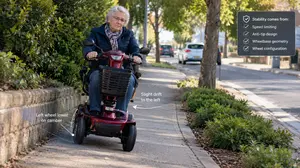
Picture this. You're on a footpath that slopes gently to the left, the kind of camber you'd barely notice on foot. On a scooter, it feels different. The left wheel is lower, the scooter wants to drift, and your hands tighten on the tiller. You're not going fast—maybe 6 km/h—but the ground feels less certain than it did a moment ago. That feeling is exactly what stability confidence features for low vision are designed to address. Not by making the scooter go faster or look sportier, but by making it feel planted, predictable, and calm—so you can keep your attention on the path instead of on your grip.
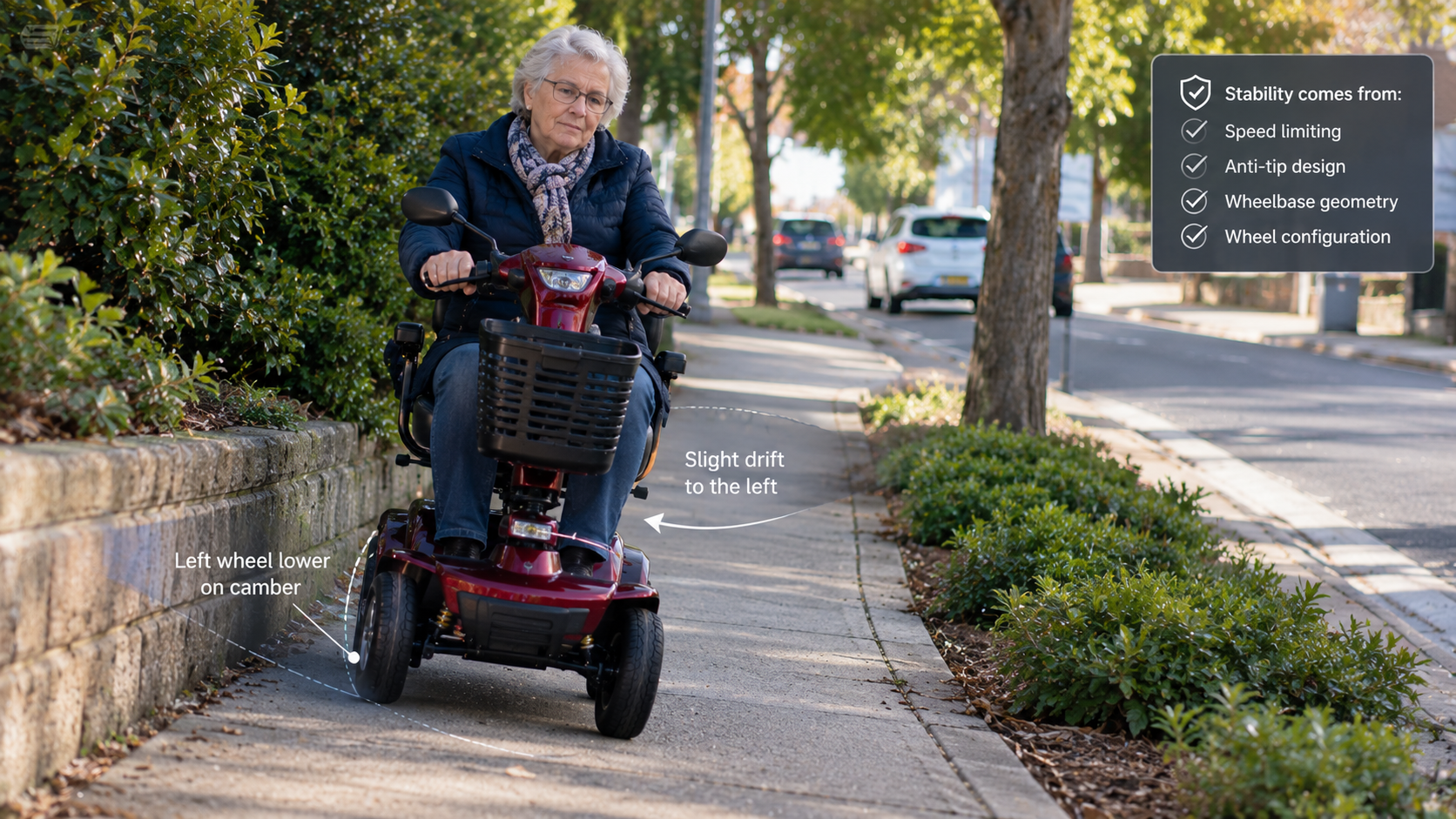
Here's the thing most buying guides miss: stability isn't one feature. It's a combination of speed limiting, anti-tip design, wheelbase geometry, and wheel configuration, working together to reduce the chance of tipping and the fear of tipping. Research on motorised scooter design is clear that stability depends on the design, operational manoeuvres, speed, environmental conditions, and role in use.
In other words, it's not just the scooter—it's the scooter plus how and where you ride it. Let's walk through the features that matter most, one at a time.
Why Stability Matters More for Low-Vision Riders
Low vision changes the stability equation in two ways. First, you detect hazards later—a camber, a kerb, or a pothole may register a second after someone with typical vision has already adjusted. Second, the visual shake from a rough ride makes it harder to read the path ahead, which compounds the first problem. A scooter that feels unstable doesn't just increase tip risk; it increases the cognitive load of every ride, because you're constantly bracing and correcting.
The good news is that the features that reduce tip risk also reduce that cognitive load. Four wheels and steady low-speed control earn their keep when confidence drops outdoors on sloped or broken pavement, as one buying guide puts it. Stability is not a luxury specification. It's the foundation of independent riding—and the first feature to understand is the one that keeps speed in check.
Speed Limiting: The Calm Feature That Does the Most Work
Speed limiting is the quiet hero of stability. It's not about going slow for the sake of it; it's about removing the sudden surges and sharp accelerations that unsettle a scooter and a rider. A scooter that accelerates smoothly and tops out at a predictable speed is far easier to control than one that lurches.
Mobility scooters typically offer low-speed settings around 6 km/h for pavement and indoor use, with road-legal models in some regions allowing up to 10 km/h or 12 km/h depending on local rules. But the number matters less than the feel: progressive acceleration rather than a sudden surge, and reliable speed limiting you can set and trust.
Some scooters go further with automatic speed reduction when cornering. The Supascoota Supalite, for example, has a speed reduction system that slows the scooter when turning a corner, plus electronic stability control. The UltraFold offers automatic speed assist that reduces speed when cornering.
These features matter for low vision because sharp turns at speed are one of the four ways a scooter can tip sideways. If the scooter slows itself before you have to think about it, you've removed a decision point—and that's a confidence feature, not just a safety one.
But speed limiting works best when it's paired with the feature that catches you if something goes wrong.
Anti-Tip Wheels: The Safety Net You Hope Never to Use
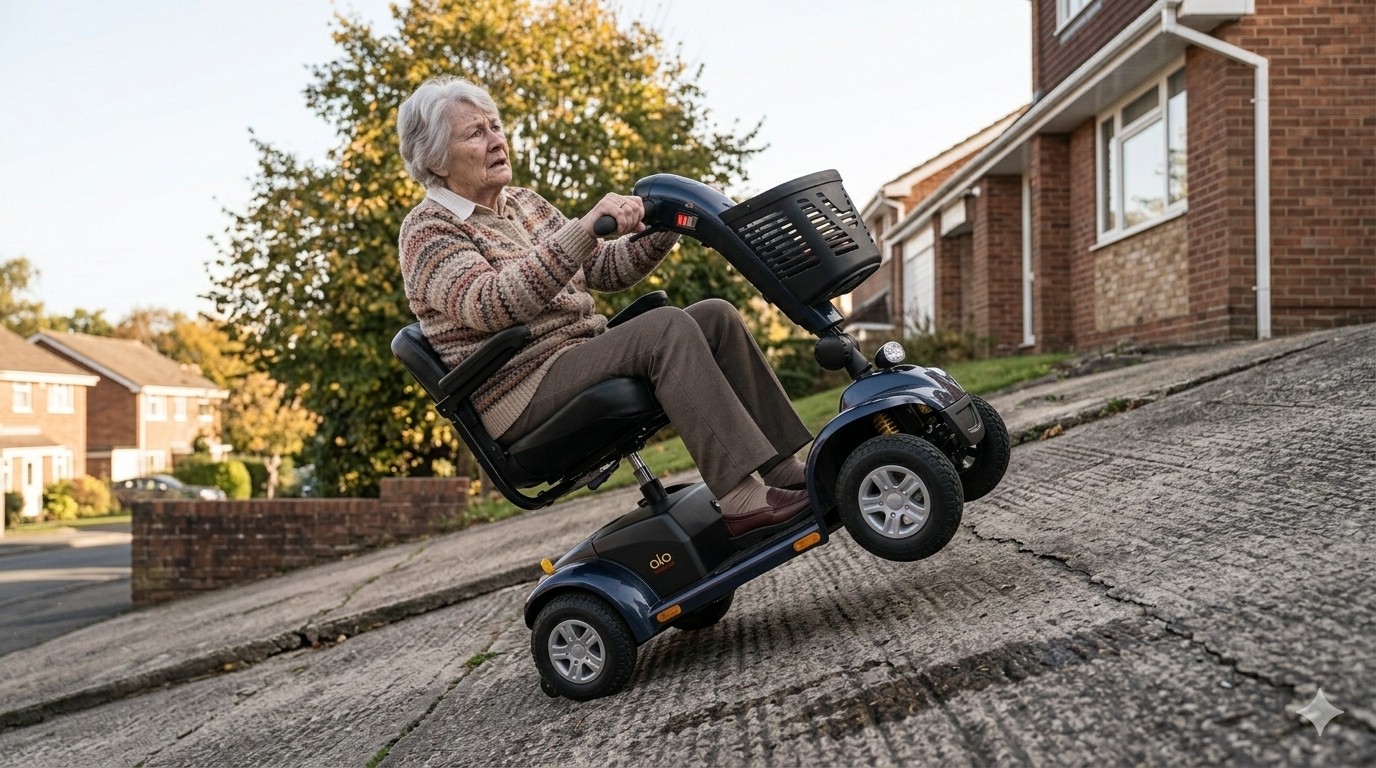
Anti-tip wheels are exactly what they sound like: small wheels or castors mounted on the frame to prevent the scooter from tipping backwards or sideways if it encounters a slope, a kerb, or an unexpected obstacle. They're a standard safety feature, and for good reason.
On rear-wheel-drive scooters, anti-tips are usually located at the rear to support the scooter on hills. On front-wheel-drive units, they're often located laterally just behind the front wheel, because those units generally lack the power for steep inclines. Some models use anti-tip rollers that prevent backwards tipping on slopes or uneven ground. And some go further: the Quingo range uses a Quintell Kerbmaster powered anti-grounding and anti-tipping system as part of its five-wheel stability design.
Here's the honest caveat: anti-tip wheels are a safety net, not a licence to take risks. They reduce the consequence of a tip, but they don't eliminate the cause. The ABLEDATA fact sheet notes that lateral anti-tippers may cause difficulties on curb cuts and ramps, so they're not a universal good—they need to be designed and positioned well. When you're evaluating a scooter, ask whether the anti-tips are part of the frame (not bolt-on afterthoughts), whether they're positioned for the terrain you'll actually ride, and whether they interfere with kerbs or ramps. A good anti-tip system should feel invisible in normal use—until the moment you need it.
Wider Wheelbase and Wheel Configuration: The Geometry of Confidence
Wheelbase—the distance between the front and rear wheels—is one of the most direct predictors of stability. A longer wheelbase increases stability and reduces the risk of tipping backward on steep inclines, and wheel width and radius help with traction on slopes. In practical terms, a scooter with a wider footprint and a longer wheelbase feels more planted, especially on cambers and uneven ground.
This is where the three-wheel versus four-wheel decision comes in. Three-wheelers turn more tightly and are easier to manoeuvre indoors, but they're less stable on uneven ground and slopes. Four-wheelers have a broader footprint that feels steadier outdoors on cambers, dropped kerbs, and uneven pavements, and their wider front wheelbase resists lateral tipping. As one health authority puts it plainly: “Three wheels are easier to manoeuvre but 4 wheels are more stable and safer on uneven terrain”.
For most low-vision riders, stability wins over agility. A planted scooter gives you the confidence to look ahead rather than down at your feet—and that's the whole game. But wheelbase isn't the only geometry that matters. Wheel camber (the inward tilt of the wheels) can increase side-to-side stability by widening the effective wheelbase, though it also increases the overall width of the scooter. And turning radius affects how predictably the scooter handles tight spaces—a responsive, calm turn reduces mental load in busy areas. The best scooter for you is the one whose geometry matches the places you actually ride.

Matching Stability Features to the Situations That Matter
Not every stability feature matters equally in every setting. Here's a simplified map:
- Uneven pavements and cambers: Prioritise four wheels, a wider wheelbase, and pneumatic tyres that absorb bumps. This is where stability confidence features earn their keep most visibly.
- Slopes and inclines: Prioritise anti-tip wheels, speed limiting, and a longer wheelbase to reduce backward tip risk.
- Indoor and crowded spaces: Prioritise predictable low-speed control and a responsive turning radius, even if the scooter is a three-wheeler.
- Kerbs and dropped pavements: Prioritise anti-tip design that doesn't catch on kerbs, plus ground clearance that lets you mount a kerb without scraping.
If you're unsure which situations apply to you, a low-vision-focused test drive is the best way to find out—because the features that feel reassuring on a showroom floor may feel different on a real camber.
The Test Drive: How to Evaluate Stability Before You Buy
Don't just ride on a flat showroom floor. Test the scooter on the surfaces and slopes you'll actually encounter. Here's a simple sequence:
- The camber check. Find a slight side slope—a driveway lip or a sloping pavement—and ride across it slowly. Does the scooter feel planted, or does it want to drift? A wider wheelbase and four wheels should feel steadier here.
- The kerb check. If possible, test a dropped kerb or a small lip. Does the scooter mount it cleanly, or does it jolt? Do the anti-tip wheels catch?
- The turn check. Turn at low speed and at a slightly higher speed (within the scooter's limits). Does it feel stable, or does it lean? Automatic cornering speed reduction should make this feel calmer.
- The stop check. Accelerate gently and brake. Does the scooter stop smoothly without pitching forward? Progressive acceleration and reliable braking are stability features too.
- The anti-tip check. Ask the dealer to show you where the anti-tip wheels are and how they're mounted. Are they part of the frame? Do they interfere with kerbs?
This sequence is part of a proper low-vision-focused test drive, and it's worth running on more than one scooter so you have a baseline. If you're also weighing up a scooter against a power wheelchair, our comparison of mobility scooter vs power wheelchair for low vision covers how stability and control differences play out. (Coming Soon!)
When to Bring in an Occupational Therapist
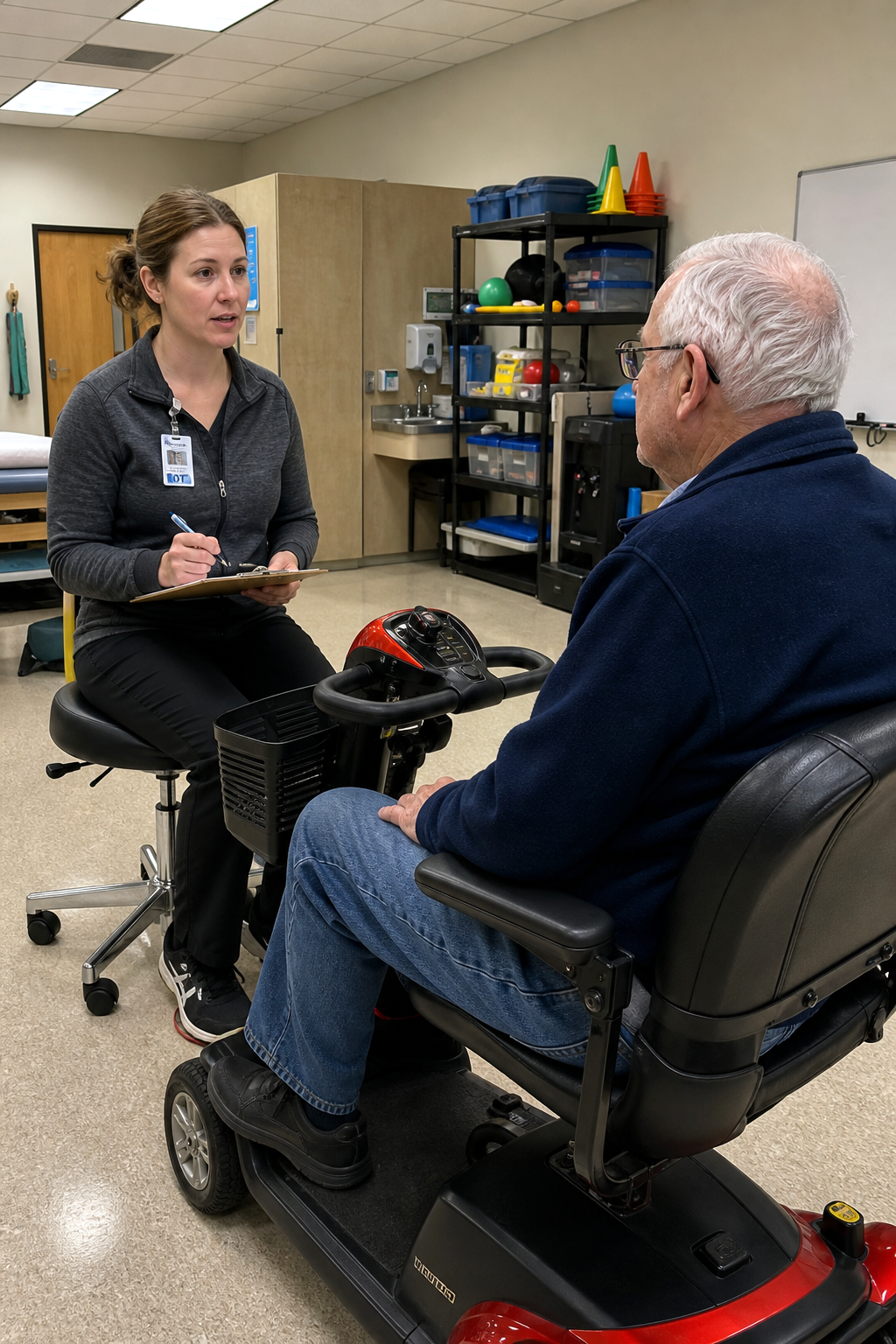
An OT isn't a gatekeeper designed to tell you “no.” A good OT is a translator—assessing your visual scanning, reaction time, and functional goals, then matching those to a device and a training plan. Stability features are only useful if they match your body and your environments, and an OT can help you work out which features actually reduce risk for you.
Research on low-vision scooter use consistently points to contrast sensitivity as a key factor in safe driving performance, and clinical guidance recommends an independent assessment before buying if vision, cognition, or physical health are part of the picture. If you have a visual field defect or reduced reaction time, an OT's input is especially valuable, because the right stability feature depends on which part of the task is actually difficult. The right OT makes the process feel like a plan, not a test.
A Final Word (Before You Go)
You don't need the widest wheelbase on the market or the most aggressive anti-tip system. You need a scooter that feels planted on the surfaces you actually ride, with speed limiting that keeps acceleration calm, anti-tip wheels that are part of the design rather than an afterthought, and geometry that matches your environments. The next time you sit on a scooter, you'll know exactly what to test—and what to walk away from.
And if you want the full picture of low-vision-friendly features, our parent guide to low vision friendly scooter features is the natural next step.
Stay mobile, stay confident!
Sign up for our monthly Mobility Scooter Newsletter to receive practical guides, expert advice, and inspiring stories that help you make the most of your scooter and download our free "Mobility Scooter Guide for Beginners."
Don't worry — your e-mail address is totally secure.
I promise to use it only to send you our newsletter, "Mobility Matters."
Recent Articles


-
The Low Vision Friendly Scooter Features Nobody Explains
Oct 30, 26 08:47 AM
 Low vision friendly scooter features that reduce risk and restore independence—without jargon, guesswork, or pressure.
-
Mobility Scooter vs Power Wheelchair for Low Vision: The Honest Guide
Oct 30, 26 08:44 AM
Mobility scooter vs power wheelchair for low vision—which is safer and easier to control? A calm, evidence-led comparison for riders and carers. -
Stability Confidence Features for Low Vision, Made Clear
Oct 30, 26 07:33 AM
Stability confidence features for low vision that actually help. Learn speed limiting, anti-tip design, and wheelbase—and when they matter most.

Ready to Feel More Confident on Your Mobility Scooter?

My Ebook, The Ultimate Guide to Mobility Scooters, walks you through choosing the right scooter, using it safely, and keeping it in top condition — all explained in clear, friendly language.
Give yourself (or someone you love) the gift of independence.




