- Home
- Health Needs Fit
- Low Vision Friendly Scooter Features
- Mobility Scooter vs Power Wheelchair for Low Vision
Mobility Scooter vs Power Wheelchair for Low Vision: Which Is Safer and Easier to Control?
Picture this. You're sitting in a mobility showroom, and in front of you are two devices. On the left, a scooter with a tiller—handlebars, a throttle lever, a dashboard. On the right, a power wheelchair with a small joystick on the armrest. The salesperson says both will “work for low vision,” but they feel completely different under your hands. One asks you to hold your arms up and steer like a bicycle. The other asks for a gentle push of a thumb. Which one is actually safer? Which one is easier to control when your eyesight is doing extra work? That's the question this guide exists to answer—and the honest answer is: it depends on you, your vision profile, your hands, and where you want to go.
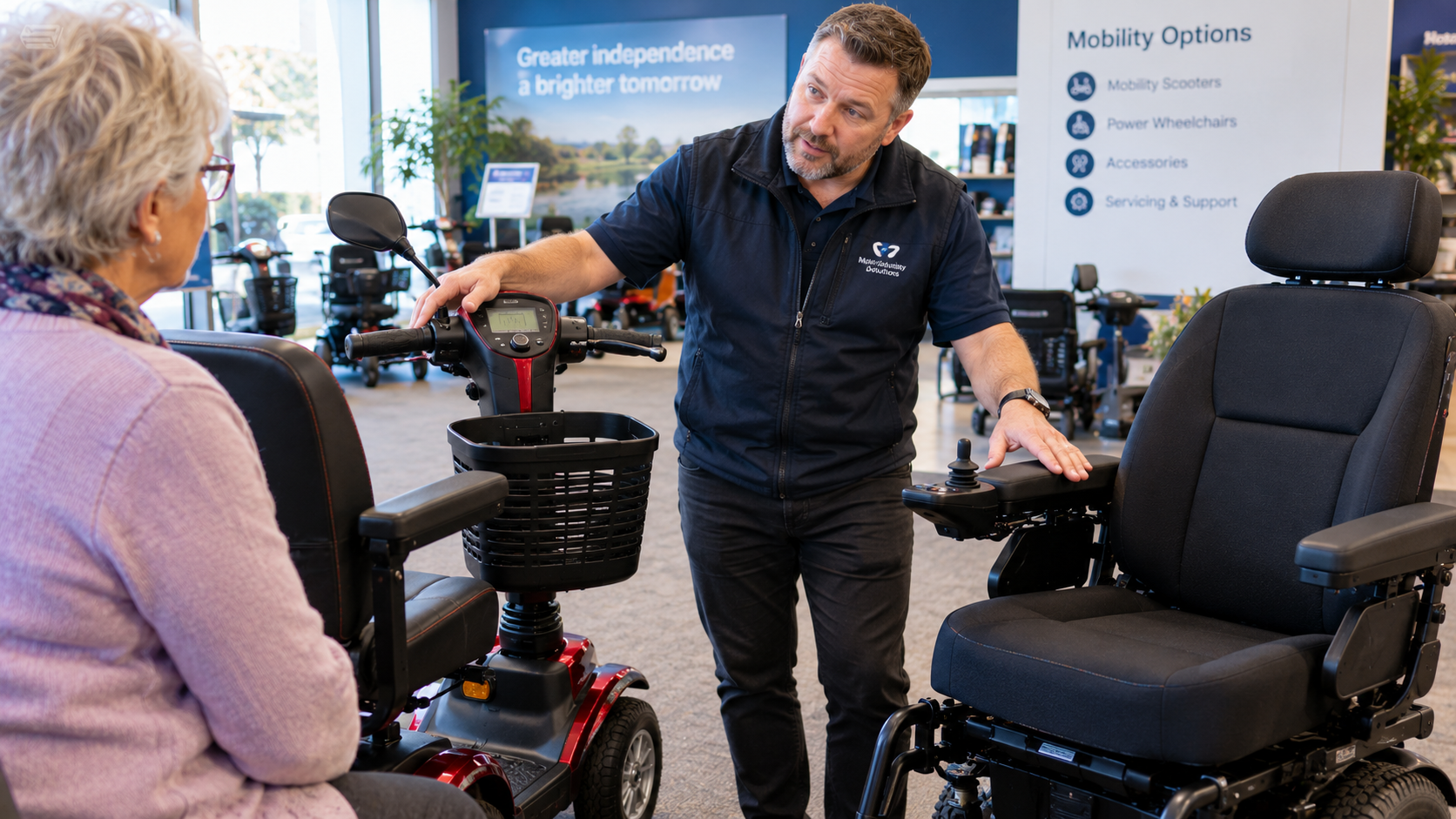
The mobility scooter vs power wheelchair for low vision decision is not about finding a winner. It's about matching a device's control interface, stability, and feedback to your body and your environments. And the good news is that the evidence is more reassuring than you might expect.
Let's walk through the comparison together, calmly and without pressure.
The Reassuring Headline: Low Vision Alone Doesn't Disqualify You
Before we compare devices, let's retire a myth. Research on practical fitness to drive mobility scooters found that approximately 90% of visually impaired participants passed an on-road driving test. On average, visually impaired participants performed worse than normal-sighted controls, but they were judged sufficiently safe—and the authors concluded that visual impairment on its own should not be viewed as a determinant of safety to drive mobility scooters.
That doesn't mean every person with low vision is automatically safe. It means the question isn't “can I drive?” but “which device, with which controls, in which environments, with what training?” That's a much more useful question—and it's the one we're about to answer.
Control Interface: Tiller vs Joystick (The Biggest Difference)
The single most important difference between a scooter and a power wheelchair is how you steer. A mobility scooter uses a tiller or handlebars, with throttle and brake levers operated by your hands and arms. A power wheelchair uses a joystick, usually mounted on the armrest, that requires very little strength or range of motion.
For low vision, this difference matters in two ways. First, the tiller asks more of your body. You need enough upper-body function and grip strength to operate it, and the tiller can force you to lean forward, which changes your posture and your view of the path. Second, the tiller asks more of your vision for confirmation. You're holding your hands out in front of you, and the controls are on the tiller—so if you can't tell the horn from the indicator by touch, you have to glance down to check.
A joystick, by contrast, keeps your hand in one predictable place on the armrest. That's a quieter, more stable control interface for someone whose eyes are already busy scanning the environment. It's also why cognitive limitations and weak hand control on one side are often reasons to choose a power wheelchair: joystick operation is simpler than tiller scooter controls.
But simpler isn't automatically better for everyone—and the next factor is stability.
Stability: Where Power Wheelchairs Usually Have the Edge
Stability is not a small detail for low vision, because you detect hazards later—a camber, a kerb, or a pothole may register a second after someone with typical vision has already adjusted. A device that feels planted gives you the confidence to look ahead rather than down at your feet.
Power wheelchairs generally have two large drive wheels plus four casters, which adds stability and reduces the likelihood of rollover accidents. Mobility scooters typically have three or four wheels, and three-wheelers in particular are less stable on uneven ground and slopes—they can tip sideways on a camber or backward on a hill. Scooters often lack the inherent stability of a six-wheel powerchair design, and while four-wheel scooters improve on this, the geometry still favours the powerchair for pure stability.
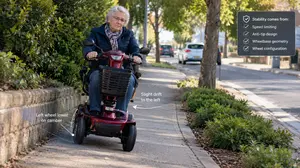
That doesn't make scooters unsafe. It means stability is a trade-off you need to understand, not ignore. If you ride mostly on smooth, flat pavements and you're comfortable with the scooter's handling, a well-chosen four-wheeler can be perfectly suitable. If you ride on cambers, uneven footpaths, or slopes—or if you want the most planted-feeling device—the powerchair's wheel configuration has a structural advantage.
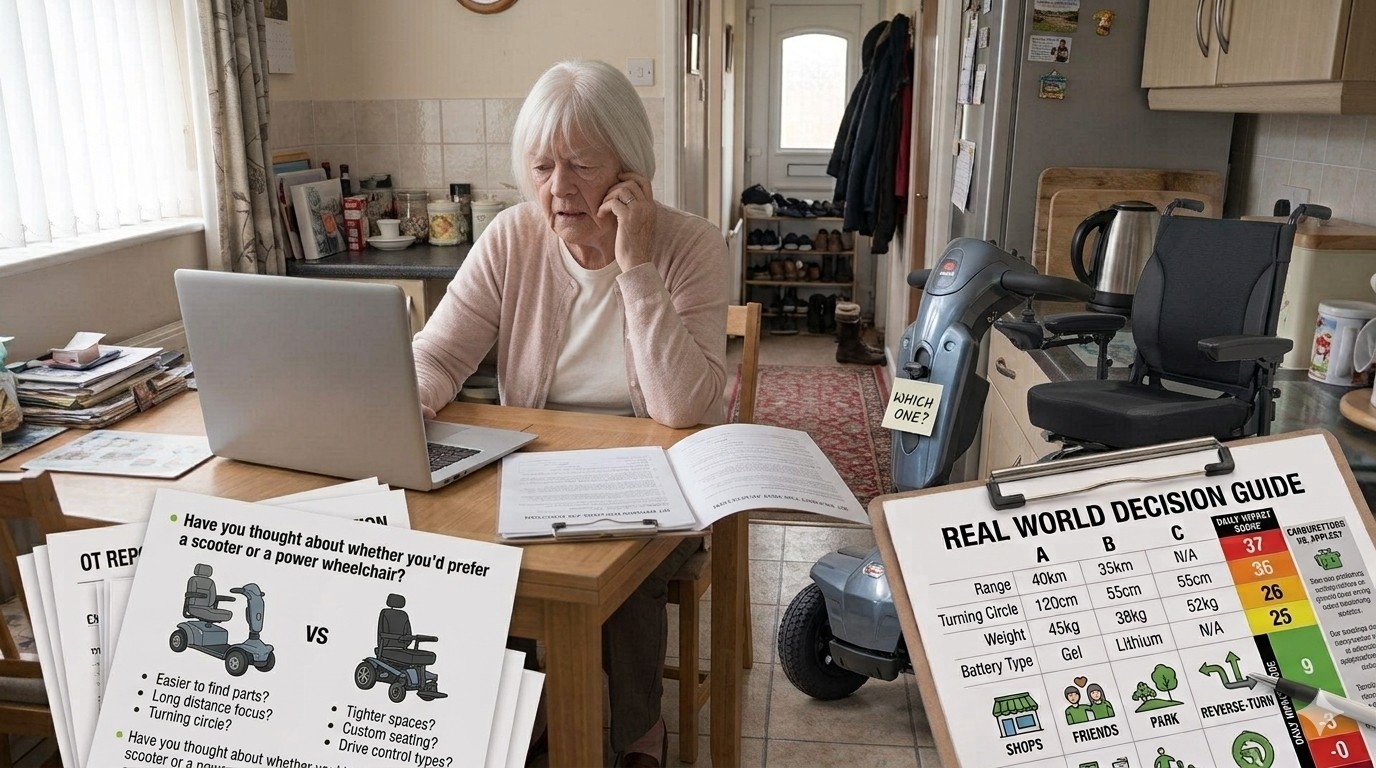
Cognitive Load and Visual Demand: Which Device Asks Less of Your Eyes?
Low vision doesn't just affect what you see; it affects how much visual checking you have to do. Every glance down at a control panel is a moment you're not scanning for hazards. So the question is: which device lets you keep your eyes on the path?
A joystick-controlled power wheelchair has a quieter visual profile in this respect. Your hand stays on the joystick, and the control interface is small and predictable. Some compact joysticks have no buttons or screens to distract the client, and they're recommended for clients with cognitive deficits for whom a screen would be distracting. A joystick can also be used by individuals with visual deficits who benefit from multiple modes of sensory feedback.
A tiller-steered scooter, by contrast, asks you to manage two hands, a dashboard, and a steering column all at once. That's not a dealbreaker—many low-vision riders manage it well—but it's a higher visual and cognitive workload, especially in busy environments. And that workload is exactly what an occupational therapist will assess.
Training and Self-Regulation: The Factor Nobody Talks About Enough
Here's something that applies to both devices: the device is only half the story. Research on older adults with low vision found that scooter users self-regulate—they manage speed, restrict their riding to familiar areas, and calculate the meaning of a trip against the potential risks. That self-regulation is a strength, but it can also lead people to avoid places they'd otherwise go.
The same research found that scooter use is typically self-regulated by default—it's often privately purchased without any prior assessment or training. That's a gap, and it's one that training can fill. Training adapted for low vision—covering things like identifying moving objects and managing speed—can build the confidence that self-regulation alone can't.
For power wheelchair users with low vision, orientation and mobility training is also available, and it focuses on navigating tight spaces, doors, and complex environments. The right training is not a sign that you're unsafe. It's a sign that you're taking the decision seriously.
Visibility and Being Seen: A Shared Concern
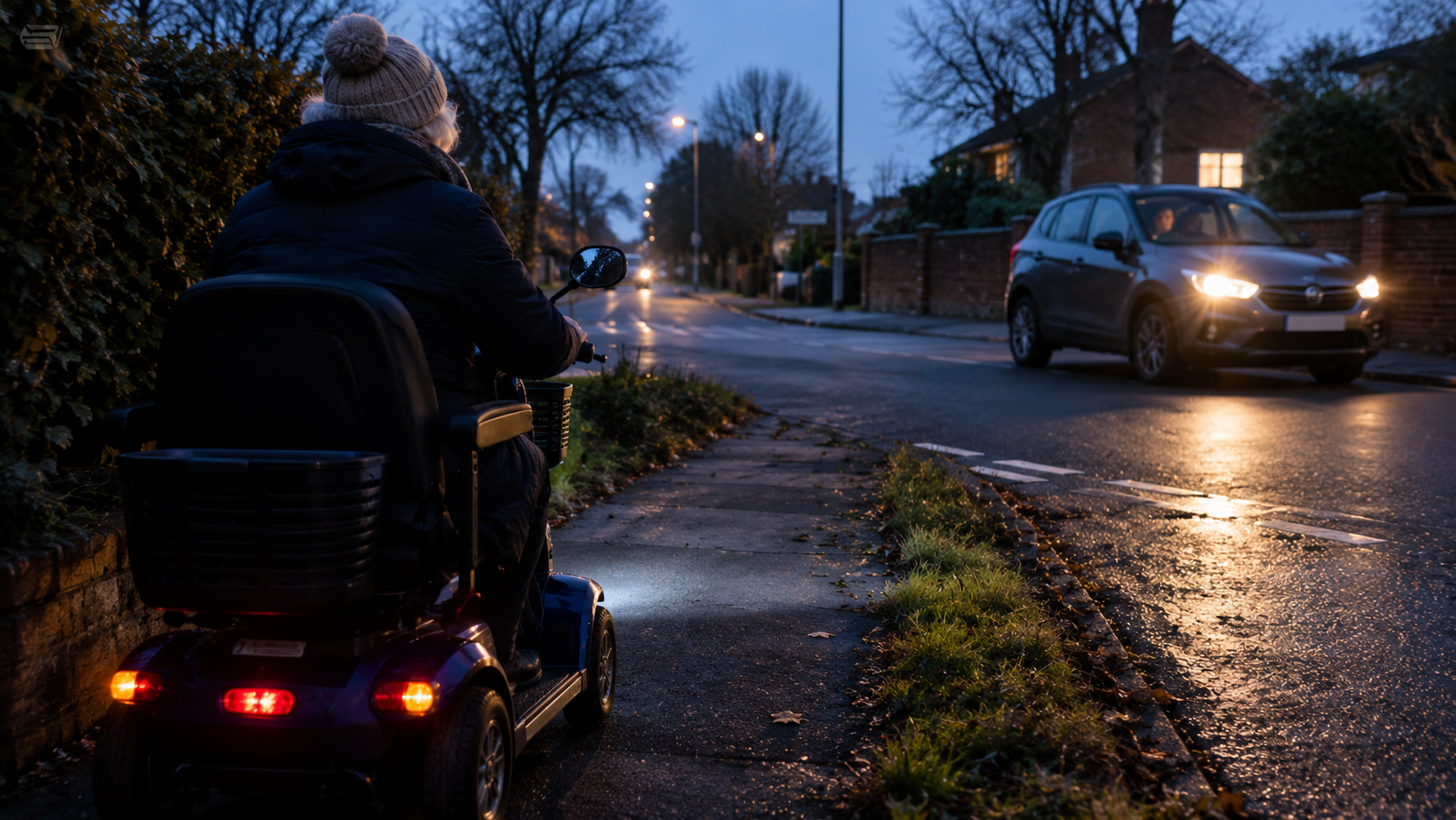
Both devices share the same visibility challenge: you are low to the ground, moving slowly, and often invisible to drivers. The features that help are similar across both—lights, reflectors, high-visibility elements—but the specifics differ.
Scooters often come with headlights, indicators, and reflectors as standard, especially road-legal models. Power wheelchairs may have lighting and reflectors as options rather than defaults, and their seating position may make them lower or less conspicuous in traffic. If you ride at dusk or after dark, ask specifically about lighting packages and reflective panels on whichever device you're considering. Being seen is not a device-type issue; it's a specification issue—and you deserve to know what's included.
When to Bring in an Occupational Therapist
This is the step where the decision gets clearer. An OT doesn't tell you “scooter” or “powerchair” based on a hunch. They assess your vision, cognition, physical capacity, and goals, and then match those to a device and a training plan.
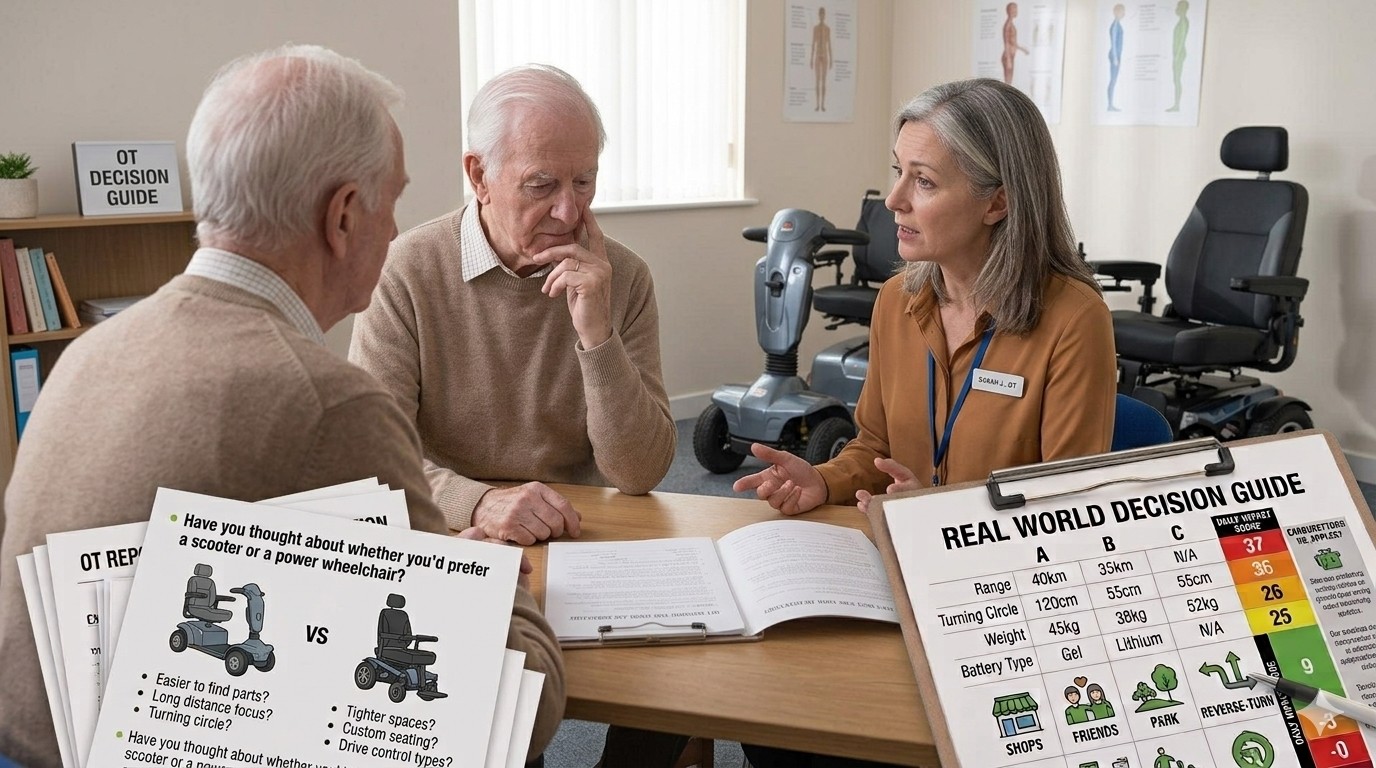
The assessment typically includes a conversation about where and how you want to ride, a review of adequate vision to scan the environment and avoid hazards, and an on-device trial that may span more than one appointment. The OT will also consider arm strength, hand function, sitting balance, neck movement, and your ability to get on and off the device. For low vision specifically, clinical guidance recommends collaboration between occupational therapists and orientation and mobility specialists, because the combination of vision loss and mobility impairment benefits from both skill sets.
If you're unsure which device suits you, this assessment is not a hurdle. It's the most efficient way to avoid buying the wrong thing—and the most reassuring way to know you've chosen well.
The Real-World Test: How to Compare Both Devices Before You Buy
Don't just read spec sheets. Test both devices in the conditions you'll actually ride in. Here's a simple comparison sequence:
- The control-by-touch test. Close your eyes and find the horn, indicator, and throttle on the scooter; then find the joystick and any auxiliary controls on the powerchair. Which interface feels more intuitive under your hands?
- The posture-and-view test. Sit on each device and notice how your posture affects what you can see. Does the tiller pull you forward? Does the joystick let you sit upright with a clear view?
- The surface test. If possible, test both on a slight camber or uneven pavement. Does one feel noticeably more planted than the other?
- The cognitive-load test. Ask yourself which device lets you keep your eyes on the path more easily. If you're constantly glancing down to check controls, that's a signal.
- The training question. Ask what training is available for each device, and whether it's adapted for low vision. A device with good training is safer than a device without it.
This sequence is part of a proper low-vision-focused test drive, and it's worth running on both device types so you have a genuine comparison.
A Final Word (Before You Go)
There is no universal winner in the mobility scooter vs power wheelchair for low vision debate. There is only the right device for you—and the right device is the one whose control interface matches your hands, whose stability matches your environments, and whose feedback matches your eyes.
A scooter may suit you if you have good upper-body control, you mainly travel outdoors on familiar routes, and you're comfortable with a tiller. A power wheelchair may suit you if you want a simpler control interface, greater stability, or postural support. Neither choice is a failure. Both are tools—and now you know how to choose between them.
And if you want the full picture of low-vision-friendly features, our parent guide to low vision friendly scooter features is the natural next step.
Stay mobile, stay confident!
Sign up for our monthly Mobility Scooter Newsletter to receive practical guides, expert advice, and inspiring stories that help you make the most of your scooter and download our free "Mobility Scooter Guide for Beginners."
Don't worry — your e-mail address is totally secure.
I promise to use it only to send you our newsletter, "Mobility Matters."
Recent Articles


-
The Low Vision Friendly Scooter Features Nobody Explains
Oct 30, 26 08:47 AM
 Low vision friendly scooter features that reduce risk and restore independence—without jargon, guesswork, or pressure.
-
Mobility Scooter vs Power Wheelchair for Low Vision: The Honest Guide
Oct 30, 26 08:44 AM
Mobility scooter vs power wheelchair for low vision—which is safer and easier to control? A calm, evidence-led comparison for riders and carers. -
Stability Confidence Features for Low Vision, Made Clear
Oct 30, 26 07:33 AM
Stability confidence features for low vision that actually help. Learn speed limiting, anti-tip design, and wheelbase—and when they matter most.
Ready to Feel More Confident on Your Mobility Scooter?

My Ebook, The Ultimate Guide to Mobility Scooters, walks you through choosing the right scooter, using it safely, and keeping it in top condition — all explained in clear, friendly language.
Give yourself (or someone you love) the gift of independence.




