- Home
- Buying Guides
- Mobility Scooter Buying Guide
- Compare Mobility Scooter Spec Sheets
How to Compare Mobility Scooter Spec Sheets (What Matters vs What to Ignore)
Picture this: You are sitting at your kitchen table with three spec sheets spread out in front of you. One scooter claims 40 kilometres of range. Another says 35. A third doesn't list range at all but boasts a "powerful 700-watt motor." One has a turning radius of 120 centimetres. Another says 55. The weights are listed as 45 kg, 38 kg, and 52 kg. There is a column called "ground clearance" with numbers you do not understand, and a row called "battery type" with words like "gel" and "lithium" that mean nothing to you yet.
You want to make the right choice. But right now, you feel like you are comparing apples to carburettors.
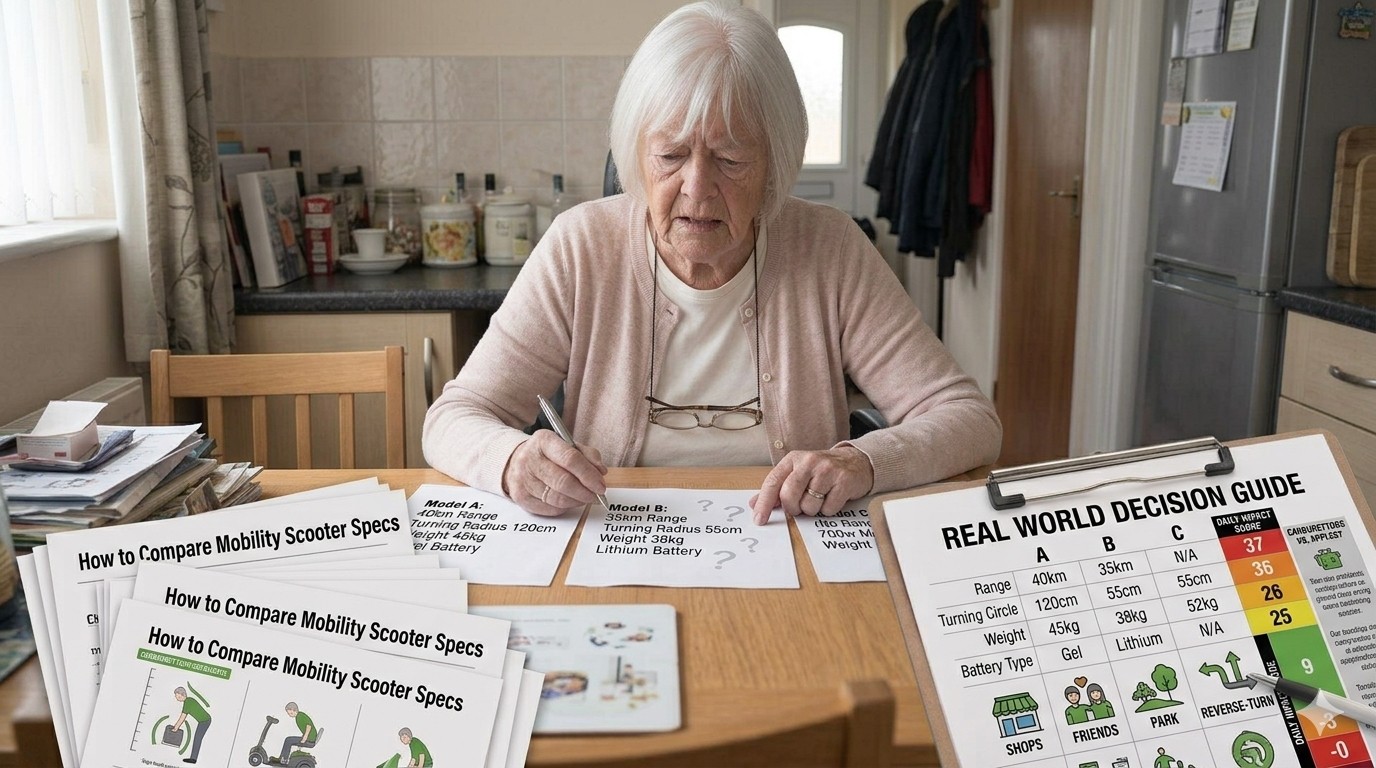
This guide exists to fix that. By the time you finish reading, you will know exactly which numbers on a mobility scooter spec sheet genuinely change your daily life, which ones are marketing noise, and how to compare models without drowning in data.
Who This Guide Is For and Why Spec Sheets Are So Confusing
This guide is for anyone who has ever stared at a spec sheet and felt their eyes glaze over. Maybe you are a first-time buyer trying to understand what you are actually paying for. Maybe you are an adult child comparing options for a parent and you want to make sure you are not being sold something unsuitable. Or maybe you have already bought one scooter and learned the hard way that the numbers did not tell the whole story.
The search intent behind this topic is commercial investigation with a strong comparison anxiety. People searching for spec sheet guidance are not just curious. They are standing at a decision point. They have two or three models in front of them, and they need a way to cut through the noise.
And here is the problem with Page 1: most results are manufacturer spec sheets themselves, which assume you already know what the numbers mean. Or they are retailer comparison tools that rank products by criteria the retailer wants you to care about.
What is missing is a neutral guide that tells you which specs actually matter, which ones you can safely ignore, and why.
The Specs That Actually Matter
Let us start with the numbers that genuinely change your daily experience. These are the specs worth spending time on.
Weight of the heaviest piece, not total weight. This is the single most misunderstood specification in the entire mobility scooter market. A scooter might weigh 45 kilograms in total, but if it dismantles into five pieces with the heaviest piece being 12 kilograms, it is far more portable than a 35-kilogram scooter that comes apart in two pieces with a 25-kilogram heaviest section.
Pride Mobility explicitly makes this point: a scooter’s total weight matters less than the weight of its heaviest single piece. When you compare spec sheets, ignore the total weight headline. Find the heaviest piece weight. That is the number your back will thank you for.
Turning radius, not turning circle. Manufacturers often list turning radius. But what you actually need to know is the turning circle, which is double the radius. A scooter with a turning radius of 55 centimetres needs a clear space of 110 centimetres to turn around without reversing.
Measure your tightest indoor space, double the scooter’s turning radius, and compare. If the scooter’s turning circle exceeds your available space, you will be reversing out of rooms for the life of the scooter. Some scooters now achieve turning radii as tight as 94 centimetres, which is remarkably compact for a four-wheel design. A three-wheel scooter will almost always offer a tighter turning radius than a four-wheel model of similar size, often by 20 to 30 centimetres or more.
Read the full guide: Mobility Scooter Turning Radius Explained: How To Measure Your Home and Avoid a “Too-Big” Scooter
Real-world range, not advertised range. Advertised range is measured under ideal conditions: flat terrain, lightweight rider, new battery, moderate speed. In the real world, most users get 70–90% of the listed range, and in cold weather or hilly terrain, that figure can drop to 60% or lower.
One industry guide recommends assuming you will get around two-thirds of the quoted range in ordinary use, and less in winter or on hills. When comparing spec sheets, do not compare advertised ranges against each other. Compare them against your longest regular trip, then apply a 30–40% reduction to see whether the scooter will actually get you there and back.
Read the full guide: Real-World Mobility Scooter Range: How to Estimate Km from Your Routine, Terrain, and Load
Weight capacity with a buffer. Weight capacity is a safety spec, not a vanity spec. A rider who is 20 pounds over the rating can technically still ride the device, but the battery drains faster, the suspension bottoms out, and the safety margin disappears.
One practical guide recommends stepping up to the next-larger model if the rider is within 30 pounds of a model’s stated rating. Another suggests choosing a unit rated for at least 50 pounds more than your actual body weight, not because the rating is inaccurate, but because you want headroom for hills, shopping, and the natural decline of battery performance over time.
Ground clearance for your actual terrain. Ground clearance determines what surfaces you can navigate without scraping the underside of the scooter. For smooth footpaths and indoor use, 5–7 centimetres is adequate.
If you regularly encounter kerbs, ramps, or uneven ground, aim for 8–10 centimetres or more. If you rarely leave smooth surfaces, higher clearance adds weight and bulk without benefit.
Battery type, because it affects everything. Lithium batteries are lighter, tolerate deeper discharge better, and require less maintenance. Gel batteries are heavier, cheaper, and hold a longer charge, making them better for extended range on larger scooters.
The battery type affects portability, range, replacement cost, and even the scooter’s overall weight. When comparing spec sheets, battery type is not a minor detail. It is a lifestyle indicator.
Read the full guide: What Should I Ask About Battery Replacement Cost, Lifespan, and Availability (For a Specific Model)?
The Specs You Can Safely Compromise On
Not every spec deserves equal weight. Here are the numbers that matter less than you might think.
Maximum speed, within reason. In Australia, mobility scooters are generally limited to 10 km/h on footpaths and in public spaces. A scooter capable of 15 km/h cannot legally be used at that speed in most public settings. Unless you have a specific legal use case for higher speeds, comparing scooters by top speed is largely irrelevant. A scooter that comfortably and smoothly achieves 8–10 km/h is doing everything you need it to do.
Motor wattage. A higher wattage number sounds impressive, but it does not automatically mean better performance. Motor efficiency, battery capacity, and the scooter’s weight all interact with wattage. A 300-watt motor on a lightweight scooter may perform as well as a 700-watt motor on a heavy one. Torque, which determines hill-climbing ability, is more meaningful than raw wattage, but it is rarely listed on consumer spec sheets. If you cannot find torque, test the scooter on a slope instead of trusting the wattage number.
Seat width and depth, unless you have specific needs. These measurements matter enormously for comfort, but they are also highly personal. A spec sheet cannot tell you whether a seat will feel comfortable after thirty minutes. Sit on the scooter. Adjust the seat. If possible, spend more than five minutes in it. The numbers are a starting point, not a verdict.
Suspension type, in isolation. Front and rear suspension sounds better than rear-only. But suspension quality varies enormously. A well-designed rear suspension may outperform a poorly designed full suspension. Test the ride quality rather than counting suspension zones.
The Specs You Can Usually Ignore
Now for the numbers that are mostly marketing.
“Up to” range figures without context. Any range figure presented without testing conditions is marketing, not data. If a manufacturer says “up to 40 km,” ask under what conditions. If they cannot tell you, treat the number as a best-case fantasy.
Top speed beyond 10 km/h. As noted above, Australian regulations cap public-use speed at 10 km/h. A scooter advertised at 16 km/h is not giving you a legal advantage on footpaths. It may have a higher-speed mode for private property, but that is not a daily-use feature for most buyers.
Number of wheels as a quality indicator. Three wheels and four wheels are not better or worse. They are different tools for different situations. A three-wheel scooter is not “lower quality” than a four-wheel scooter; it is more manoeuvrable but less stable on slopes. Compare the configuration to your actual needs, not to a perceived hierarchy.
“Heavy-duty” as a standalone label. Heavy-duty scooters are rated for higher weights and rougher terrain, but the label alone tells you nothing. A scooter rated for 500 pounds that was engineered as an afterthought around a standard frame is not the same as one built from the ground up for bariatric use. Look at the actual weight capacity, frame construction, and motor specifications rather than the marketing category.

A Practical System for Comparing Spec Sheets
Here is a simple method you can use at the showroom or at your kitchen table.
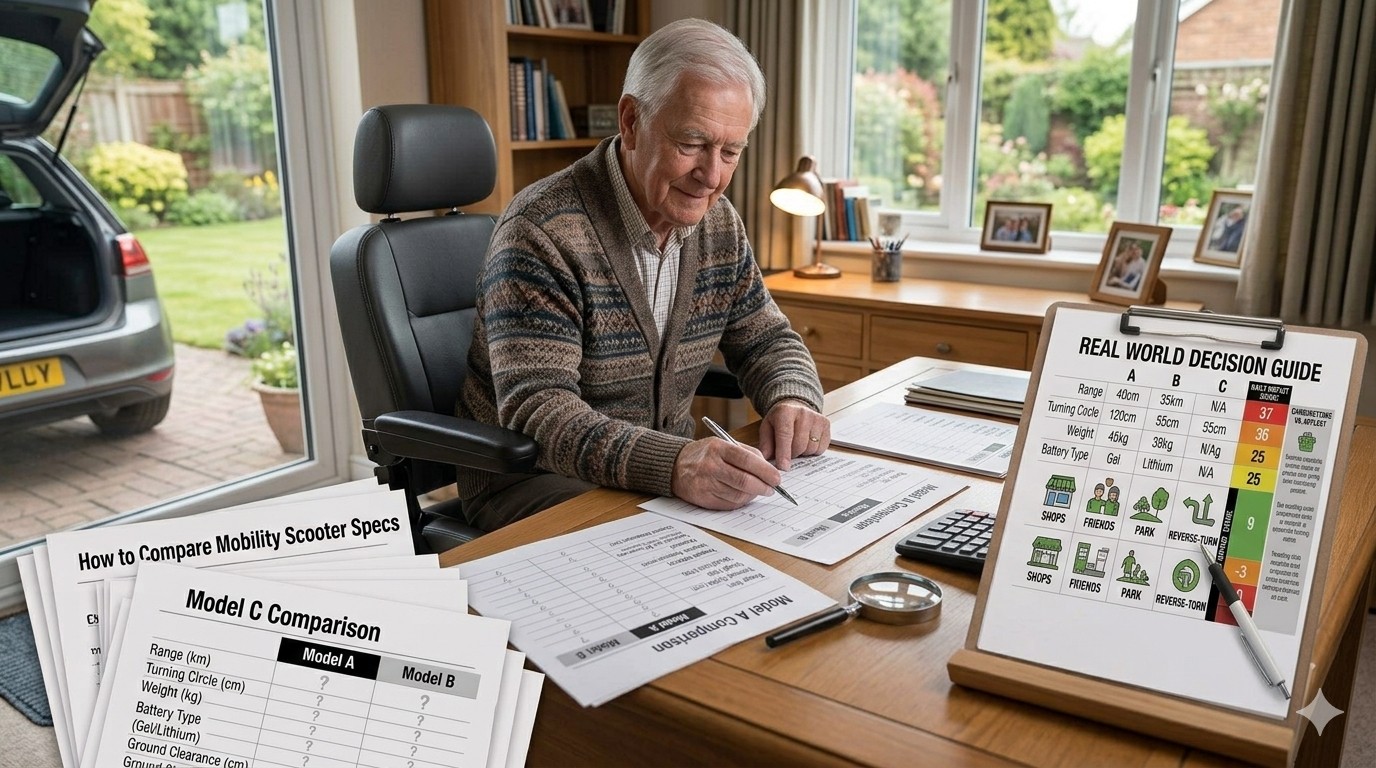
Step 1: Circle the five specs that matter. Heaviest piece weight, turning radius (double it), real-world range estimate (advertised × 0.7), weight capacity minus your weight (you want a buffer of at least 15–20 kg), and ground clearance. These five numbers will eliminate most unsuitable models immediately.
Step 2: Cross out the three specs that do not. Maximum speed above 10 km/h, motor wattage, and total weight (as opposed to heaviest piece weight). If a spec sheet leads with these numbers, the manufacturer is selling to your excitement, not your needs.
Step 3: Match the remaining specs to your measurements. You should already have your hallway width, tightest turning space, car boot dimensions, and longest regular trip written down. Compare each scooter’s circled specs to those numbers. Any scooter that fails on turning radius or heaviest piece weight is eliminated, no matter how good it looks elsewhere.
Step 4: Test what the specs cannot tell you. Seat comfort, control ergonomics, ride quality, and your own confidence are not measurable on a spec sheet. A scooter that passes the paper test still needs a test drive. Use our mobility scooter test-drive checklist to evaluate the things numbers cannot capture.
Your Spec Sheet Comparison Checklist
Before you buy, confirm you have compared these five things across every model on your shortlist:
Heaviest piece weight. Can you lift it safely from floor to boot height?
Turning circle (radius × 2). Does it fit your tightest indoor space with at least 10 cm of clearance?
Real-world range estimate (advertised × 0.7). Does it exceed your longest regular trip by at least 30%?
Weight capacity buffer. Is the scooter rated at least 15–20 kg above your body weight?
Ground clearance. Does it match the surfaces you actually encounter?
If a scooter passes all five, it deserves a test drive. If it fails on any one, cross it off the list and move to the next.

Your Next Step
You now have a method for comparing spec sheets that focuses on the numbers that change your daily life and ignores the ones that do not. The next step is to take this method to your supplier. Ask for the heaviest piece weight. Ask what the real-world range looks like in Australian conditions. Ask to measure the turning circle against your hallway.
For more guidance on every stage of the buying process, return to our Mobility Scooter Buying Guide hub, where you will find deep dives on test-driving, car boot fit, turning radius, liftability, real-world range, warranty, and buying used.
The right scooter is the one that fits your measurements, your routine, and your body. With these comparison skills in hand, you are well equipped to find it.
Stay mobile, stay confident!
Sign up for our monthly Mobility Scooter Newsletter to receive practical guides, expert advice, and inspiring stories that help you make the most of your scooter and download our free "Mobility Scooter Guide for Beginners."
Don't worry — your e-mail address is totally secure.
I promise to use it only to send you our newsletter, "Mobility Matters."
Recent Articles


-
The NDIS Mobility Scooter Funding Guide I Wish Someone Had Given Me
Sep 24, 26 09:26 AM
 NDIS funding for mobility scooters doesn't have to be confusing. Here's your friendly guide to eligibility, assessment, costs, and approval.
 -
Mobility Scooter Buying Guides– No More Guesswork
Sep 24, 26 07:28 AM
 Mobility Scooter Buying Guides — don’t buy before reading this. Expert tips on features, safety, and getting the best value.
 -
Mobility Scooter Buying Guide: Don't Buy Until You Read This
Sep 24, 26 07:02 AM
Mobility Scooter Buying Guide: Confused by choices? We walk you through types, costs, test drives and car boot fit so you buy with total confidence.



Ready to Feel More Confident on Your Mobility Scooter?

My Ebook, The Ultimate Guide to Mobility Scooters, walks you through choosing the right scooter, using it safely, and keeping it in top condition — all explained in clear, friendly language.
Give yourself (or someone you love) the gift of independence.




