- Home
- Buying Guides
- Mobility Scooter Buying Guide
- Mobility Scooter Turning Radius Explained
Mobility Scooter Turning Radius Explained: How to Measure Your Home and Avoid a “Too-Big” Scooter
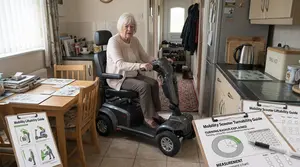
Picture this: You have found a scooter that ticks every box. The range is impressive. The seat feels like a favourite armchair. The price is within reach. You bring it home, filled with optimism. And then you try to turn it around in your kitchen.
It gets stuck. The front wheels bump against the cupboard. You try reversing, but the hallway is too narrow. You are wedged between the fridge and the dining table, wondering how a machine designed to give you freedom has somehow made you feel trapped in your own home.
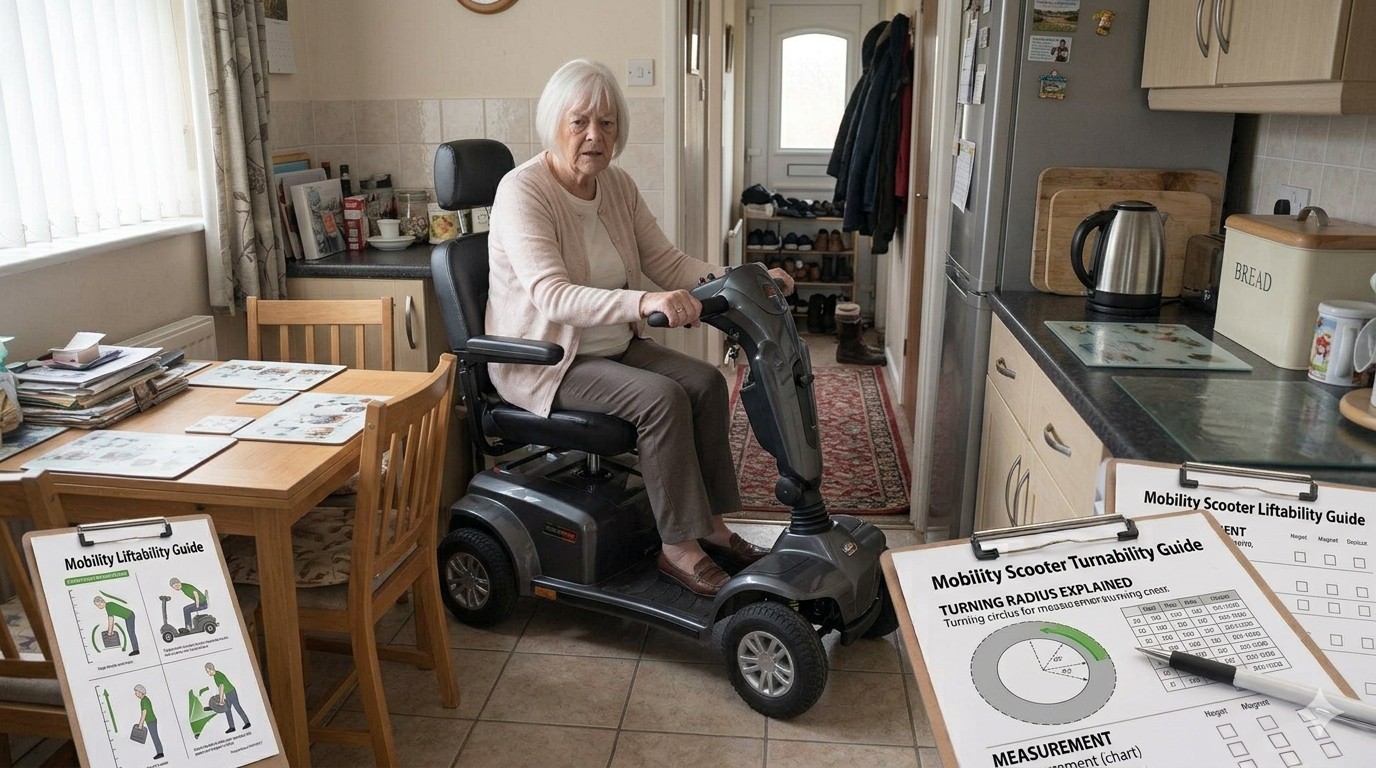
This is what happens when turning radius is treated as an afterthought. The mobility scooter turning radius explained below is your protection against that scenario.
By the end of this guide, you will know exactly what turning radius means, how to measure your home, and how to choose a scooter that moves with you rather than against you.
What Is a Turning Radius, Really?
Let’s start with the simplest possible explanation. A turning radius is half the space it takes for your scooter to complete a full circle. Imagine dipping your scooter’s wheels in paint and driving in the tightest circle you can. That paint mark on the ground is your turning circle. The distance from the centre of that circle to the outer edge is your turning radius.
Why does it matter? Because manufacturers advertise turning radius, but what you actually need to know is the turning circle, which is double the radius. If a scooter has a turning radius of 50 centimetres, you need a clear circle of 100 centimetres to turn it around without reversing.
A compact travel scooter might have a turning radius under 50 centimetres, meaning it can spin in a space just over a metre wide. A large, heavy-duty road scooter might have a turning radius of 150 centimetres or more, requiring a three-metre circle to turn around. That is the difference between gliding through your hallway and getting stuck at the end of it.
And here is the part that catches people out: a tight turning radius is not a luxury. It is the difference between a scooter you can use indoors and one that lives permanently in the garage.
Why Turning Radius Matters More Indoors Than Outdoors
Outdoors, you have space. If your scooter needs a wide arc to turn, you can swing out onto the pavement or find a quiet corner of a car park. The world is your turning circle.
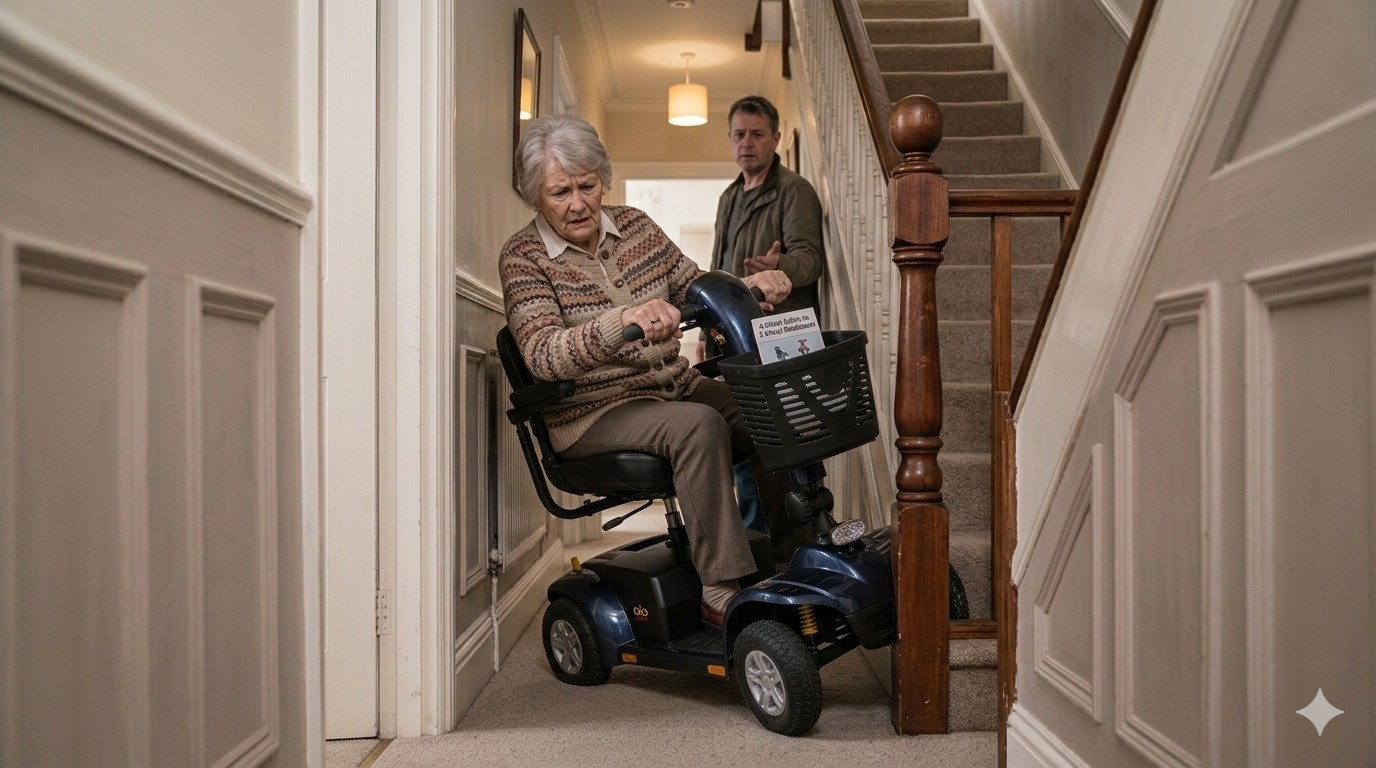
Indoors, everything changes. Standard hallways in Australian homes are often 90 to 100 centimetres wide. Doorways are typically 76 to 80 centimetres clear. A kitchen with an island bench might leave you a turning space of barely a metre. These are not generous dimensions.
A scooter that handles beautifully on a footpath can become completely unusable inside your home if its turning circle is too large. You will find yourself reversing out of rooms instead of turning around. You will avoid the kitchen entirely. You will start parking the scooter outside because getting it through the front door is too much effort.
That is why measuring your home before you buy is not optional. It is the single most practical thing you can do to ensure your scooter actually improves your daily life.
How to Measure Your Home: A Room-by-Room Approach
Grab a tape measure and a notepad. You are going to measure four things, and you are going to write them down. Do not trust your memory on this one.
Your narrowest doorway. Measure the clear opening between the doorstop and the edge of the open door, not the frame. This is the gatekeeper. If the scooter cannot get through here, nothing else matters. Aim for at least five centimetres of extra clearance beyond the scooter’s width.
Your tightest hallway or corridor. Measure wall to wall at the narrowest point. A scooter needs to travel down this hallway and, ideally, turn at the end of it. A hallway that is 95 centimetres wide is fine for straight travel but may be too tight for turning.
Your turning spaces. This is the big one. Identify the places where you will need to turn around: the kitchen, the living room, the bathroom, the end of the hallway. For each space, measure the largest clear circle you can find. A scooter with an 85-centimetre turning circle needs roughly a 95 to 100-centimetre clear space to turn comfortably. A scooter with a 120-centimetre turning circle needs approximately 130 to 135 centimetres.
Your parking and charging spot. Where will the scooter live when you are not using it? Measure that space too. You need room to park, charge, and get on and off without blocking a doorway or tripping hazard.
Write these numbers down. Take them with you when you shop. A good supplier will appreciate that you have done your homework.
What Turning Radius Should You Aim For?
There is no single answer, because every home is different. But here are some practical benchmarks based on common scooter types.
Compact travel scooters often have turning radii between 40 and 55 centimetres. These are the most agile options and are best suited to homes with tighter hallways and smaller rooms. Some three-wheel models can turn in an exceptionally tight space.
Mid-size scooters typically have turning radii between 55 and 80 centimetres. These are a good middle ground for homes with moderate space. They can usually navigate standard hallways and turn in most living rooms, though very tight kitchens may still be a challenge.
Large and heavy-duty scooters often have turning radii of 100 centimetres or more. Some full-size models exceed 150 centimetres. These are designed primarily for outdoor use and should only be considered for indoor use if you have very generous floor space.
Three-wheel scooters generally offer a tighter turning radius than four-wheel scooters of the same size, sometimes by as much as 30 centimetres or more. That extra agility is why three-wheel models are often recommended for indoor use. The trade-off is stability, which we will come to shortly.
Three Wheels, Four Wheels, and the Turning Trade-Off
This is where the turning radius conversation becomes a genuine decision rather than just a measurement exercise.
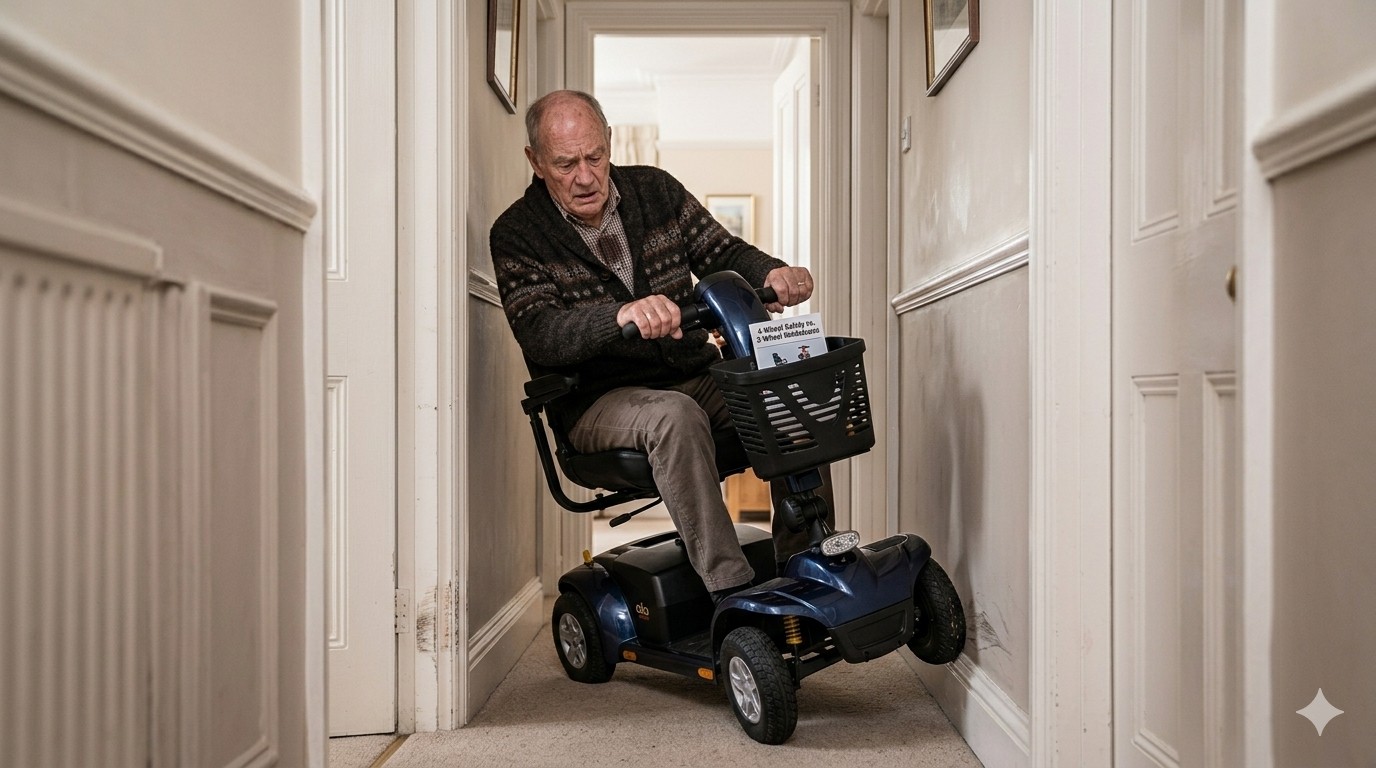
A three-wheel scooter pivots on a single front wheel, which allows it to turn in a remarkably tight circle. If your home has narrow hallways, tight kitchen corners, or a small bathroom, a three-wheel scooter may be the only option that truly works indoors.
A four-wheel scooter is more stable, particularly on slopes and uneven ground. It is the better choice if you have balance concerns or if you spend most of your time outdoors. But that stability comes at a cost: a wider turning circle. Some four-wheel scooters need nearly twice the space to turn around compared to a comparable three-wheel model.
The good news is that some modern four-wheel scooters have narrowed the gap. Certain models now feature turning radii as tight as 94 centimetres, which is remarkably compact for a four-wheel design. If you need four-wheel stability but also have indoor space constraints, these are worth seeking out.
The key is to know your measurements before you test drive. Then you can feel the difference for yourself rather than relying on specification sheets alone.
Your Turning Radius Checklist
Before you buy any mobility scooter, run through these questions:
What is the scooter’s turning radius? Write down the number. Double it to get the turning circle.
What is your tightest turning space at home? Measure it. Compare it to the scooter’s turning circle. You want at least 10 centimetres of clearance.
Can you turn around in your kitchen? This is often the tightest room. If the scooter cannot turn there, will you still use it indoors?
Can you turn around at the end of your hallway? If not, you will be reversing every time you leave a room.
Does the scooter fit through your narrowest doorway? Measure the clear opening. Add five centimetres of clearance for the scooter’s width.
Have you test-driven the scooter in a tight space? A showroom floor is usually wide open. Ask to test in a narrow aisle or a marked-out turning circle.
If you can answer these questions with confidence, you have done more preparation than most buyers. And that preparation will pay off every single day you use your scooter.
Your Next Step
You now have the mobility scooter turning radius explained in plain language, along with a practical method for measuring your home. The next step is simple: grab that tape measure, write down your numbers, and take them with you when you shop.
For more guidance on every stage of the buying process, return to our Mobility Scooter Buying Guide hub, where you will find deep dives on test-driving, car boot fit, liftability, real-world range, warranty, and buying used. And if you are still deciding between a three-wheel and four-wheel scooter, our test-drive checklist will help you feel the difference for yourself.
The right scooter is the one that fits your life, not just your body. With these measurements in hand, you are well on your way to finding it.
Stay mobile, stay confident!
Sign up for our monthly Mobility Scooter Newsletter to receive practical guides, expert advice, and inspiring stories that help you make the most of your scooter and download our free "Mobility Scooter Guide for Beginners."
Don't worry — your e-mail address is totally secure.
I promise to use it only to send you our newsletter, "Mobility Matters."
Recent Articles


-
Mobility Scooter Buying Guide: Don't Buy Until You Read This
Sep 21, 26 08:01 AM
 Mobility Scooter Buying Guide: Confused by choices? We walk you through types, costs, test drives and car boot fit so you buy with total confidence.
 -
Mobility Scooter Turning Radius Explained: Measure First
Sep 21, 26 07:57 AM
Mobility Scooter Turning Radius Explained: Learn what turning radius means, how to measure your home, and avoid buying a scooter that's too big. -
Mobility Scooter "Liftability": Can You Load It Yourself?
Sep 21, 26 06:54 AM
Mobility Scooter Liftability: Don't risk your back. Learn how to match your strength to the right scooter, ramp, or hoist with this friendly guide.

Ready to Feel More Confident on Your Mobility Scooter?

My Ebook, The Ultimate Guide to Mobility Scooters, walks you through choosing the right scooter, using it safely, and keeping it in top condition — all explained in clear, friendly language.
Give yourself (or someone you love) the gift of independence.

