- Home
- Buying Guides
- Avoiding Mobility Scooter Sales Pressure
- Extended Warranty and Service-Plan Upsells
Extended Warranty and Service-Plan Upsells for Mobility Scooters: Say No With Confidence
Extended warranty and service-plan upsells for mobility scooters are one of the quietest pressure points in the entire buying process. They rarely arrive with a hard sell. They arrive at the end of the conversation, when you are tired, when the scooter has been chosen, and when a friendly voice says, “Most people take the extra cover—it’s just peace of mind.” It sounds sensible. It sounds responsible. But for many buyers, it is a payment for protection they already have, wrapped in a reassurance they did not need.

Picture this. You have negotiated the price, signed the paperwork, and you are finally relaxing. Then the salesperson slides a second form across the desk. “This is our three-year protection plan,” they say. “It covers the motor, the battery, and the controller. It’s $300, but it’s worth it for the peace of mind.” You hesitate. You are not sure what your rights are without it, and you do not want to look irresponsible. You sign. Six months later, the motor develops a fault.
You dig out the extended warranty and discover it covers less than you thought—and that you may have had a right to a repair under Australian Consumer Law anyway, for free. This is not a rare story. It is the most common add-on trap in the mobility market.
This guide is about recognising it, understanding what you are actually entitled to, and having the words to say no—without feeling like you are taking a risk.
What an Extended Warranty Actually Is (and What It Is Not)
An extended warranty is a voluntary extra protection you buy for a product, usually for a set price and time period beyond any manufacturer’s warranty. It is optional. It is not a legal requirement. And it is not the same thing as your consumer guarantees.
Your consumer guarantees are automatic rights under the Australian Consumer Law (ACL). They do not cost you anything, and they cannot be excluded by a dealer. They include the guarantee that goods are of acceptable quality, fit for purpose, match their description, and are durable for a reasonable period. These rights exist regardless of any warranty—voluntary, manufacturer’s, or extended.
This distinction matters because extended warranties apply in parallel to your statutory rights. They do not override or alter your consumer guarantees, and they do not affect a trader’s responsibility to meet those guarantees. A dealer must not represent to you that you are required to pay for rights that are equivalent to your consumer guarantees. In plain English: if an extended warranty is offering you the same protection you already have for free, you are paying for nothing.
Deeper dive: If you want the full planning-stage framework for staying in control from first enquiry to final signature, start with the hub: Avoiding Mobility Scooter Sales Pressure .
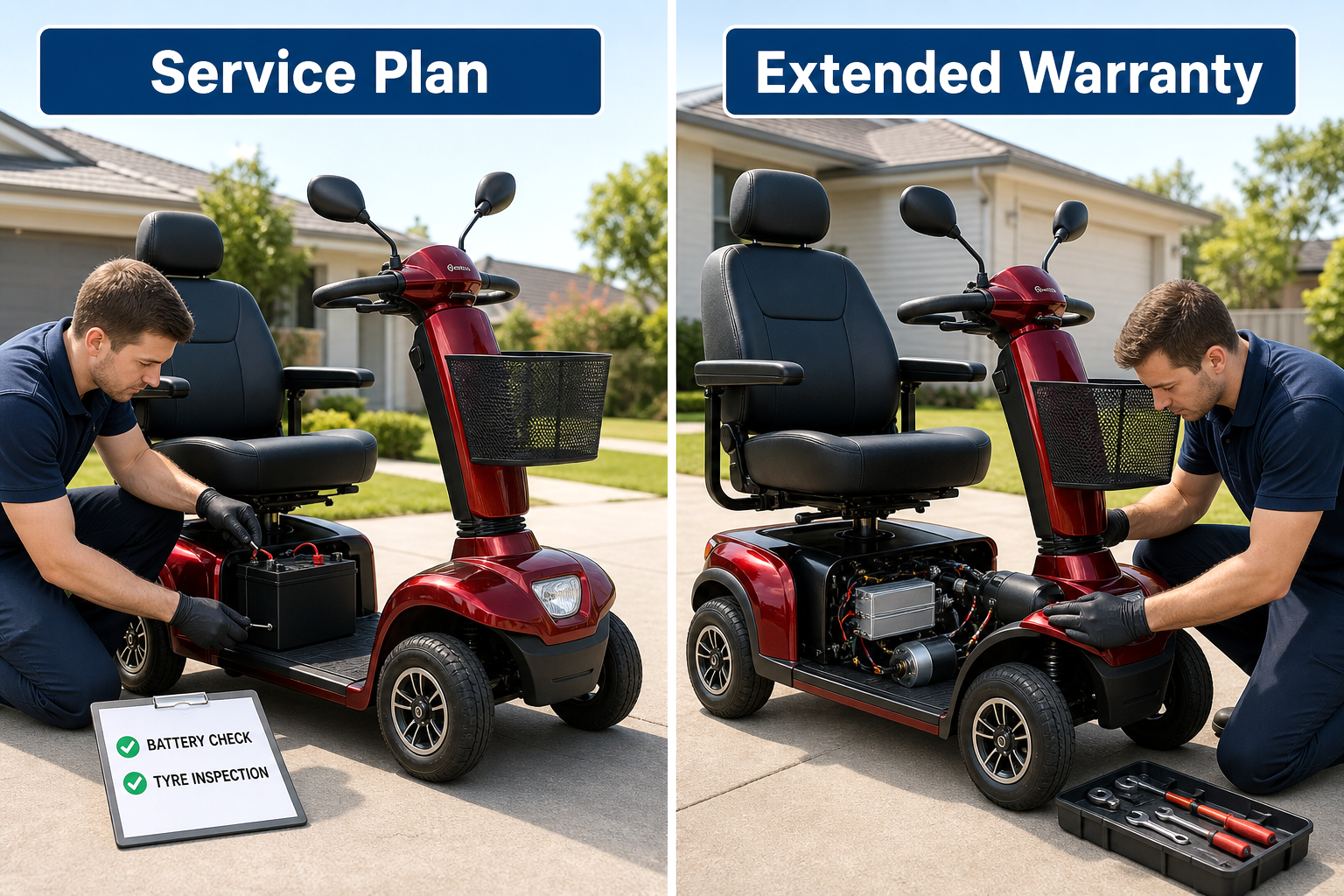
The Painful Truth: When an Extended Warranty Adds Nothing
The Australian Competition and Consumer Commission (ACCC) has been clear that extended warranties may offer “potentially less than [consumers] received automatically at no additional expense under their statutory rights”. The ACCC has taken enforcement action against companies that misled consumers about their guarantee rights, and it continues to investigate misleading practices.
Consumer legal guidance for people with disability is even more direct: “Most of the time, you already have protection for free under the consumer law, so an extended warranty may not give you any extra protection”.
So what does this look like in practice? Imagine a scooter with a standard manufacturer’s warranty of one year on the motor and six months on the battery. An extended warranty offers to double the motor cover to two years and the battery cover to 12 months for $199. On paper, that sounds like a meaningful upgrade. But under the ACL, the consumer guarantee of acceptable quality does not have a fixed expiry date. It lasts for a period that is “reasonable” given the product’s price, quality, and expected lifespan.
For a scooter costing several thousand dollars, a reasonable consumer might expect the motor to last well beyond two years. If the motor fails at 18 months due to a manufacturing defect, the consumer guarantee may already entitle you to a remedy—even without the extended warranty.
The extended warranty is not necessarily worthless. It may provide convenience: a faster claims process, a loan scooter, or onsite service. But if it is simply duplicating rights you already have, you are paying for peace of mind that the law already gave you for free.
Deeper dive: For the full list of documents to demand before you pay for any add-on, see: Don't Buy on a Handshake: What to Ask for in Writing Before Buying a Mobility Scooter
When an Extended Warranty Might Be Worth Considering
This is not a case for rejecting every add-on on principle. Extended warranties and service plans can offer genuine value—but only when they provide something you would not otherwise get. The key question is not “Is this a good deal?” but “What does this give me that my consumer guarantees do not?”
Accidental damage cover. Consumer guarantees cover manufacturing defects and failures of acceptable quality. They do not cover you if you drop the scooter, spill liquid on the controller, or damage it in a collision. If an extended warranty includes accidental damage protection, that is a genuine additional benefit. Check the wording carefully: does it cover accidental damage, or only mechanical and electrical failures?
Onsite service and faster turnaround. Some extended warranties and service plans include onsite repairs, priority scheduling, or a loan scooter while yours is being fixed. If you rely on your scooter daily and cannot easily transport it to a repair centre, this convenience may be worth paying for. A standard service can cost around $160, with collection and return adding $120. If a plan bundles these costs at a discount, it may represent real value.
Battery coverage beyond the standard period. Batteries are the most common failure point on a mobility scooter, and standard battery warranties are often short—six to 12 months is typical. An extended warranty that genuinely extends battery coverage beyond what the manufacturer offers may be worth considering, provided the terms are clear and the price is proportionate. A replacement battery can cost $300 to $600, so extending coverage by two years for $199 could make financial sense if the coverage is comprehensive.
The test is simple: ask the dealer to explain, in writing, exactly what the extended warranty covers that your consumer guarantees do not. If they cannot articulate a clear, specific additional benefit, the warranty is likely duplicating your existing rights.
Deeper dive: For the complete warranty checklist—including what a written warranty must contain—see: Don't Buy on a Handshake: What to Ask for in Writing Before Buying a Mobility Scooter

The Service-Plan Upsell: What to Watch For
Service plans are a close cousin of the extended warranty, and they carry their own risks. A service plan is a prepaid arrangement for scheduled maintenance—typically an annual or six-monthly service. It can be a convenient way to budget for upkeep, but it can also be an expensive way to pay for something you could arrange yourself.
The first question to ask is: what does the service actually include? A basic annual service for a mobility scooter typically costs between $140 and $175, depending on whether it is in-store or onsite. Some providers charge $160 for a basic annual service, plus $120 for collection and return. If a service plan costs $400 for three years and covers two services, it may be reasonable value. If it costs $600 and covers the same services you could book directly for $300, you are paying a premium for convenience.
The second question is: what happens if you do not use it? Some service plans are non-refundable and non-transferable. If you move house, change scooters, or simply forget to book the service, you may lose the value. Ask whether the plan can be transferred or refunded if unused.
The third question is: does the plan lock you into a particular provider? A service plan that requires you to use the dealer’s own workshop may limit your options if you move or if the dealer’s service quality declines. A plan that allows you to use any accredited provider is more flexible.
Industry codes of practice are clear that if a product will need servicing regularly, the dealer must explain what is entailed and outline the likely costs, and must make it clear whether maintenance is offered by the dealer or will have to be obtained elsewhere. A dealer who is vague about these details is not giving you the information you need to decide whether the plan is worth it.
Deeper dive: If a home demonstration is where the service plan is being pitched, the guide: Home-Visit Mobility Scooter Sales: Spot the Red Flags, End It Calmly
The Red Flags: When the Upsell Turns Into Pressure
Not every extended warranty offer is a pressure tactic. But some are. These are the red flags that should make you pause.
“You need this to be covered.”
This is a misrepresentation. Your consumer guarantees exist regardless of whether you buy an extended warranty, and a dealer must not imply otherwise. If a salesperson suggests that you will be unprotected without the add-on, they are misrepresenting your rights.
“The manufacturer’s warranty is only 12 months—after that, you’re on your own.”
This is also misleading. The manufacturer’s warranty is a voluntary promise, but your consumer guarantees under the ACL do not have a fixed expiry date. They last for a reasonable period, which may be longer than the manufacturer’s warranty.
“This price is only available today.”
This is the same “today-only” pressure tactic that applies to the scooter itself, applied to the add-on. A genuine extended warranty offer does not need a countdown clock. If the price disappears because you want to think about it, the urgency was manufactured.
“Everyone takes it—it’s just what you do.”
This is social pressure dressed as reassurance. You are not everyone. You are a buyer with specific needs and specific rights, and you are entitled to make a decision based on your own circumstances.
The bundled presentation. The ACCC has expressed concern that extended warranties are sometimes bundled with a sale in a way that obscures the cost of the warranty or even the fact that it is being purchased at all. If the add-on is presented as part of the package rather than as a separate, optional decision, ask for it to be priced and explained separately.
Deeper dive: For word-for-word scripts to handle the sales conversation itself, see: Mobility Scooter Salesperson Scripts: What to Say to Slow Things Down and Keep Control

What to Say: Scripts for Declining the Upsell
You do not need to be rude or suspicious to decline an extended warranty. You need a calm, clear sentence that closes the conversation without leaving you feeling exposed.
When you are offered an extended warranty:
“Thank you. Before I decide, could you tell me in writing exactly what this covers that my consumer guarantees under Australian Consumer Law do not already cover?”
This script shifts the burden of proof to the dealer. A transparent dealer will be able to explain the specific additional benefits. A dealer who cannot is relying on your uncertainty.
When you are told you “need” the warranty:
“I understand your recommendation. I would like to review the written terms and compare them with my rights under the ACL. I will let you know if I decide to proceed.”
When you are told the price is only available today:
“I have a policy of not making same-day decisions on add-ons. Please put the offer in writing, and I will review it in my own time.”
When you are ready to decline:
“Thank you for explaining. I have decided not to take the extended warranty. I am comfortable relying on my consumer guarantees and the manufacturer’s warranty.”
A legitimate dealer will accept this without argument. A pushy one will keep trying—and that persistence is your signal that the add-on is more about their revenue than your protection.
Deeper dive: For the full list of deposit and refund questions to ask before you pay anything, see: Mobility Scooter Deposit and Refund Questions to Ask Before You Pay Anything
What to Ask Instead: The Questions That Reveal the Real Value
If you are genuinely considering an extended warranty or service plan, these are the questions that will tell you whether it is worth the money.
“What does this cover that my consumer guarantees do not?” This is the single most important question. If the answer is vague, the warranty is probably duplicating your existing rights.
“Is accidental damage included?” Consumer guarantees do not cover accidental damage. If the warranty does, that is a genuine additional benefit. If it does not, the gap between the warranty and your free rights is much smaller.
“What is the claims process, and how long does it take?” A warranty is only as good as its claims process. Ask how long a repair typically takes, whether a loan scooter is provided, and whether the repair is done onsite or at a service centre.
“Is the warranty transferable if I sell the scooter?” Some extended warranties are transferable; others are not. A transferable warranty may add value if you plan to sell the scooter later.
“Can I see the full terms and conditions before I pay?” If the dealer cannot provide the written terms before you pay, the warranty is not something you can evaluate. The paperwork comes first.
“What is the cancellation and refund policy?” If you change your mind, can you get your money back? Is there a cooling-off period? These terms should be in writing.

The Bottom Line: You Already Have More Protection Than You Think
The most important thing to remember about extended warranty and service-plan upsells for mobility scooters is this: you are not unprotected without them. Australian Consumer Law gives you automatic rights that exist regardless of any warranty a dealer sells you, and those rights do not have a fixed expiry date. An extended warranty is only worth buying if it gives you something genuinely additional—accidental damage cover, onsite service, a loan scooter, or extended battery coverage beyond what the manufacturer offers.
The right dealer will explain the difference clearly and put it in writing. The wrong dealer will rely on your uncertainty and your fear of being unprotected. You now have the questions, the scripts, and the knowledge to tell the difference. Say no when the add-on adds nothing. Say yes only when it adds something real.
And remember: the best protection you have is not a warranty—it is knowing your rights.
This guide is part of our complete series on choosing the right battery capacity for your mobility scooter. If you found this helpful, these related guides will take you further:
1. Mobility scooter buying checklist that prevents pressure selling (Australia-focused)
2. What to ask for in writing before buying a mobility scooter (quote, warranty, returns, servicing)
3. Mobility scooter deposit and refund questions to ask before you pay anything
4. How to run a no-pressure mobility scooter demo or trial (set rules, timebox, decision criteria)
5. Mobility scooter comparison sheet: how to compare two quotes apples-to-apples
6. Mobility scooter salesperson scripts: what to say to slow things down and keep control
7. Home-visit mobility scooter sales: red flags and how to end the appointment
9. “Today-only deal” tactics: how to verify mobility scooter discounts and price claims
Frequently Asked Questions
Do I need an extended warranty to be protected if my mobility scooter breaks down?
No. Australian Consumer Law provides automatic consumer guarantees that goods are of acceptable quality, fit for purpose, and durable for a reasonable period. These rights exist regardless of any extended warranty, and they do not have a fixed expiry date.
What is the difference between a consumer guarantee and an extended warranty?
Consumer guarantees are automatic rights under the ACL that cost nothing and cannot be excluded. An extended warranty is a voluntary, paid add-on that runs in parallel to your statutory rights and should provide additional benefits beyond them.
How much does an extended warranty for a mobility scooter cost?
Costs vary. Examples in the Australian market include a one-year extension for $199 and a general extended warranty for $300. The value depends on what the warranty covers that your consumer guarantees do not.
When is an extended warranty actually worth it?
It may be worth considering if it includes accidental damage cover, onsite service, a loan scooter, or extended battery coverage beyond the standard period—benefits that are genuinely additional to your free consumer guarantees.
Can a dealer tell me I need an extended warranty to be covered?
No. A dealer must not represent that you are required to pay for rights that are equivalent to your consumer guarantees. Doing so is misleading and may breach the Australian Consumer Law.
What should I ask instead of just saying yes to an extended warranty?
Ask: “What does this cover that my consumer guarantees under Australian Consumer Law do not already cover?” If the dealer cannot explain a clear, specific additional benefit in writing, the warranty is likely duplicating your existing rights.
Stay mobile, stay confident!
Sign up for our monthly Mobility Scooter Newsletter to receive practical guides, expert advice, and inspiring stories that help you make the most of your scooter and download our free "Mobility Scooter Guide for Beginners."
Don't worry — your e-mail address is totally secure.
I promise to use it only to send you our newsletter, "Mobility Matters."
Recent Articles


-
Mobility Scooter Extended Warranty: When to Say No (and Ask This)
Nov 26, 26 08:22 AM
 Extended warranty and service-plan upsells for mobility scooters — learn when to say no, what your rights already cover, and what to ask instead.
-
Avoiding Mobility Scooter Sales Pressure Before You Buy
Nov 26, 26 08:15 AM
 Avoiding mobility scooter sales pressure begins with knowledge. This friendly hub walks you through every step—calmly and clearly.
-
Used Mobility Scooter: Buy Safely on Gumtree & Marketplace
Nov 26, 26 08:09 AM
Buying a used mobility scooter without getting pressured or scammed is possible. Get the inspection checklist and scam-avoidance scripts before you buy.



Ready to Feel More Confident on Your Mobility Scooter?

My Ebook, The Ultimate Guide to Mobility Scooters, walks you through choosing the right scooter, using it safely, and keeping it in top condition — all explained in clear, friendly language.
Give yourself (or someone you love) the gift of independence.




