- Home
- Mobility Scooter Types
- Mobility Scooter Types Overview:
- How to Choose a Mobility Scooter in Australia
How Do I Choose the Right Mobility Scooter Type in Australia? (Step-by-Step Decision Guide)
You already know the broad types of mobility scooters — travel, folding, mid-size, heavy-duty, all-terrain, and bariatric. The harder question is which one is right for you, in your suburb, with your footpaths, your car, and your daily destinations.

This guide walks you through a practical, Australia-specific decision process. It covers the state-by-state rules that affect where you can legally ride, the transport limits that determine whether your scooter fits on a bus or train, and the funding pathways that can reduce what you pay out of pocket.
If you need a refresher on the types themselves, start with our Mobility Scooter Types: The Complete Guide hub page. This article assumes you understand the basic categories and focuses on the Australian decision layer.
Step 1: Map Your Daily Routes Before You Look at Any Scooter
The single biggest mistake Australian buyers make is choosing a scooter based on showroom appearance or a friend's recommendation, then discovering it cannot handle their actual local environment.
Before you compare models, write down the answers to these questions:
- Where will you ride most? Indoor only? Local footpaths? Shopping centres? Shared paths? Gravel or grass? Sloped driveways?
- What is the surface quality? Smooth concrete, cracked pavements, brick paving, gravel, or uneven grass?
- Are there hills? Even a modest incline changes the motor power and battery range you need.
- How will you transport it? Will it stay at home, or go in a car boot regularly?
- How far is your longest typical trip? To the shops? To a medical appointment? To visit family?
- What is your weight, height, and upper-body strength? These determine the type, seat size, and tiller style you need.
A 3-wheel folding scooter might be perfect for a flat, smooth suburb with wide footpaths. The same scooter becomes a liability on a hilly, cracked-footpath route with a sloped driveway.
The environment decides the type more than the type decides the environment.
Step 2: Choose 3-Wheel or 4-Wheel Based on Stability vs Manoeuvrability
This is the configuration choice that affects everything else. 3-wheel scooters turn tighter, which suits indoor use, small shops, and narrow hallways. 4-wheel scooters are more stable on slopes, cambered footpaths, and uneven ground, and offer more legroom for taller users.
In Australia, footpaths in older suburbs are often cracked, uneven, or sloping toward the road for drainage. If your regular route includes any of these conditions, a 4-wheel scooter is the safer choice. If your primary use is indoor manoeuvrability around a small home, a 3-wheel model may serve you better.
If you have balance concerns, always choose 4 wheels. The extra stability is not a marketing feature — it is a genuine safety difference on Australian footpaths and kerbs.
Step 3: Match the Scooter Type to Your Transport Reality
How the scooter travels when you are not riding it determines whether you need a portable model or a full-size one.
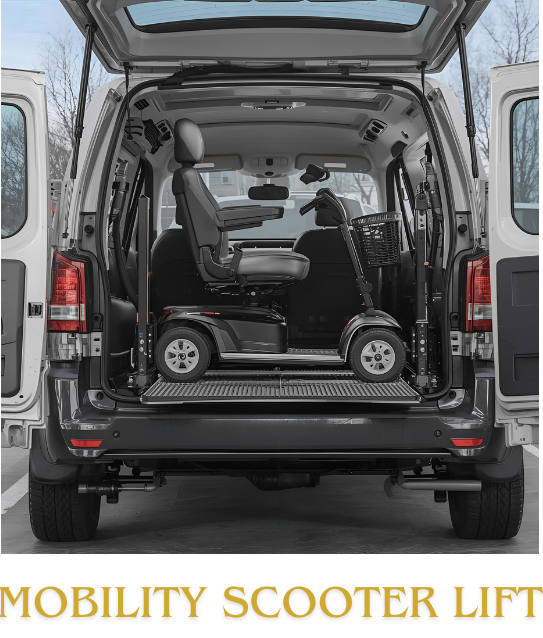
If you need to lift it into a car boot regularly: You need a travel or folding scooter. The critical number is the weight of the heaviest single piece. A folding scooter that stays in one piece at 25 kg may be easier to manage than a travel scooter that breaks into five pieces, each requiring a separate lift. Measure your boot opening, internal floor, and lip height before you buy.
If the scooter stays at home and you ride everywhere: A mid-size or full-size scooter gives you more comfort, range, and terrain capability without the weight compromise.
If you use public transport: Scooter dimensions matter. In Queensland, for example, a mobility device must fit in an allocated space of 1300 mm by 800 mm, be less than 750 mm wide, and have a total weight of user plus device under 300 kg to travel on accessible public transport.
Check your local transport authority's requirements before you buy, because a scooter that fits your car may not fit a bus or train.
Step 4: Check Your State's Rules Before You Commit
Mobility scooters are treated as pedestrian aids in most of Australia, capped at 10 km/h on footpaths and shared paths. But the details vary by state, and one state is a significant outlier.
Queensland is the only state or territory that requires registration for mobility scooters used on footpaths or road-related areas. Registration is free, has no minimum age requirement, and includes compulsory third-party insurance at no extra cost. Scooters over 170 kg unladen need a special circumstances permit instead.
Everywhere else — NSW, Victoria, WA, SA, Tasmania, the ACT, and the NT — registration is not required. However, the national 10 km/h speed limit applies everywhere, and scooters must have an unladen weight of no more than 170 kg in most states to be classified as a mobility device rather than a motor vehicle.
Roads are a last resort in all states. Use footpaths and shared paths first. Roads should only be used when no footpath, nature strip, or shared path exists, and riders should keep to the side and face oncoming traffic, just as a pedestrian would. Bike lanes are best avoided because scooters travel slower than cyclists and create risk for both.
If you travel regularly between states, check the relevant state road authority for any local council variations.
Step 5: Confirm Public Transport Compatibility
Public transport access for mobility scooters varies by state and mode of transport.
In Victoria, mobility scooters continue to be allowed on the public transport network, while e-scooters face stricter rules and must be folded and switched off. Most regional V/Line trains and coaches are accessible with a motorised mobility device.
In Queensland, the dimensional and weight requirements listed above apply, and passengers using mobility scooters in wheelchair-accessible taxis are required to dismount and transfer into a seat.
In NSW, mobility scooters are permitted on footpaths and shared paths at 10 km/h, but are only allowed on roads when crossing.
Before you buy, contact your local transport authority or check their website for the specific dimensions, weight limits, and booking requirements that apply to your regular routes.
Step 6: Understand NDIS and Other Funding Pathways
If you are an NDIS participant, mobility scooters and electric wheelchairs can be funded through your plan under Assistive Technology (Capital Supports). You will need an assessment from an Occupational Therapist or Physiotherapist for equipment over $1,500, and the equipment must link to your NDIS goals — particularly around mobility, independence, and community participation.
Trials are available, meaning you can test equipment before purchasing to ensure it is the right fit, and both hiring and buying options can be funded depending on your needs.
A recent Federal Court ruling confirmed that the NDIA can be ordered to fund a mobility scooter when it is a reasonable and necessary support under the NDIS Act. If your plan does not include mobility equipment but you believe it should, this ruling strengthens the case for requesting a review.
For non-NDIS buyers, some state health departments, veterans' affairs programs, and charitable organisations offer partial funding or subsidies. Check with your GP, occupational therapist, or local community health centre for what is available in your area.
Step 7: Test the Heaviest Piece and the Tightest Turn
Before you finalise your choice, do two practical tests:
Lift test: If you plan to transport the scooter, physically lift the heaviest piece you will need to handle. If you cannot lift it safely and repeatedly, the scooter is the wrong type regardless of how well it performs on paper.
Turn test: Measure the tightest turn in your home — a hallway corner, a bathroom door, a kitchen entry. Compare that to the scooter's turning radius.
Folding scooters often achieve 80–90 cm; full-size models may need 200 cm or more. If the scooter cannot make the turn, you will end up parking it outside and walking indoors, which defeats the purpose.
If possible, test the scooter on your actual footpath, your actual driveway, and your actual car boot before you buy. Many Australian stockists offer demonstrations or short-term hire, which is far cheaper than buying the wrong scooter.
Step 8: Verify Weight Capacity with a Safety Margin
Do not choose a scooter where your weight is close to the maximum capacity. Always leave at least 20 kg of margin for safety, motor longevity, and performance on inclines. A scooter pushed to its limit will struggle on hills, drain its battery faster, and wear out sooner.
Standard scooters typically support 113–136 kg. Mid-size and full-size models range from 150–180 kg. Bariatric models support 200–350 kg. If you are close to a threshold, move up a category rather than risking performance and safety.

The Australian Decision Checklist
Before you commit, confirm each of these:
- Routes mapped: You know your surfaces, hills, and distances.
- Wheel configuration: 4-wheel for stability, 3-wheel for tight indoor manoeuvrability.
- Transport fit: The scooter fits your car boot and, if needed, your local public transport.
- State rules: You know whether registration is required and where you can legally ride.
- Weight margin: You have at least 20 kg of safety margin below the maximum capacity.
- Funding: You have checked NDIS, state, or other funding options.
- Tested: You have lifted the heaviest piece, measured your tightest turn, and ideally test-ridden on your own routes.
If you can tick every box, you have chosen the right type. If any box is unticked, go back to that step before you buy.
The Bottom Line
Choosing the right mobility scooter type in Australia is not about finding the most expensive model or the one with the longest range. It is about matching the scooter to your actual body, your actual home, your actual routes, and your state's actual rules.
Start with your daily reality, not the showroom. Check the rules before you commit. Test the practical details before you pay. And if you are unsure, start with our Mobility Scooter Types: The Complete Guide hub page for the full category overview, then come back here to make the local decision.
The right scooter does not just move you from A to B. It gives you back the confidence to go there — legally, safely, and comfortably.
Stay mobile, stay confident!
Sign up for our monthly Mobility Scooter Newsletter to receive practical guides, expert advice, and inspiring stories that help you make the most of your scooter and download our free "Mobility Scooter Guide for Beginners."
Don't worry — your e-mail address is totally secure.
I promise to use it only to send you our newsletter, "Mobility Matters."
Recent Articles


-
Portable vs Travel vs Folding Mobility Scooters Buyer's Guide
Sep 15, 26 11:01 AM
 Confused by "portable," "travel," and "folding" mobility scooter listings? This guide explains what Australian sellers actually mean, with real weight comparisons and a decision framework.
 -
Mobility Scooter Types Overview: No More Confusion
Sep 15, 26 10:54 AM
 Mobility scooter types explained in plain English. Includes Australian footpath rules, airline battery limits, and the one mistake most first-time buyers make.
 -
How to Choose a Mobility Scooter in Australia Guide (2026)
Sep 15, 26 07:29 AM
 Choosing a mobility scooter in Australia? This guide covers registration requirements by state, public transport dimensions, NDIS funding steps, and practical testing advice.


Ready to Feel More Confident on Your Mobility Scooter?

My Ebook, The Ultimate Guide to Mobility Scooters, walks you through choosing the right scooter, using it safely, and keeping it in top condition — all explained in clear, friendly language.
Give yourself (or someone you love) the gift of independence.

