- Home
- Mobility Scooter Types
- Mobility Scooter Types Overview:
- When Is a 4-Wheel Scooter the Wrong Choice
When Is a 4-Wheel Scooter the Wrong Choice (Real-Life Scenarios That Cause Regret)?
Picture this: You did the sensible thing. You read the comparisons. You listened to the advice. Everyone said four wheels are safer than three, so you bought a 4-wheel scooter. It arrived. It felt solid and secure. And then you tried to turn it around in your hallway. The front wheels caught the skirting board. You backed up, tried again, and caught the doorframe. Ten minutes later, you were still stuck, sweating, and wondering why no one told you that "more stable" also means "harder to live with."
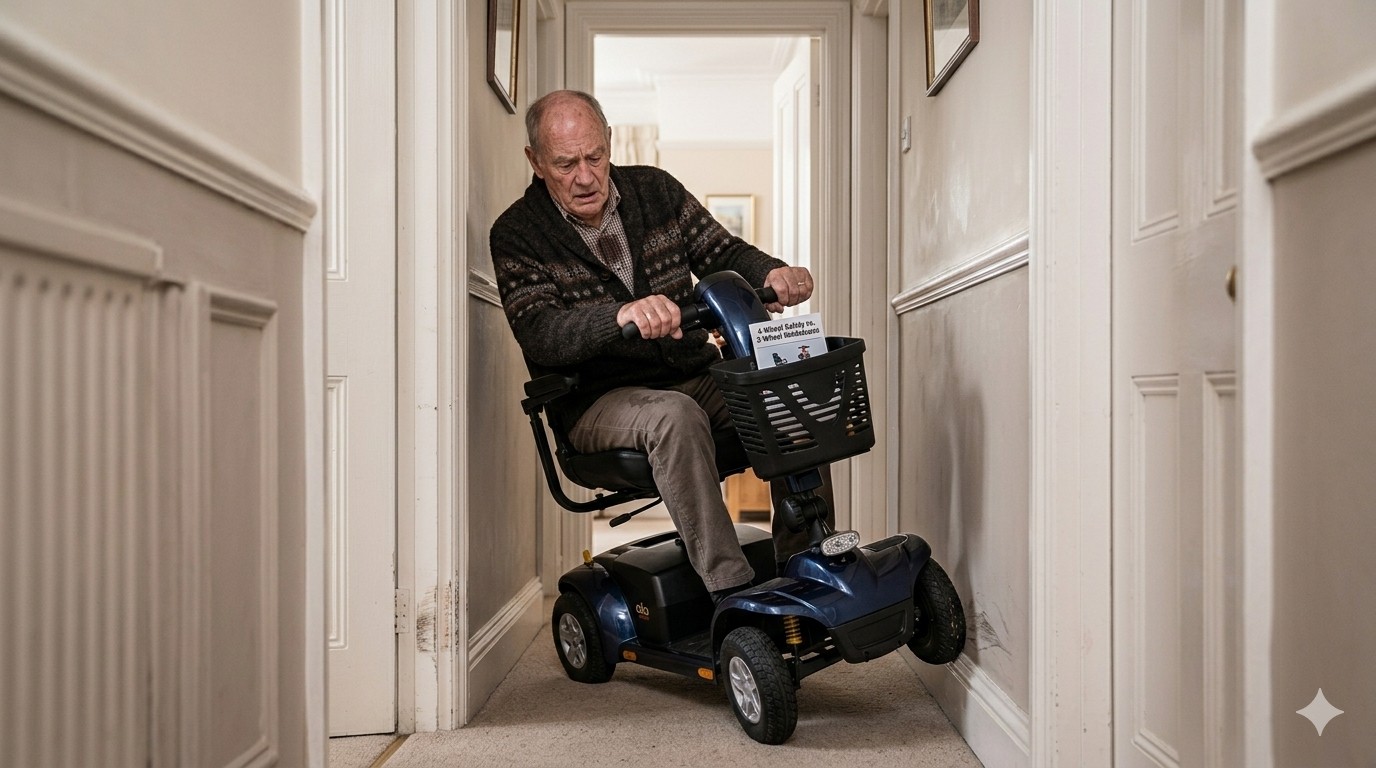
When is a 4-wheel scooter the wrong choice? It is the wrong choice the moment your daily reality includes tight indoor spaces, frequent car transport, limited lifting ability, or a budget that cannot absorb a mistake.
And the hardest part is that the same articles that recommend four wheels for stability rarely explain what you sacrifice to get it.
This guide is that missing conversation. It walks you through the real-life scenarios where 4-wheel scooters cause regret, why those scenarios happen, and what to choose instead.
By the end, you will know whether the extra stability is worth the trade-offs in your specific life—or whether three wheels were right all along.
Why 4-Wheel Scooters Feel Safer Until You Try to Live With One
The case for 4-wheel scooters is simple and genuinely convincing. A scooter with two front wheels and two rear wheels has a rectangular footprint, which distributes weight more evenly than the triangular footprint of a 3-wheel scooter. That makes it more stable on slopes, uneven footpaths, grass, and gravel, and it reduces the risk of tipping when the front wheel hits an obstacle. For anyone with balance concerns, four wheels are the safer default.
But safety is not the only thing that matters. A scooter must also fit your home, your car, and your daily routine. And the same design features that make a 4-wheel scooter stable—a wider footprint, a longer wheelbase, heavier construction—are the exact features that make it harder to manoeuvre indoors, harder to lift into a car boot, and more expensive to buy and maintain. That is not a design flaw. It is a trade-off. But it is a trade-off that many buyers do not fully understand until after they have spent their money.
If you have ever felt your 4-wheel scooter fight you in a tight space, the next scenario will feel uncomfortably familiar.
Real-Life Scenario 1: Tight Indoor Spaces and Narrow Hallways
A 4-wheel scooter has a wider turning radius than a 3-wheel scooter. That is not a minor specification. It is the difference between navigating your hallway and getting stuck in it.
One user review of a 4-wheel scooter put it plainly: "Not really a con, but it's not good at running around in the house. I bought it for outdoors." That is the honest version of the trade-off. A 4-wheel scooter that turns like a battleship is fine in a shopping centre aisle or on a wide footpath. It is not fine in a 90 cm hallway, a narrow bathroom door, or a kitchen with an island bench that leaves only one route through.
If your primary use is indoor mobility—getting from the bedroom to the kitchen, navigating a small apartment, or moving around a home with tight corners—a 4-wheel scooter is the wrong choice unless you can find a model with a genuinely compact turning radius. Some premium 4-wheel scooters now achieve turning radii as tight as 94 cm thanks to patented technology, but those models are the exception, not the rule.
If your home has narrow doorways and tight turns, the next scenario is worth reading carefully.

Real-Life Scenario 2: Car Transport and the Lifting Problem
A 4-wheel scooter is often heavier and bulkier than a comparable 3-wheel model. That matters most when you need to lift it into a car boot or transport it regularly.
Some 4-wheel scooters do dismantle into manageable pieces. The Monarch Buzz, for example, is a four-wheel portable scooter that pulls apart easily with the heaviest section weighing 13 kg to 15 kg, depending on the listing. But many 4-wheel models are not designed for easy transport.
Full-size 4-wheel scooters frequently weigh 40 kg to 60 kg or more, and they do not fold or break down for a car boot. As one mobility retailer notes, a large 4-wheel scooter like the Pride Maxima is "large and heavy enough that you'll want a vehicle lift or hitch-mounted carrier to move it—it doesn't fold or break down for the trunk."
If you cannot lift 15 kg to 20 kg safely and repeatedly, or if your car boot is small and your scooter is large, a 4-wheel scooter is the wrong choice. A travel scooter that dismantles into lighter pieces, or a folding 3-wheel scooter, may serve you far better.
But transport is not the only hidden cost. The next scenario is about money.
Real-Life Scenario 3: The Cost You Did Not Budget For
4-wheel scooters are typically more expensive than 3-wheel scooters. That is not a small difference. Mid-range 4-wheel scooters often cost between $1,500 and $3,500, while high-end models can exceed $6,000. The stability and weight capacity that 4-wheel scooters offer come at a premium.
If you are on a fixed income, if you are paying out of pocket without insurance or funding support, or if you are buying a scooter for occasional use rather than daily dependence, the extra cost of four wheels may not be justified. A 3-wheel scooter can handle smooth indoor floors and gentle outdoor footpaths perfectly well. If your routes are flat, predictable, and close to home, you may be paying for stability you do not actually need.
But cost is not just about the purchase price. It is also about the cost of getting it wrong. A 4-wheel scooter that is too bulky for your home or too heavy for your car is not a good investment at any price.
And that leads to the scenario that causes the deepest regret.

Real-Life Scenario 4: When You Bought for a Parent and It Did Not Work Out
If you are a caregiver or an adult child who bought a 4-wheel scooter for a parent, you already know the stakes. You chose four wheels because you wanted safety. You chose four wheels because you wanted to reduce fall risk. You chose four wheels because every article told you it was the safer default.
Then the scooter arrived. It did not fit through the bathroom door. Your parent could not turn it in the hallway. It was too heavy for you to lift into the car on your own. And now it sits in the corner of the lounge room, unused, because using it is more stressful than not using it.
That is the quiet regret. Not a dramatic fall, but a slow retreat from independence because the scooter never became practical enough to use. A 4-wheel scooter is the wrong choice when the caregiver's lifting ability, the home's layout, or the user's daily routes make it a burden rather than a tool.
And if that sounds like your situation, the next scenario explains why smaller can sometimes be safer.
Real-Life Scenario 5: When the Extra Stability Creates New Risks
This scenario is counterintuitive but important. A heavier, wider 4-wheel scooter can create new risks in certain environments. A scooter that is difficult to turn may cause the user to overreach or twist in the seat, increasing strain on the back and shoulders. A scooter that is too heavy to lift may encourage unsafe lifting techniques by caregivers. And a scooter that is too large for the home may force the user to park it outside, exposing it to weather and theft.
Stability on the footpath does not matter if the scooter is too heavy to get to the footpath in the first place. Safety is not just about tipping resistance. It is also about usability, accessibility, and whether the scooter fits the life it is supposed to serve.
When a 4-Wheel Scooter Is the Right Choice
To be clear: a 4-wheel scooter is often the right choice. It is the right choice when outdoor stability is the priority, when the user has balance concerns, when the routes include slopes, grass, gravel, or uneven ground, and when the home and car can accommodate the larger size and weight. It is the right choice for many first-time buyers, and it is the safer default for most caregivers who are unsure.
But it is not the right choice for everyone. It is the wrong choice when tight indoor manoeuvrability matters more than outdoor stability, when car transport is a daily requirement and lifting ability is limited, when budget is tight and the extra cost cannot be justified, or when the home layout simply cannot accommodate a wider, longer scooter.
The Better Choice: When to Stay With 3 Wheels
A 3-wheel scooter is not always the less safe option. It is the better option when your routes are smooth and flat, when indoor manoeuvrability is the priority, when you need the lightest possible scooter for car transport, and when your balance is reliable enough to manage the triangular footprint. A 3-wheel scooter that gets used every day is safer than a 4-wheel scooter that sits unused because it is too difficult to live with.
If you are torn between the two, test both. Sit on them. Turn them in a tight space. Lift the heaviest piece. Drive them on your actual footpath. The right choice is the one that fits your life, not the one that wins the spec sheet comparison.
Read the full guide: When Is a 3-Wheel Scooter the Wrong Choice (Real-Life Scenarios That Cause Regret)?
The Bottom Line
A 4-wheel scooter is the wrong choice when tight indoor spaces, frequent car transport, limited lifting ability, a tight budget, or a caregiver's practical constraints make the extra stability a burden rather than a benefit.
It is the right choice when outdoor stability, balance support, and terrain capability matter more than manoeuvrability and portability.
Do not let the phrase "more stable" make the decision for you. More stable is not always more usable. The best scooter is the one you can actually use—every day, in your home, in your car, and on your routes.
And sometimes, that scooter has three wheels, not four.
Stay mobile, stay confident!
Sign up for our monthly Mobility Scooter Newsletter to receive practical guides, expert advice, and inspiring stories that help you make the most of your scooter and download our free "Mobility Scooter Guide for Beginners."
Don't worry — your e-mail address is totally secure.
I promise to use it only to send you our newsletter, "Mobility Matters."
Recent Articles


-
Mobility Scooter Buying Guides– No More Guesswork
Sep 18, 26 10:46 AM
 Mobility Scooter Buying Guides — don’t buy before reading this. Expert tips on features, safety, and getting the best value.
 -
Mobility Scooter Buying Guide: Don't Buy Until You Read This
Sep 18, 26 10:34 AM
 Mobility Scooter Buying Guide: Confused by choices? We walk you through types, costs, test drives and car boot fit so you buy with total confidence.
 -
Mobility Scooter Types Overview: No More Confusion
Sep 18, 26 08:02 AM
 Mobility scooter types explained in plain English. Includes Australian footpath rules, airline battery limits, and the one mistake most first-time buyers make.


Ready to Feel More Confident on Your Mobility Scooter?

My Ebook, The Ultimate Guide to Mobility Scooters, walks you through choosing the right scooter, using it safely, and keeping it in top condition — all explained in clear, friendly language.
Give yourself (or someone you love) the gift of independence.



