- Home
- Health Needs Fit
- Low Vision Friendly Scooter Features
- Mobility Scooter Sounds and Alerts
What Sounds and Alerts Should a Mobility Scooter Have for Low Vision (Horn Loudness, Indicator Clicks, and Reverse Beeper) ?
Picture this. You're reversing out of a tight parking spot at the shops. You can't see the pedestrian behind you—your mirrors are angled awkwardly and the sun is in your eyes—but you hear a steady beep, and you know the scooter is telling the world you're backing up. A moment later, you flick the indicator, and you hear a clear click. You didn't have to look down. Your ears did the checking for you. That's the quiet power of the right sounds and alerts on a mobility scooter for low vision—they let your hearing carry some of the load your eyes are already carrying.
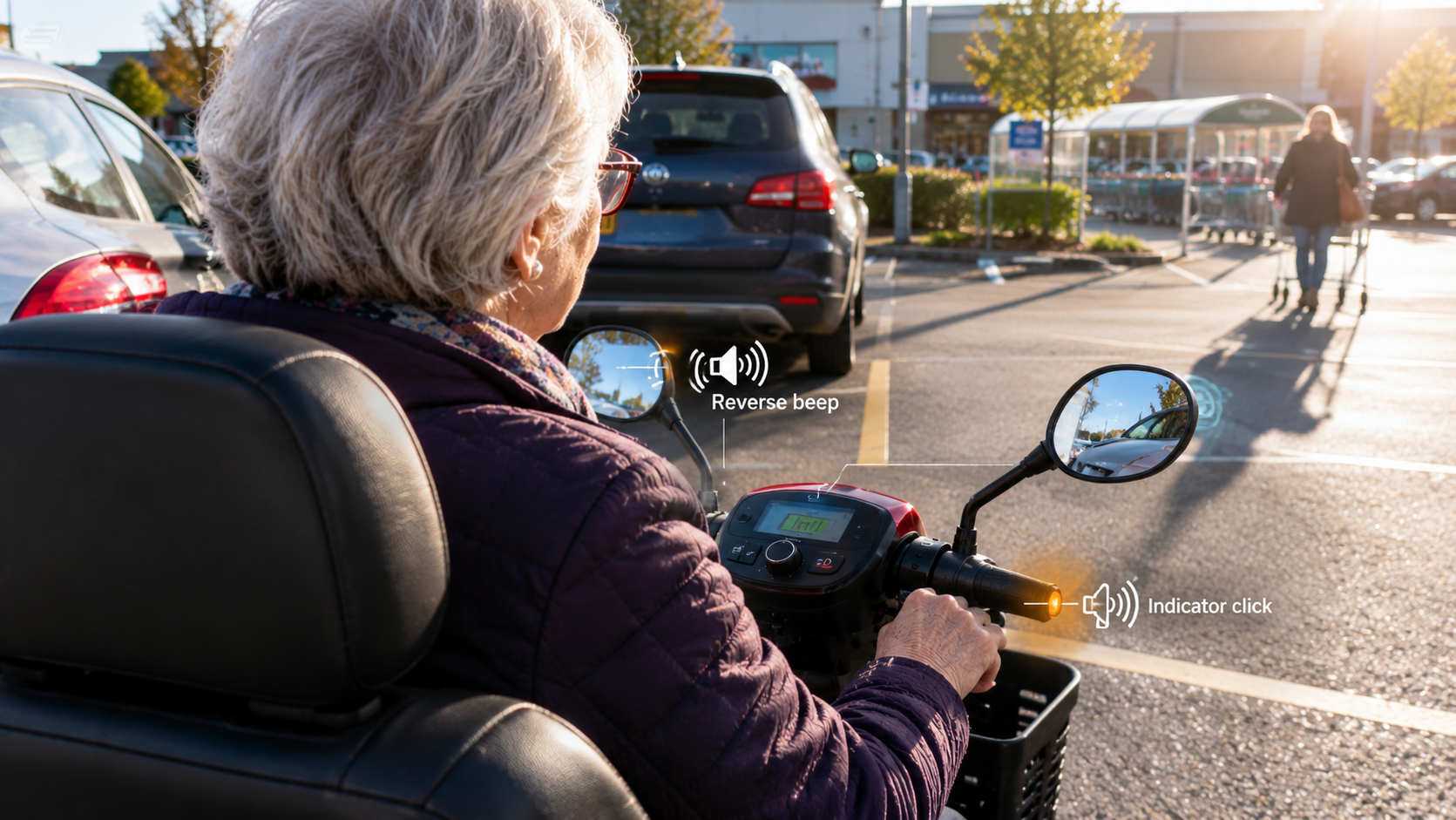
Here's the uncomfortable truth that makes this topic urgent: research on electric scooters found missed detection rates of 90–97% in typical city soundscapes when no acoustic alerting system was present. Electric vehicles are quiet by design, and that quietness is a real safety problem for people who rely on sound to navigate.
For a low-vision rider, a scooter that communicates audibly isn't a luxury. It's a layer of safety that works even when your eyes are busy. Let's walk through what to listen for, starting with the alert that warns others you're coming.
The Horn: Your Voice When You Need to Be Heard
The horn is the most basic audible safety feature on any scooter, and it's also the one most often underspecified. What should you look for? Loudness, distinctiveness, and findability.
On loudness, there's a useful benchmark in the standards. ISO 7176-14 requires a sound pressure level of at least 65 dB(A) for scooters not intended for outdoor use, and at least 75 dB(A) for scooters intended for outdoor use. That's a minimum, not a target. A horn that barely meets 75 dB(A) will struggle to cut through traffic noise, a busy shopping centre, or a windy day. Look for a horn that is clearly audible over ambient noise—and test it in a noisy space, not a silent showroom.
But loudness alone isn't enough. The horn also needs to be distinct from every other alert on the scooter. If the horn sounds like the indicator click or the low-battery warning, your brain has to stop and work out what it just heard—and that pause is exactly when you need clarity.
A horn should sound like a horn: a single, continuous, recognisable signal. And crucially, it should be findable by touch. If you have to look down to find the horn button, it's not doing its job in an emergency. That's why tactile markers on the horn button—or a horn button that is a different shape from everything else—matter so much. A horn you can find by feel is a horn you'll actually use.
But the horn is only the beginning; the quieter, more frequent alerts matter just as much.
Indicator Clicks: The Alert You'll Hear Most Often
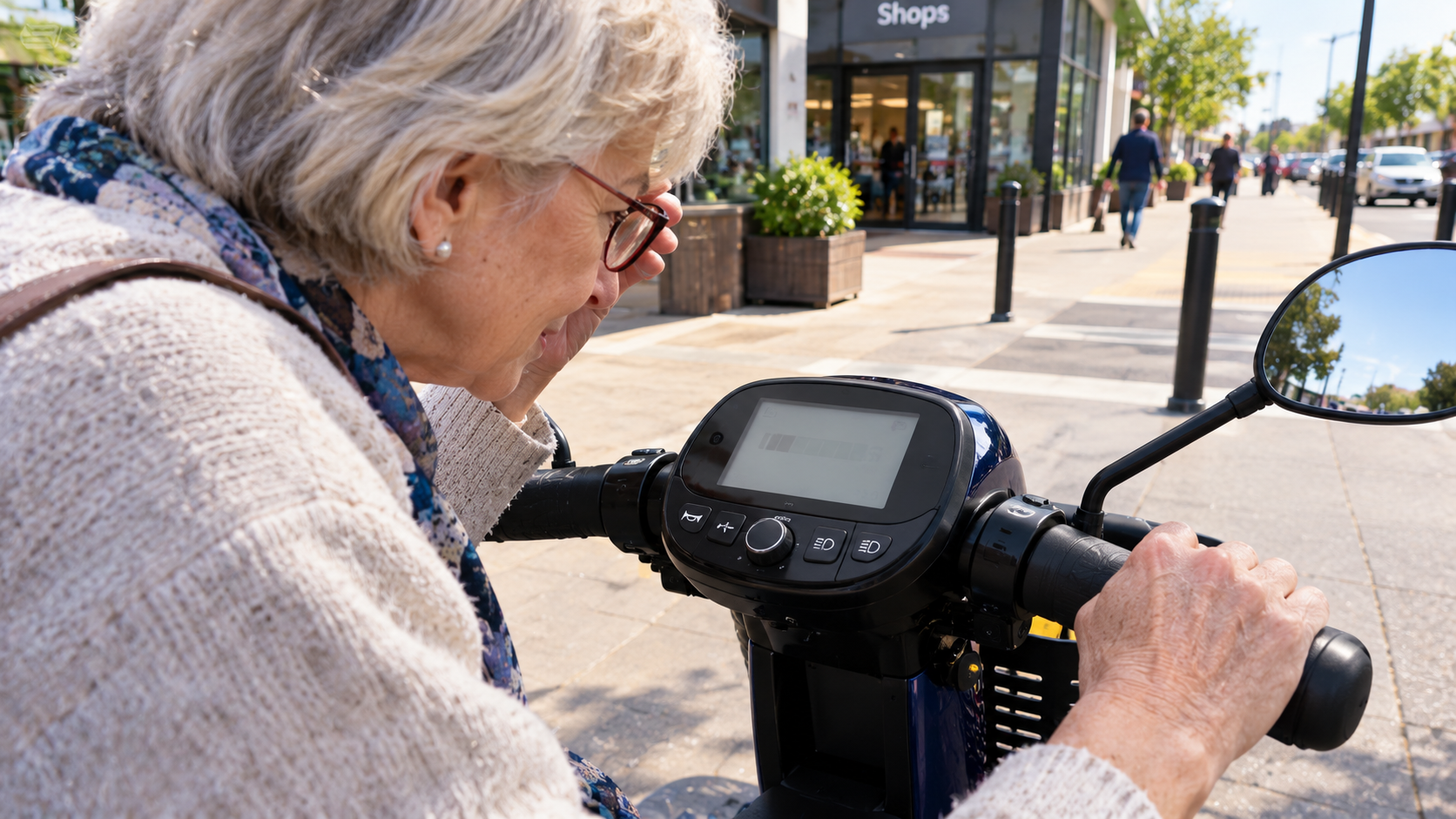
Turn signals are a communication tool, and for low-vision riders, the audible click is what makes them trustworthy. Without a click, you have to glance down at the handlebars to confirm the indicator is on—and every glance down is a moment you're not watching the path.
Many scooters now include indicator alerts that sound while the indicators are active. The TGA Vita, for example, has a buzzer that sounds when the indicators are in use, specifically to remind the rider they are active. Some systems go further: the Invacare Orion's electronic system can be programmed to emit an acoustic signal when the direction indicators are actuated, and this is activated in the delivery status by default. That's a good default. You want the click to be on by default, not something you have to remember to enable.
What should the click sound like? It should be distinct from the horn and distinct from the reverse beeper, and it should be audible over ambient noise without being so loud that it becomes irritating. Some riders prefer a soft click; others need something more assertive. The key is that it's consistent—the same sound every time, so your brain learns it and stops needing to check. If the indicator click is too quiet or too similar to another alert, you're back to glancing down.
And speaking of alerts that warn others, the reverse beeper deserves its own moment.
Reverse Beepers: Warning Others, Reassuring You
Reversing is one of the highest-risk manoeuvres on a scooter, because your visibility is limited and pedestrians may not expect you to move backwards. A reverse beeper solves two problems at once: it warns people behind you that you're backing up, and it confirms to you that the scooter is in reverse mode.
The TGA Vita's reverse buzzer sounds automatically whenever the scooter is in reverse, specifically to warn nearby pedestrians. The Sunrise Medical manual describes a reversing beeper that sounds when you pull the left-hand lever towards you to move in reverse. And on some models, the horn itself beeps when the vehicle is in reverse. The principle is consistent: reversing should never be silent.
What should you look for? A beeper that is clearly audible but not panic-inducing, and one that is distinct from the indicator click. Some scooters allow you to adjust the beeper volume or even disable it, which is useful if you ride in settings where the sound would be disruptive—but for low vision, the default should be on. A reverse beeper is a courtesy to others and a confirmation for you. It's a small feature with a big confidence payoff.
And there are a few more alerts worth knowing about.
Beyond the Basics: Battery Warnings, Hazard Alerts, and Error Signals
The three headline alerts—horn, indicator, and reverse—are the ones you'll use most, but they're not the whole picture. A well-designed scooter also uses sound to tell you about status changes you might otherwise miss.
Low battery warnings are the most important of these. When battery levels are critically low, a buzzer sounds and a warning light flashes, advising the rider to recharge immediately. For a low-vision rider, the audible warning is often more useful than the visual one, because it reaches you even when you're not looking at the display. Some systems also emit an acoustic signal when battery capacity is low as a programmable option, activated in the delivery status on some models.
Hazard warning alerts are another useful layer. When the hazard lights are activated, an audible warning can accompany them, so you know the emergency visibility mode is on. And some scooters use distinct beep patterns for different states—for example, a single beep for forward mode and a double beep for reverse mode. These patterns are a quiet form of communication between you and the machine.
If the scooter can tell you what mode it's in without you having to look, that's one less thing competing for your vision. But all of this only works if the sounds are actually distinguishable from one another.

The Golden Rule: Distinct, Consistent, and Audible in Noise
Here's the principle that ties everything together: every alert should have its own signature. The horn should not sound like the indicator. The indicator should not sound like the reverse beeper. The low-battery warning should not sound like the hazard alert. If they all blur together, you're back to guessing—and guessing is exactly what you're trying to avoid.
Consistency matters just as much. The same action should produce the same sound every time, so your brain can learn the language of the scooter. And audibility in noise is the test that separates a good alert from a decorative one. A click that's audible in a silent showroom but disappears in a shopping centre isn't doing its job. A horn that meets the minimum decibel standard but can't be heard over traffic isn't doing its job either.
The best way to evaluate this is to test the sounds in the conditions you'll actually ride in. Ask the dealer to turn on background noise, or test near a doorway or a busy area. Press the horn, flick the indicator, put the scooter in reverse, and listen.
Can you tell them apart with your eyes closed? If yes, the audible feedback is working. If not, keep looking. And if you want to go deeper on the control features that work alongside sound, our guide to mobility scooter control features that help with low vision is a useful companion.
But before you decide, there's one more practical step.
The Sound Test: What to Do Before You Buy
Don't just read the spec sheet. Listen. Here's a simple sequence you can run at a dealer:
- The eyes-closed check. Close your eyes and ask the dealer to activate the horn, the indicator, and reverse—one at a time, in random order. Can you identify each sound without looking? If not, the alerts aren't distinct enough.
- The noise check. Ask the dealer to create some background noise—a radio, a fan, or simply stand near a doorway. Repeat the test. Can you still hear the indicator click? Can you still identify the horn?
- The findability check. With your eyes closed, try to locate the horn button by touch. If you can't find it in a few seconds, the button needs a tactile marker or a different shape.
- The default check. Ask whether the indicator click and reverse beeper are on by default, or whether they need to be enabled. For low vision, the default should be on—you shouldn't have to remember to turn on a safety feature.
- The volume check. If the scooter allows you to adjust alert volume, test it at the lowest and highest settings. You want a range that works in both quiet and noisy environments.
This sequence is part of a proper low-vision-focused test drive, and it's worth running on more than one scooter so you have a baseline. If you're also weighing up a scooter against a power wheelchair, our comparison of mobility scooter vs power wheelchair for low vision covers how audible feedback and control differences play out. (Coming Soon!)
A Final Word (Before You Go)
You don't need the loudest horn on the market. You need alerts that are distinct, consistent, findable, and audible in the places you actually ride. The horn that warns others, the click that confirms your indicator, the beeper that says “I'm reversing”—these are quiet safety features, and they matter more than most buyers realise.
The next time you sit on a scooter, close your eyes and listen. Your ears will tell you what your eyes can't. And if you want the full picture of low-vision-friendly features, our parent guide to low vision friendly scooter features is the natural next step.
Stay mobile, stay confident!
Sign up for our monthly Mobility Scooter Newsletter to receive practical guides, expert advice, and inspiring stories that help you make the most of your scooter and download our free "Mobility Scooter Guide for Beginners."
Don't worry — your e-mail address is totally secure.
I promise to use it only to send you our newsletter, "Mobility Matters."
Recent Articles


-
The Low Vision Friendly Scooter Features Nobody Explains
Oct 30, 26 08:47 AM
 Low vision friendly scooter features that reduce risk and restore independence—without jargon, guesswork, or pressure.
-
Mobility Scooter vs Power Wheelchair for Low Vision: The Honest Guide
Oct 30, 26 08:44 AM
Mobility scooter vs power wheelchair for low vision—which is safer and easier to control? A calm, evidence-led comparison for riders and carers. -
Stability Confidence Features for Low Vision, Made Clear
Oct 30, 26 07:33 AM
Stability confidence features for low vision that actually help. Learn speed limiting, anti-tip design, and wheelbase—and when they matter most.

Ready to Feel More Confident on Your Mobility Scooter?

My Ebook, The Ultimate Guide to Mobility Scooters, walks you through choosing the right scooter, using it safely, and keeping it in top condition — all explained in clear, friendly language.
Give yourself (or someone you love) the gift of independence.




