- Home
- Health Needs Fit
- Low Vision Friendly Scooter Features
- Low-Vision-Focused Test Drive Checklist
How Do I Do a Low-Vision-Focused Test Drive of a Mobility Scooter? A Step-by-Step Checklist
Picture this. You've done the research, you've read the guides, and you're finally standing next to a scooter you think might be the one. The dealer is smiling, the showroom is bright, and everything looks fine from where you're standing. Then you sit on it, and the questions start tumbling: Can I actually read this display? Can I find the horn without looking down? Will I be able to see a kerb before I hit it? A standard test drive won't answer any of that. A low-vision-focused test drive of a mobility scooter will—and that's exactly what this step-by-step checklist is for.
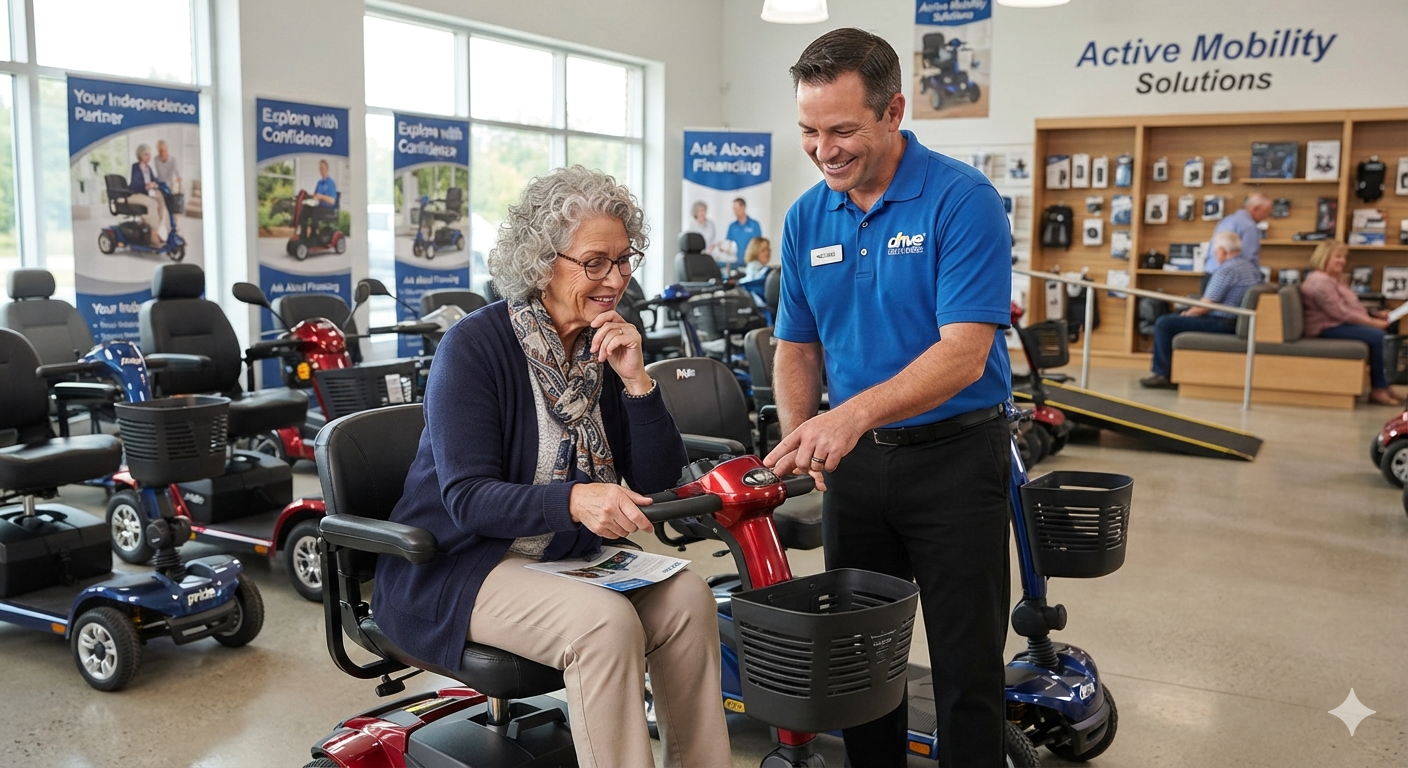
Here's the truth that most buying guides skip: visual impairment on its own should not be viewed as a determinant of safety to drive mobility scooters, and roughly 90% of visually impaired participants passed a practical scooter driving test in research settings. What matters is how you test, and whether the scooter's features match the way your eyes work.
So let's walk through it together, one step at a time, so you can leave the showroom knowing—not guessing.
.
Before You Arrive: What to Bring and What to Ask
A good test drive starts before you touch a tiller. Call ahead and ask whether the dealer can have more than one model ready, whether they can take the scooter outside (or at least to a doorway), and whether they're comfortable with you spending 20–30 minutes on the trial. A dealer who rushes you is telling you something.
Bring the shoes you normally wear outdoors—footwear affects how comfortably you reach the floorplate and operate the controls. Bring any mobility aids you currently use, like a cane or walking frame, so you can see where they fit on the scooter. And bring a friend or carer if you can, not to make decisions for you, but to ask the questions you might forget and to watch how the scooter looks from the outside.
You're not being demanding. You're being prepared—and the next step is about fit.
Step 1: The Fit Check (Before You Move a Single Metre)
Don't drive anything until you've sat on it properly. Adjust the seat height and armrests first, and if the tiller is adjustable, set it to a comfortable angle. You should feel secure, not stretched, cramped, or wobbly.
Then run a simple reach test. Can you reach every control without leaning forward or straining your shoulders? Can you rest your arms, back, and feet comfortably? If you have to stretch to reach a button, your posture shifts, and your view of the path shifts with it. A scooter that fits your body keeps your visual field stable—and stable vision is the whole point.
Now you're ready to find the controls by touch.
Step 2: The Eyes-Closed Control Check
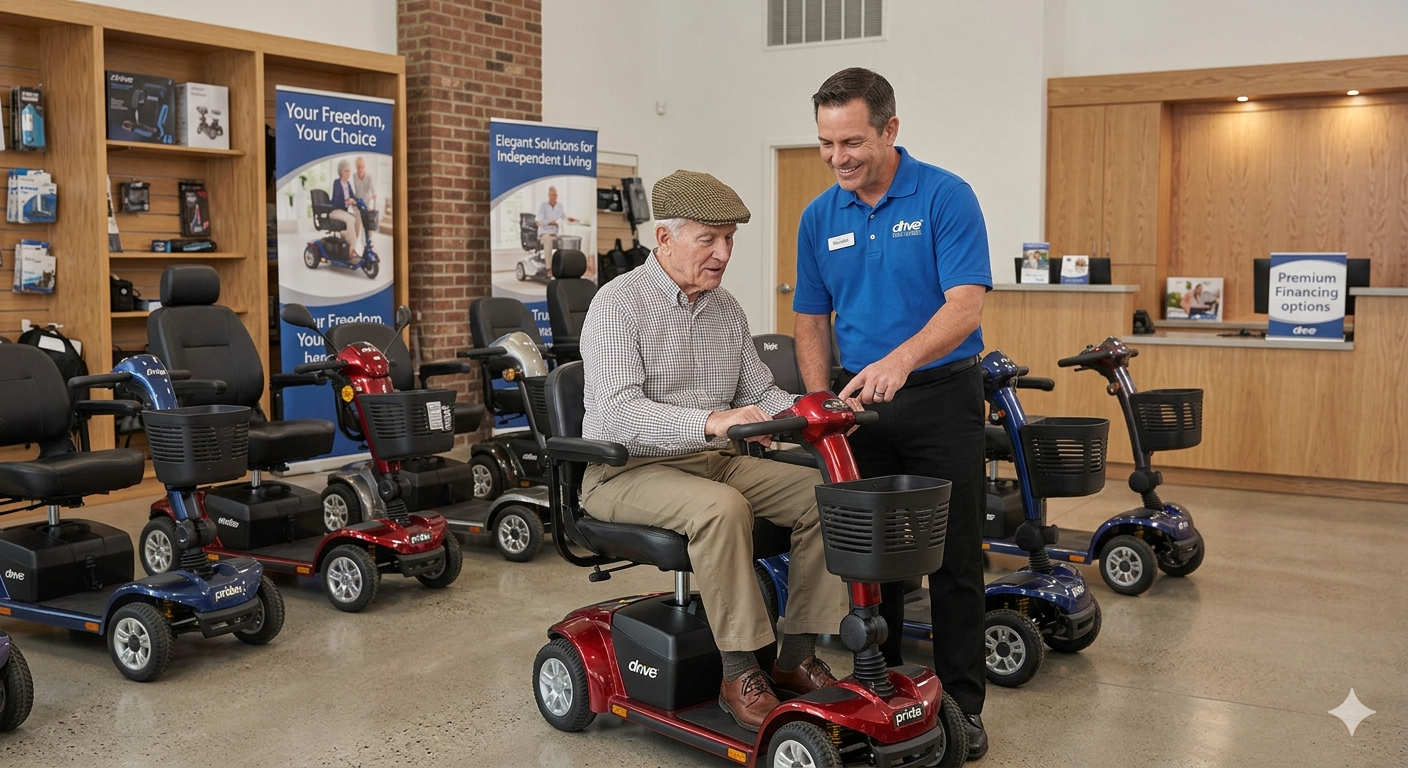
This is the step that separates a low-vision test drive from a standard one. Close your eyes and find the horn, the indicator, and the throttle by touch alone. If your thumb knows where they are, the layout is working for you. If you're fumbling, the design isn't doing its job—and no amount of “modern styling” fixes that.
While your eyes are closed, also notice whether you can tell the buttons apart by shape or texture. A raised dot on the horn, a distinct click on the indicator, a textured grip on the tiller—these are the features that let your hands do the work your eyes shouldn't have to. When you open your eyes, check whether the buttons are clear, simple to read, and reachable. If they're grey-on-grey or identical to each other, that's a red flag.
Once your hands are oriented, it's time to see how the scooter behaves.
Step 3: The Control Response Test
Now start moving—slowly. Test the forward and reverse switches, the speed dial, and the brakes. Do they feel intuitive? Does the scooter stop smoothly when you release the throttle? A scooter that lurches or hesitates is harder to control when your reaction time is doing extra work.
Try both speed settings if the scooter has them—typically 6 km/h (4 mph) for pavement use, and 12 km/h (8 mph) if it's a road-legal Class 3 model in the UK. The low-speed setting should feel calm and predictable, not jerky. And if the scooter has speed limiting or a slow-speed mode, test it now—these are the features that give you confidence in crowded spaces.
But controls are only half the story; the next step is about what you can see.
Step 4: The Display and Glare Test
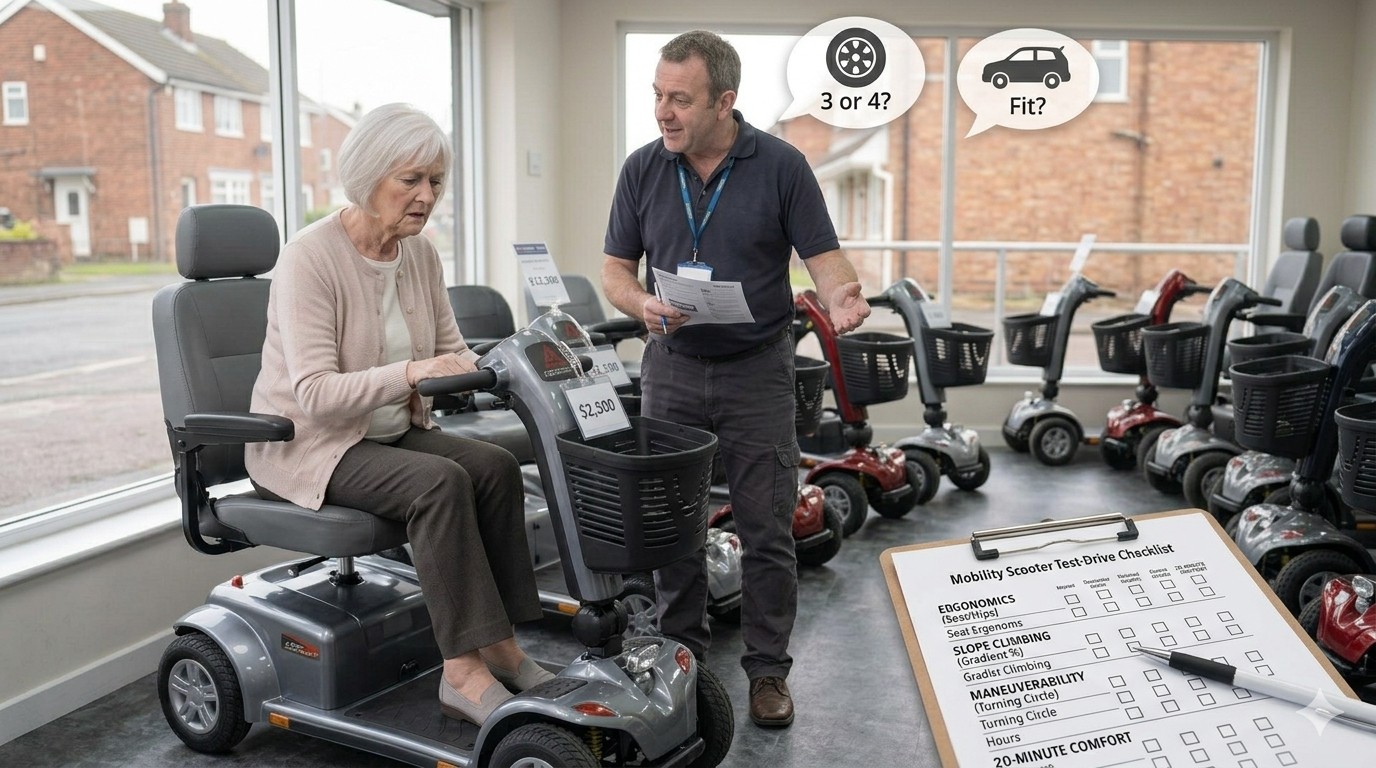
Your display is your main source of feedback, and it needs to work in real light, not showroom light. Sit in a normal riding position and check whether you can read the speed and battery level without leaning forward. Then face the scooter toward a window or doorway and check again.
If the display becomes a pale rectangle in daylight, that's a problem. Look for high contrast, large well-prioritised font, and a matte or anti-glare surface rather than a glossy one. If the scooter has automatic or adjustable backlighting, test it in both bright and dim conditions. A display that's readable in the showroom but unreadable outdoors is a display that will fail you when it matters.
Once you can read the dash, it's time to look up—and check what others can see.
Step 5: The Visibility Check (Seeing and Being Seen)
Ask the dealer to turn on the lights, and then walk 10–15 metres away and look back at the scooter. Can you see the front light, the rear light, and the reflectors? A scooter that's invisible from that distance in daylight is under-equipped—and after dark, the stakes are higher.
Check for bright LED headlights, high-mounted brake and turn signals, rear reflectors, and side reflectors that catch light from angles your headlight doesn't cover. If the scooter has kerb lights or puddle lights, test them in a dim area—they're genuinely useful for spotting the edge of a kerb. And if you'll ride at dusk or after dark, ask whether the headlights activate automatically or need a manual switch.
Being seen is as important as seeing—and the next step is about the ground beneath you.
Step 6: The Surface Test (Kerbs, Ramps, and Uneven Ground)
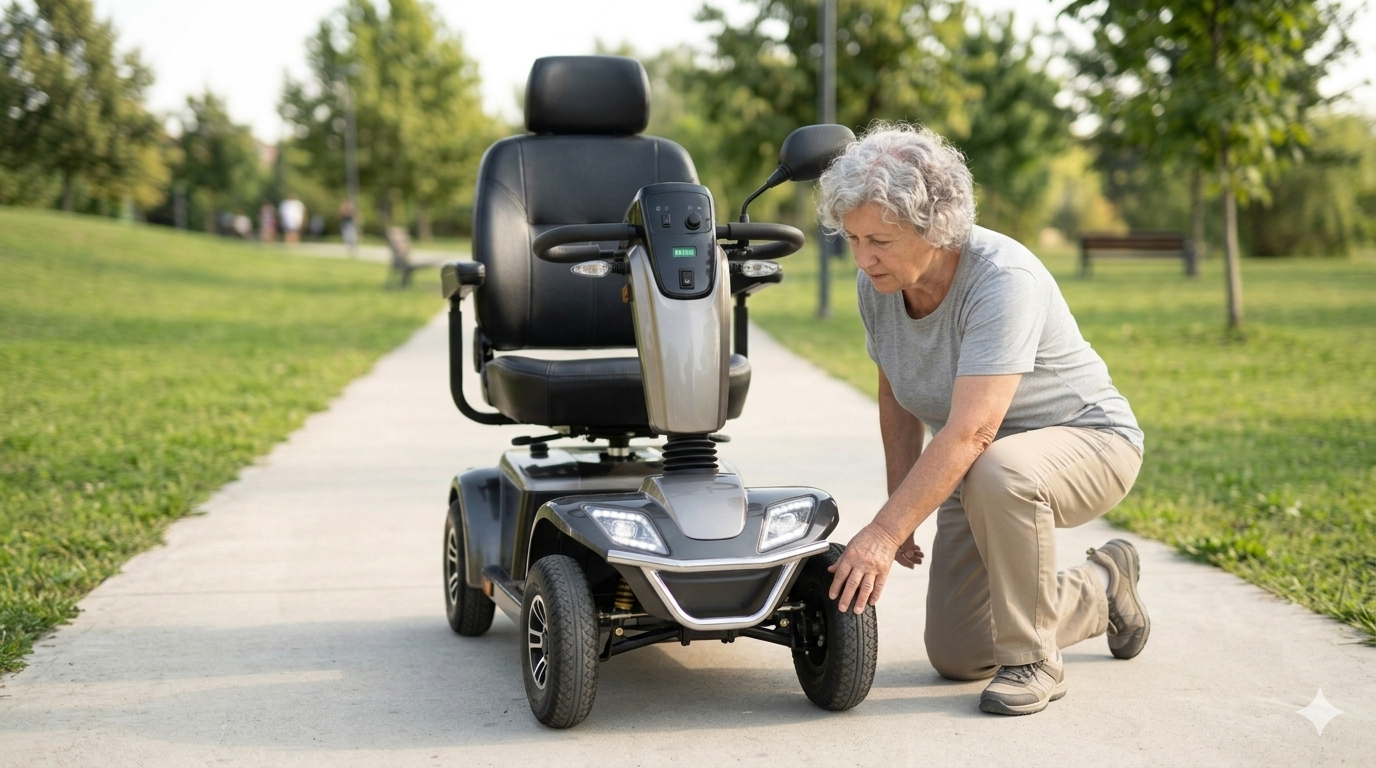
Don't just glide across a smooth showroom floor. Ask to test the scooter on different surfaces: carpet, smooth flooring, pavement, grass, or gravel if possible. A lightweight scooter might feel great on smooth floors but struggle on uneven ground, and you need to know which one you're buying.
If there's a kerb or a driveway lip nearby, test it at the actual kerb, not on flat pavement. Can the scooter clear it without jolting you? Does the suspension absorb the bump, or does it transmit every shock through the frame? Vibration creates visual shake, which makes it harder to read the path ahead—so a smoother ride is a clearer ride. And if the scooter has pneumatic tyres, notice how they cushion the ride compared with solid tyres. Your eyes will thank you.
Now let's talk about turning.
Step 7: The Turning and Tight-Space Test
Drive the scooter around, turn in tight spaces, reverse, and steer around corners. Can you navigate easily without feeling unstable? If you'll be using the scooter indoors—in shops, at home, or in a supermarket aisle—test how well it handles small turns.
This is also where you'll notice whether the scooter's turning radius is predictable. A responsive, calm turn reduces mental load in busy spaces—you're not fighting the steering while scanning for hazards. And if you're choosing between three and four wheels, test both if you can: three-wheelers turn tighter, but four-wheelers feel more planted on uneven ground. Stability usually wins for low-vision riders.
Once you're comfortable moving, it's worth checking the quieter details.
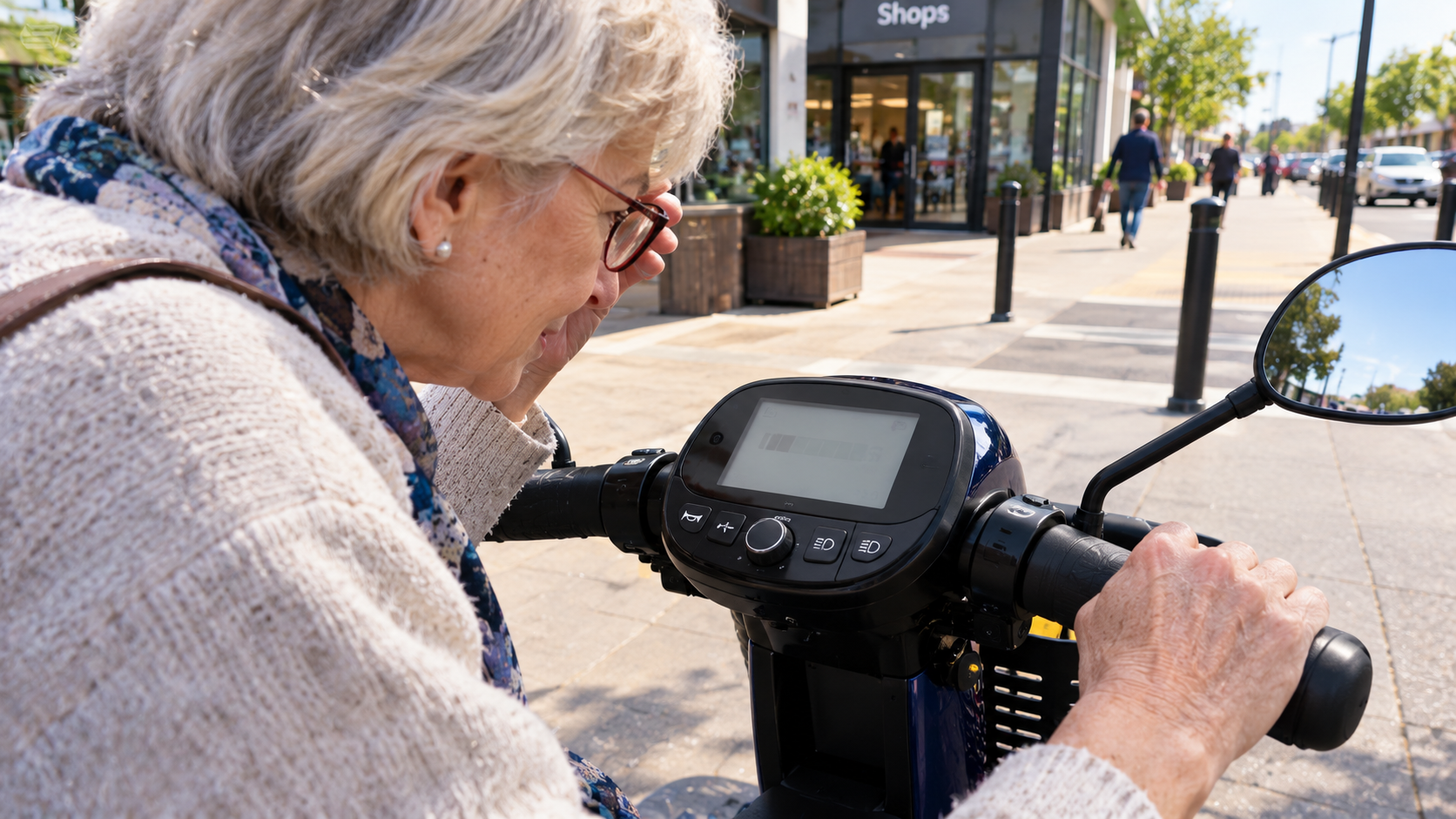
Step 8: Listen for Noise and Feedback
A well-made scooter should operate quietly. Listen for rattling, squeaks, or anything that feels rough. But also listen for the feedback you want to hear: the indicator click, the horn tone, and any audible alerts for low battery or reverse. If the horn and the indicator sound similar, or if the alerts are too quiet to hear in a shopping centre, the feedback isn't doing its job.
Test the sounds in a noisy space, not a silent showroom—ask the dealer to turn on some background noise, or test near a doorway. A distinct horn you can find by touch and a clear indicator click are quiet safety features, and they matter more than most buyers realise.
Now, before you decide, there's one more conversation to have.
Step 9: The Questions to Ask the Dealer (and the Red Flags)
Ask specific, observable questions: “Can I read the display in daylight? Can I tell the horn from the indicator by touch? How does it handle a kerb? What's the turning radius, and can we test it? Does the headlight activate automatically?” A good dealer will welcome these. A poor one will change the subject—and that tells you something.
Watch for red flags: grey-on-grey controls, a glossy unreadable screen, a horn you can't locate by feel, dim or missing indicators, a tiller that forces you to lean to read the dash, or a salesperson who dodges the visibility questions. If any of these show up, walk away—there's another scooter out there that fits you better.
And if you're unsure whether a scooter is the right device at all, an occupational therapist can help.
Step 10: When to Bring in an Occupational Therapist
An OT isn't a gatekeeper designed to tell you “no.” A good OT is a translator—assessing your visual scanning, reaction time, and functional goals, then matching those to a device and a training plan. The assessment typically involves a conversation about where and how you want to ride, a clinical review of vision and cognition, and an on-device trial that may span more than one appointment.
Research on low-vision scooter use consistently points to contrast sensitivity as a key factor in safe driving performance—four out of five participants who failed an on-road scooter test had contrast sensitivity below a clinical cut-off. That's not a reason to give up; it's a reason to test carefully, with the right support. If you have a visual field defect, an OT's input is especially valuable, because field loss can affect hazard detection in ways that are hard to self-assess. The right OT makes the process feel like a plan, not a test.

A Final Word (Before You Go)
You don't need a perfect scooter. You need one you can operate by touch, read in daylight, and trust on a kerb. The ten steps above are designed to turn a stressful showroom visit into a confident decision—and to give you language for the questions you might otherwise forget to ask.
Take your time. Test more than one scooter. And remember that visual impairment alone doesn't disqualify you—it just means the test drive needs to be smarter.
You've got this.
Stay mobile, stay confident!
Sign up for our monthly Mobility Scooter Newsletter to receive practical guides, expert advice, and inspiring stories that help you make the most of your scooter and download our free "Mobility Scooter Guide for Beginners."
Don't worry — your e-mail address is totally secure.
I promise to use it only to send you our newsletter, "Mobility Matters."
Recent Articles


-
The Low Vision Friendly Scooter Features Nobody Explains
Oct 29, 26 07:19 AM
 Low vision friendly scooter features that reduce risk and restore independence—without jargon, guesswork, or pressure.
-
How Carers Make a Mobility Scooter Easier to Use With Low Vision
Oct 29, 26 07:17 AM
How can carers make a mobility scooter easier to use with low vision? Labels, tactile markers, and simple setup tweaks that build daily confidence. -
The Low-Vision-Focused Test Drive Checklist Nobody Hands You
Oct 29, 26 05:48 AM
 How do I do a low-vision-focused test drive of a mobility scooter? Here's the checklist that turns a stressful showroom visit into a confident decision.


Ready to Feel More Confident on Your Mobility Scooter?

My Ebook, The Ultimate Guide to Mobility Scooters, walks you through choosing the right scooter, using it safely, and keeping it in top condition — all explained in clear, friendly language.
Give yourself (or someone you love) the gift of independence.



