- Home
- Services and Shopping
- Mobile Repair Call-out Expectations
- Signs Your Mobility Scooter Is Unsafe To Ride Before a Technician Arrives
Signs Your Mobility Scooter Is Unsafe to Ride Before a Technician Arrives
Here's the honest truth: signs your mobility scooter is unsafe to ride before a technician arrives aren't always dramatic. They don't always come with flashing warning lights or sudden breakdowns.
Often, they're subtle—a change in performance, a new sound, a feeling that something just isn't right. And it's precisely these subtle signs that are the most dangerous, because they're the easiest to ignore.

Picture this: It's a beautiful morning. You've got your coffee, your shopping list, and your favourite route planned. You power up your mobility scooter, and something feels... off.
Maybe it's a faint burning smell you can't quite place. Maybe the steering feels looser than yesterday. Or perhaps your scooter made a strange grinding noise on that last corner. You pause. You wonder.
Is this safe? Should I still go?
This guide is your friendly, practical safety companion. We'll walk through the warning signs that mean stop riding immediately, the red flags that require urgent attention, and the checks you can safely do yourself before a technician arrives. Because your independence matters—but your safety matters more.
Let's start with the most obvious—and most urgent—warning signs. These are the ones you should never, ever ignore.
Immediate Danger: Stop Riding Now
Some signs aren't warnings—they're emergencies. If you notice any of the following, stop using your scooter immediately. Do not attempt to drive it, even a short distance. Your safety—and the safety of others—depends on it.
Burning Smell or Smoke
If you smell anything burning—electrical, plastic, or rubber—pull over immediately, turn off the scooter, and move to a safe distance.
A burning smell can indicate an electrical short, overheating motor, or failing battery. In the case of lithium-ion batteries, overheating can escalate to fire or even explosion.
What to do: Turn off the scooter, move away from it if you see smoke or sparks, and call for help. Do not attempt to investigate the source of the smell yourself.
Sparks or Visible Electrical Issues
Sparks from any part of your scooter—especially near the battery, controller, or wiring—are a serious electrical hazard. They can indicate exposed wires, short circuits, or failing components.
What to do: Stop using the scooter immediately. Do not touch exposed wiring. Call a qualified technician.
Battery Bulging, Leaking, or Overheating
Lithium-ion batteries that are swollen, bulging, leaking, or extremely hot to the touch are a major fire risk. This is one of the most dangerous faults a mobility scooter can develop.
What to do: Do not use the scooter. Do not attempt to charge the battery. Do not puncture or handle the battery. If the battery is bulging, leaking, or overheating, move the scooter to a well-ventilated area away from flammable materials and contact a professional immediately.
Those are the emergencies. But what about the warning signs that are less obvious—the ones that creep up on you over time?
Visual Warning Signs: What Your Eyes Can Tell You
Before you even sit on your scooter, a quick visual inspection can reveal a lot about its safety. Here's what to look for.
Frame Cracks or Structural Damage
Your scooter's frame is its backbone. Cracks in the frame—especially near high-stress points like the steering column, seat mounting, or battery housing—are a serious safety concern. Even small cracks in aluminium or steel weaken the entire structure and can cause complete failure while you're riding.
What to look for:
- Visible cracks in the metal frame
- Bent or twisted parts
- Rust that pits the metal (not just surface rust)
- Wobbling or instability when you sit on the scooter
What to do: If you see any cracks or structural damage, do not ride the scooter. Contact a technician for assessment. This is not a DIY repair.
Tyre Damage or Uneven Wear
Your tyres are your only contact with the ground. If they're compromised, your stability and braking are compromised too.
What to look for:
- Cracks in the rubber (especially on solid tyres)
- Flat spots or uneven wear patterns
- Bald spots or exposed cords
- Pneumatic tyres that are visibly deflated
- Bulges or lumps on the tyre surface
What to do: Check your tyre pressure regularly (most pneumatic tyres require 35–45 PSI). Replace any tyre that shows cracking, flat spots, or excessive wear.
Your eyes can catch a lot. But your ears are just as important—because scooters often talk to you before they fail.
Auditory Warning Signs: What Your Scooter Is Trying to Tell You
New sounds are your scooter's way of saying "something isn't right." Don't ignore them.
Grinding, Squealing, or Clicking Noises
Unusual noises while driving often point to mechanical issues:
- Grinding: Could indicate worn bearings, brake issues, or motor problems
- Squealing: Often related to brakes or belts
- Clicking: May indicate debris around the wheels or a loose component
What to do: If you hear a new noise that wasn't there before, have your scooter inspected before continuing to use it.
Hissing or Cracking Sounds from the Battery
Failing lithium batteries have been reported to make hissing or cracking sounds. This is a serious warning sign of potential fire risk.
What to do: Stop using the scooter immediately. Do not charge the battery. Contact a professional.
Sounds tell you something's wrong. But sometimes, the problem is what you don't hear—or what you feel.

Performance Changes: When Things Don't Feel Right
Changes in how your scooter performs are often the earliest warning signs of a developing problem.
Reduced Range or Battery Performance
If your scooter isn't going as far as it used to on a full charge, your battery may be failing. Batteries typically last 2–4 years, and their performance declines gradually.
What to look for:
- Needing to charge more frequently
- Losing power quickly during use
- Slower speed on hills or ramps
- Battery not holding charge
What to do: If your battery performance has dropped noticeably, have it tested. A failing battery isn't just inconvenient—it can leave you stranded.
Sluggish Response or Reduced Speed
If your scooter feels sluggish, struggles to accelerate, or won't reach its normal top speed, there may be an issue with the motor, controller, or battery.
What to do: Don't ignore it. Have the scooter diagnosed by a professional.
Pulling to One Side
If your scooter pulls to the left or right when you're driving straight, it could indicate:
- Uneven tyre pressure
- Misaligned wheels
- A bent axle or frame
- Brake issues on one side
What to do: Check your tyre pressures first. If the problem persists, have a technician inspect the alignment and steering components.
Performance changes are one thing. But there's another category of warning signs that's even more critical—the ones that affect your ability to stop safely.
Brake Warning Signs: When Stopping Becomes a Question
Your brakes are your most important safety feature. If they're failing, you're at serious risk.
Delayed or Spongy Brake Response
If your brakes feel less responsive, require more force to engage, or feel "spongy," they need attention.
What to do: Test your brakes on a flat, quiet surface. If they don't engage promptly or firmly, stop riding and call a technician.
Brakes That Don't Hold on an Incline
Test your brakes on a slight incline. They should hold the scooter firmly without rolling. If your scooter rolls when parked on a slope, the electromagnetic brake may be failing.
Unusual Brake Noises
Squealing, grinding, or scraping sounds when you brake indicate worn brake pads or other issues.
What to do: Don't wait. Brake problems only get worse—and the consequences of brake failure can be catastrophic.
Now that you know what to look for, let's talk about what you can safely check yourself—and when to stop and call a professional.
Safe Pre-Ride Checks You Can Do Yourself
Before every ride—or at least weekly—take two minutes to do these checks. Think of it like fastening your seatbelt: quick, simple, non-negotiable.
Visual Inspection
- Check for frame cracks or damage
- Inspect tyres for cracks, flat spots, or excessive wear
- Look for loose or corroded electrical connections
- Check that all bolts and screws are tight
Battery Check
- Ensure the battery is fully charged
- Look for any signs of bulging, leaking, or overheating
- Check that battery connections are clean and secure
Brake Test
- On level ground, try to push the scooter gently—it should resist movement
- On a slight incline, the scooter should hold firmly
- Listen for unusual noises when braking
Steering and Controls
- Check that the tiller (steering column) is secure and doesn't wobble
- Ensure the throttle moves smoothly
- Test that the key turns and the control panel lights up
These checks take just a couple of minutes and can save you from a breakdown—or worse. But what about the checks you should never do yourself?
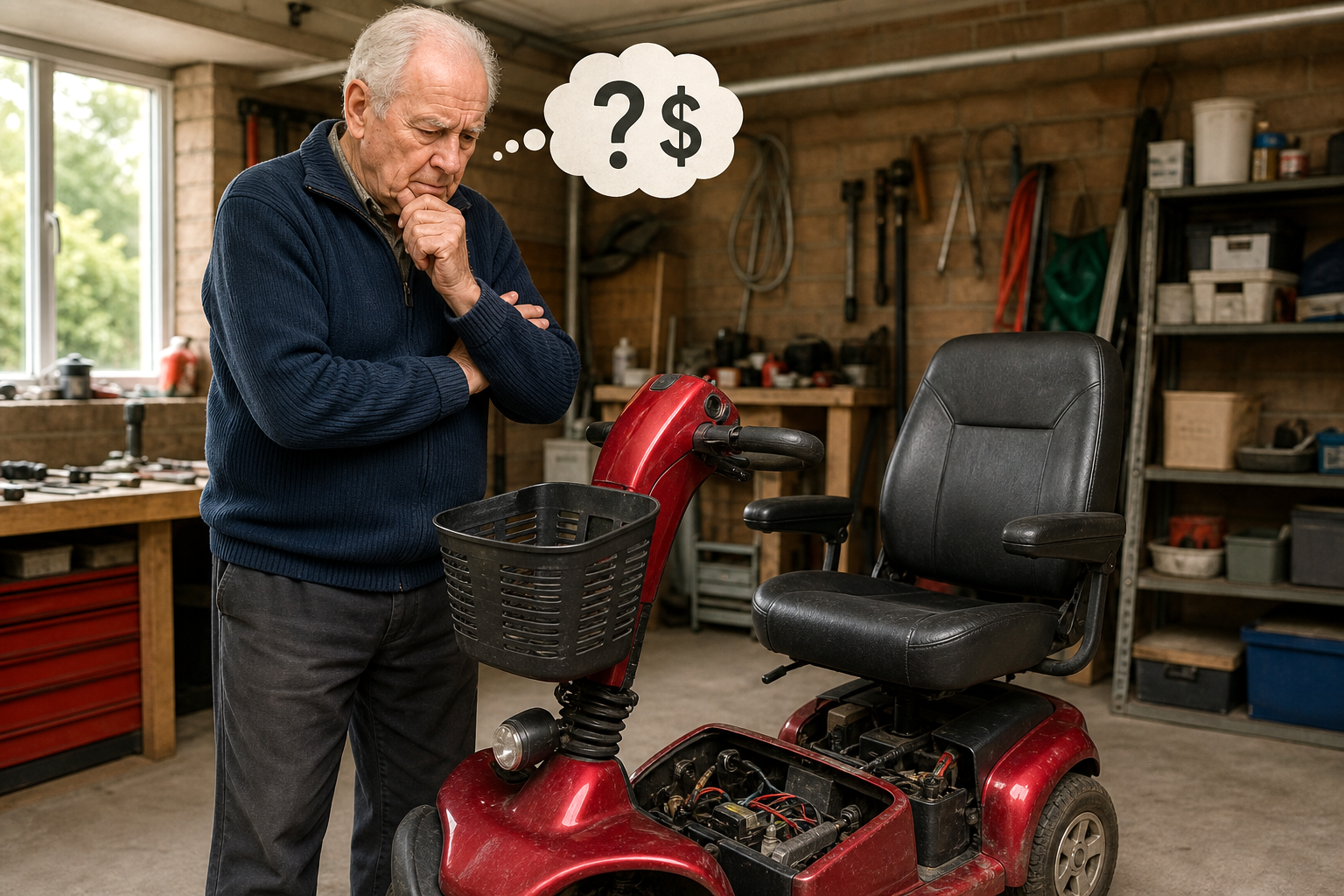
When to Stop and Call a Technician
Some problems are beyond DIY. If you notice any of the following, do not attempt to fix it yourself. Call a qualified technician immediately.
|
Warning Sign |
Why It's Dangerous |
|
Burning smell or smoke |
Fire risk—electrical short or motor failure |
|
Sparks from any part |
Electrical hazard—risk of shock or fire |
|
Battery bulging, leaking, or overheating |
Fire and explosion risk |
|
Frame cracks or structural damage |
Risk of catastrophic failure while riding |
|
Brake failure or severe reduction in braking |
Loss of stopping ability—serious injury risk |
|
Exposed or frayed wiring |
Shock and fire risk |
|
Complete power loss with no obvious cause |
Could indicate controller or motor failure |
If you see any of these, turn off the scooter, don't ride it, and call a professional.
What to Do While Waiting for the Technician
Once you've identified that your scooter is unsafe to ride, and you've called a technician, here's what to do:
- Turn off the scooter and remove the key.
- If the scooter is on a slope, engage the brake and, if possible, move it to level ground.
- If you smell burning or see smoke, move away from the scooter and keep others away.
- If the battery is bulging or overheating, move the scooter to a well-ventilated area away from flammable materials—but do not handle the battery yourself.
- Have your scooter's make, model, and a clear description of the problem ready when the technician calls.
- Do not attempt to use the scooter—even for a "quick trip." It's not worth the risk.

Your Peace of Mind Matters Most
Your mobility scooter is your freedom. It's your ticket to independence, to connection, to the life you want to live. When something feels wrong, it's natural to want to brush it aside—to hope it's nothing, to keep going, to not make a fuss.
But here's what we want you to remember: your safety is never a fuss. Those warning signs aren't nagging—they're protecting you. That burning smell isn't "probably nothing"—it's a signal. That wobble in the steering isn't "just how it feels today"—it's a message.
Knowing the signs your mobility scooter is unsafe to ride before a technician arrives isn't about being paranoid. It's about being empowered. It's about recognising that you deserve to move through the world safely, confidently, and without fear.
So take those two minutes before each ride. Do the checks. Listen to what your scooter is telling you. And if something doesn't feel right—trust that feeling. Call a technician. Wait for the all-clear.
Because your independence is precious. And nothing—not a shopping trip, not an appointment, not a social visit—is worth risking your safety for.
You've got this. And help is only a phone call away.
Need more help? Contact your local mobility equipment provider for servicing advice or to book a technician. And if you're an NDIS participant, don't forget to check your plan has available funding for urgent repairs—mobility scooter repairs are capped at $3,000 under the scheme.
Back to Top/ Back to Mobile Repair Call-out Expectations/ Back to Services and Shopping. / Back to Home
Stay mobile, stay confident!
Sign up for our monthly Mobility Scooter Newsletter to receive practical guides, expert advice, and inspiring stories that help you make the most of your scooter and download our free "Mobility Scooter Guide for Beginners."
Don't worry — your e-mail address is totally secure.
I promise to use it only to send you our newsletter, "Mobility Matters."
Recent Articles


-
Portable vs Travel vs Folding Mobility Scooters Buyer's Guide
Sep 15, 26 11:01 AM
 Confused by "portable," "travel," and "folding" mobility scooter listings? This guide explains what Australian sellers actually mean, with real weight comparisons and a decision framework.
 -
Mobility Scooter Types Overview: No More Confusion
Sep 15, 26 10:54 AM
 Mobility scooter types explained in plain English. Includes Australian footpath rules, airline battery limits, and the one mistake most first-time buyers make.
 -
How to Choose a Mobility Scooter in Australia Guide (2026)
Sep 15, 26 07:29 AM
 Choosing a mobility scooter in Australia? This guide covers registration requirements by state, public transport dimensions, NDIS funding steps, and practical testing advice.



Ready to Feel More Confident on Your Mobility Scooter?

My Ebook, The Ultimate Guide to Mobility Scooters, walks you through choosing the right scooter, using it safely, and keeping it in top condition — all explained in clear, friendly language.
Give yourself (or someone you love) the gift of independence.




