- Home
- Funding and Coverage
- NDIS Funding for Mobility Scooters
- Mobility Scooter vs Powered Wheelchair for NDIS
Mobility Scooter vs Powered Wheelchair for NDIS: How to Decide (and How to Justify It)
Picture this. You're sitting in your OT's office. She's just told you that powered mobility would make a real difference to your independence. You nod. You understand. Then she asks the question you weren't prepared for: “Have you thought about whether you'd prefer a scooter or a power wheelchair?”
You haven't. You didn't know you needed to. And now you're worried that the wrong answer could mean months of delays, a refused application, or — worse — equipment that doesn't actually fit your life.
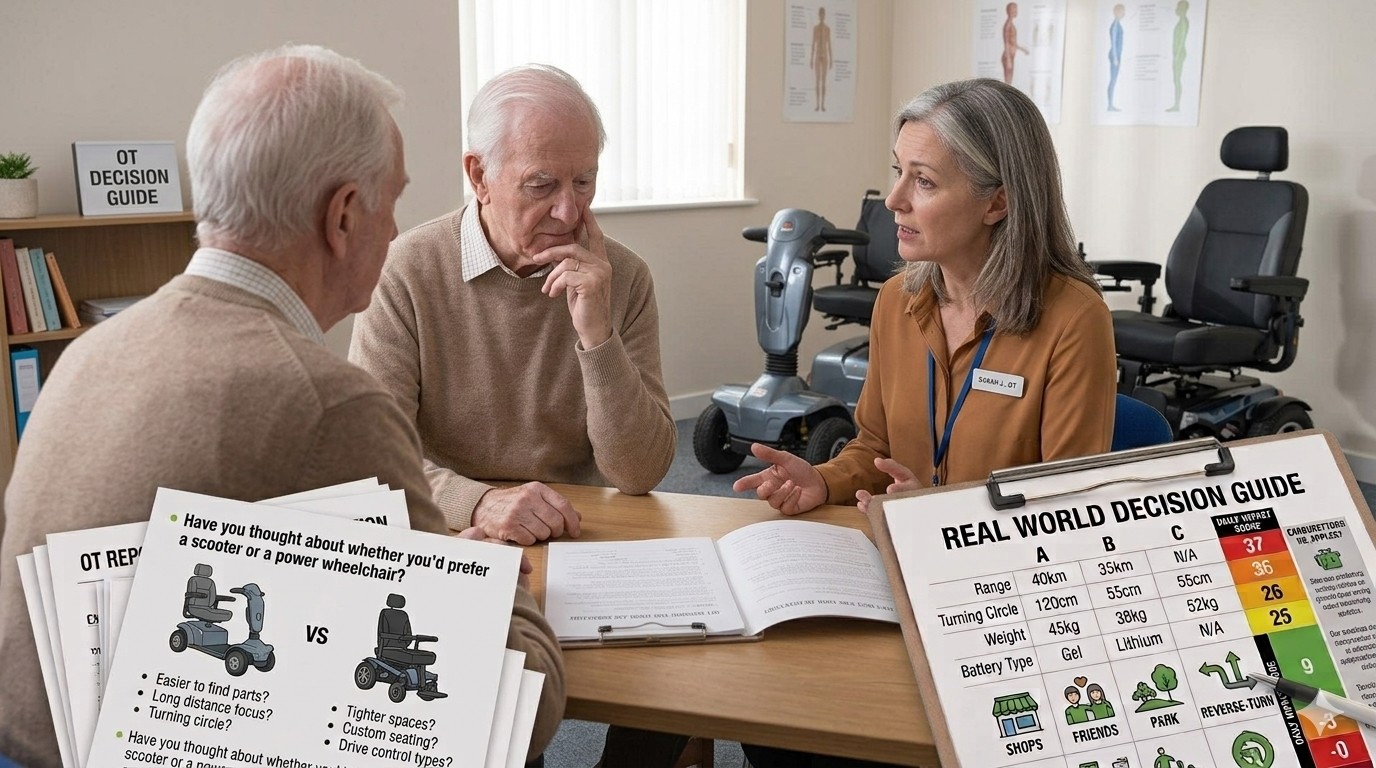
Here's the truth: mobility scooter vs powered wheelchair for NDIS isn't a trick question. It's a genuine decision, and it's one you can make with confidence when you understand what each device is designed to do.
This guide will walk you through the differences, help you assess which one matches your daily life, and show you how to frame your choice so the NDIS says yes. By the end, you'll know exactly what to ask for — and why.
The Core Differences: A Side-by-Side Comparison
Let's start with the essentials. Both mobility scooters and powered wheelchairs (also called power chairs or electric wheelchairs) are battery-powered devices that help you get around without walking. Both are funded through the NDIS under Assistive Technology. Both require an OT assessment for equipment over $1,500. But that's where the similarities end.
A mobility scooter has a seat, a flat footrest platform, and handlebars — called a tiller — that you steer with both hands, like a bicycle. You need reasonable grip strength and upper-body coordination to operate one safely. Scooters are built primarily for outdoor use: footpaths, shopping centres, parks, and community errands. They typically turn in a wider radius, so they're not ideal for tight indoor spaces.
A powered wheelchair uses a joystick — usually mounted on the armrest — that you push with minimal hand strength. The chair responds smoothly to small movements. Power chairs are designed for people who need full seating support throughout the day, with adjustable armrests, footrests, headrests, and sometimes trunk supports. They turn in a much tighter radius, making them suitable for navigating hallways, bathrooms, and kitchens at home.
So which one is right for you? The answer depends on three things: your physical abilities, where you'll use it most, and how long you'll sit in it.
Let's explore each.
Your Body, Your Abilities: What You Can Comfortably Operate
The first question is about you — not the device. Can you grip handlebars and turn a tiller with both hands? Can you sit upright without needing extra postural support? Can you safely transfer on and off a seat independently? If the answer to these is yes, a mobility scooter may serve you well. Scooters are often easier to board and less intimidating for first-time users.
But if you have limited hand strength, tremor, reduced grip, or difficulty sitting upright for extended periods, a powered wheelchair is likely the safer and more comfortable choice. Power chairs require minimal physical effort to operate and provide the seating support that scooters don't. The joystick can even be adapted for chin, head array, or breath control if hand function is severely limited.
Your OT will assess all of this. But knowing the questions in advance helps you have a more productive conversation — and helps you understand why your OT is recommending what they recommend.
Now, let's talk about where you'll actually use the device, because this is where many applications go wrong.
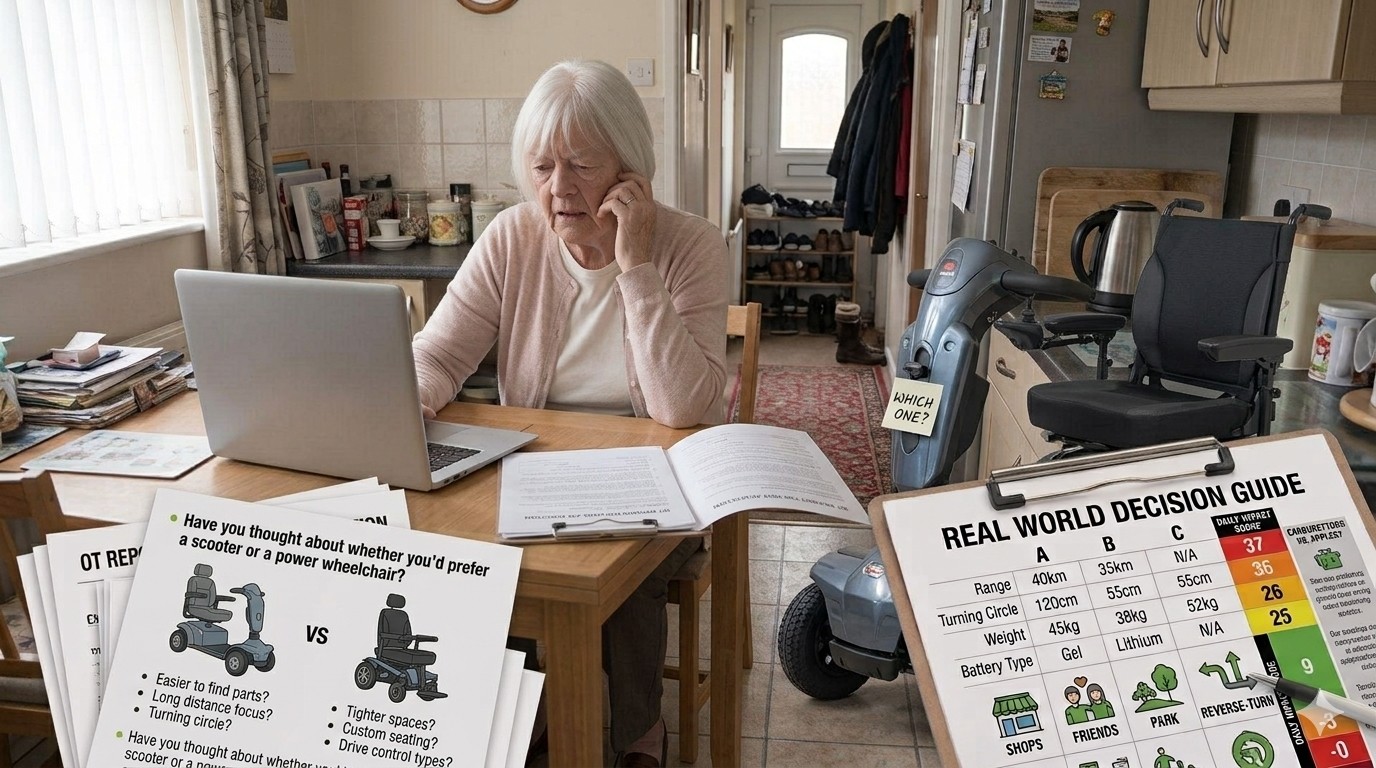
Where You'll Use It: Indoor, Outdoor, or Both?
This is the practical heart of the decision. Where do you need to go? What does your home look like? What does your neighbourhood look like?
If most of your travel happens outdoors — getting to the shops, attending appointments, visiting family across town — a mobility scooter gives you more range and a more comfortable ride over longer distances. Most scooters can cover 25km or more on a single charge. They handle footpaths and shopping centres well.
If you need to use the device indoors as well as outdoors — navigating hallways, getting to the bathroom, moving between rooms — a powered wheelchair is the better fit. Power chairs turn in a radius of 400 to 550mm, tight enough for most Australian homes. Scooters need considerably more room to turn and are not designed for tight indoor spaces.
Some participants genuinely need both. A wheelchair for home and daily indoor activities, and a scooter for community outings. This isn't greed or confusion — it's a legitimate request when your needs span both environments. The NDIS can fund both if your evidence justifies it, and we'll show you how to frame that request shortly.
But first, there's one more factor that affects your choice: how long you'll be seated.
How Long You'll Sit: Comfort and Postural Support
If you spend most of the day seated in your device, a powered wheelchair is almost always the better choice. Power chairs are designed as full seating systems. They support your whole body — back, arms, legs, and sometimes trunk — keeping you positioned correctly whether you're seated for an hour or all day. This matters enormously if you have trunk weakness, pressure injury risk, or significant postural needs.
Mobility scooters have a standard upright seat. They work well if you can sit comfortably without extra support, but they're not designed for people with significant postural requirements. If you find yourself shifting uncomfortably after 30 minutes, a scooter may not be the right long-term solution.
Your OT will assess this during your trial. But the trial isn't just about comfort — it's about evidence. And that evidence is what will justify your request to the NDIS. Let's look at how to build it.

How to Justify Your Choice to the NDIS: The Evidence Framework
The NDIS needs to see that your chosen device is “reasonable and necessary.” In practice, that means your evidence needs to link three things: your impairment, your functional limitation, and your device choice. The Eastham ruling in February 2026 made this clearer than ever — your qualifying impairment only needs to be a contributory cause of your need for the device, not the sole or dominant cause.
Here's a simple framework you can share with your OT:
|
What to Show |
What It Looks Like in Your Report |
|
Your impairment |
“Due to [impairment], I experience [specific functional limitation].” |
|
Your functional limitation |
“This means I cannot [daily activity], which restricts my ability to [goal].” |
|
Your environment |
"At home, I need to navigate [specific spaces]. In the community, I need to [specific activity].” |
|
Why this device |
“A [scooter/wheelchair] is the right solution because [specific reason]. A [alternative] would not meet my needs because [specific limitation].” |
|
Value for money |
“This device costs [amount], which is comparable to alternatives and will reduce my reliance on [other supports].” |
If you're considering both devices, your report should explain why each one serves a different need — and why one cannot replace the other. The Eastham ruling supports this approach: your needs don't have to stem from a single impairment, and your equipment doesn't have to serve a single purpose.
This framework is the backbone of your application. Without it, even a strong recommendation from your OT can fall flat. With it, your request is clear, logical, and hard to refuse.
Now, let's talk about the trial — because that's where your framework gets its proof.
The Trial: Your Evidence-Gathering Opportunity
A trial isn't just a chance to see if you like the device. It's a chance to gather the observations that will strengthen your application. For scooters, pay attention to how you manage the tiller, whether the seat height is comfortable, and how you navigate kerbs and slopes. For power chairs, note how easily you operate the joystick, whether the seating supports you comfortably for extended periods, and how well the chair manoeuvres in your home.
If you're trialling both devices, compare them directly. Which one felt safer? Which one left you less fatigued? Which one made you feel more confident? These observations become evidence. Your OT can include them in the report, turning your lived experience into justification.
And if you're wondering whether your trial can be funded — it can. The NDIS supports short-term rental and trial of AT through your plan. Your OT or support coordinator can help you arrange it.
Once you've trialled and decided, the final step is making sure your request reaches the NDIS in the right format. And that's simpler than you might think.
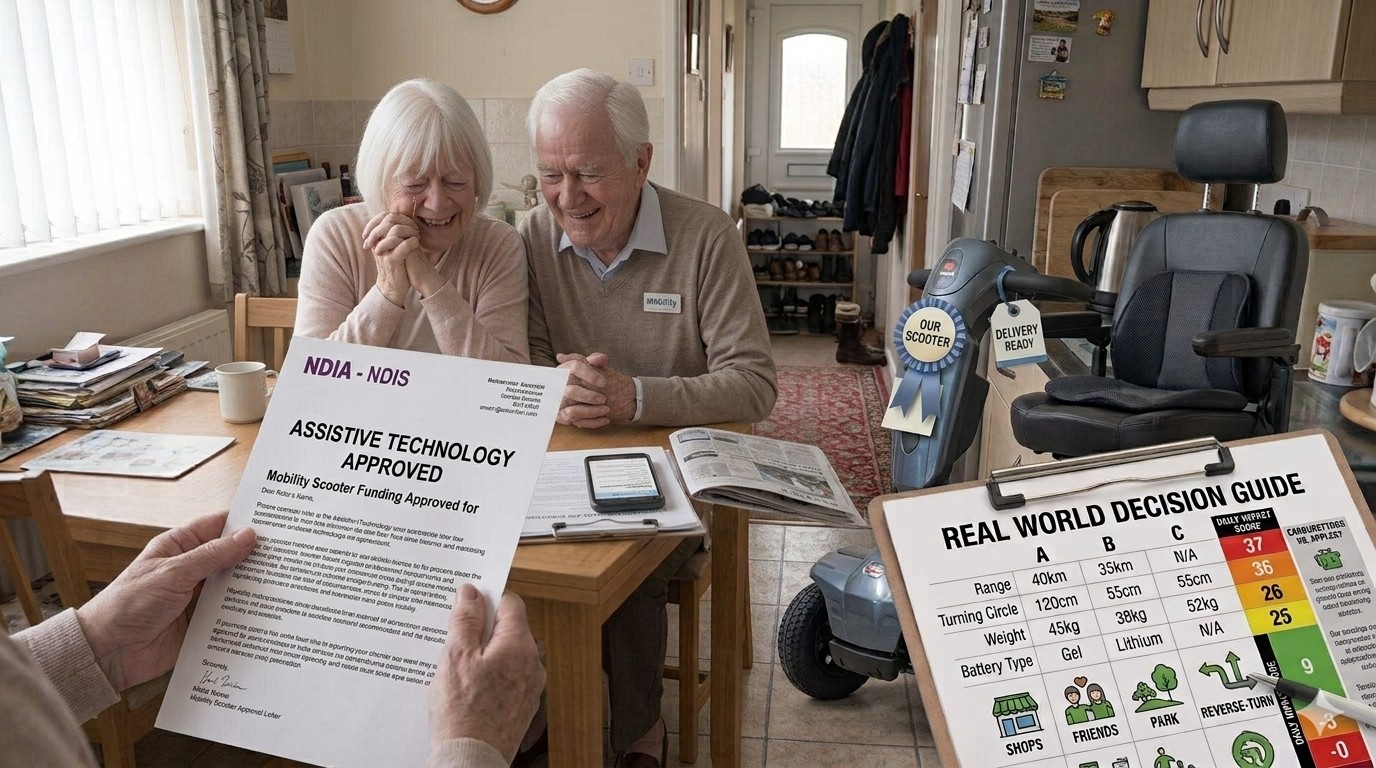
What Happens Next: From Decision to Delivery
Once your OT report and quote are submitted, the NDIS reviews your request. For mid-cost AT — which covers most scooters and standard power chairs — you need written advice from your OT, but you don't need multiple quotes. For high-cost AT — which includes complex power chairs with custom seating — you'll need a comprehensive assessment and supplier quotes.
Timelines vary. Straightforward applications often process within two to six weeks once documentation is complete. If your request is approved, the next steps are ordering, delivery, setup, and training. We've covered that full process in our guide to what happens after NDIS approves your mobility scooter.
For now, the key is this: the decision you make today sets the foundation for everything that follows. And you're more prepared to make it than you were ten minutes ago.
FAQs: Mobility Scooter vs Powered Wheelchair for NDIS
Can the NDIS fund both a scooter and a power wheelchair?
Yes, if your evidence shows that each device serves a distinct purpose that the other cannot meet. Some participants use a power chair indoors and a scooter for community outings. Your OT report should explain why both are necessary.
Which one is easier to get approved?
Neither is inherently easier. Approval depends on the strength of your evidence — specifically, how well your OT report links your impairment to your functional limitations and then to the device choice.
Do I need a trial before the NDIS will approve my request?
A trial is not strictly required for mid-cost AT, but it significantly strengthens your application and helps ensure you choose the right device.
What if my needs change after I get one device?
Your plan can be reviewed if your circumstances change. If your mobility deteriorates or your environment changes, you can request a plan review and provide updated evidence.
Can I choose a scooter if my OT recommends a wheelchair?
You can request whichever device you prefer, but the NDIS will assess whether it meets the reasonable and necessary criteria. If your OT recommends a wheelchair and you request a scooter, your evidence needs to explain why the scooter is the better fit for your needs.
How does the Eastham ruling affect my choice?
The Eastham ruling confirms that your qualifying impairment only needs to be a contributory cause of your need for the device. If you have multiple impairments, you no longer need to prove that your mobility issue is your “primary” disability.
Your Next Step: Decide with Confidence
You don't have to have all the answers right now. You just need to know the right questions to ask. Can you operate a tiller comfortably? Where will you use the device most? How long will you sit in it? And how will you justify your choice to the NDIS?
Your next step is to book a conversation with your OT. Bring this guide. Bring the justification framework. Ask about a trial. And if you're still unsure, ask your OT to walk you through the differences — that's what they're there for.
A powered mobility device isn't just equipment. It's the freedom to move through your day without pain, without planning, and without asking for help. Choosing the right one matters.
And now you have the tools to choose well.
Stay mobile, stay confident!
Sign up for our monthly Mobility Scooter Newsletter to receive practical guides, expert advice, and inspiring stories that help you make the most of your scooter and download our free "Mobility Scooter Guide for Beginners."
Don't worry — your e-mail address is totally secure.
I promise to use it only to send you our newsletter, "Mobility Matters."
Recent Articles


-
The NDIS Mobility Scooter Funding Guide I Wish Someone Had Given Me
Sep 29, 26 09:08 AM
 NDIS funding for mobility scooters doesn't have to be confusing. Here's your friendly guide to eligibility, assessment, costs, and approval.
 -
NDIS Scooter Refused? Internal Review Explained (and Why It Works)
Sep 29, 26 09:06 AM
Appealing a refused mobility scooter request — your rights, your deadline, and your pathway to a fair decision. Internal review explained. -
NDIS Mobility Scooter vs Powered Wheelchair: Which One Is Right?
Sep 29, 26 08:06 AM
Mobility scooter vs powered wheelchair for NDIS doesn't have to be confusing. Here's how to decide and how to frame your evidence.



Ready to Feel More Confident on Your Mobility Scooter?

My Ebook, The Ultimate Guide to Mobility Scooters, walks you through choosing the right scooter, using it safely, and keeping it in top condition — all explained in clear, friendly language.
Give yourself (or someone you love) the gift of independence.




