- Home
- Mobility Scooter Types
- Mobility Scooter Types Overview:
- How to Choose a Mobility Scooter for Hills and Sloped Driveways
How to Choose a Mobility Scooter Type for Hills and Sloped Driveways (What to Prioritise)
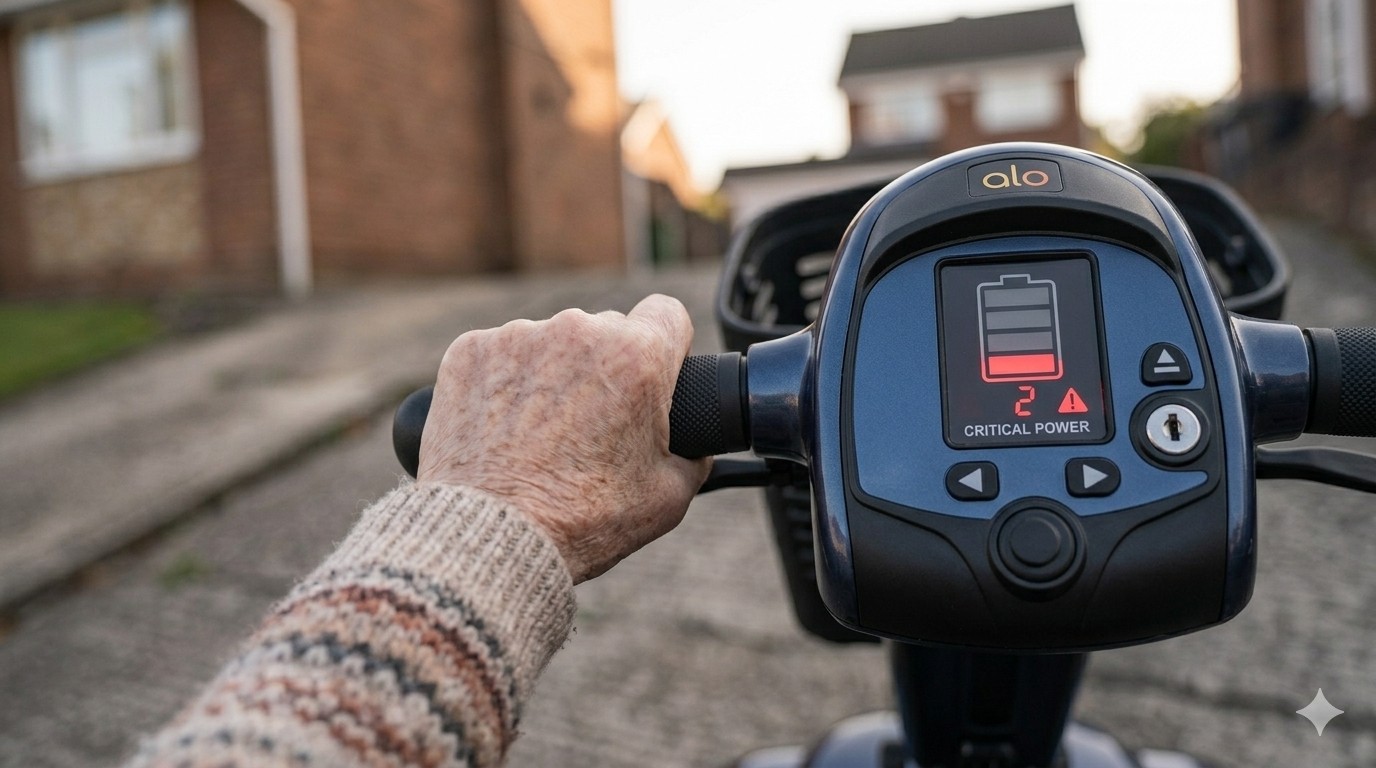
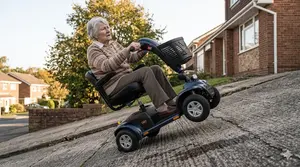
Picture this: You have just bought your first mobility scooter. It is light, nimble, and perfect for the flat footpaths around your local shops. Then you turn toward home, and you face the slope of your own driveway. The scooter slows. The motor strains. The battery indicator drops two bars in thirty seconds. Halfway up, you feel the front wheel lighten, and for a terrifying moment, you are not sure whether the scooter will make it—or whether you will.
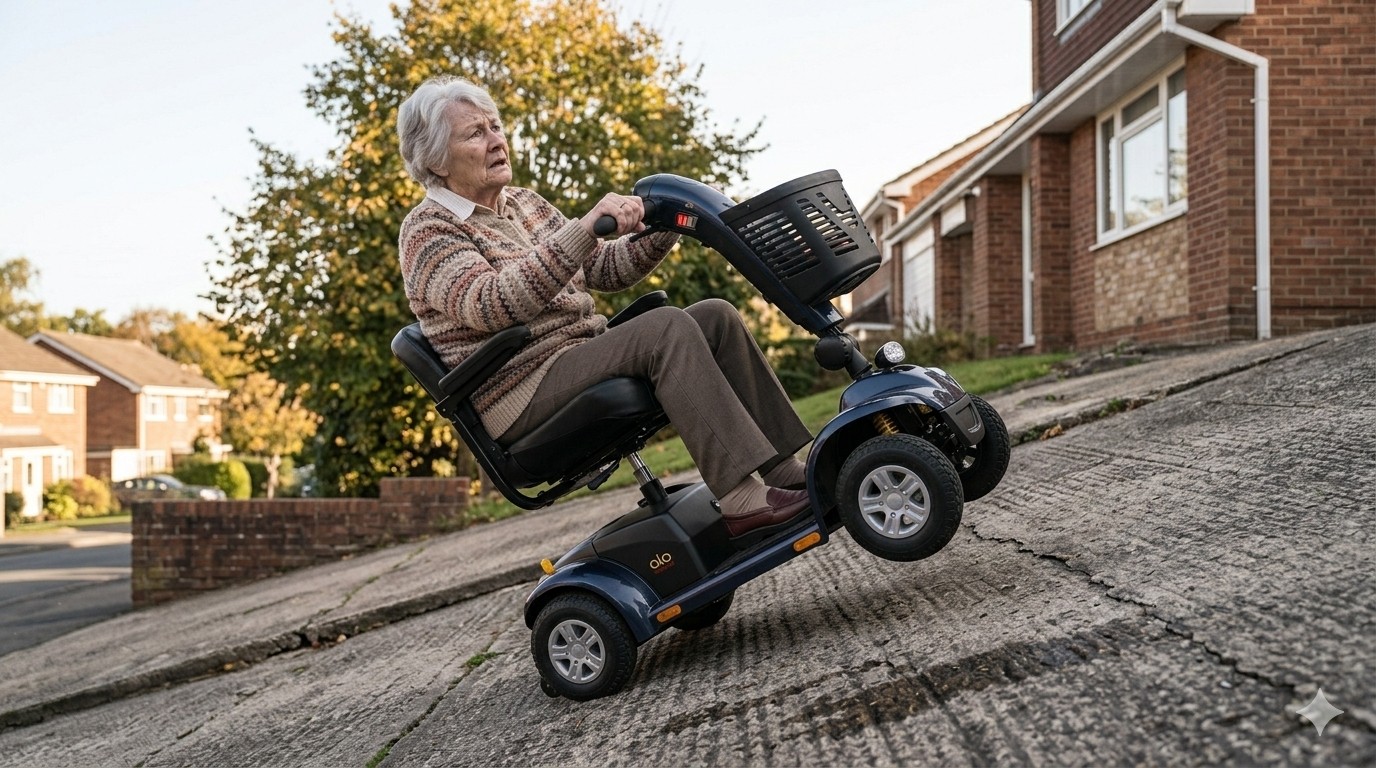
How to choose a mobility scooter type for hills and sloped driveways is not just a specification question. It is a safety question, a confidence question, and a financial question.
The wrong scooter on a hill is not merely inconvenient. It is dangerous. And the hardest part is that most showroom tests happen on flat floors, where every scooter feels capable.
This guide will walk you through exactly what to prioritise when hills are part of your daily reality. You will learn how incline ratings actually work, why motor torque matters more than top speed, how wheel configuration changes stability on slopes, and what braking features prevent the terrifying rollback that causes so many falls.
By the end, you will have a clear, prioritised checklist that lets you choose with confidence instead of guesswork.
Why Hills Change Everything About Scooter Performance
A hill is not just a flat surface tilted upward. It is a fundamentally different operating environment that stresses every component of a mobility scooter in ways that flat ground never does.
When you climb a hill, the motor must work harder to overcome gravity. That extra effort draws more current from the battery, which drains it faster. Real-world data shows that hills, combined with stop-start journeys and cold weather, can reduce usable range by 25% to 40% compared to advertised figures. A scooter advertised as covering 30 km on flat ground may cover only 18 km to 22 km on a hilly route.
But range is only part of the story. Hills also affect stability, braking, and traction. A scooter that feels perfectly stable on a flat footpath may feel precarious on a cambered slope or during a descent. And a scooter that climbs confidently on a dry day may struggle on a wet surface with reduced tyre grip.
This is why choosing a scooter for hills requires a different set of priorities than choosing one for flat, indoor, or occasional use.
The next section explains the single most important structural decision you will make.
Priority 1: Choose 4 Wheels (Almost Always)
If hills and sloped driveways are part of your regular routes, the wheel configuration decision is effectively made for you. A 4-wheel scooter is measurably safer on a sloped driveway.
Here is why. A 3-wheel scooter has a triangular footprint: one wheel in front, two in back. On a slope, the single front wheel carries the entire front load, and any lateral force—a camber, a turn, a surface transition—pushes the scooter toward a tipping point. A 4-wheel scooter distributes weight across a wider, rectangular footprint, which resists lateral tipping and provides a meaningful margin of stability on slopes and at higher speeds.
Four-wheel scooters provide excellent stability over any kind of terrain by resisting tipping and safely handling hills and curbs. They are also the better choice for users who may suffer from poor balance, because they require less active micro-adjustment from the rider.
The trade-off is a wider turning radius, which matters indoors. But if your primary concern is hills, stability wins.
The next priority explains the specification that determines whether the scooter can climb the hill at all.
Priority 2: Motor Power (Torque) Over Top Speed
A scooter's ability to climb a hill is determined by torque, not top speed. A scooter may be capable of 8 mph on flat roads but struggle uphill if torque is low.
Torque is the rotational force the motor delivers to the wheels. It is what allows the scooter to maintain momentum against gravity. A high-torque motor can climb a slope without slowing dramatically or drawing excessive current from the battery. A low-torque motor will slow, strain, and drain the battery faster.
For hilly terrain, look for a motor with higher wattage and a design intended for outdoor use. Mid-size and full-size Class 3 scooters generally use higher-power motors, giving more torque for hills, longer journeys, and mixed terrain. Some heavy-duty models feature motors rated at 800W or higher and can climb slopes up to 25 degrees. Others, like the TopGun Everest, use a 1000W high-torque motor specifically designed for hills and uneven surfaces.
Boot scooters and folding scooters prioritise light weight and portability, which usually means a smaller motor and battery. Their performance is best suited to flatter, shorter journeys. If you live in a genuinely hilly area, a boot scooter is often not the right solution.
But motor power alone is not enough. The battery must be able to sustain the current draw that hill climbing demands. That is the next priority.
Priority 3: Battery Capacity and the Range Reality Check
Climbing hills uses significantly more power than riding on flat ground. A battery that provides 30 km of flat-range may provide only 18 km to 22 km on a hilly route. Small scooters with limited amp-hour batteries may drain quickly, reduce range dramatically, and struggle near the end of the charge.
For hilly areas, choose a scooter with a larger capacity battery and more amp-hours than you think you need. Consider models with extended range options if your daily routes include sustained inclines. And always remember that battery age matters: a tired battery will climb hills less effectively than a new one, even if the specifications are identical.
The next priority is the one that prevents the terrifying moment when the scooter starts rolling backward on a slope.
Priority 4: Braking and Descent Control (The Safety Feature You Cannot Skip)
Climbing a hill is one challenge. Descending safely is another. On a slope, a scooter without proper braking control can roll backward when the user releases the throttle, or accelerate dangerously on a descent.
Look for scooters with automatic electromagnetic braking systems. These engage automatically when you release the controller, providing steady stopping on slopes and preventing rollback. Some models also feature Hill Descent Control (HDC), which enables controlled and safer descents by automatically regulating speed on downhill gradients.
Automatic electromagnetic brakes stop smoothly and securely when you release the controller, even on inclines and declines. Anti-roll-back features are particularly important on hills: cheap scooters may roll slightly before brakes engage, which is something to avoid on slopes.
If the scooter you are considering does not have electromagnetic braking or descent control, it is the wrong choice for hills. This is not a premium feature. It is a safety requirement.
The next priority determines whether the tyres can actually grip the slope.
Priority 5: Tyres, Wheel Size, and Traction
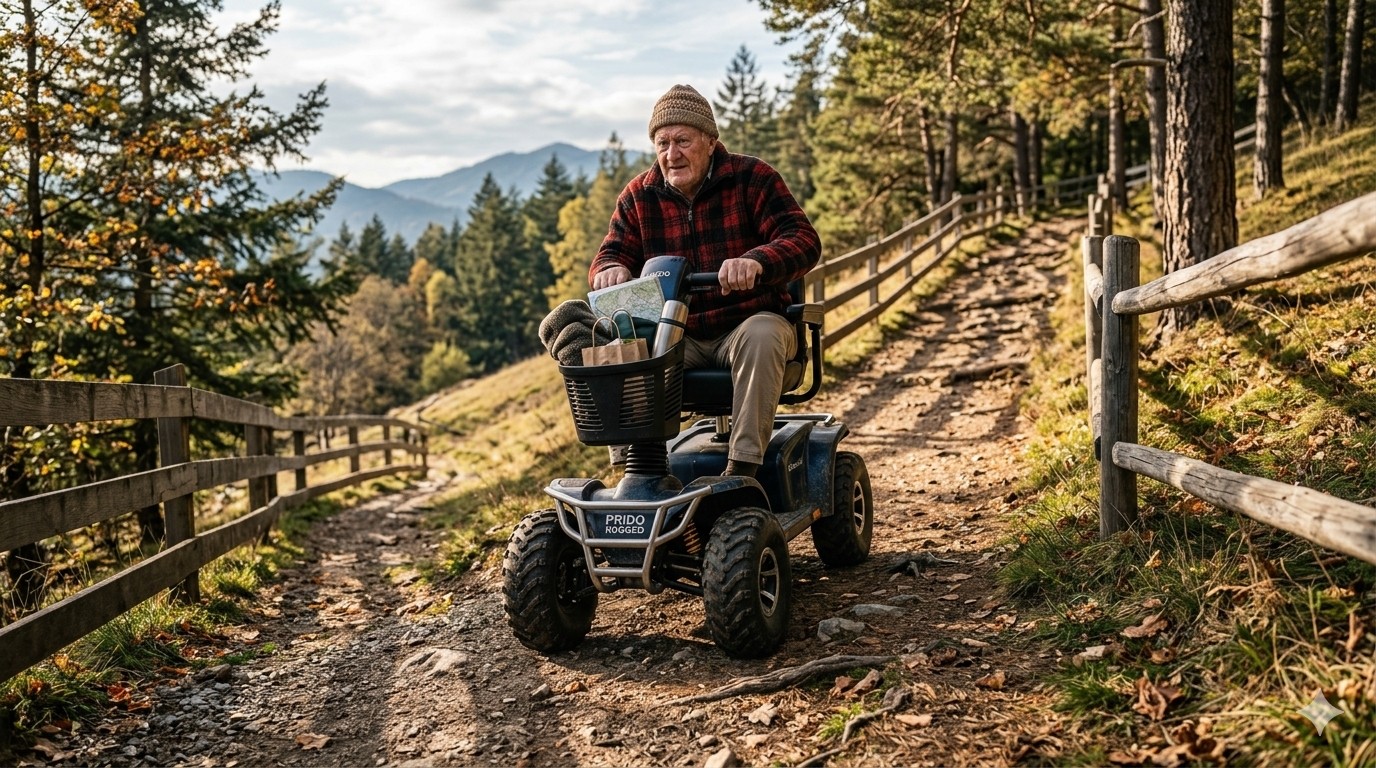
Larger wheels improve stability, grip, and climbing ability on slopes. Pneumatic, air-filled tyres offer better traction, absorb uneven surfaces, and improve hill performance compared to small solid tyres. Small solid tyres may struggle on rough slopes and provide less cushioning.
Wheel size matters far more in inclined areas than on flat ground. A scooter with larger wheels can roll over surface transitions, kerbs, and uneven patches without losing momentum or traction. A scooter with small wheels may catch, slip, or slow dramatically.
If your hilly route includes wet surfaces, gravel, or uneven paving, pneumatic tyres with a tread pattern designed for outdoor use are essential.
The next priority is the one that tells you whether the scooter can handle your specific slope before you buy it.
Priority 6: Understand Incline Ratings (and Do Not Trust Them Blindly)
Most manufacturers list an incline rating, often shown as 6°, 8°, or 10°. But what does that mean in real life?
An incline rating is tested under ideal conditions: fully charged battery, standard user weight, and smooth surface. Real-world performance depends on user weight, surface condition (wet ground, gravel, or tarmac), tyre type, and battery age.
The maximum safe slope for many scooters is around 6° to 10° depending on the model and load. Some heavy-duty models claim up to 25° climbing capacity, but those figures are for specific configurations and conditions. A scooter rated at 8° may struggle on a wet 8° slope with a heavier user and a partially charged battery.
If you regularly travel up hills, always choose a scooter with a higher incline rating than you think you need. And if possible, test the scooter on your actual slope before you buy.
The next priority determines whether the scooter can maintain stability during the climb.
Priority 7: Weight Distribution and Wheelbase
A longer wheelbase improves stability when climbing or descending. A scooter with a longer distance between the front and rear wheels resists pitching backward on an incline and forward on a descent.
Four-wheel scooters provide better balance and feel more secure on hills than three-wheel models. They also distribute the rider's weight more evenly across the chassis, which reduces the load on any single wheel and improves traction.
If you are a heavier user, weight distribution becomes even more critical. Choose a scooter with a weight capacity that leaves at least 20 kg of margin below the maximum, because hill climbing with a scooter at its weight limit will strain the motor, drain the battery faster, and reduce stability.
The Hill-Ready Scooter Checklist
Before you buy, confirm each of these:
- 4 wheels for maximum stability on slopes and cambered surfaces.
- High-torque motor (higher wattage, designed for outdoor use).
- Larger battery capacity to handle the extra power draw of hill climbing.
- Electromagnetic braking with anti-rollback and, ideally, hill descent control.
- Pneumatic tyres with good tread for traction on slopes and uneven surfaces.
- Incline rating higher than your steepest regular slope, with a safety margin.
- Longer wheelbase for stability during climbs and descents.
- Weight capacity with 20 kg margin for performance and safety.
If a scooter fails any of these checks, it is the wrong choice for hills. If it passes all of them, you can climb with confidence.
The Bottom Line
Choosing a mobility scooter for hills and sloped driveways comes down to prioritising stability, torque, battery capacity, and braking control over portability and top speed. Four wheels are almost always the right configuration.
Torque matters more than speed. Battery range drops 25% to 40% on real hills, so choose more capacity than you think you need. Electromagnetic braking with descent control is not optional. And incline ratings are tested under ideal conditions—always choose a higher rating than you think you need.
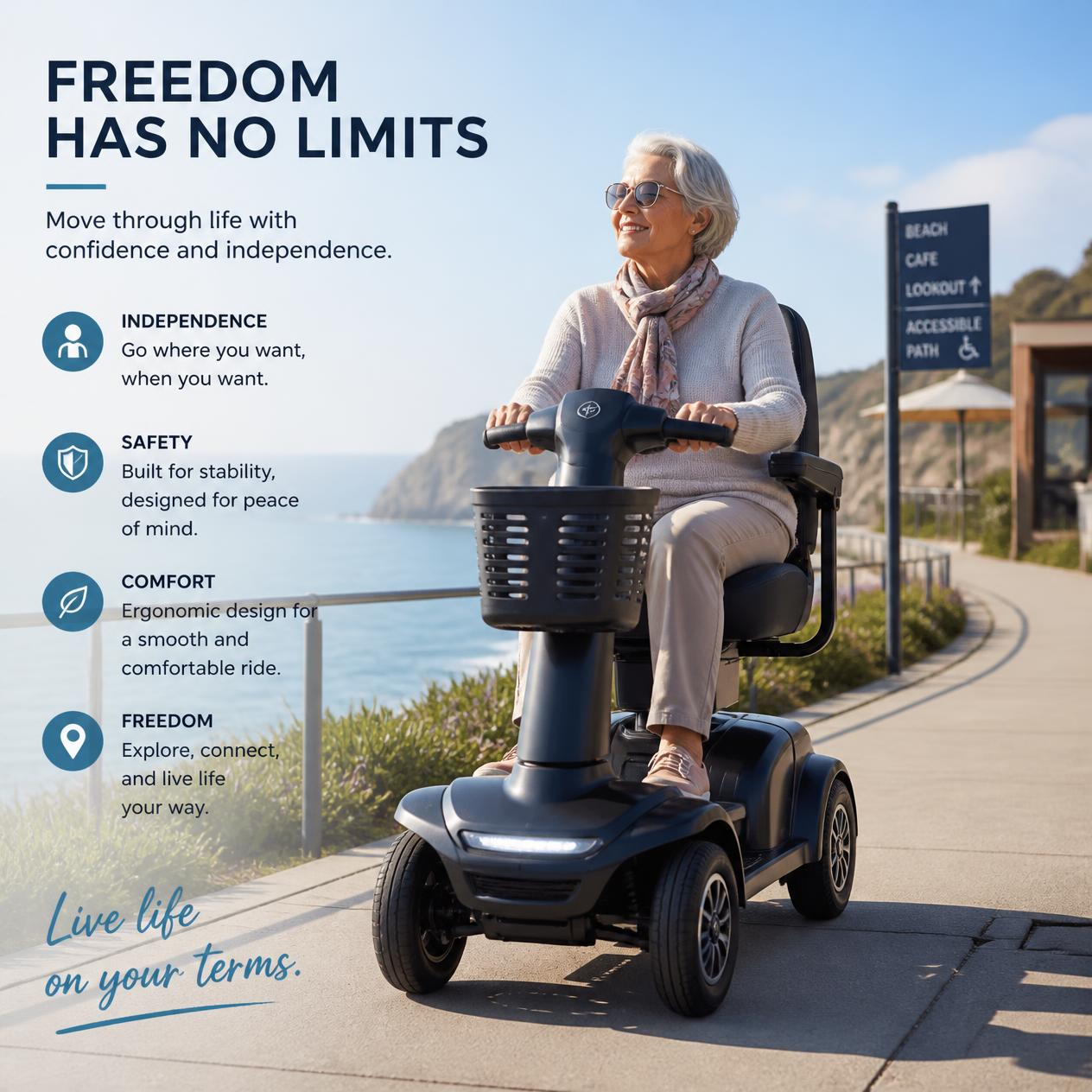
The right scooter for hills is the one that lets you climb your driveway without gripping the handlebars tighter, without watching the battery drop, and without wondering whether you will make it.
Choose for the hill, and the flat ground will take care of itself.
Stay mobile, stay confident!
Sign up for our monthly Mobility Scooter Newsletter to receive practical guides, expert advice, and inspiring stories that help you make the most of your scooter and download our free "Mobility Scooter Guide for Beginners."
Don't worry — your e-mail address is totally secure.
I promise to use it only to send you our newsletter, "Mobility Matters."
Recent Articles


-
Mobility Scooter Types Overview: No More Confusion
Sep 17, 26 08:08 AM
 Mobility scooter types explained in plain English. Includes Australian footpath rules, airline battery limits, and the one mistake most first-time buyers make.
 -
How to Choose a Mobility Scooter for Hills and Sloped Driveways
Sep 17, 26 08:06 AM
 How to choose a mobility scooter type for hills and sloped driveways? Learn the 7 priorities that prevent rollback, tipping, and battery drain.
 -
When Is a 3-Wheel Scooter the Wrong Choice? Real Scenarios
Sep 17, 26 07:17 AM
When is a 3-wheel scooter the wrong choice? Real-life scenarios—slopes, curbs, balance issues—that cause regret, and what to choose instead.

Ready to Feel More Confident on Your Mobility Scooter?

My Ebook, The Ultimate Guide to Mobility Scooters, walks you through choosing the right scooter, using it safely, and keeping it in top condition — all explained in clear, friendly language.
Give yourself (or someone you love) the gift of independence.



