- Home
- Services and Shopping
- Mobility Scooter Service Options
- How Often Should You Service a Mobility Scooter
How Often Should You Service a Mobility Scooter?
Picture this.
You're cruising along, enjoying the fresh air, feeling that wonderful sense of independence. Then suddenly—a strange noise from the motor. Or worse, the scooter just stops. You're stranded, frustrated, and wondering: could this have been prevented?
The honest answer is almost always yes.
If you've been asking yourself how often should you service a mobility scooter, you're already ahead of the game. Because here's the thing: most breakdowns don't happen out of nowhere. They're the result of tiny issues that gradually worsen over time—a loose connection here, a worn brake pad there, a battery that's slowly losing its capacity.
And the best part? A simple, regular service can catch all of these issues before they become expensive, stressful problems.
But here's the confusion: ask five different people how often you should service a mobility scooter, and you might get five different answers. Once a year? Twice a year? Only when something goes wrong?
Let's clear this up once and for all. By the time you finish reading, you'll know exactly how often you should service your scooter—and you'll understand why that answer might be different for someone else.
Part One: The Short Answer (And Why It's Never Quite That Simple)
Let's start with what most people want to know. How often should you service a mobility scooter?
The industry standard is at least once a year. That's the baseline recommendation from most manufacturers and mobility dealers.
But here's the catch: that's just the starting point. The real answer depends entirely on how you use your scooter. Think of it like a car—a car that does 10,000 km a year on smooth motorways needs less frequent servicing than one that does 30000 km on bumpy country roads. The same principle applies to your mobility scooter.
The experts are unanimous on this: "Servicing frequency depends on usage, terrain, and storage conditions." And that's exactly what we're going to explore in detail.
But before we get into the specifics, let's talk about why servicing matters in the first place.

Part Two: Why Should You Service Your Mobility Scooter at All?
You might be thinking: "My scooter seems fine. Why spend money on a service?"
That's a fair question. Here's why.
1. Safety First
This is the most important reason. Your mobility scooter has brakes, tyres, steering components, and an electrical system.
If any of these fail while you're using it, the consequences can be serious. A routine service checks all of these critical safety components to ensure they're working correctly.
2. Cost Prevention
Here's the simple maths: a $100 service can prevent a $300 repair. That's the reality of preventative maintenance.
Many breakdowns are caused by issues that a trained technician would spot early—and fix cheaply.
3. Warranty Protection
Most manufacturers require annual servicing by an approved technician to maintain the warranty.
If you skip services and later need to make a warranty claim, the manufacturer may refuse to honour it.
4. Longevity
A well-maintained scooter lasts longer. Simple as that.
Regular servicing keeps everything working efficiently, reducing strain on components and extending the life of your scooter.
5. Resale Value
If you ever decide to sell your scooter, a documented service history is gold.
It proves to potential buyers that the scooter has been properly cared for. It can boost your resale value and make the sale much smoother.
6. Peace of Mind
This one matters more than you might think. Knowing that your scooter has been professionally checked means you can go out with confidence.
No more worrying about breakdowns. No more anxiety about getting stranded.
Part Three: The "How Often" Decision Matrix
Now let's get specific. How often should you service a mobility scooter for you?
Use this simple decision matrix to find your personalised schedule.
1. Light Use: Every 18 to 24 Months
This applies if:
- You use your scooter once a week or less
- You only travel short distances
- You stick to smooth pavements and flat terrain
- You store your scooter indoors in a dry, temperature-controlled environment
If this sounds like you, your scooter experiences minimal wear and tear. An annual service might be overkill. A service every 18 to 24 months is usually sufficient—provided you're not noticing any warning signs.
2. Moderate Use: Every 12 Months
This is the standard recommendation for most users. It applies if:
- You use your scooter several times a week
- You travel medium distances (up to a few miles)
- You encounter a mix of terrain (pavements, some slopes, occasional uneven ground)
- You store your scooter indoors but perhaps in a garage or shed that isn't fully climate-controlled
For the majority of mobility scooter owners, an annual service is the sweet spot. It catches issues before they become problems and keeps everything running smoothly.
3. Heavy Use: Every 6 Months
This applies if:
- You use your scooter daily
- You travel long distances regularly
- You tackle steep hills, uneven terrain, or cobblestones
- You use your scooter in all weather conditions
- You carry heavy loads or have a heavy-duty scooter
If this sounds like you, your scooter works hard. The batteries, tyres, brakes, and motor all experience significant strain.
A six-monthly service is strongly recommended to keep everything safe and reliable.
4. The "Age" Factor
Here's something many people overlook. How often should you service a mobility scooter also depends on how old it is.
- 0-2 years old: Annual service is usually fine for most users.
- 3-5 years old: Consider moving to a six-monthly service. Components start to show wear.
- 5+ years old: Six-monthly service is strongly recommended. Ageing components need closer monitoring.
5. The "Warning Sign" Trigger
Here's the most important rule: don't wait for a scheduled service if you notice any of these warning signs. If you experience any of these, book a service immediately—regardless of when your last one was.
- Reduced range: You can't travel as far on a full charge
- Struggling on slopes: Hills that used to be easy now cause the scooter to slow significantly
- Unusual noises: Squeaking, grinding, or rattling sounds
- Uneven steering: The scooter pulls to one side
- Dashboard warning lights: Any lights that weren't there before
- Battery not charging properly: Takes much longer (or shorter) than it used to
- Brakes feel different: Less responsive or making noise
- Visible damage: Cracks, bulges, or leaks anywhere on the scooter
Part Four: What Happens During a Professional Service?
One of the biggest reasons people avoid servicing is simply not knowing what they're paying for. Let's demystify it.
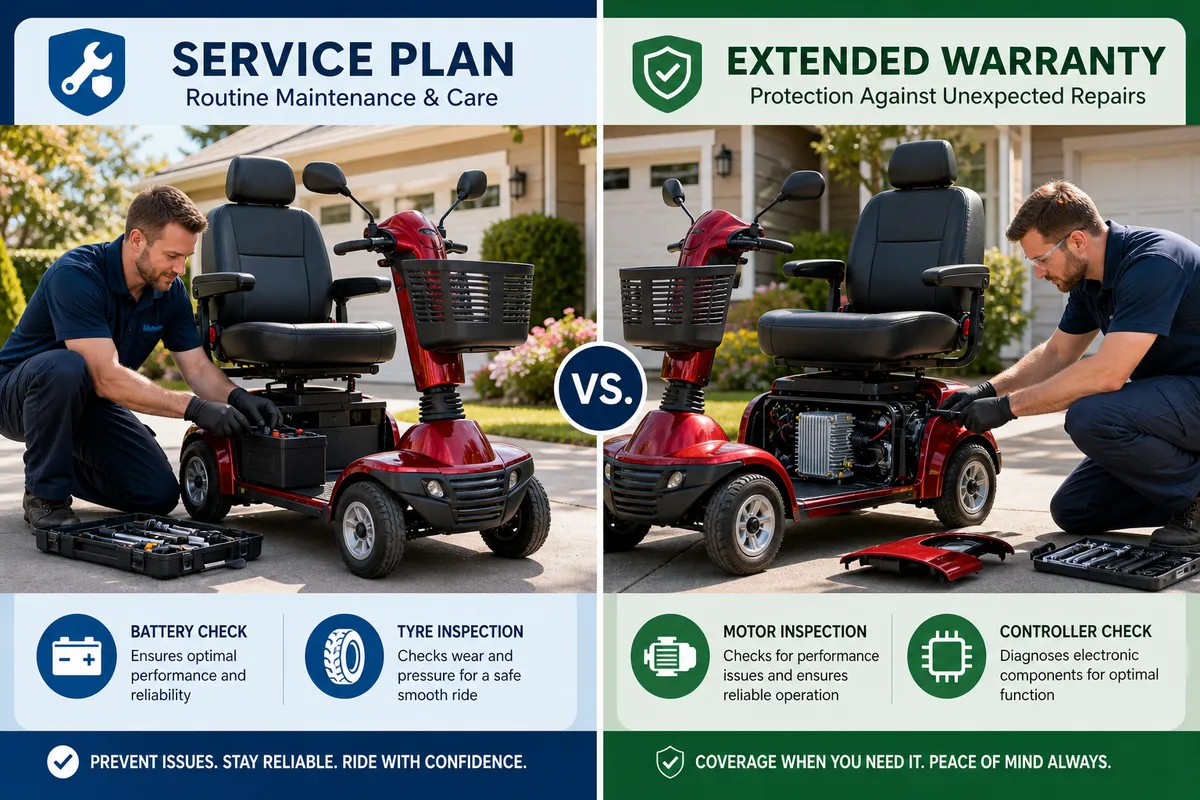
A professional mobility scooter service should include:
- Voltage testing on each battery
- Load testing to assess actual capacity
- Charging system inspection
- Wiring check for loose connections or wear
- Controller diagnostics
Battery & Electrical System
- Voltage testing on each battery
- Load testing to assess actual capacity
- Charging system inspection
- Wiring check for loose connections or wear
- Controller diagnostics
Tyres & Wheels
- Tread depth inspection
- Check for cracks or damage
- Tyre pressure adjustment
- Wheel alignment check
- Caster and wheel bearing inspection
Brakes
- Stopping efficiency test
- Brake cable condition check
- Handbrake or emergency brake inspection
- Brake pad wear assessment
Motor & Drive System
- Motor performance check
- Unusual noise inspection
- Drive belt or gear inspection (if applicable)
- Acceleration and deceleration smoothness test
Steering & Suspension
- Steering column tightness check
- Handlebar alignment
- Suspension component inspection (if fitted)
Comfort & Safety
- Seat stability and locking mechanism
- Armrest security
- Mirrors, lights, and horn functionality
- Overall frame inspection for cracks or damage
The Result
At the end of the service, you should receive a detailed report. This should tell you:
- What was checked
- What passed
- What needed adjustment
- What might need replacing soon (so you can budget for it)

Part Five: How Much Does a Service Cost?
This is one of the most common questions after how often should you service a mobility scooter.
The typical cost for a professional service is £50 to £150 in the UK, or $75 to $200 in the US and Australia. The exact cost depends on:
- Your location and the dealer's pricing
- The size and complexity of your scooter
- Whether any parts need replacing during the service
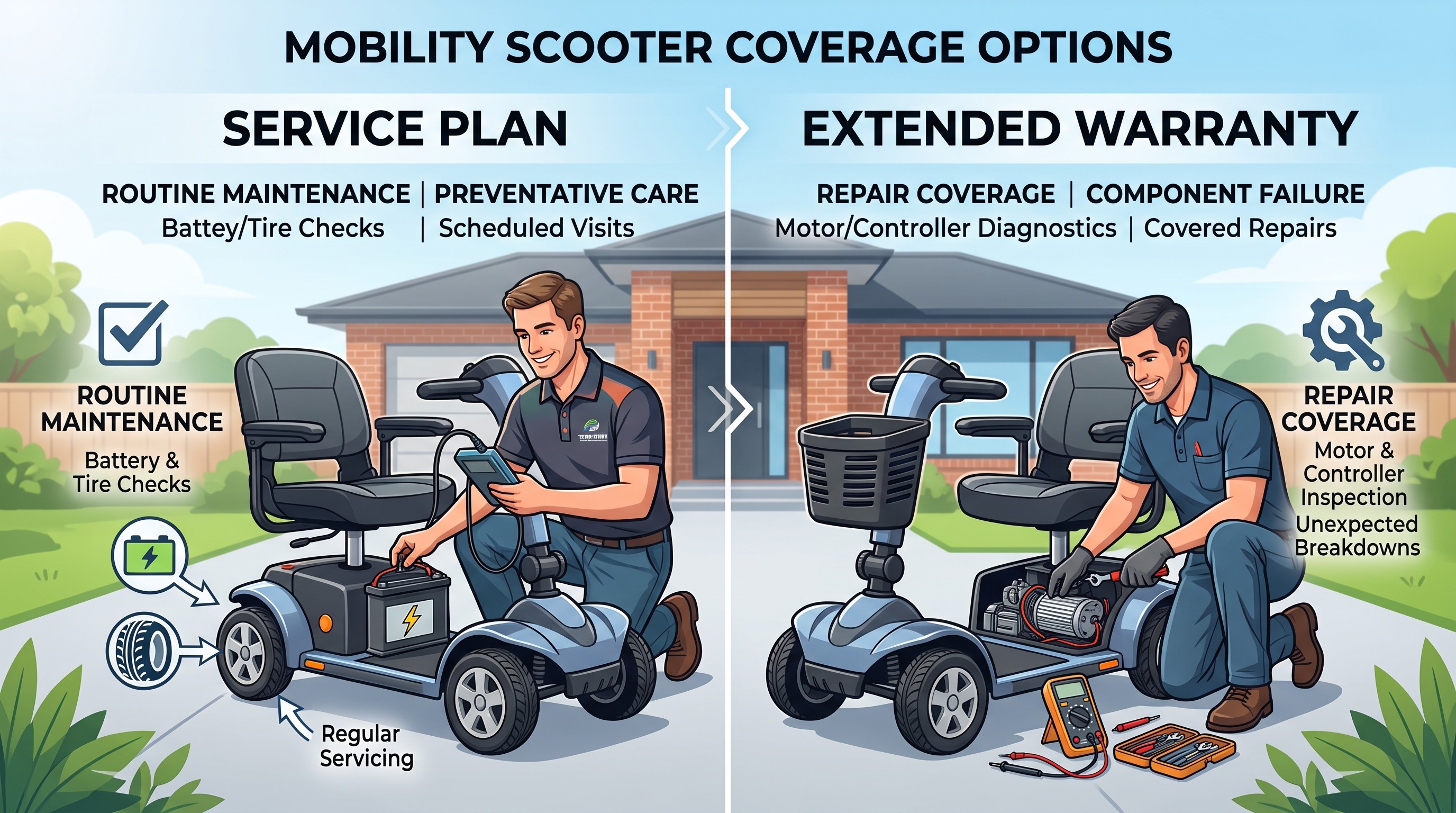
Some dealers offer service plans that bundle an annual service with parts discounts or priority call-outs. These can be good value if you plan to keep your scooter long-term.
Here's the crucial context: that $75 to $150 service is significantly cheaper than an emergency repair or a breakdown recovery.
Think of it as insurance for your scooter's health.
Part Six: What Can You Do Yourself Between Services?
This is a great question. How often should you service a mobility scooter doesn't mean you can't do basic checks yourself.
Between professional services, you can and should do the following simple checks:
Monthly (or More Often)
✅ Tyre Pressure: Keep tyres inflated to the recommended pressure. Under-inflated tyres reduce battery life and make steering harder.
✅ Visual Inspection: Look for obvious issues—cracks, leaks, loose parts, worn tyres.
✅ Clean the Scooter: Keep it clean and dry. Dirt and moisture cause corrosion over time.
✅ Charge Correctly: Charge after every use. Don't leave batteries partially discharged.
✅ Check Connections: Make sure battery connections are tight and corrosion-free.
When You Notice Something
✅ Test the Brakes: On a level surface, engage the brake and try to push the scooter. It should hold firmly.
✅ Check the Steering: The handlebars should feel solid, not wobbly or loose.
✅ Test the Lights: Ensure headlights, indicators, and hazard lights (if fitted) are working.
✅ Listen: Pay attention to any new or unusual sounds while driving.
What to Leave to the Professionals
❌ Electrical diagnostics: Controllers and wiring are complex. Leave these to trained technicians.
❌ Motor repairs: Motor issues require specialist knowledge.
❌ Battery load testing: You can't accurately test battery health without the right equipment.

Part Seven: The "Cost of Doing Nothing" Section
Let's be honest about what happens if you don't service your scooter.
Scenario 1: Battery Failure
A dead battery costs $200- $500 to replace. A service could have flagged the decline early, giving you time to budget and plan.
Instead, you're hit with an emergency cost and stranded without transport.
Scenario 2: Brake Failure
Worn brakes are a safety hazard. A simple adjustment during a service might cost $50. Ignoring it until the brakes fail?
A full brake system replacement could cost $250 to $500—and the safety risk is simply not worth it.
Scenario 3: Motor Damage
Dust, moisture, and general wear gradually damage the motor.
A $180 service could have identified the issue early. A full motor replacement? $500 to $1000.
Scenario 4: Voided Warranty
Manufacturers often require evidence of regular servicing before approving a warranty claim. Skipping services could mean you're on the hook for a repair that should have been covered.
Scenario 5: Reduced Resale Value
When you eventually sell or trade in your scooter, the buyer will ask about service history. No history? They'll offer less. A documented history? They'll pay more.
The message is clear: servicing isn't an expense—it's an investment in safety, reliability, and long-term value.
Part Eight: Choosing a Service Provider
When you've decided how often you should service a mobility scooter, the next question is who should do it.
Look For:
- Approved technicians: Ideally trained by the manufacturer of your scooter
- Transparent pricing: You should know what you're paying for upfront
- Service reports: A detailed report of what was done
- Reputation: Check reviews or ask for recommendations from other users
Questions to Ask:
- "How long will the service take?"
- "What exactly does the service include?"
- "Do you offer a loan scooter while mine is being serviced?"
- "Do you provide a written report after the service?"
Part Nine: Service Plans—Are They Worth It?
Your Next Steps
So here's what I'd like you to do.
Step 1: Assess your usage. Go through the decision matrix in Part Three. Be honest about how often and how hard you use your scooter.
Step 2: Check your service history. When was your last service? If it's been more than 12 months—or more than 6 months for heavy users—it's time to book one.
Step 3: Find a reputable service provider. Ask for recommendations, check reviews, and ask the questions we listed above.
Step 4: Book a service. Don't put it off. A service is a small investment that protects a much larger one—your independence and safety.
Step 5: Set a reminder. Once you've had your service, set a calendar reminder for your next one. Don't rely on memory.

Final Thoughts
Let's come back to where we started. How often should you service a mobility scooter?
The answer is: at least once a year for most users. More often if you use it heavily, less often if you use it lightly. And always—always—if you notice any warning signs.
Your mobility scooter is more than a piece of equipment. It's your connection to independence. It's how you get to the shops, visit friends, enjoy the outdoors, and live life on your own terms.
Doesn't that deserve a little bit of care?
A service isn't just about the scooter. It's about you. It's about peace of mind. It's about confidence. It's about knowing that when you head out the door, you're going to get back home safely.
So book that service. Set that reminder. And keep enjoying the freedom that your scooter gives you.
You've got this.
Stay mobile, stay confident!
Sign up for our monthly Mobility Scooter Newsletter to receive practical guides, expert advice, and inspiring stories that help you make the most of your scooter and download our free "Mobility Scooter Guide for Beginners."
Don't worry — your e-mail address is totally secure.
I promise to use it only to send you our newsletter, "Mobility Matters."
Recent Articles


-
Portable vs Travel vs Folding Mobility Scooters Buyer's Guide
Sep 15, 26 11:01 AM
 Confused by "portable," "travel," and "folding" mobility scooter listings? This guide explains what Australian sellers actually mean, with real weight comparisons and a decision framework.
 -
Mobility Scooter Types Overview: No More Confusion
Sep 15, 26 10:54 AM
 Mobility scooter types explained in plain English. Includes Australian footpath rules, airline battery limits, and the one mistake most first-time buyers make.
 -
How to Choose a Mobility Scooter in Australia Guide (2026)
Sep 15, 26 07:29 AM
 Choosing a mobility scooter in Australia? This guide covers registration requirements by state, public transport dimensions, NDIS funding steps, and practical testing advice.



Ready to Feel More Confident on Your Mobility Scooter?

My Ebook, The Ultimate Guide to Mobility Scooters, walks you through choosing the right scooter, using it safely, and keeping it in top condition — all explained in clear, friendly language.
Give yourself (or someone you love) the gift of independence.

