- Home
- Mobility Scooter Types
- Mobility Scooter Types Overview:
- How to Measure Your Car Boot
How Do I Measure My Car Boot to Choose a Portable Mobility Scooter (and Avoid Buying the Wrong Type)?
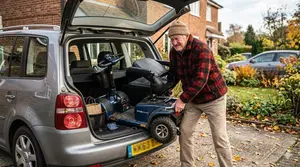
Picture this: Your new portable mobility scooter has just arrived. You’ve read the reviews, saved for months, and imagined the freedom it will bring. You wheel it out to the driveway, open your car boot, and—it doesn’t fit.
The boot opening is two centimetres too narrow. The folded height is three centimetres too tall. The heaviest piece is heavier than you can safely lift. And now you’re stuck with a scooter that lives in the garage instead of one that takes you to the shops.
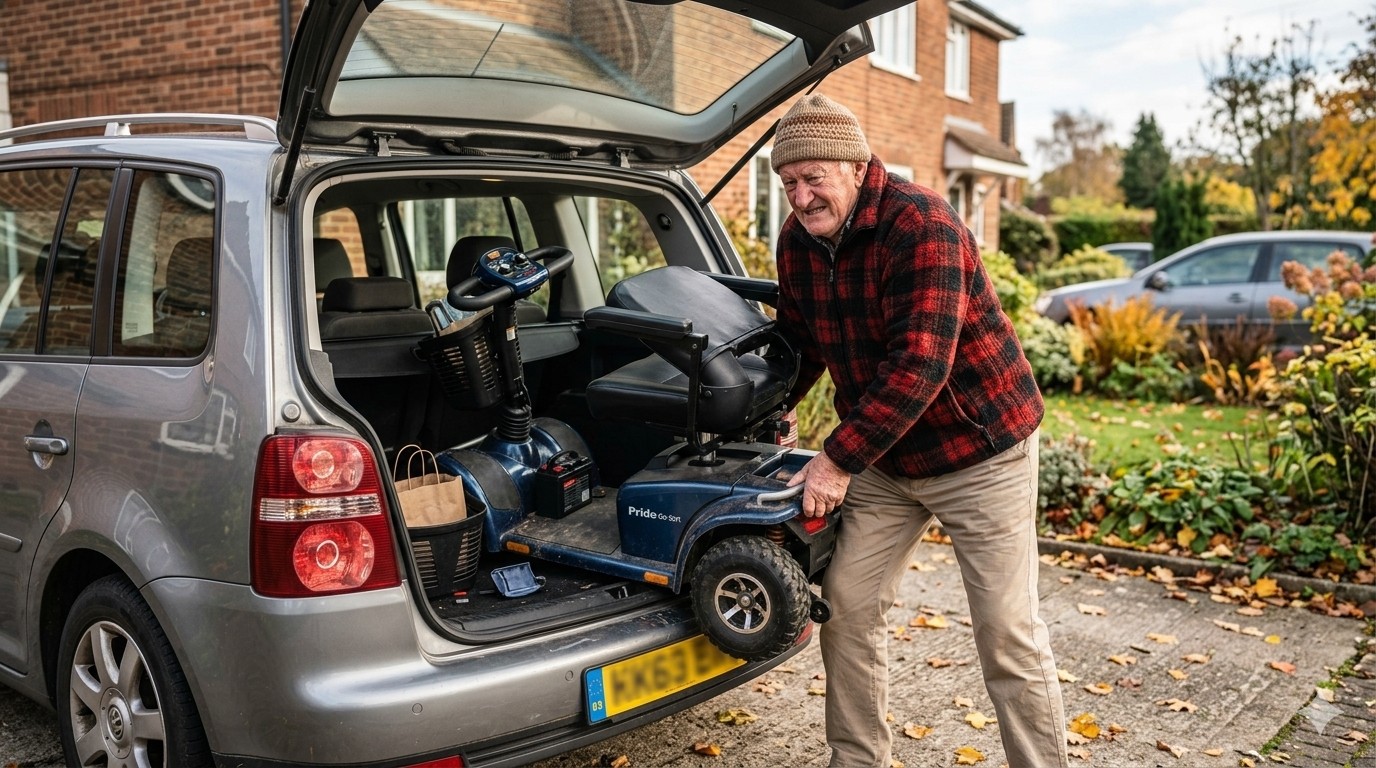
This is not a rare story. It is one of the most common and most avoidable mistakes in mobility scooter buying. And it happens for one simple reason: buyers measure the scooter’s folded dimensions against the car’s advertised boot volume in litres, not against the actual boot opening and usable space.
This guide will walk you through exactly how to measure your car boot to choose a portable mobility scooter, step by step, with the numbers that actually matter. You will learn what to measure, where to measure it, how to compare those numbers to scooter specifications, and how to avoid the four most common boot-fit mistakes.
By the end, you will have a simple checklist that lets you buy with confidence instead of crossing your fingers.
Why Boot Volume in Litres Tells You Almost Nothing
Car manufacturers advertise boot space in litres. That number is almost useless for mobility scooter buyers because it measures the total volume of the boot cavity, not the opening you have to lift the scooter through, and not the usable floor space once wheel wells, hinges, and spare tyre kits take their share.
A car with 400 litres of advertised boot space might have an opening only 80 cm wide and 65 cm tall. If your scooter folds to 85 cm wide, it does not matter that the boot has plenty of room once the scooter is inside. It cannot get through the door.
The numbers that actually determine fit are the boot opening width, boot opening height, usable boot floor length, and load lip height.
Those are the four measurements you need before you compare any scooter. Everything else is secondary.
Step 1: Gather Your Tools (Takes Two Minutes)
You do not need special equipment. You need a retractable metal tape measure at least 3 metres long, a notepad or phone for recording numbers, and an empty boot. Remove shopping bags, spare tyre covers, floor mats, and anything else that eats into usable space.
You also need the scooter’s specification sheet, specifically the folded dimensions and the heaviest single piece weight. If the listing does not provide those numbers, ask the seller before you go any further. A scooter without folded dimensions is a scooter you cannot safely buy for car transport.
If you are considering a heavier model, ask a second person to help during the test-fit phase. Lifting a 25 kg folded scooter into a boot is not a one-person job for many buyers, and there is no shame in admitting that before you buy rather than after.
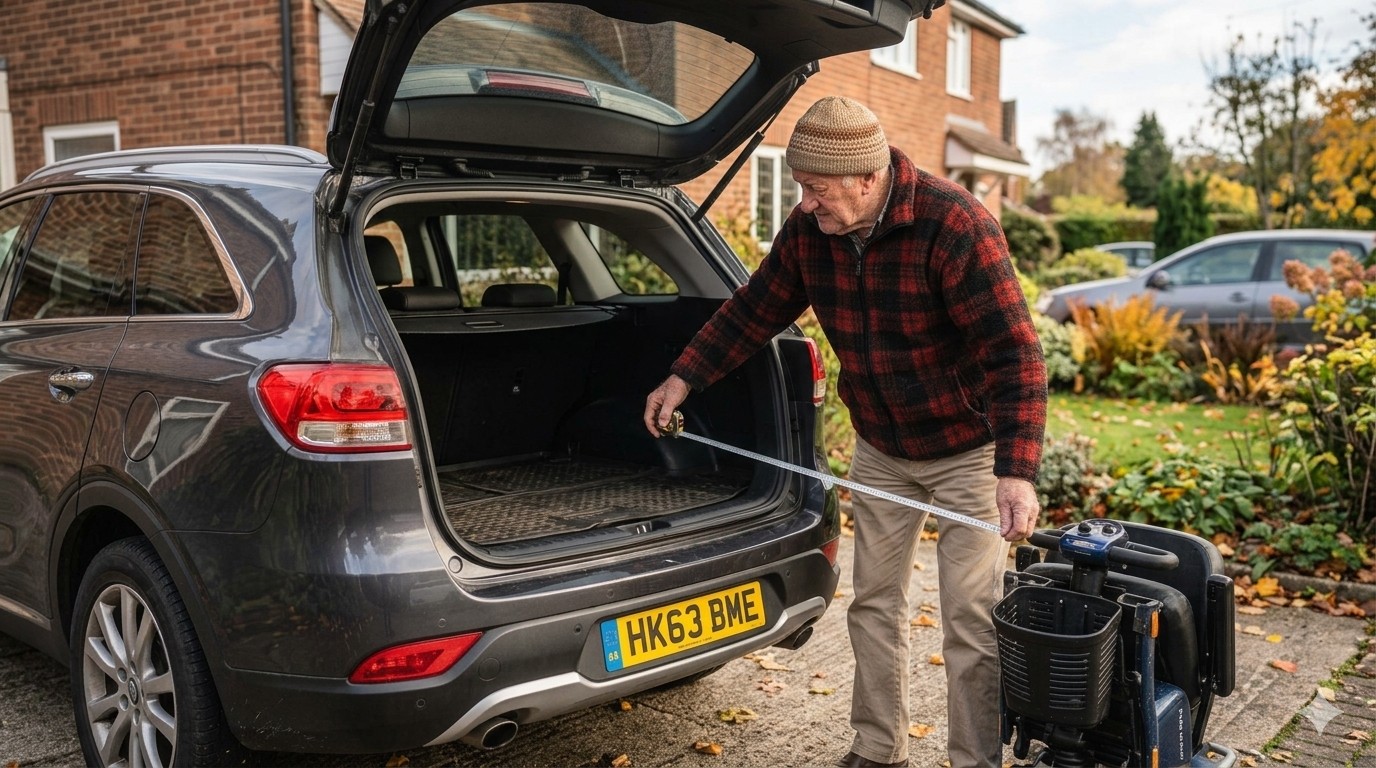
Step 2: How Do I Measure My Car Boot Opening Width?
Open the boot fully. Stand behind the car and look at the aperture, the actual hole the scooter must pass through. Measure the narrowest horizontal point across that opening, not the widest point of the boot interior.
The narrowest point is often near the wheel wells or the tailgate struts. On some hatchbacks, the opening tapers toward the top. Measure at the narrowest section because that is the limiting dimension.
Write this number down. For most small hatchbacks, the boot opening width is between 75 cm and 95 cm. For SUVs and wagons, it is often 95 cm to 110 cm. If your scooter’s folded width is within 5 cm of this number, you are cutting it fine. Leave at least 5 cm of clearance on each side for easy loading.
Step 3: How Do I Measure My Car Boot Opening Height?
Still standing behind the car, measure the vertical distance from the bottom edge of the boot opening to the lowest obstruction at the top. That obstruction might be the tailgate glass, the parcel shelf, or the upper lip of the opening.
Do not measure the internal height of the boot floor to the roof. Measure the opening height, because that is what the scooter must pass through during loading.
On sedans, the boot opening height is often much lower than the internal boot height because the rear deck cuts across the aperture. On hatchbacks and SUVs, the opening is usually taller, often 65 cm to 85 cm. If your scooter folds to 70 cm tall and your opening is 65 cm, it will not slide in without tilting, and tilting changes the effective clearance.
Step 4: How Do I Measure Usable Boot Floor Length?
This is the measurement that determines whether the scooter can sit completely inside with the boot closed. Open the boot and measure from the inside of the tailgate lip to the back of the rear seats with the seats in their normal upright position.
If you are willing to fold the rear seats down, measure that distance as well, because it gives you a much longer floor. But remember: folding seats down means you lose passenger space, and you may not want to do that every time you transport the scooter.
For most small hatchbacks, usable boot floor length with seats up is 60 cm to 80 cm. For SUVs and wagons, it is 90 cm to 120 cm. If your scooter folds to 97 cm long and your usable floor is 80 cm, the scooter will not fit with the boot closed unless you fold the seats.
Step 5: How Do I Measure Load Lip Height?
The load lip is the raised edge at the bottom of the boot opening, the part you have to lift the scooter over. Measure from the ground to the top of that lip.
A lower load lip makes loading easier because you do not have to lift the scooter as high. A higher lip, common on SUVs and some wagons, requires more lifting effort. If you have limited upper-body strength or shoulder problems, load lip height is one of the most important numbers you will measure.
For most sedans and hatchbacks, the load lip is 60 cm to 70 cm from the ground. For SUVs, it can be 75 cm to 85 cm. If your scooter’s heaviest piece weighs 20 kg and your load lip is 80 cm high, you are lifting 20 kg to chest height. That is a very different task from lifting 15 kg to waist height.
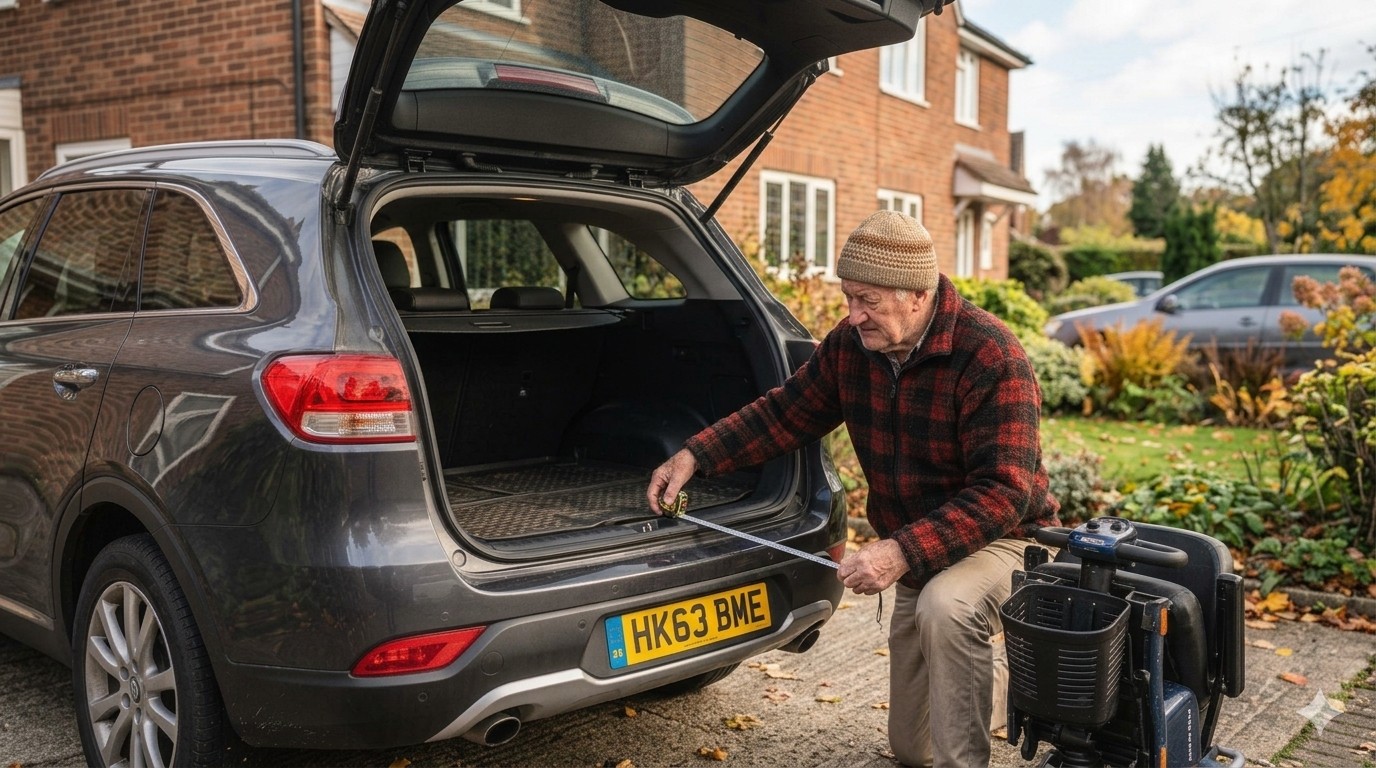
Step 6: Compare Boot Measurements to Scooter Folded Dimensions
Now you have four boot numbers: opening width, opening height, usable floor length, and load lip height. Next, get the scooter’s folded dimensions and heaviest piece weight.
Compare them like this:
- Folded width vs opening width: The scooter’s folded width must be at least 5 cm narrower than the boot opening width. More clearance is better.
- Folded height vs opening height: The scooter’s folded height must be at least 5 cm shorter than the boot opening height.
- Folded length vs usable floor length: The scooter’s folded length must be at least 5 cm shorter than the usable floor length if you want to close the boot without folding seats.
- Heaviest piece weight vs your lifting ability: You must be able to lift the heaviest single piece safely and repeatedly. A one-off lift is not the same as loading the scooter three times a week.
If any of these comparisons fail, the scooter is the wrong type for your car, no matter how well it performs on paper.
Step 7: The Real-World Test (If You Can)
Numbers are essential, but they are not a substitute for a physical test. If you can visit a showroom or arrange a demonstration, bring your car and ask to test-fit the scooter into your actual boot. Five minutes of real-world loading tells you more than an hour of measuring.
If a showroom visit is not possible, ask the seller for a return policy that covers boot-fit failure. Some sellers allow returns if the scooter does not fit your vehicle, but many do not. Know the policy before you buy.
The Four Most Common Boot-Fit Mistakes (and How to Avoid Them)
Mistake 1: Measuring internal boot space instead of the opening. The boot interior may be large, but the opening is the limiting factor. Always measure the aperture.
Mistake 2: Assuming “foldable” means “fits my boot.” A foldable scooter can still be too wide, too tall, or too long for a small car. Always compare folded dimensions to opening dimensions.
Mistake 3: Ignoring the heaviest piece weight. A travel scooter that dismantles into five pieces is only portable if you can lift the heaviest piece. A folding scooter that stays in one piece at 25 kg is only portable if you can lift 25 kg.
Mistake 4: Forgetting the battery. Many listings quote scooter weight without the battery. The battery can add 2–4 kg to the heaviest piece. If the battery is designed to stay attached during transport, include it in your lifting calculation.
A Quick Reference: What Fits in Common Australian Cars?
|
Car type |
Typical boot opening width |
Typical opening height |
Typical usable floor length |
Best scooter type |
|
Small hatchback (e.g., Toyota Yaris, Mazda 2) |
75–85 cm |
55–65 cm |
60–75 cm |
Lightweight folding scooter under 20 kg |
|
Medium hatchback (e.g., VW Golf, Hyundai i30) |
85–95 cm |
65–75 cm |
75–90 cm |
Folding scooter or compact travel scooter |
|
SUV / wagon (e.g., Toyota RAV4, Subaru Outback) |
95–110 cm |
75 –85 cm |
90–120 cm |
Most folding and travel scooters |
|
Sedan (e.g., Toyota Camry) |
80–90 cm |
50–60 cm |
70–85 cm |
Folding scooter with low folded height |
These are approximate ranges. Your specific car may vary. Measure your own boot before you rely on any general table.
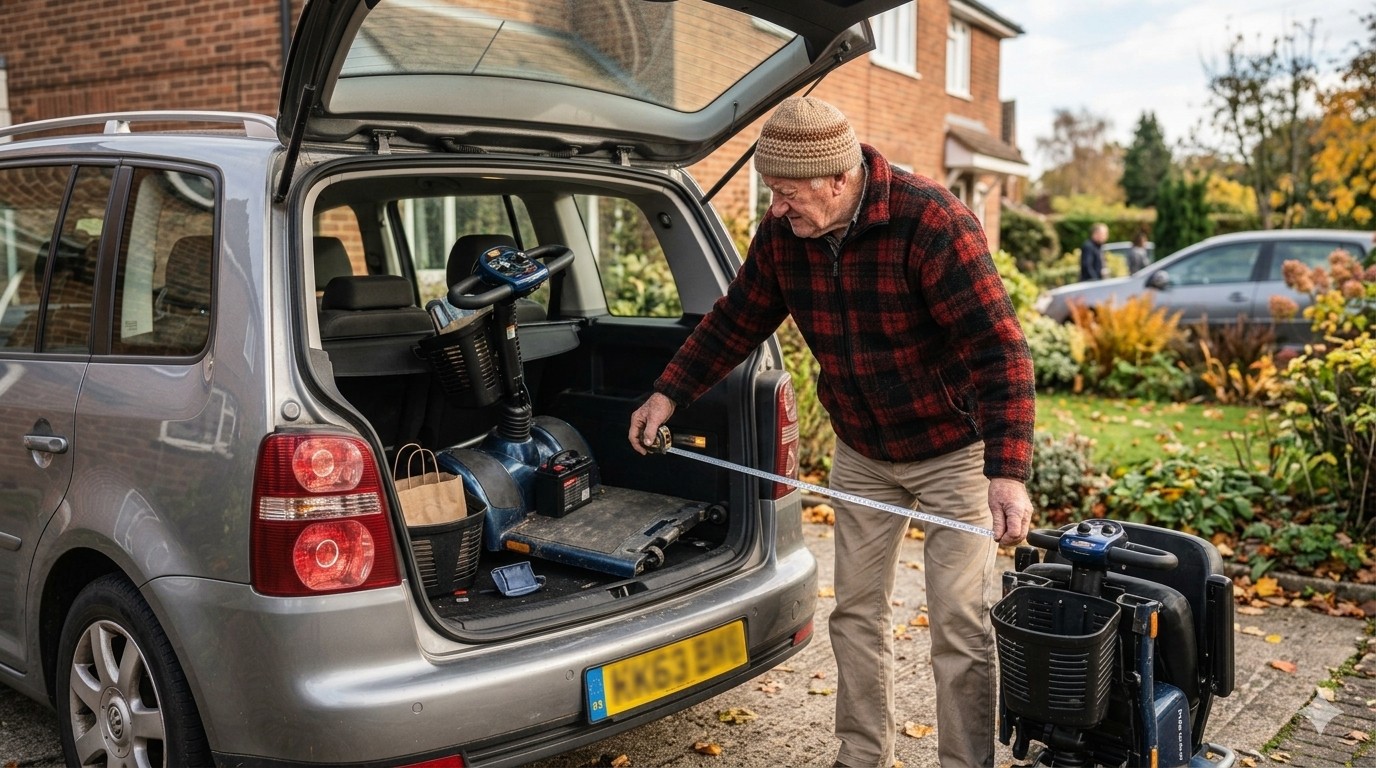
What If My Boot Is Too Small?
If your measurements show that no portable scooter will fit your current car, you have three options. You can choose a lighter, smaller folding scooter with a narrower folded width. You can use a boot hoist or carrier that lifts the scooter for you, removing the need for manual lifting. Or you can accept that your car is not suitable for scooter transport and use a different travel solution, such as public transport or a taxi service that accommodates mobility devices.
None of these options are failures. They are simply different paths to the same goal: getting you and your scooter where you need to go.
The Bottom Line
Measuring your car boot for a portable mobility scooter is not complicated, but it must be done before you buy.
Measure the opening width, opening height, usable floor length, and load lip height. Compare those to the scooter’s folded dimensions and heaviest piece weight. Leave at least 5 cm of clearance on every dimension. Test the lift before you commit.
Do these things, and you will never be the person standing in the driveway wondering why the scooter will not fit. You will be the person who measured once, bought once, and got back to living.
Stay mobile, stay confident!
Sign up for our monthly Mobility Scooter Newsletter to receive practical guides, expert advice, and inspiring stories that help you make the most of your scooter and download our free "Mobility Scooter Guide for Beginners."
Don't worry — your e-mail address is totally secure.
I promise to use it only to send you our newsletter, "Mobility Matters."
Recent Articles


-
Mobility Scooter Types Overview: No More Confusion
Sep 16, 26 09:57 AM
 Mobility scooter types explained in plain English. Includes Australian footpath rules, airline battery limits, and the one mistake most first-time buyers make.
 -
When Is a 3-Wheel Scooter the Wrong Choice? Real Scenarios
Sep 16, 26 09:54 AM
 When is a 3-wheel scooter the wrong choice? Real-life scenarios—slopes, curbs, balance issues—that cause regret, and what to choose instead.
 -
How to Measure Your Car Boot for a Portable Mobility Scooter
Sep 16, 26 07:59 AM
How do I measure my car boot to choose a portable mobility scooter? Follow this step-by-step guide to avoid buying a scooter that won’t fit your car.

Ready to Feel More Confident on Your Mobility Scooter?

My Ebook, The Ultimate Guide to Mobility Scooters, walks you through choosing the right scooter, using it safely, and keeping it in top condition — all explained in clear, friendly language.
Give yourself (or someone you love) the gift of independence.

