- Home
- Mobility Scooter Travel and Transport
- Storage Planning for Small Spaces
- How to Secure a Mobility Scooter at Home Near the Door
How Can I Secure a Mobility Scooter at Home When Indoor Space Forces "Near-the-Door" Storage?
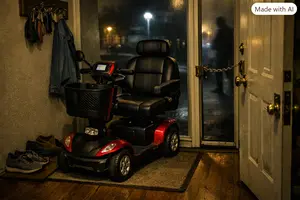
Picture this. Your scooter lives in the entryway. It has to—there is nowhere else for it to go. Every time you walk past it, you feel a small pang of worry. It is the most expensive thing you own, and it is sitting right beside the front door, visible from the street, and only a few steps from the outside world. You have heard stories of scooters being stolen from hallways and porches. You have read about thieves who target mobility devices because they are small, light, and easy to sell. And you are wondering: is there anything I can actually do to keep it safe?
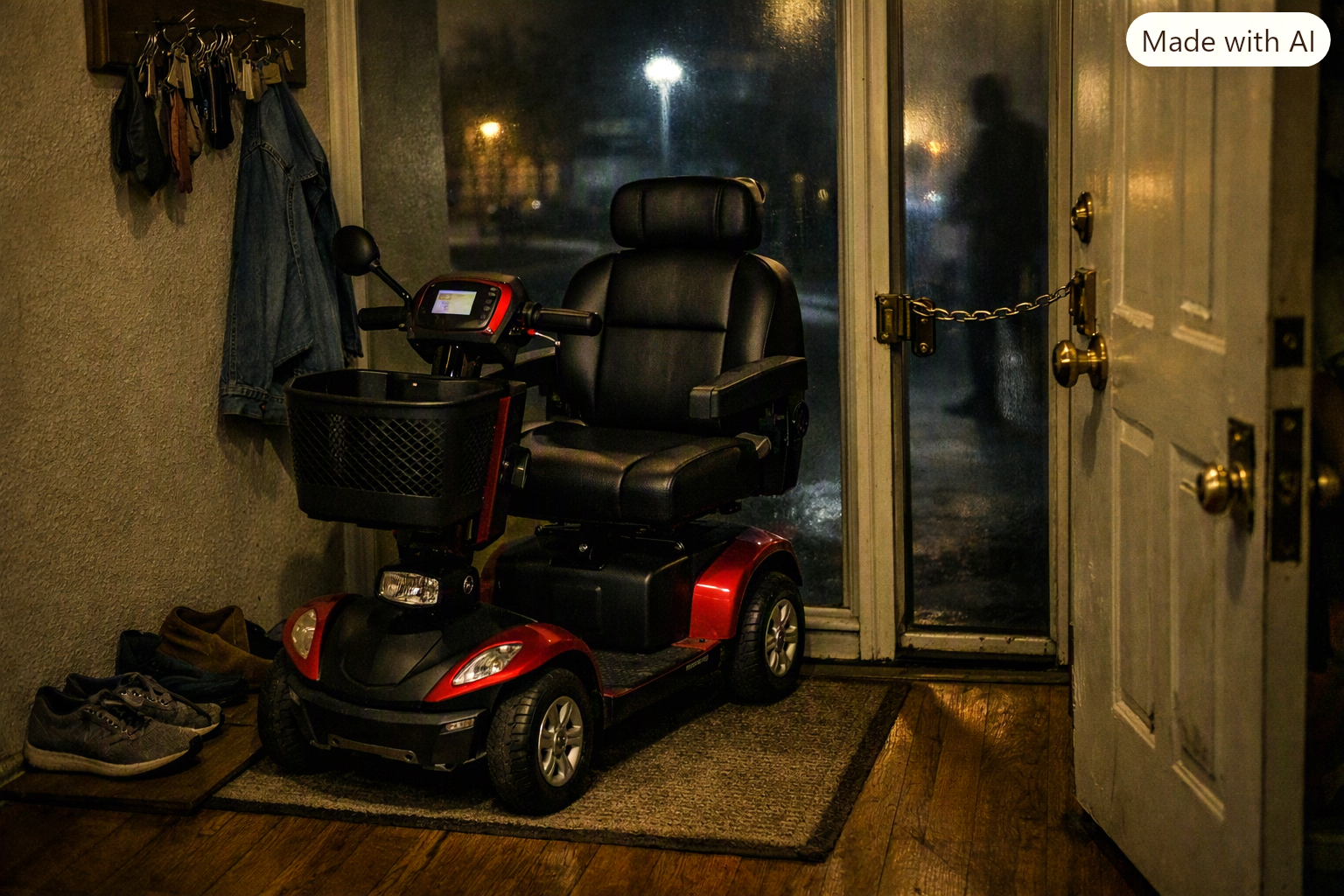
Take a breath. You are asking exactly the right question, and the answer is yes. Learning how can I secure a mobility scooter at home when indoor space forces "near-the-door" storage is not about finding a single magical lock. It is about building layers of protection that make your scooter a hard target—so hard that a thief moves on to an easier opportunity.
This guide will walk you through every practical measure, from simple habits to physical anchors, alarms, and smart technology, with honest advice for Australian homes and strata buildings. By the end, you will have a security system you can feel confident in.
Let's start by understanding what you are actually protecting against.
Understanding the Risk: Why Near-the-Door Storage Feels Vulnerable
Mobility scooters are attractive targets for thieves. They are valuable—typically costing between $2,000 and $15,000—and they are often small and light enough to be physically lifted and loaded into a vehicle. Queensland Police have noted that the small size and weight of mobility scooters makes them "an easy target for theft" because they can be "physically picked up and loaded onto or into another vehicle".
When your scooter is stored near the door, it is exposed to several specific risks. It may be visible through a window or glass panel, which allows a thief to identify it as a target. It is close to the exit, which gives a thief a fast escape route. And if it is stored in a shared hallway or common area, it may be accessible to anyone who enters the building.
But here is the reassuring part: thieves look for the path of least resistance. They want a quick, quiet, low-risk job. If your scooter is locked, alarmed, and marked, the risk goes up—and they will likely move on.
Your goal is not to make theft impossible. Your goal is to make your scooter less appealing than the alternative.
And that starts with simple habits.
Layer 1: Simple Habits That Make a Big Difference
Before you spend money on locks and equipment, start with habits. These cost nothing and are surprisingly effective.
Remove the Key—Every Time
This is the single most important habit. Never leave the key in your scooter when it is unattended, even for a moment. Police across Australia consistently list this as the first line of defence. If there is no key, the scooter cannot be driven away. The South Australia Police recommend removing the key and locking the scooter when not in use. The same goes for any NFC card or electronic access fob if your scooter uses one.
Engage the Steering Lock
Many scooters have a steering lock or tiller lock. If yours does, use it every time you park. This makes the scooter harder to wheel away, even if someone manages to bypass the ignition.
Store It Out of Sight
If your scooter is visible through a window or glass door, consider moving it slightly so it is hidden from the street or hallway. A breathable cover can also conceal the scooter and make it less obviously a valuable item. The South Australia Police recommend parking your scooter "out of sight or consider concealing it with a cover" when at home.
Use Freewheel Mode Carefully
Never leave your scooter in freewheel mode when parked. Freewheel mode disengages the motor, allowing the scooter to roll freely. If it is left in this mode on a slope, it could roll away—or be easily pushed away by a thief. Make sure the scooter is in drive mode before you leave it.
These habits are your first layer. But they are not enough on their own. Let's look at the physical security measures that form the next layer.
Layer 2: Physical Security—Locks, Chains, and Anchors
Physical security is where you make it genuinely difficult for someone to take your scooter. The key is to use the right equipment correctly.
Choose the Right Lock
Not all locks are created equal. For a mobility scooter, you need a lock that is resistant to cutting and picking. Police recommend high-quality, anti-theft locks—specifically, D-locks or heavy-duty chain and padlock combinations.
A D-lock (also called a U-lock) is a solid, hardened steel lock that is difficult to cut with bolt cutters. A heavy-duty chain with a padlock offers more flexibility because it can wrap around different parts of the scooter and a fixed anchor point. The South Australia Police recommend using "high-quality locks resistant to cutting" and using "two different types of locks" for added security.
Loop the Lock Through the Frame—Not the Seat
This is a common mistake. Always loop your lock through the main frame of the scooter—not a removable part like the basket, seat, or battery. These components can be detached, which means they provide weaker anchor points. The main frame is the strongest and most secure attachment point.
Use a Ground Anchor or Wall Anchor
A lock is only as strong as what it is attached to. If you lock your scooter to a flimsy railing or a loose piece of furniture, a determined thief can simply break the anchor point. A ground anchor or wall anchor provides a fixed, sturdy point that is designed to resist leverage attacks.
Ground anchors are rated for pull force. A strong anchor should be rated for at least 200kg of pull force. The Urban UR55 ground anchor, available in Australia for around $93, is a hardened steel anchor that can be bolted to floors or walls. The Oxford Bruteforce Anchor is another option, made of hardened steel and attack-tested for floors and walls. The Kovix Floor Anchor features a 14mm locking pin and a double-locking mechanism, with no need for an external padlock.
If you are renting or in a strata building, check whether you are permitted to install a ground anchor. If not, a heavy-duty chain wrapped around a sturdy, immovable fixture—such as a concrete pillar or a fixed railing—may be an alternative.
Consider a Wheel Clamp
A wheel clamp is a visible, physical deterrent that locks around one wheel, making it impossible to drive or roll the scooter away. They are affordable and effective, but they can be difficult to use if you have trouble reaching the ground. If you choose a wheel clamp, make sure you have the correct measurements for your scooter's wheel.
Physical security is powerful, but it works best when combined with detection. That is where alarms and trackers come in.
Layer 3: Alarms and Tracking—Detection and Recovery
If a thief manages to bypass your locks, the next layer is detection and recovery. Alarms deter thieves, and trackers help you get your scooter back.
Install a Mobility Scooter Alarm
An audible alarm is a simple, inexpensive addition that can deter a thief before they even start. These alarms emit a loud noise if they detect motion—such as someone sitting on the scooter or attempting to move it.
Police recommend considering an audible alarm to deter thieves. Most alarms have adjustable volume settings and are easy to install.
Use a GPS Tracker
A GPS tracker provides a recovery layer. If your scooter is stolen, a tracker can send you a text alert with its location, making it easier for police to recover it. Most bike GPS trackers can be used for mobility scooters.
This is particularly valuable for scooters stored near the door, where a theft may happen quickly and without warning.
Mark Your Scooter for Identification
Marking your scooter makes it harder to sell and easier to identify if it is recovered. The South Australia Police recommend photographing your scooter and recording any markings and the serial number. They also recommend marking your scooter with your driver's licence number or proof of age card, prefixed by the letter "S" for South Australia (e.g., S123456). Check with your local police for the recommended marking method in your state.
Now that you have the physical and technological layers in place, let's look at the legal and strata considerations that apply if you are in an apartment building.
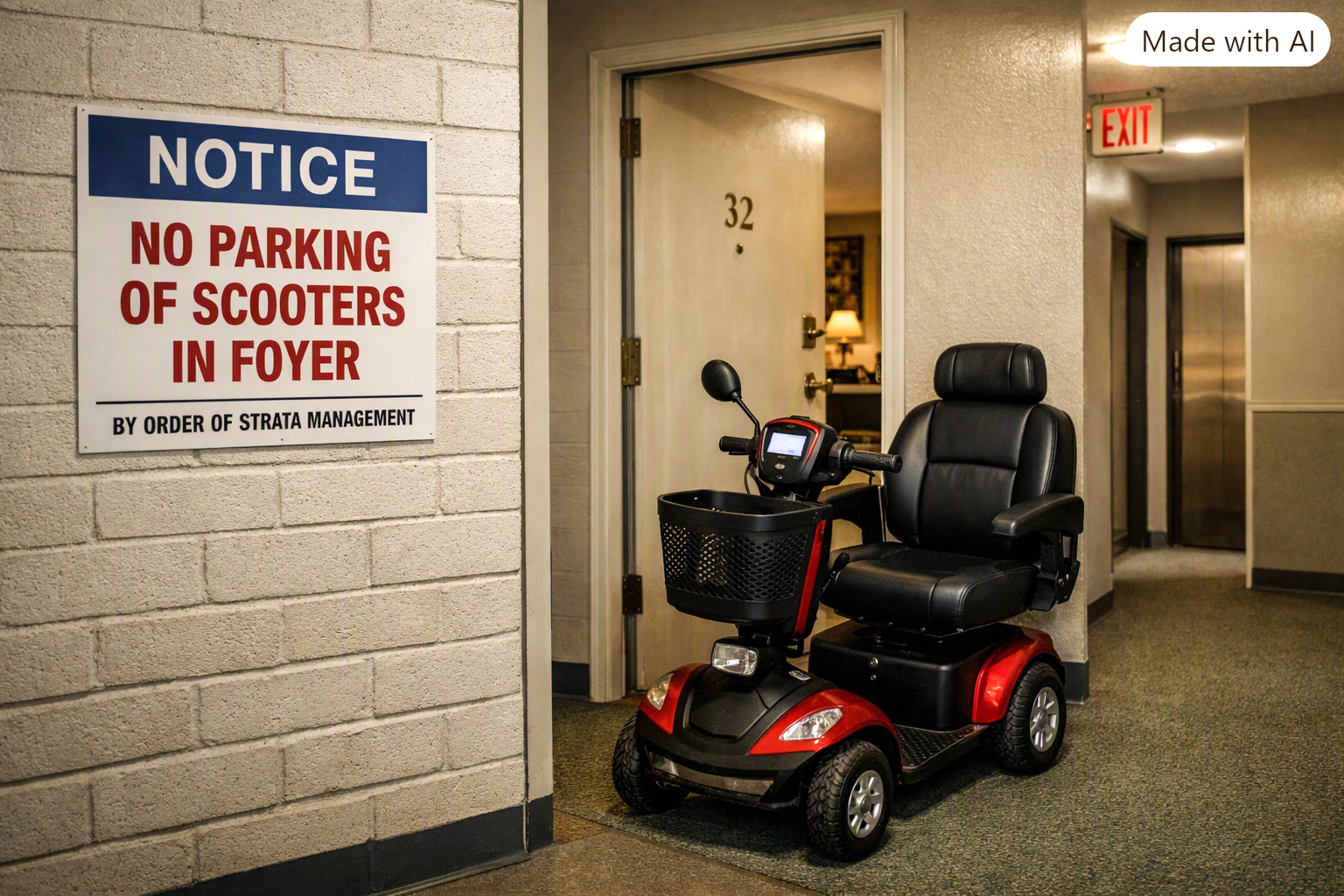
Layer 4: Navigating Strata and Rental Rules
If you live in a strata building or a rental property, you need to understand the rules that apply to near-the-door storage—and how to work within them.
Check Your By-Laws and Rental Agreement
Strata by-laws can regulate what you store in common areas. In New South Wales, for example, the Strata Schemes Management Regulation 2016 states that an owner or occupier must not "park or stand any motor or other vehicle on common property" without prior written approval of the owners corporation. A mobility scooter may be considered a vehicle under this regulation.
If you are renting, your lease agreement may also have clauses about storing items in common areas. Check both your by-laws and your lease before assuming you can store your scooter near the door.
The Egress Problem
Even if your by-laws allow near-the-door storage, fire safety rules are non-negotiable. Mobility scooters must not block escape routes. If your entryway is your only exit, storing a scooter there—even a folded one—may create a hazard. Fire authorities consistently advise against storing or charging scooters in hallways or escape routes.
The solution is to ensure there is always a clear path to the door. If your scooter is stored near the door but does not block the exit, you may be able to negotiate a compromise with your strata committee or landlord.
Get Permission in Writing
If you need permission to store your scooter near the door—especially if it is in a common area—get it in writing. This protects you if a neighbour complains or if the building's management changes.Consider a Purpose-Built Storage Unit
Some buildings are installing purpose-built mobility scooter storage units near entrances. These are weatherproof, secure, and designed to keep common areas clear. If your building does not have one, this is a conversation worth having with your strata committee.
Now that you have the rules sorted, let's look at the insurance side—because even the best security cannot guarantee your scooter will never be stolen.
Consider a Purpose-Built Storage Unit
Some buildings are installing purpose-built mobility scooter storage units near entrances. These are weatherproof, secure, and designed to keep common areas clear. If your building does not have one, this is a conversation worth having with your strata committee.
Now that you have the rules sorted, let's look at the insurance side—because even the best security cannot guarantee your scooter will never be stolen.
Layer 5: Insurance—Your Financial Safety Net
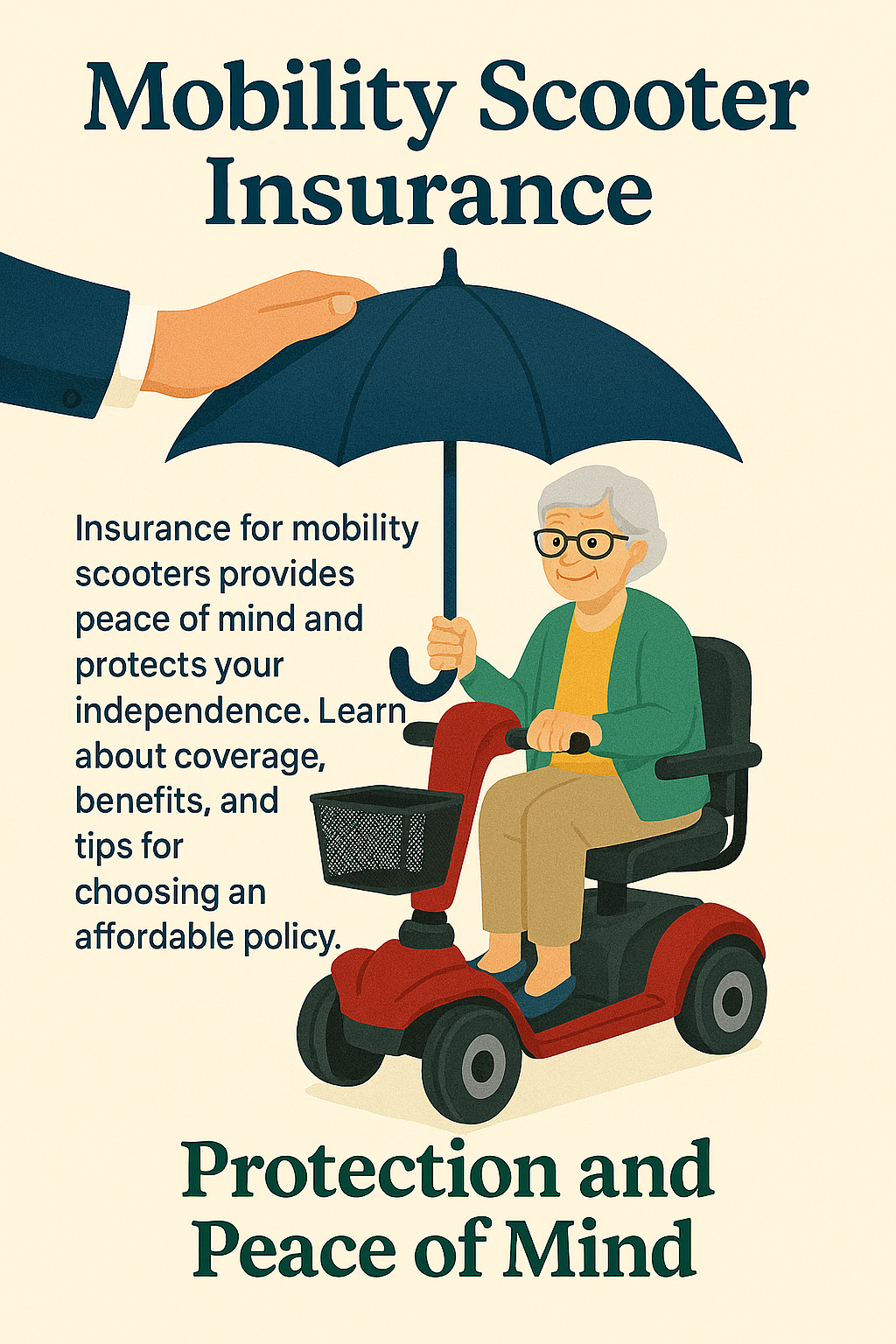
Insurance is not a substitute for security, but it is an essential backstop. If your scooter is stolen despite your best efforts, insurance ensures you are not left without a mobility aid and without the funds to replace it.
Does Your Home Contents Insurance Cover Your Scooter?
Many home contents insurance policies cover mobility scooters as part of their standard coverage. For example, Apia Home Contents Extra covers mobility scooters "in an insured event" such as fire, theft, malicious damage, and flood when at home.
Allianz Australia offers optional Portable Contents cover that includes "external medical aids and devices including wheelchairs and mobility scooters" for loss or damage caused by theft or accident anywhere in the world. RAA in South Australia offers dedicated mobility scooter insurance that covers theft or attempted theft.
Check the Fine Print
Not all policies are the same. Some may require specific security measures—such as a certain type of lock or storage in a locked garage—before they will pay out on a theft claim. Some may have limits on the value of the scooter. Some may exclude theft if the scooter was left unattended in a common area.
Read your policy carefully and speak to your insurer about your specific storage situation.
Consider Dedicated Scooter Insurance
If your home contents policy does not provide adequate coverage, or if you want broader protection, consider dedicated mobility scooter insurance.
These policies are designed specifically for mobility devices and may offer higher coverage limits and additional benefits, such as a hire scooter while yours is being repaired or replaced.

Frequently Asked Questions
How can I secure a mobility scooter at home when indoor space forces near-the-door storage?
Use a layered approach: remove the key, use a steering lock, lock the scooter to a ground anchor or sturdy fixture with a high-quality D-lock or chain, install an alarm, and consider a GPS tracker. Mark your scooter for identification and ensure it is covered by insurance.
What is the best lock for a mobility scooter?
A high-quality D-lock or heavy-duty chain and padlock. Use two different types of locks for added security. Always loop the lock through the main frame—not a removable part like the seat or basket.
Do I need a ground anchor for my mobility scooter?
A ground anchor provides a fixed, sturdy point that is much stronger than a railing or piece of furniture. If you can install one, it significantly improves security. If you cannot, wrap a heavy-duty chain around a sturdy, immovable fixture.
Are mobility scooter alarms effective?
Yes. An audible alarm deters thieves by drawing attention to the theft attempt. Police recommend them as a simple, effective deterrent.
Can I install a ground anchor in a rental property?
Check your lease agreement first. If you cannot install a permanent anchor, consider a heavy-duty chain wrapped around a sturdy fixture, or ask your landlord for permission.
Does home contents insurance cover a mobility scooter stored near the door?
Many policies do, but you must check the fine print. Some policies may require specific security measures or may exclude theft from common areas. Speak to your insurer about your specific situation.
What should I do if my mobility scooter is stolen?
Report it to the police immediately. Provide them with the serial number, photographs, and any markings. If you have a GPS tracker, share the location with police. Contact your insurer to lodge a claim.
Can I store my scooter in a shared hallway if I lock it?
Only if your by-laws and fire safety regulations allow it. Even a locked scooter can block egress in an emergency. Check with your strata committee or landlord before storing in a common area.
You Can Protect What Matters
Securing a mobility scooter stored near the door is not about finding one perfect solution. It is about building layers. Remove the key. Lock it to something sturdy. Alarm it. Track it. Mark it. Insure it. Each layer makes your scooter a harder target, and together they create a system that gives you peace of mind.
You have already done the hardest part by thinking this through. If you are still planning your storage setup, our guide to storage planning for small spaces will help you map out the rest.
If you are in an apartment building and need to navigate strata rules, our guide to planning mobility scooter storage in an apartment building without blocking egress or common areas has you covered.
And if charging is your next worry, our safe charging station guide will set your mind at ease.
You have got this—and we are here to help every step of the way.
Stay mobile, stay confident!
Sign up for our monthly Mobility Scooter Newsletter to receive practical guides, expert advice, and inspiring stories that help you make the most of your scooter and download our free "Mobility Scooter Guide for Beginners."
Don't worry — your e-mail address is totally secure.
I promise to use it only to send you our newsletter, "Mobility Matters."
Recent Articles


-
Storage Planning for Small Spaces: Measure, Plan, Store Safely
Oct 14, 26 09:02 AM
 Storage planning for small spaces doesn't have to be stressful. Learn how to measure, charge, and safely store your mobility scooter at home.
 -
Mobility Scooter Security When Stored Near the Door at Home
Oct 14, 26 08:58 AM
 How can I secure a mobility scooter at home when indoor space forces "near-the-door" storage—a layered security guide for peace of mind.
 -
Car Boot & Home Storage for Mobility Scooters: Make It Work
Oct 14, 26 07:00 AM
How do I plan storage for a mobility scooter in a car boot and at home so it works day to day? Read this before you buy.
Ready to Feel More Confident on Your Mobility Scooter?

My Ebook, The Ultimate Guide to Mobility Scooters, walks you through choosing the right scooter, using it safely, and keeping it in top condition — all explained in clear, friendly language.
Give yourself (or someone you love) the gift of independence.




