- Home
- Mobility Scooter Travel and Transport
- Storage Planning for Small Spaces
- How to Plan Mobility Scooter Storage in Apartment Buildings
How Do I Plan Mobility Scooter Storage in an Apartment Building Without Blocking Egress or Common Areas (Australia)?
Picture this. You live in a unit on the third floor of a modest apartment block. You have just been approved for a mobility scooter—a lifeline that will let you get to the shops, visit friends, and stop relying on others for every trip. There is just one problem. Your apartment is small. Your hallway is narrow. And when you asked your strata manager about storing the scooter in the foyer, you were told, politely but firmly, that it would be a safety hazard and a breach of by-laws. You are left wondering: is there any way to make this work.
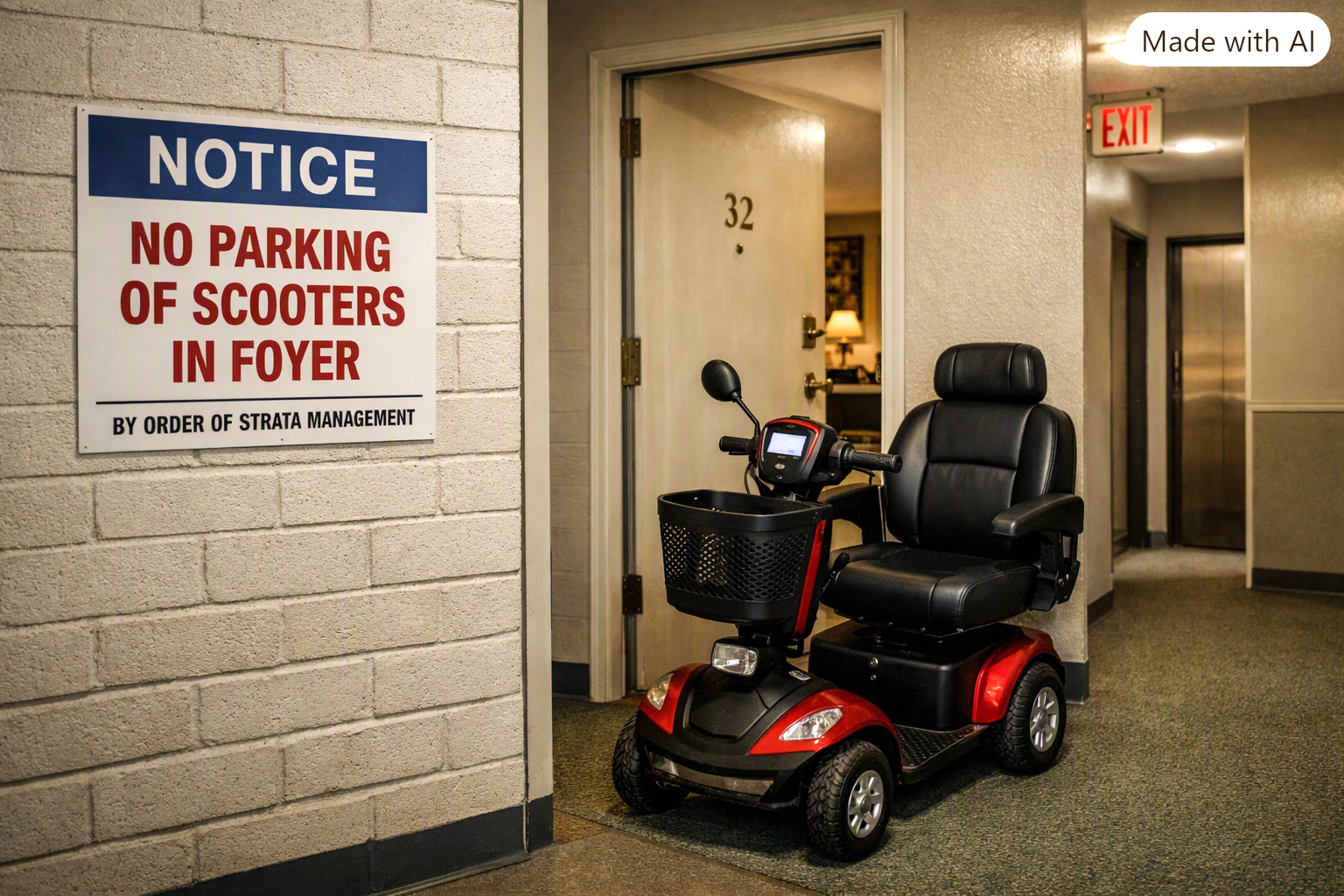
Take a deep breath. You are not the first person to face this, and you will not be the last. Learning how to plan mobility scooter storage in an apartment building without blocking egress or common areas is a challenge, but it is absolutely solvable.
This guide will walk you through the rules, the risks, the by-laws, and the practical solutions that work in the Australian strata context. By the end, you will have a clear plan—and the confidence to present it to your building.
Let's start with why this matters so much.
Why Egress and Common Areas Are Non-Negotiable
In any apartment building, common areas—corridors, stairwells, lobbies, and walkways—serve a dual purpose. They are shared space for everyday living, and they are emergency escape routes. When a fire breaks out, those corridors fill with toxic smoke in minutes. Every second counts, and every obstruction matters.
Fire authorities in Australia are unambiguous on this point. Storing or charging mobility scooters in corridors, stairwells, or near exit doors is a serious fire risk. Lithium-ion batteries, which power most scooters, can enter a state called thermal runaway—a self-sustaining reaction that ignites rapidly, releases toxic gases, and is extremely difficult to extinguish. Water alone does not stop it, and standard building fire suppression may not control it.A battery fire in a corridor does not just endanger one apartment—it can trap people upstairs and fill escape routes with smoke in moments.
That is why the Strata Schemes Management Act allows by-laws that keep these devices out of corridors, stairwells, and other escape routes.It is also why many buildings treat mobility scooters as prohibited items in common areas unless a designated storage area is provided.
This is not about being unkind to scooter users. It is about protecting everyone—including you. But here is the good news: safety and accessibility are not mutually exclusive. There are solutions.
Understanding the Australian Legal and Strata Framework
Before you can plan storage, you need to understand who decides what. In Australia, apartment buildings operate under state-based strata legislation. The Strata Schemes Management Act (or its state equivalent) gives owners corporations the power to make by-laws about common property use. Those by-laws can regulate where mobility scooters are stored and charged.
Crucially, by-laws cannot be harsh, unconscionable, or oppressive. A blanket ban on mobility scooters without a building-specific safety justification may be challenged. The better approach—and the one that many well-managed buildings take—is to regulate rather than prohibit. This means creating an approval process, designating safe storage and charging areas, and setting safety conditions that everyone can follow.
There is also a broader legal context. The Disability Discrimination Act 1992 (Cth) protects people with disability from discrimination, and mobility scooters used as disability aids fall under this protection.This does not mean a building must allow scooters in corridors, but it does mean a building cannot refuse reasonable accommodation without justification.
If you are being refused permission, it is worth understanding your rights—and approaching the conversation with solutions rather than confrontation.

The Real Problem: Where Do You Actually Put It?
Now we get to the practical part. If your apartment is small and your building does not have a dedicated scooter storage room, where can the scooter actually go? Let's run through the realistic options.
Option 1: Inside Your Apartment (If You Can)
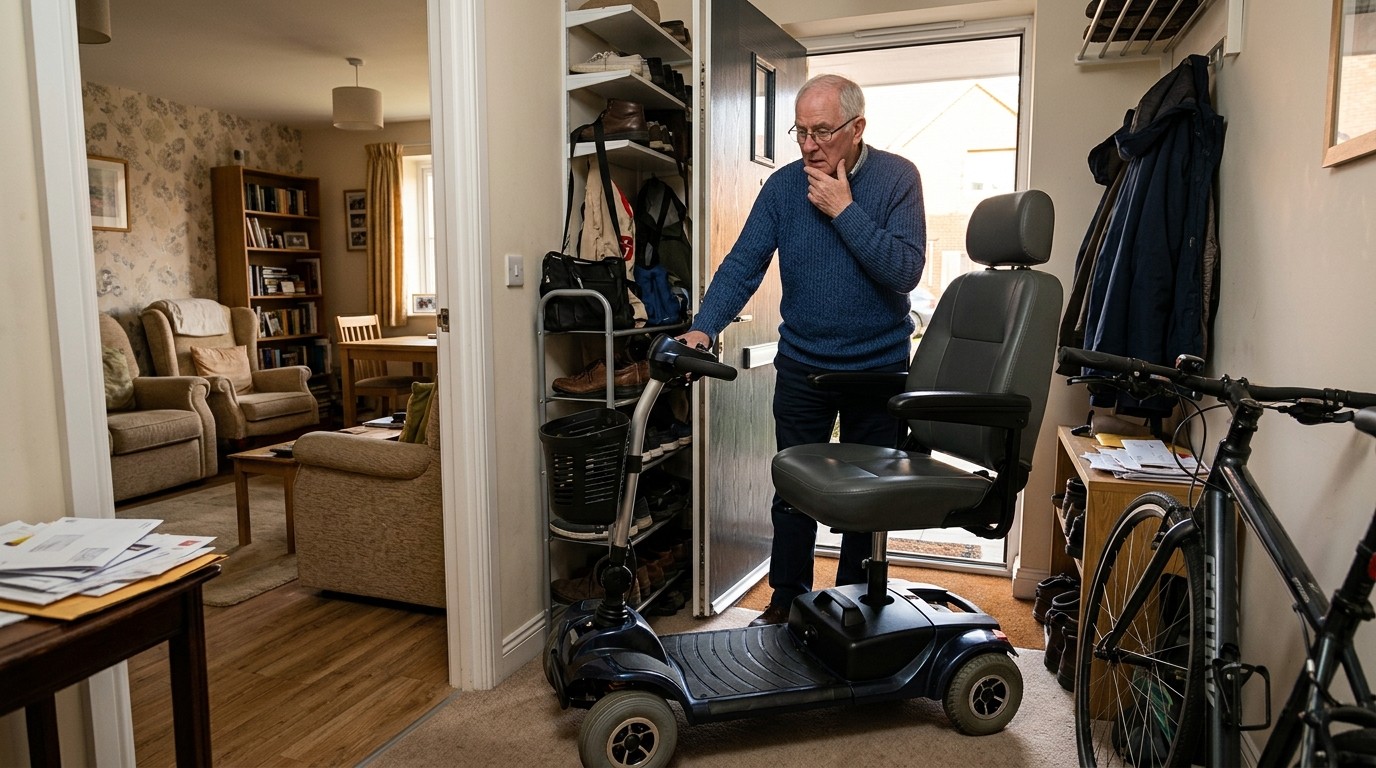
The safest place for a mobility scooter—from a fire safety perspective—is inside your own apartment, away from common escape routes. If you can store it in a hallway, a cupboard, or a corner of a room, that is ideal.
The challenge is space. A compact folding scooter might take up as little as one square metre when folded. A larger scooter might need considerably more. If you can make it fit without blocking your own exit path, this is often the simplest solution—and it does not require strata approval because it is within your own lot.
But what if you cannot fit it inside? That is where the next options come in.
Option 2: A Designated Common Area Storage Room
Some buildings have a dedicated storage room, bike cage, or basement area that can be adapted for scooter storage. If your building has one, this is the gold standard. A purpose-built storage room with proper ventilation, charging points, and fire safety measures can accommodate multiple scooters safely.
If your building does not have one, this is something you could raise with your strata committee. A shared storage solution benefits all residents who use mobility devices, and it keeps common corridors clear.
Option 3: Your Car Space or Garage
If you have an allocated car space or garage, this can be a viable storage location—provided it is secure, dry, and has access to power for charging. Check your strata by-laws: some buildings prohibit parking vehicles in car spaces, but a mobility scooter may be treated differently from a car.
If your garage is damp or unventilated, you will need to take extra care to protect the battery and electronics.
Option 4: A Balcony (With Caution)
Storing a scooter on a balcony is possible but comes with risks. Balconies are exposed to weather and temperature extremes, which can damage batteries and accelerate corrosion. They are also often visible from the street, making theft a concern.
If you must use a balcony, use a breathable cover, bring the battery indoors for charging, and check your by-laws first—many buildings prohibit balcony storage of mobility devices.
Charging: The Hidden Compliance Issue
Even if you find a place to store your scooter, you still need to charge it. And charging is where many apartment dwellers run into trouble.
The safest approach is to charge your scooter inside your own apartment, away from escape routes and flammable materials. If you cannot do that, a designated common area charging station is the next best option. Some buildings are beginning to install these, recognising that residents need a safe place to charge mobility devices.If your building does not have one, this is a conversation worth having with your strata committee.
What you should never do is charge your scooter in a common corridor, stairwell, or foyer—even temporarily. Unauthorised use of common property power points can be restricted by by-law, and charging in an escape route is a serious safety breach.
If you must use an extension lead, keep it short, rated for the load, and never run it under rugs or across walkways.
How to Approach Your Strata Committee (and Win)
If you need permission to store or charge your scooter in a common area, how you approach the conversation matters enormously. Here is a framework that works.
Come with a solution, not a problem. Instead of asking "Can I store my scooter in the corridor?", propose a specific, safety-compliant plan. For example: "I would like to install a lockable, weatherproof storage unit in my allocated car space, with a dedicated power point for charging. Here are the specifications."
Acknowledge the safety concerns. Show that you understand why egress matters. Explain how your proposal keeps escape routes clear and meets fire safety requirements.
Reference the by-laws. If your building already has a by-law about mobility devices, read it carefully. If it does not, you may need to propose one. A by-law can be voted on at an AGM or EGM.
Get it in writing. Whatever is agreed, get it in writing. This protects you and the building.
Consider a trial period. If the committee is hesitant, propose a three-month trial. This gives everyone a chance to see that the arrangement works.
And remember: you are not asking for a favour. You are asking for reasonable accommodation that allows you to live independently. That is a legitimate request, and well-managed buildings should be able to accommodate it.
What If Your Building Simply Cannot Accommodate You?
Sometimes, despite your best efforts, a building genuinely cannot provide a compliant storage solution. If that happens, you have options. You could explore whether a folding scooter with a smaller footprint could fit inside your apartment. You could look into removable batteries that allow you to charge indoors while storing the scooter elsewhere. You could also seek advice from a disability advocate or your state's anti-discrimination body if you believe you are being treated unfairly.
The key is not to give up. There is almost always a workable solution—it just might take a little creativity and persistence to find it.

Frequently Asked Questions
Can I store my mobility scooter in my apartment building's common area?
Only if your building has a designated storage area and you have permission from the owners corporation. Storing in corridors, stairwells, or foyers is prohibited under fire safety requirements and strata by-laws.
Can a strata by-law ban mobility scooters entirely?
By-laws cannot be harsh, unconscionable, or oppressive. A blanket ban without a building-specific safety justification may be challenged. The better approach is to regulate storage and charging rather than prohibit entirely.
Where should I charge my mobility scooter in an apartment building?
The safest place is inside your own apartment, away from escape routes. If that is not possible, a designated common area charging station with proper ventilation and fire safety measures is the next best option.
What should I do if my strata committee refuses permission?
Come back with a specific, safety-compliant proposal. Get it in writing. If you believe you are being treated unfairly, seek advice from a disability advocate or your state's anti-discrimination body.
Can I store my scooter in my allocated car space?
This depends on your building's by-laws. Some buildings prohibit parking vehicles in car spaces, but mobility scooters may be treated differently. Check your by-laws and speak to your strata manager.
How do I propose a scooter storage solution to my strata committee?
Prepare a written proposal that includes the exact location, dimensions, charging arrangements, and how escape routes will remain clear. Reference relevant by-laws and safety standards. Propose a trial period if the committee is hesitant.

You Have a Right to Mobility
Planning mobility scooter storage in an apartment building is not just a logistical challenge. It is a question of dignity, independence, and fairness. You deserve to be able to use the mobility aid that keeps you connected to your community. Your building deserves to be safe. These two things can coexist—and with the right approach, they will.
If you are still in the planning stage, our guide to storage planning for small spaces will help you map out the rest of your home storage plan.
If measuring your space is your next step, our guide to how to measure your home for a mobility scooter walks you through every dimension that matters. And if charging is your biggest worry, our safe charging station guide (Coming Soon!) has you covered.
You have got this—and we are here to help every step of the way.
Stay mobile, stay confident!
Sign up for our monthly Mobility Scooter Newsletter to receive practical guides, expert advice, and inspiring stories that help you make the most of your scooter and download our free "Mobility Scooter Guide for Beginners."
Don't worry — your e-mail address is totally secure.
I promise to use it only to send you our newsletter, "Mobility Matters."
Recent Articles


-
Storage Planning for Small Spaces: Measure, Plan, Store Safely
Oct 12, 26 08:28 AM
 Storage planning for small spaces doesn't have to be stressful. Learn how to measure, charge, and safely store your mobility scooter at home.
 -
How to Store a Mobility Scooter in an Apartment Building (AU)
Oct 12, 26 08:26 AM
 How do I plan mobility scooter storage in an apartment building without blocking egress or common areas? Learn the rules, risks, and workable options.
 -
How to Measure Your Home for a Mobility Scooter Before Buying
Oct 12, 26 06:18 AM
How to measure your home for a mobility scooter without the stress. Grab a tape measure—this guide covers every dimension that matters.
Ready to Feel More Confident on Your Mobility Scooter?

My Ebook, The Ultimate Guide to Mobility Scooters, walks you through choosing the right scooter, using it safely, and keeping it in top condition — all explained in clear, friendly language.
Give yourself (or someone you love) the gift of independence.




