- Home
- Mobility Scooter Types
- Small Home Storage Friendly Scooters
- Folding vs Disassembly Travel Scooters
Folding vs Disassembly Travel Scooters for Small Homes: Which Stores Smaller in Real Life (And Which Is Easier Day-to-Day)?
Picture this. You have narrowed your search to two scooters. One folds in a single fluid motion, like a suitcase with a hinge. The other comes apart into four or five pieces, each light enough to carry separately. The brochure for both says “compact.” The price tags are similar. And you are standing in your hallway, wondering which one will actually make your life easier—not just on paper, but on a wet Tuesday morning when you are tired, your back is stiff, and the scooter needs to go back in the cupboard.
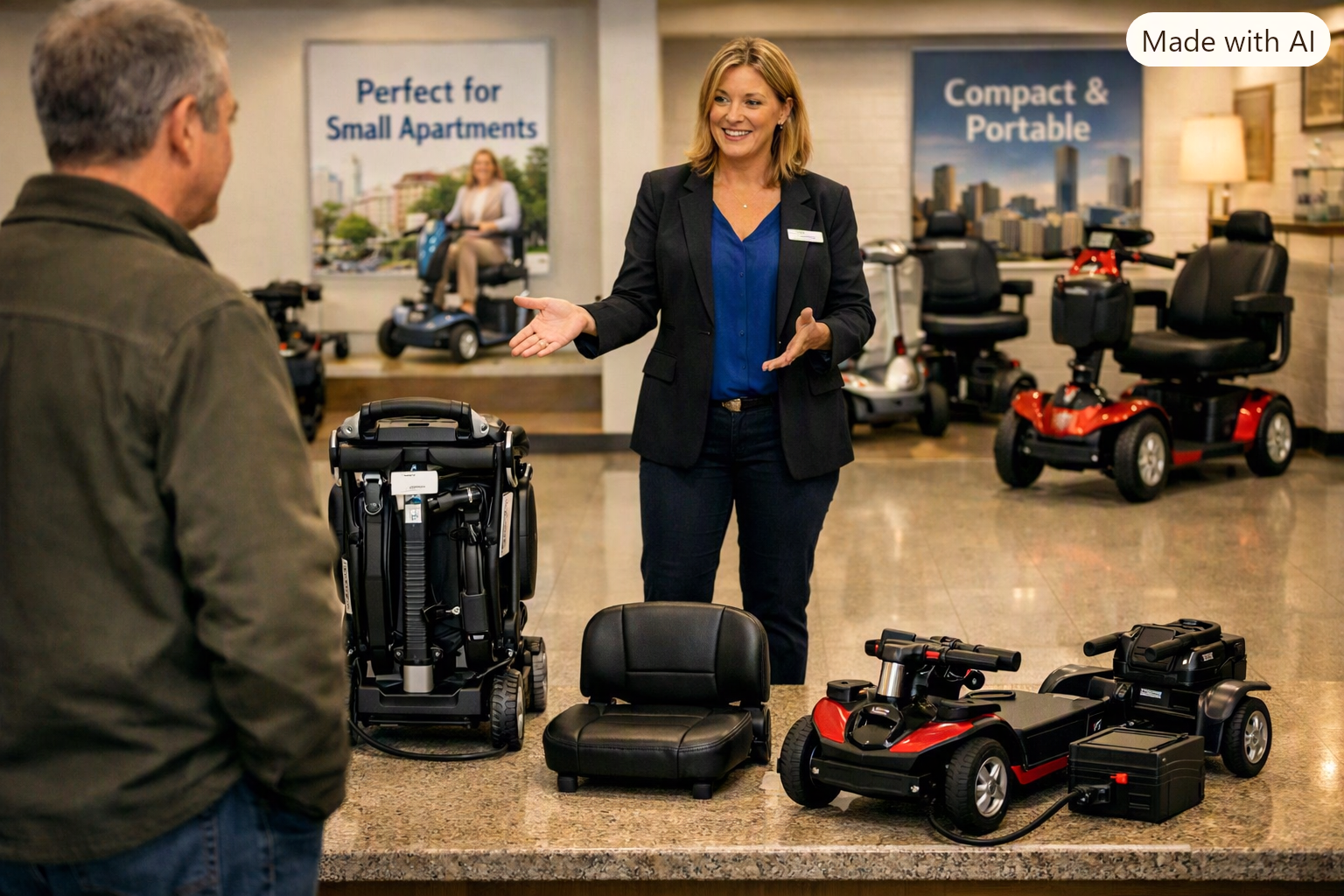
This is the question that folding vs disassembly travel scooters for small homes always comes down to, and it is the question that Page 1 rarely answers clearly. The product pages tell you the folded dimensions and the total weight. They do not tell you what it feels like to lift the folded package over a door threshold, or to bend down and reconnect five pieces when your hands are cold.
This guide is about that feeling. It is about the real-life difference between two clever mechanisms, and how to choose the one that respects your space and your strength.
Let’s take the guesswork out of it.
The Two Mechanisms, Clearly Explained (And Why the Labels Mislead)
Before we compare, let’s name the players. This is the part where the fog starts to lift.

A folding scooter collapses into one main unit. You release a latch or press a button, and the steering column folds down while the rear section tucks under. Most folding scooters collapse in 5 to 10 seconds. Some can be rolled like a suitcase once folded, using built-in wheels on the base. The whole scooter stays together. There are no loose pieces to keep track of.
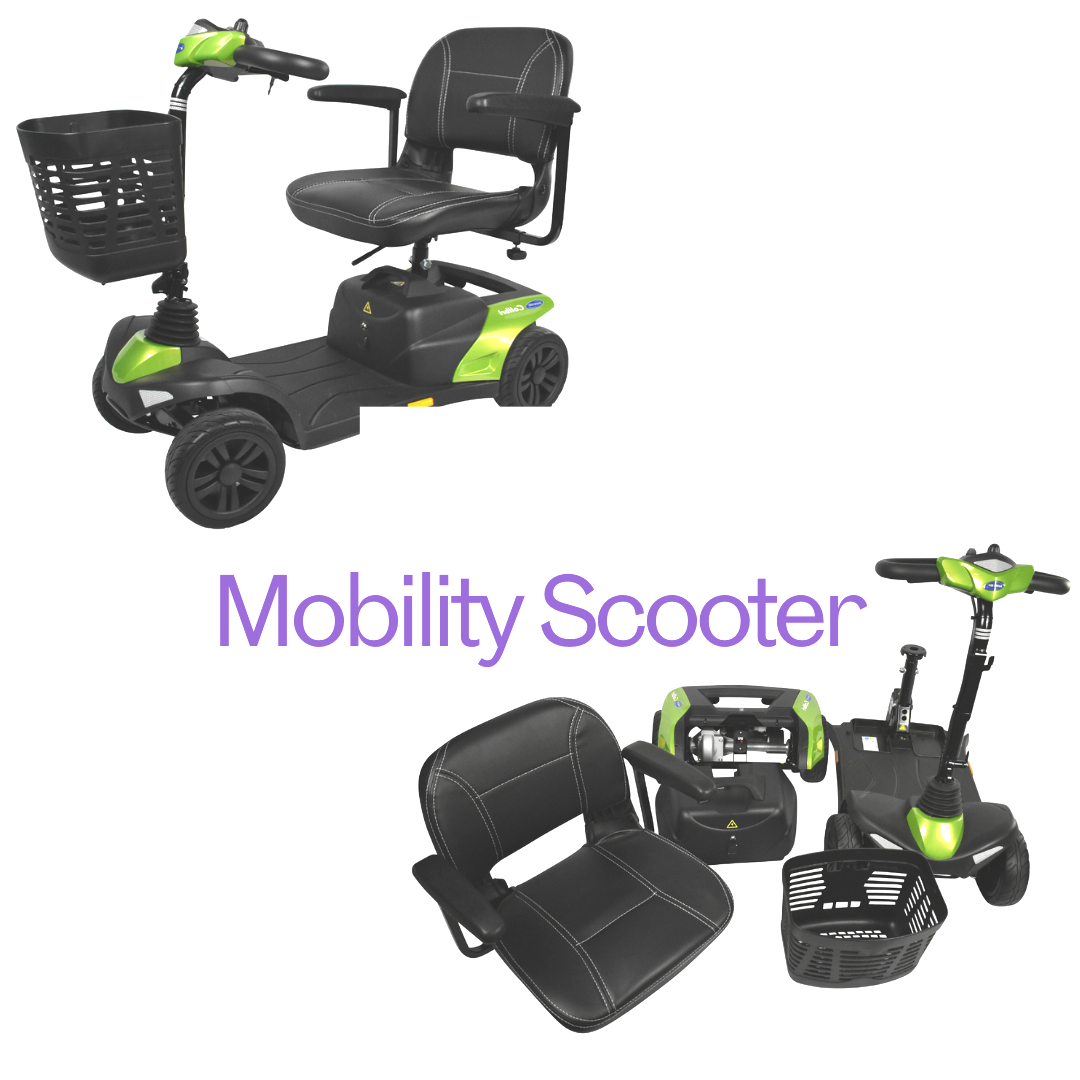
A disassembly scooter (sometimes called a “dismantling” or “boot” scooter) separates into four or five individual pieces. Typically, the seat lifts off first, then the battery pack, then the rear section detaches from the front section. Each piece weighs significantly less than the whole. Assembly takes longer—expect 2 to 5 minutes to take apart or put back together—and it requires a certain amount of bending and reaching.
Here is the first myth to clear away: “compact” does not mean the same thing for both mechanisms. A folding scooter can be compact when folded but heavy as a single package. A disassembly scooter can be bulkier when separated but far lighter in each hand.
Which one “stores smaller” depends entirely on what you are measuring—and which one is “easier” depends on who is lifting it. The next section shows why the numbers tell different stories.
The Weight Test: Why the “Heaviest Lift” Is the Only Number That Matters
This is the heart of the folding vs disassembly decision, and it is where most buyers get caught out.
A folding scooter retains the weight of the complete scooter when it is folded. That means you lift the entire unit at once. Typical folding scooters weigh between 20 kg and 30 kg, though there are exceptions—the AeroCarbon, for example, weighs just 13 kg when folded. The CareCo Minimus weighs 17.8 kg with the battery removed, and the GoGo Compact comes in at 21 kg including batteries. Lifting 20 kg over a car boot lip or into a high cupboard is manageable for some people, but challenging or impossible for others—especially on a bad day, with a stiff back or cold hands.
A disassembly scooter, by contrast, breaks the weight into manageable pieces. The heaviest single component on most disassembling scooters is between 10 kg and 18 kg—often significantly less than the whole folded package. The Motion Healthcare Alumina has a heaviest piece of around 10 kg. The TGA Zest comes in at 12 kg. The Pride Go-Go Elite Traveller 2 has a heaviest piece of approximately 15.8 kg. That is the number that decides whether you can store the scooter independently. As one guide puts it with refreshing honesty: “Do not compare total scooter weight alone. The number that matters is the heaviest lift”.
So here is the first honest answer: a disassembly scooter usually wins the weight test. It does not matter that the total scooter is heavier. What matters is that no single piece exceeds your safe lifting limit. If you are the person who will be moving the scooter every day, that difference is not academic. It is the difference between independence and dependence on a carer.
The Storage Test: Which Actually Stores Smaller in Real Life?
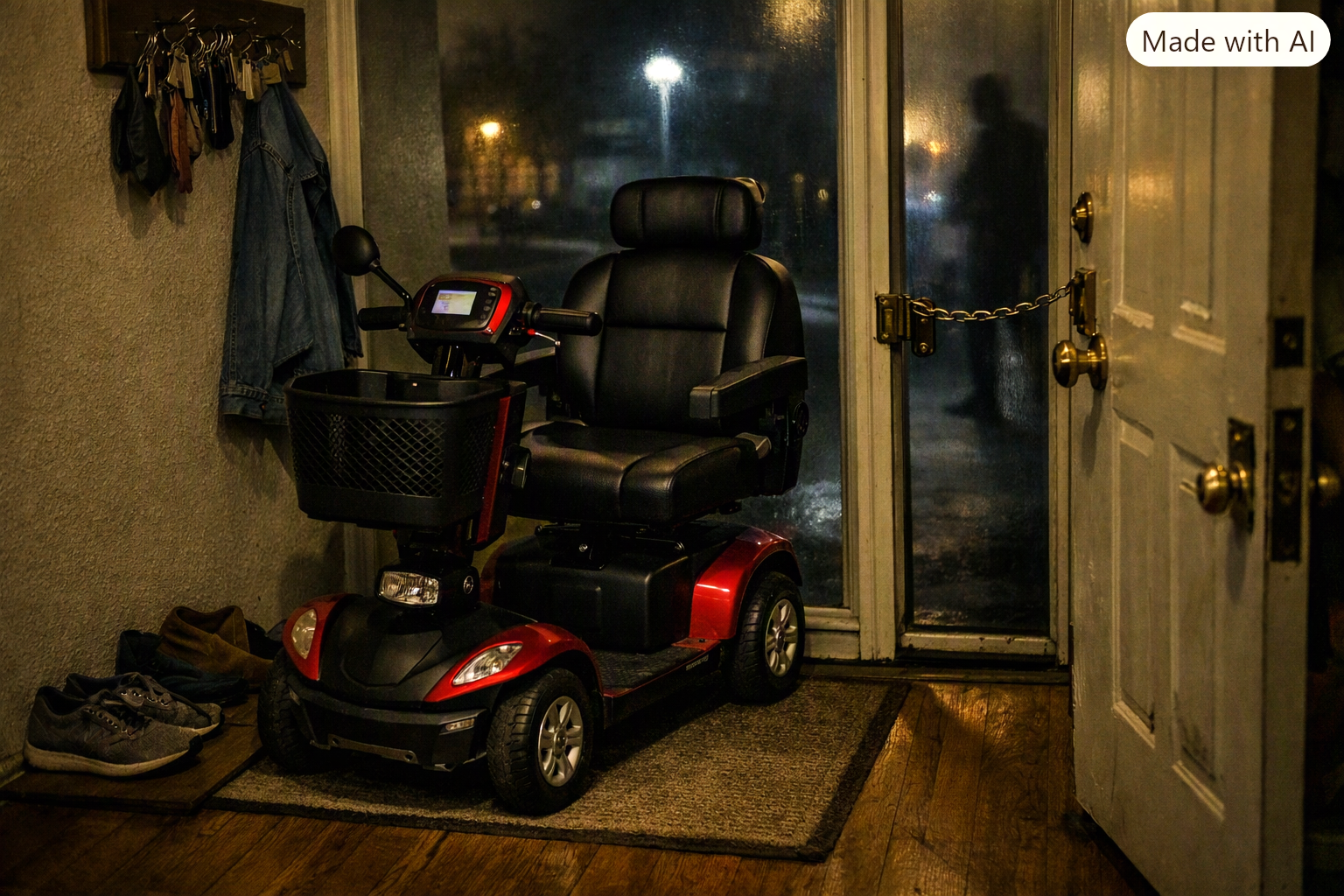
Now for the storage question, and the answer is more nuanced than the weight test. Both mechanisms can store small, but they store differently, and your cupboard’s geometry decides which works better.
Folding scooters store as a single package. The GoGo Compact folds to 760 × 565 × 275 mm—tidy, shallow, and easy to slide under a bed or into a narrow cupboard. The AeroCarbon folds to 38 × 52 × 69 cm, which is genuinely compact for a four-wheel scooter. The advantage is simplicity: one package, one place, no pieces to distribute. The disadvantage is that the package is heavy, and it must fit as a single object. A cupboard with a narrow door or an awkward angle can make a folded scooter frustrating to manoeuvre, even if the internal dimensions look generous.
Disassembly scooters store as multiple pieces. This can be an advantage in a small home, because the pieces can be distributed. The seat can go on a shelf, the battery can be carried indoors to charge, and the frame can slide into a corner. One source notes that because the parts can be separated, “it’s possible to put some parts on a seat of the car too” if the boot is full. The disadvantage is that you need somewhere to put each piece, and the assembly process leaves parts on the floor while you work. A cramped hallway can become a temporary obstacle course.
So here is the second honest answer: folding scooters often store smaller as a single package, but disassembly scooters store more flexibly across a small home. If your cupboard is a single, neat box with a wide door, folding may win. If your storage is scattered—a cupboard here, a shelf there, a charging spot in another room—disassembly may be the more practical geometry.
Day-to-Day Ease: Speed vs Strength
The daily experience of using each mechanism is where the decision becomes emotional. This is not just about storage. It is about how the scooter fits into your morning routine, your energy levels, and your sense of dignity.
Folding scooters win on speed and simplicity. There are no loose pieces to keep track of. The scooter is ready to go in seconds. For quick trips, frequent stops, and moments when you just want to get moving, folding is a pleasure. But that speed comes at a cost: the folded package is heavy, and lifting it repeatedly can wear you down. As one mobility specialist puts it, “If somebody has to lift the entire scooter into a high car boot, the folding mechanism has solved only half the problem”.
Disassembly scooters win on lifting and independence. Each piece is lighter, so the physical demand is spread across several smaller lifts rather than one big one. For people with limited strength or back problems, this is often the deciding factor. The trade-off is time and bending. Dismantling requires you to bend down, which can be difficult for some users, and reassembly takes a few minutes. But for many people, a few minutes of manageable work is far preferable to one impossible lift.
Here is the third honest answer: if you have help lifting, or you are strong enough for the folded package, folding is faster and simpler. If you are lifting alone, or your strength is limited, disassembly is the kinder choice.
Neither is “better.” They solve different problems.

The Decision Framework: Which One Is Right for Your Home?
You now have the three tests. Here is how to put them together.
Choose a folding scooter if: your storage spot is a single, accessible box; you can comfortably lift 15–25 kg as a single package (or you have help); you value speed and simplicity; and your priority is quick, frequent trips rather than daily dismantling.
Choose a disassembly scooter if: your storage is distributed or awkward; your lifting ability is limited (or you want to protect your back); you are willing to spend a few minutes on assembly in exchange for lighter individual pieces; and independence in handling the scooter matters more to you than speed.
And if neither feels quite right? There is a third path. A folding scooter that can be rolled rather than carried—like the Sterling S50 Carbon, which can be tilted and rolled on its rear wheels once folded—splits the difference. And a car boot hoist can eliminate lifting entirely if you have a vehicle and the budget. The goal is not to force yourself into one mechanism.
The goal is to find the mechanism that respects your space and your strength.
Your Next Step
You now have more than a comparison. You have a framework. Measure your storage spot, weigh the heaviest thing you can safely lift on a bad day, and decide whether speed or lifting ease matters more in your daily routine. That is how you choose between folding and disassembly with confidence, not guesswork.
If the hallway itself is the tightest part of the puzzle, the guide to narrow hallways and tight turns shows how turning radius and length shape daily practicality. And if the storage spot is a cupboard or under-stairs space, the guide to closet and under-stairs storage walks you through the features that make tight spaces safe and workable.
You are closer to a scooter that actually fits your life than you think.

Frequently Asked Questions
Which stores smaller in real life: a folding or a disassembly scooter?
It depends on your space. A folding scooter stores as one compact package, which can be tidier. A disassembly scooter stores as multiple pieces, which can be distributed across a small home. Folding often wins for a single cupboard; disassembly wins for flexible, scattered storage.
Is a folding scooter always lighter than a disassembly scooter?
No. The total weight of a folding scooter may be lighter, but you lift the whole package at once. A disassembly scooter may be heavier overall, but its heaviest piece is usually much lighter—often 10–18 kg compared to 20–30 kg for a folded scooter.
What is the heaviest piece, and why does it matter?
For a disassembly scooter, it is the single heaviest component you must lift. For a folding scooter, it is the folded package weight. It matters more than total weight because it is the real limit on who can store and handle the scooter independently.
Which is easier to use every day?
Folding is faster—seconds rather than minutes. Disassembly is easier on your body because each piece is lighter. If you have help lifting, folding is simpler. If you are lifting alone or your strength is limited, disassembly is usually kinder.
Do I need to bend down to dismantle a scooter?
Yes, disassembly typically requires bending to release latches and lift pieces from low positions. If bending is difficult, a folding scooter with a high handle or a scooter that can be rolled may be a better option.
Can I store a disassembly scooter if I have very little space?
Yes, because the pieces can be distributed—seat on a shelf, battery indoors, frame in a corner. But you need somewhere to put each piece, and assembly can temporarily clutter a small hallway.
Are folding scooters more expensive?
Generally, yes. Folding scooters, especially those with automatic folding functions, are typically more expensive than their dismantling counterparts. Budget is a legitimate part of the decision.
Which is more comfortable: folding or disassembly?
Disassembly scooters are often more comfortable, with more padding and larger seats. Folding scooters sometimes save weight by using simpler, firmer seats. If comfort on longer journeys matters, a disassembly model may serve you better.
Can I use a folding scooter if I have a bad back?
Only if the folded package is within your safe lifting limit. A folding scooter that weighs 20–25 kg may be too heavy for someone with a bad back. A disassembly scooter with a 10–12 kg heaviest piece is often the safer choice.
What if neither mechanism works for my home?
Consider a folding scooter that can be rolled rather than carried, a car boot hoist, or a different storage location entirely. The goal is a scooter you can actually handle, not a mechanism you have to fight.
Stay mobile, stay confident!
Sign up for our monthly Mobility Scooter Newsletter to receive practical guides, expert advice, and inspiring stories that help you make the most of your scooter and download our free "Mobility Scooter Guide for Beginners."
Don't worry — your e-mail address is totally secure.
I promise to use it only to send you our newsletter, "Mobility Matters."
Recent Articles


-
Small Home Storage Friendly Scooters That Actually Fit Your Flat
Nov 12, 26 08:01 AM
 Small Home Storage Friendly Scooters start with your tape measure. Learn the route, not just the spot, before you spend a penny.
-
Safe Storage + Charging Spot for Scooters: No Hazards, No Blocking
Nov 12, 26 07:46 AM
 Safe storage + charging spot: never in a hallway, never overnight, never unattended. This friendly guide shows what to do instead.
-
Folding vs Disassembly Travel Scooters for Small Homes: The Truth
Nov 12, 26 12:57 AM
Folding vs disassembly travel scooters for small homes: one stores smaller, the other lifts lighter. Here is the real-life comparison.


Ready to Feel More Confident on Your Mobility Scooter?

My Ebook, The Ultimate Guide to Mobility Scooters, walks you through choosing the right scooter, using it safely, and keeping it in top condition — all explained in clear, friendly language.
Give yourself (or someone you love) the gift of independence.




