- Home
- Mobility Scooter Types
- Small Home Storage Friendly Scooters
- Home-Measurement Checklist
A Home-Measurement Checklist for Storage-Friendly Scooters (Doorways, Hallway Width, Turning Space, Parking Spot Size)
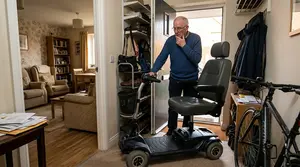
Picture this. You have found the scooter. It is compact, it folds, it promises to solve the storage puzzle. And then you stand in your hallway with a tape measure in one hand and a knot of anxiety in your stomach, because you have no idea which numbers to write down, which measurements matter most, or whether the whole thing will even fit through the front door. The brochure gave you specs. Nobody gave you a method.
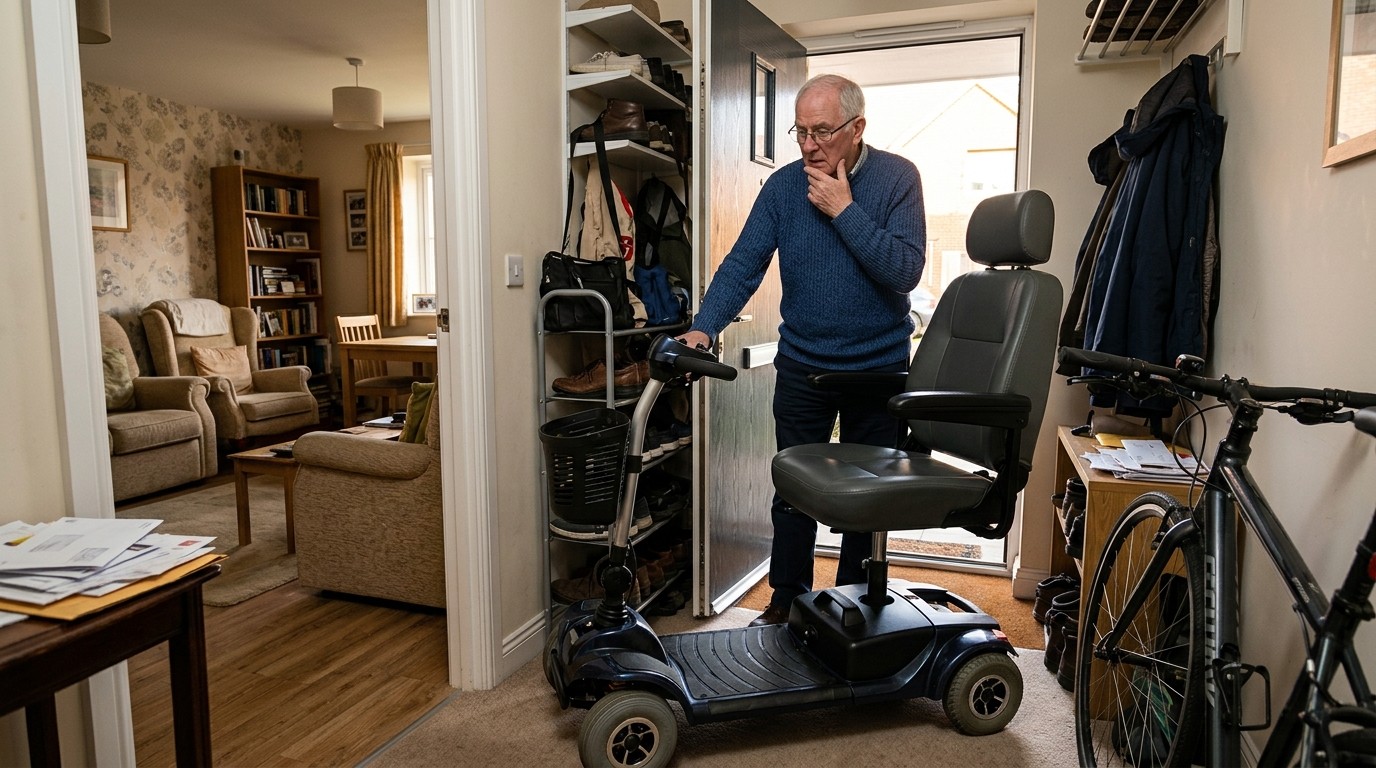
This is exactly why a home-measurement checklist for storage-friendly scooters is the most practical tool in your buying journey. It turns a vague, stressful “will it fit?” into a clear, room-by-room decision you can make with confidence. You do not need to be technical. You do not need to guess. You just need a tape measure, a notebook, and the checklist below.
Let’s walk through it together, one doorway at a time.
Why the Checklist Beats the Spec Sheet Every Time
Product pages give you the scooter’s numbers. Your home gives you the real numbers. The fit lives where the two meet—and most buyers never check both sides of the equation.
One practical guide puts it plainly: “A scooter can fit through a doorway and still be difficult to manoeuvre once you are inside” . The solution is to measure your entire route, not just one opening. Another expert source agrees: “Measure the route, not just the space” . A corridor wide enough to drive along may still be impossible to turn in.
The checklist that follows is built around that principle. It walks you from the outside in—entry point, doorways, hallway, turning space, storage spot, charging access—and tells you exactly what to measure and why. By the end, you will have every number you need to filter out unsuitable scooters before you read a single review.
And the first number starts at your front door.
Section 1: Doorways — The First Hard Limit
Doorways are where most scooter purchases succeed or fail. Measure the clear opening, not the frame. The clear opening is the usable gap between the door stop and any permanent obstruction, measured with the door open as far as it normally opens . Hinges, draught excluders, and door stops can reduce the usable width by several centimetres.
Write down the narrowest clear opening on your route. Then compare it to the scooter’s overall width. Most standard scooters are between 55 cm and 70 cm wide, and you need at least 10–15 cm of clearance for comfortable daily use . A scooter that is only 2–3 cm narrower than the doorway is not practically usable—you will clip the frame or need to approach at a precise angle every time.
Do not assume every door is the same size. Measure the bedroom, bathroom, kitchen, and any other doorway on your normal route . And check the tiller and handlebar width separately, because they may extend wider than the scooter’s body.
Once you have your narrowest doorway number, the next measurement—the hallway—tells you whether you can actually move once you are through.
Section 2: Hallway Width — The Straight-Passage Test
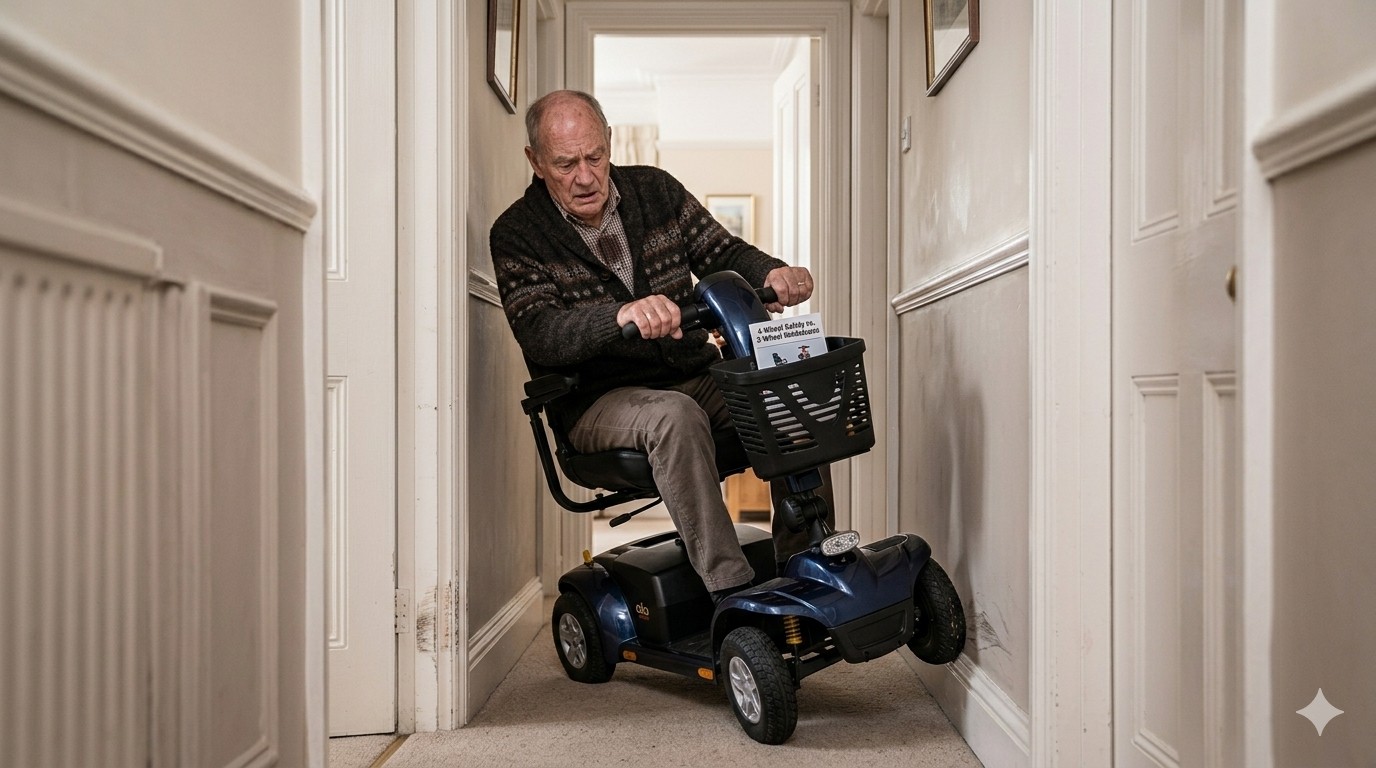
Hallway width tells you whether the scooter can travel in a straight line without scraping walls or forcing you to shuffle sideways. Measure the usable width at the narrowest point, noting any furniture, baseboards, or wall projections that reduce the clear space .
Accessibility guidelines offer useful reference points. A minimum hallway width of 36 inches (approximately 91 cm) is often cited, with 48 inches (approximately 122 cm) recommended for comfortable passing . For scooter users, research suggests that 95% need a width of at least 110 cm for 90-degree turns in a hallway . Your own hallway may be wider or narrower, but the principle is the same: the narrower the hallway, the more precisely the scooter must fit.
Write down the narrowest hallway width on your route. If the scooter’s overall width leaves less than 10 cm of clearance on either side, treat that as a tight fit that will require careful handling. And remember: passing through a hallway is only half the journey.
The turn at the end of it is the next test.
Section 3: Turning Space — The Geometry That Decides Daily Ease
Turning space is where many storage-friendly scooters reveal their true colours. The key spec is the turning radius—the half-circle a scooter needs to make a full U-turn. The practical rule is simple: the space needed to turn around is roughly double the advertised turning radius . A scooter with a 96 cm turning radius needs about 192 cm of clear width to complete a full circle in one smooth movement.
But you do not always need a full U-turn. A K-turn—using reverse and forward to reposition—can work in tighter spaces. The question is whether you have enough room to manoeuvre safely, without scraping paint or losing patience.
Measure the clear floor space at your tightest turn: the distance from the corner to the opposite wall or doorway. Compare it to twice the scooter’s turning radius for a full U-turn, or plan a K-turn if the space is tighter. Three-wheel scooters typically turn tighter than four-wheel models—sometimes by 30 cm or more—which makes them favourites for narrow hallways .
Write down both the tightest turn clearance and the turning radius of any scooter you are considering. If the numbers are close, test the turn with a broom handle or a friend holding a tape at the scooter’s width. It sounds silly. It works.
And once you know the turn works, the final piece of the puzzle is where the scooter will actually live.
Section 4: The Parking Spot and Storage Space — The Final Destination
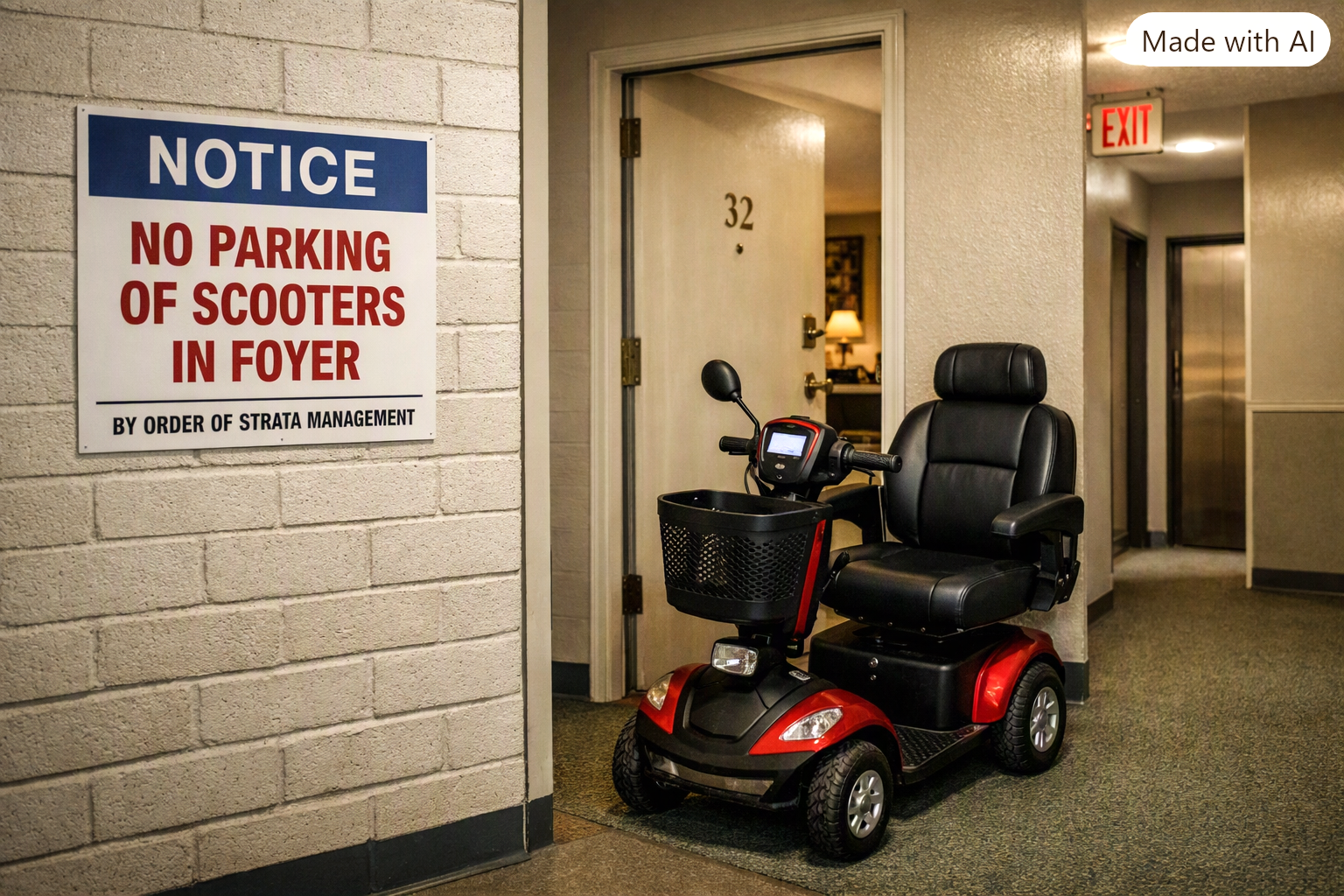
The parking spot is the place the scooter will sit when it is assembled and ready to use. The storage space is where it will go when it is folded or dismantled. They may be the same place, or they may be different—and you need to measure both.
For the parking spot, measure the floor area the assembled scooter will occupy, including the length from front wheel to rear wheel, the width at the widest point, and the clearance needed to walk past or open a door beside it. Mark the footprint on the floor with masking tape and live with it for a day. Can you still get to the kitchen? Can a carer pass? Can you reach the charging socket without climbing over the scooter?
For the storage space, measure the internal height, width, and depth of the cupboard or corner. Then measure the door opening separately, because a wide cupboard with a narrow door is a trap. Leave at least 5 cm of clearance on each side . Compare both sets of numbers to the scooter’s folded or dismantled dimensions.
And do not forget the heaviest piece. For a dismantling scooter, this is the weight of the single heaviest component you must lift. For a folding scooter, it is the folded package weight. Compare it to what you can safely lift on a bad day, not your best day . The storage spot only works if you can actually get the scooter there.
Section 5: Charging Access and Safety — The Step Most Checklists Miss
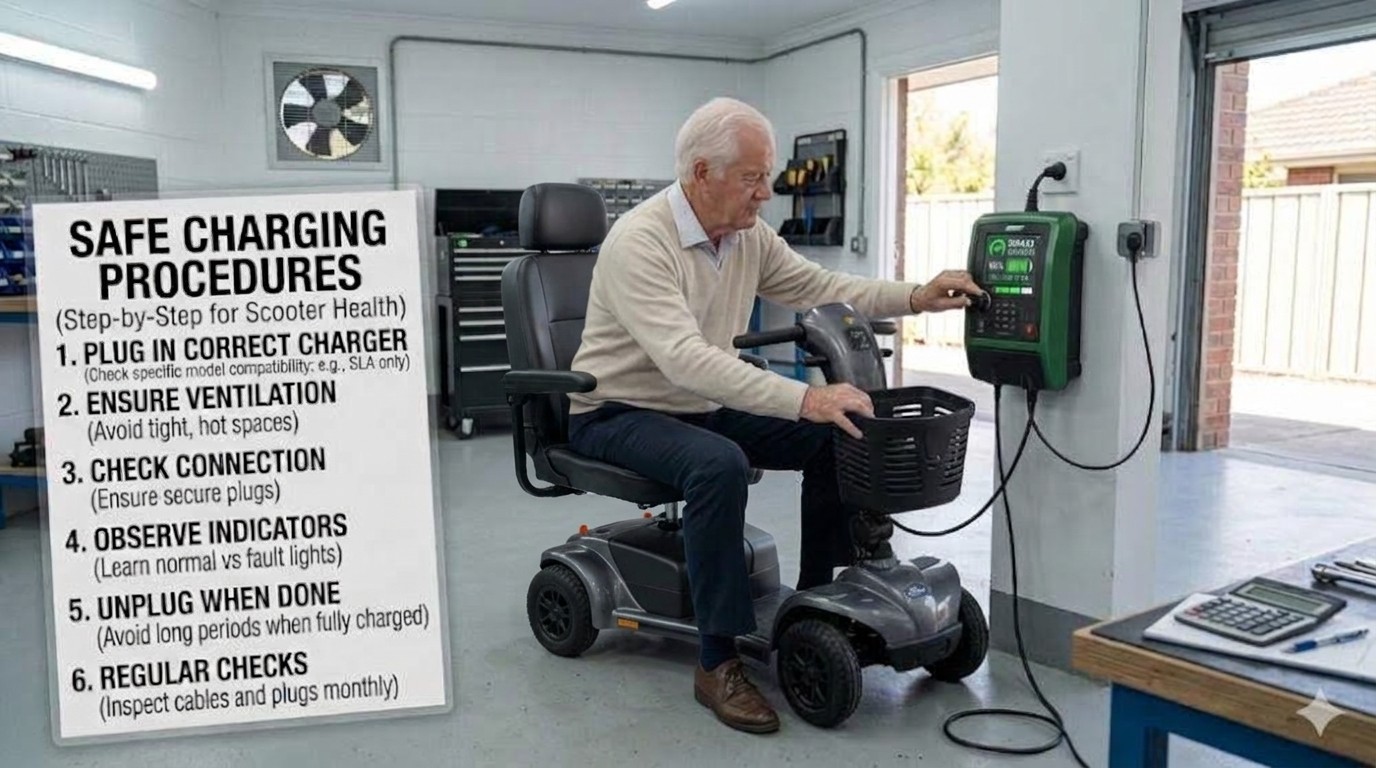
A scooter needs a safe place to charge, and this is where the checklist becomes a safety tool as much as a measurement tool. Fire services are unambiguous: do not store or charge a scooter in a hallway or escape route, because it could block your way out in a fire . The safest place is outside the home—a shed or garage—or a room inside with a fire-resistant door and a smoke detector .
Check whether there is a socket where the scooter will live. Many sheds and some garages have none, and running an extension lead outdoors as a permanent arrangement is not safe . If the scooter has a removable battery, this becomes much easier—you can carry the battery indoors and charge it in the warm . Charge on a non-combustible surface, use only the supplied charger, and never leave it charging unattended or overnight.
Write down your charging plan alongside your measurements. A scooter that fits perfectly but cannot be charged safely is not a solution. And a scooter that blocks your escape route is a risk no measurement can justify.
Your Printable Checklist (Copy This Down)
Here is the full checklist in one place. Take it with you as you measure.
Doorways: Narrowest clear opening (cm). Compare to scooter width. Minimum 10–15 cm clearance.
Hallway: Narrowest usable width (cm). Note obstructions. Check passing space.
Turning space: Tightest corner clearance (cm). Compare to twice the turning radius. Plan for a K-turn if needed.
Parking spot: Assembled length and width (cm). Mark on floor. Check walking clearance and socket access.
Storage space: Internal height, width, depth (cm). Door opening (cm). Compare to folded/dismantled dimensions.
Heaviest piece: Weight (kg). Compare to your safe lifting limit on a bad day.
Charging: Socket location. Safe surface. Ventilation. Not on an escape route. Removable battery if needed.
With these numbers written down, you can filter out unsuitable scooters in minutes. And the final section shows you what to do when the numbers do not quite line up.
When the Numbers Do Not Fit: Honest Options
Sometimes the doorway is wide enough but the turn is too tight. Sometimes the storage spot is perfect but the heaviest piece is beyond your lifting limit. These are not failures. They are information.
Option one: adjust the storage plan. If the scooter fits the parking spot but not the cupboard, maybe the cupboard is not the right home. A corner of a room or a covered outdoor store may work better.
Option two: choose a different mechanism. A dismantling scooter with a light heaviest piece may solve a lifting problem. A three-wheel scooter with a tight turning radius may solve a hallway problem. The right compromise depends on which number is the binding constraint.
Option three: accept the trade-off honestly. A larger, more comfortable scooter may not fit your storage space. A smaller, storage-friendly scooter may be less comfortable outdoors. Neither choice is wrong. The wrong choice is the one made without measuring .

Your Next Step
You now have a method that goes beyond the spec sheet. Measure the doorways, the hallway, the turning space, the parking spot, the storage space, the heaviest piece, and the charging access. Compare those numbers to the scooter’s specs. If the fit works, you have found a scooter that respects your home. If it does not, you have saved yourself from a daily frustration.
If the turning space is the tricky part, the guide to narrow hallways and tight turns explains the geometry in plain English. And if the storage spot is a cupboard or under-stairs space, the guide to closet and under-stairs storage shows how to make tight spaces safe and workable.
You are closer to a scooter that actually fits than you think.
FAQs
What should I measure at home before buying a mobility scooter?
Measure the narrowest doorway, hallway width, tightest turning space, parking footprint, storage space, heaviest piece you can lift, and charging access. Measure the whole route, not just one doorway.
How do I measure a doorway for a mobility scooter?
Measure the clear opening with the door open as far as it normally opens, from the door stop to any obstruction. Do not measure the frame. Allow at least 10–15 cm of clearance beyond the scooter’s width.
How much hallway width do I need for a scooter?
There is no single number, but accessibility guidance often cites 91 cm as a minimum and 122 cm as comfortable. For scooter users, research suggests 110 cm for 90-degree turns. Measure your narrowest point and compare.
How do I measure turning space?
Measure the clear floor space at your tightest corner. The space needed for a full U-turn is roughly double the scooter’s turning radius. A K-turn can work in tighter spaces if you have room to reverse safely.
What is the difference between parking footprint and storage space?
The parking footprint is the floor area the assembled scooter occupies when ready to use. The storage space is where it goes when folded or dismantled. Measure both, because a scooter can fit one and fail the other.
How much clearance should I leave around a parked scooter?
Aim for at least 5 cm on each side for walking past, and more if you need to turn, reverse, or pass a hinge. A close fit can scrape paint and make every journey tense.
Can I charge a mobility scooter in a hallway?
No. Fire services advise against charging or storing a scooter in a hallway or escape route, because it could block your way out in a fire. Charge in a safe, ventilated space away from escape routes.
What if my storage space is too small for any scooter?
Consider a folding or dismantling scooter stored in a different location, a secure outdoor shed, or a ground-floor parking spot. A scooter you can actually store is worth more than a better one you cannot.
How do I measure for a dismantling scooter’s heaviest piece?
Check the product specification for the heaviest single component. Compare it to what you can safely lift on a bad day, not your best day. If it is not listed, ask the retailer before buying.
What are common mistakes people make when measuring for a scooter?
Measuring the cupboard but not the door opening. Forgetting the turning space. Ignoring the route between storage and use. And underestimating the heaviest piece. Measure the whole picture.
Stay mobile, stay confident!
Sign up for our monthly Mobility Scooter Newsletter to receive practical guides, expert advice, and inspiring stories that help you make the most of your scooter and download our free "Mobility Scooter Guide for Beginners."
Don't worry — your e-mail address is totally secure.
I promise to use it only to send you our newsletter, "Mobility Matters."
Recent Articles


-
Small Home Storage Friendly Scooters That Actually Fit Your Flat
Nov 11, 26 03:32 AM
 Small Home Storage Friendly Scooters start with your tape measure. Learn the route, not just the spot, before you spend a penny.
-
A Home-Measurement Checklist for Storage-Friendly Scooters
Nov 11, 26 03:28 AM
 A home-measurement checklist for storage-friendly scooters starts with your tape measure, not the brochure. Get every number in one place.
-
Folded Dimensions vs “Parked Footprint”: The Real Fit Test
Nov 10, 26 08:53 PM
 Folded dimensions vs “parked footprint” is the measurement method that prevents scooter regret. Learn both numbers before you buy

Ready to Feel More Confident on Your Mobility Scooter?

My Ebook, The Ultimate Guide to Mobility Scooters, walks you through choosing the right scooter, using it safely, and keeping it in top condition — all explained in clear, friendly language.
Give yourself (or someone you love) the gift of independence.




