- Home
- Health Needs Fit
- Low Vision Friendly Scooter Features
- Lighting and Visibility Features
Lighting and Visibility Features for Low-Vision Scooter Riders: Day vs Night Your Headline
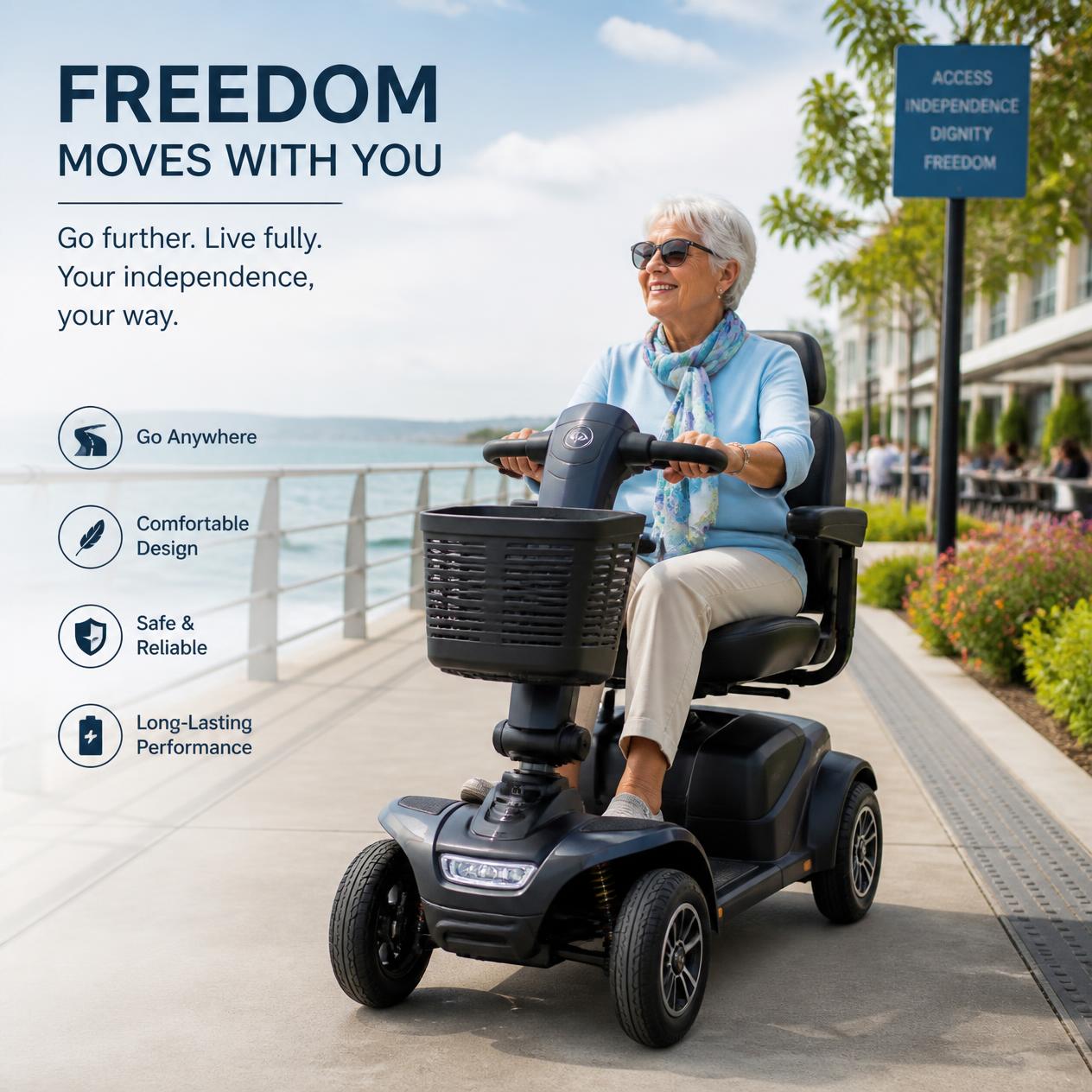
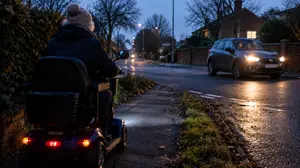
Picture this. It's a winter afternoon, and the light is already fading as you head home from the shops. You can see the path ahead—just about—but the bigger worry is whether the driver pulling out of a side street can see you. You're low to the ground, moving at walking pace, and dressed in a dark coat. For a moment, you feel invisible. That feeling is exactly why the right lighting and visibility features for low-vision scooter riders matter so much—not just so you can see, but so you can be seen. And the features that help in daylight are not always the same ones that help after dark.
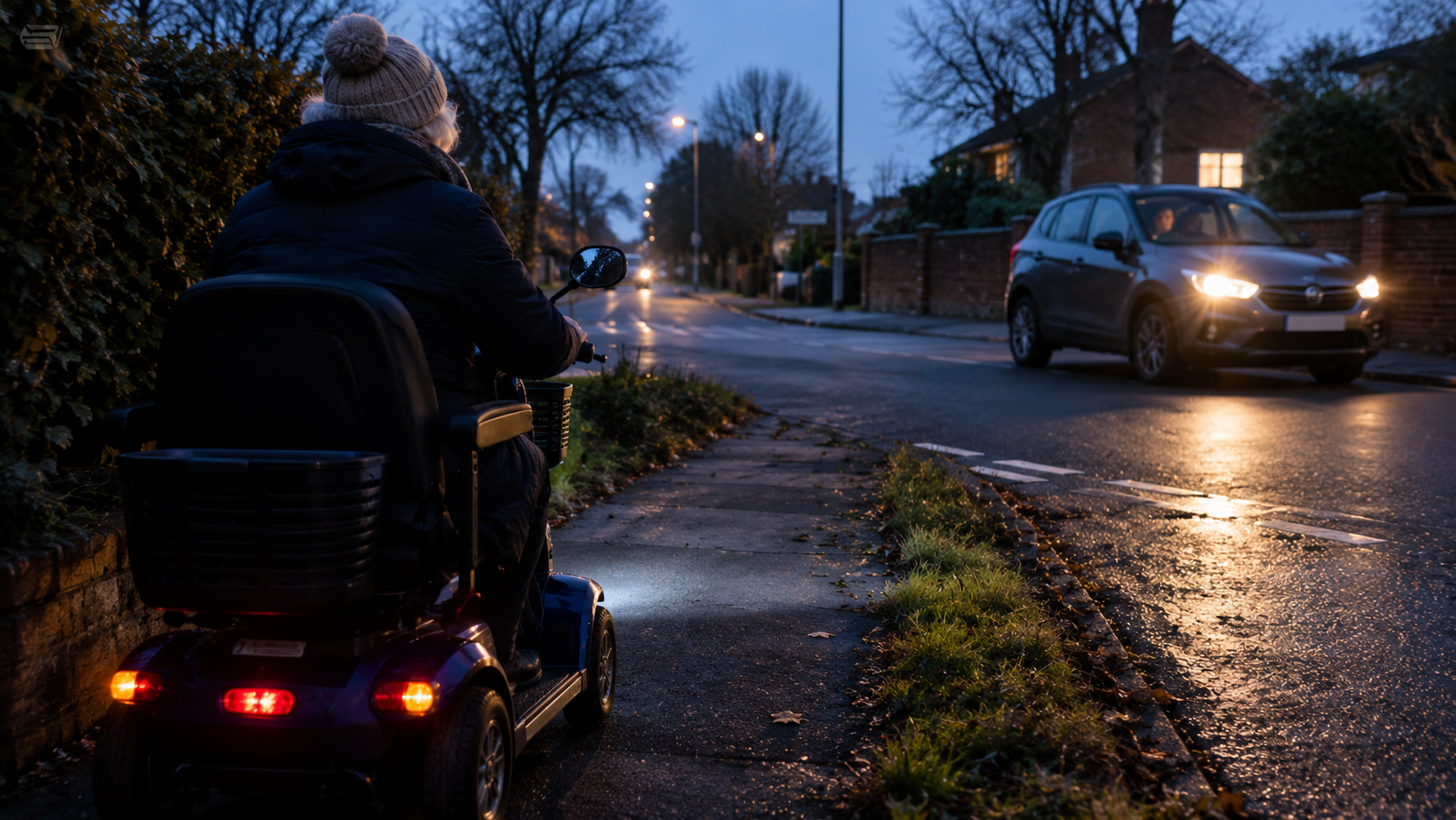
Visibility is a two-way street. Your eyes need help reading the path, and other people's eyes need help noticing you. The best scooters solve both problems, but they do it with different tools depending on the light. Once you know what to prioritise for day versus night, the whole buying decision gets simpler.
Let's walk through it together.
Why Visibility Is a Low-Vision Issue (Not Just a Lighting Issue)
Here's something worth knowing up front: research on slow motorised vehicles has found that contrast sensitivity is closely linked to scooter driving performance. In one study, four out of the five participants who failed an on-road mobility scooter test had contrast sensitivity below a clinical cut-off, and low contrast sensitivity contributed to a higher number of collisions in a driving simulator. In plain terms, if your eyes struggle to tell light from dark, the consequences show up on the road—especially when the light is poor.
And there's a second layer. Vision Australia's research found that 35% of respondents who are blind or have low vision had been involved in a collision or near-collision with an electric vehicle, and 75% said electric vehicle technology had reduced their confidence to leave the house. The core problem, as they put it, is that electric vehicles are silent at low speeds—but the visibility problem cuts both ways. Low-vision riders need to see and be seen, and the features that make that possible are not optional extras. They're the foundation of confident independent travel.
So what does “good” look like? Let's start with the principle that ties it all together.
The Core Principle: See and Be Seen
Every lighting feature on a scooter serves one of two jobs. Active lighting helps you see the path ahead—headlights, kerb lights, puddle lights. Passive visibility helps others see you—reflectors, reflective panels, high-visibility frame colours, running lights that stay on. The best scooters combine both, because a bright headlight that illuminates the ground in front of you does nothing to warn a driver approaching from the side.
The day-versus-night split matters because the balance shifts. In daylight, your priority is being noticed against a busy background—contrast, colour, and movement. After dark, your priority is illuminating the path without creating glare, plus making sure your presence is unmistakable to traffic. Keep that split in mind, because everything that follows hangs on it.
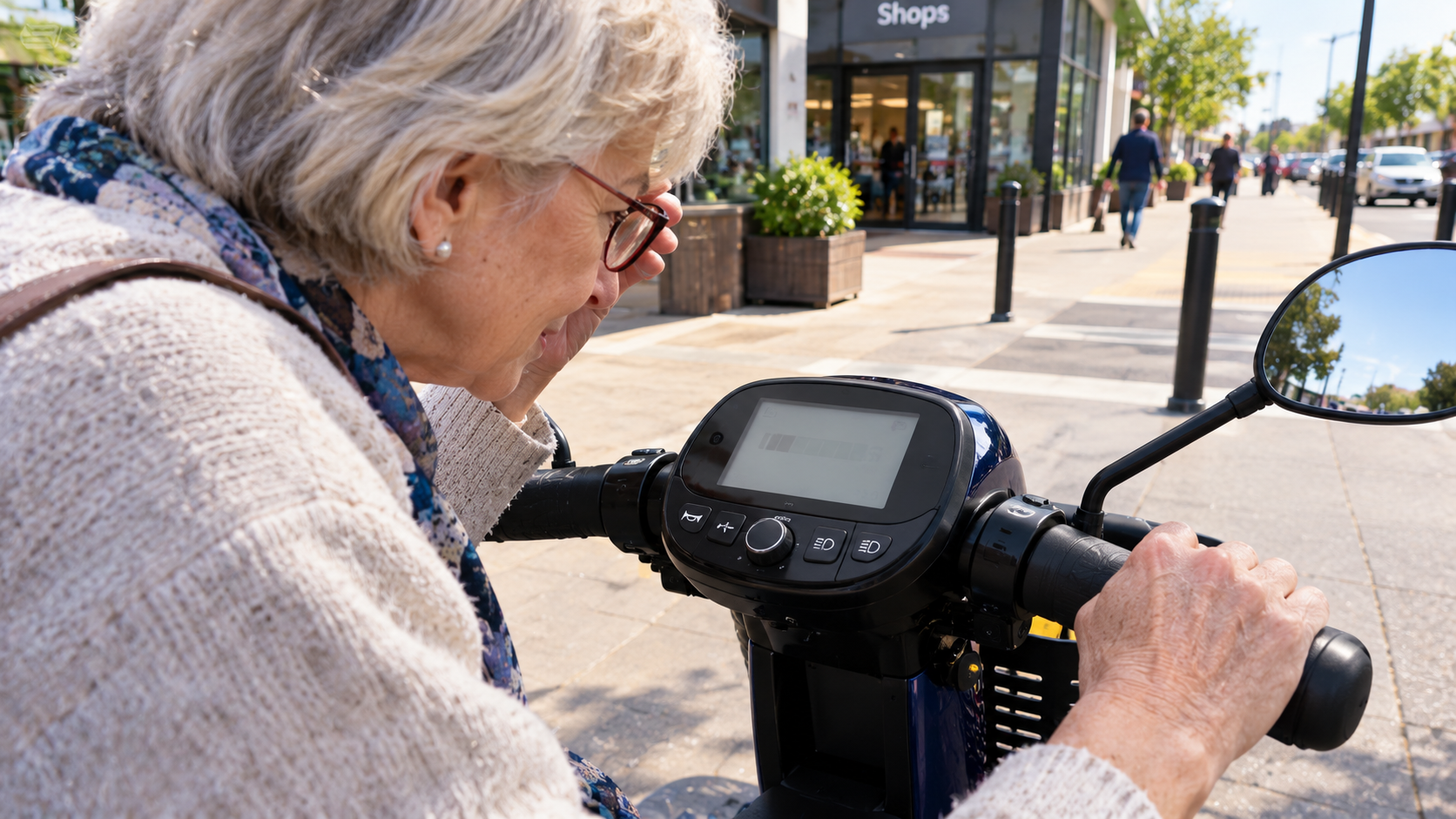
Daytime Visibility: Contrast, Colour, and Being Noticed
You might assume daytime visibility is easy—it's light, after all. But low vision changes the equation, because contrast sensitivity declines and busy backgrounds (shopfronts, parked cars, pedestrians) compete for attention. The features that help in daylight are the ones that increase contrast between you and your surroundings.
High-visibility frame colours are the simplest example. A bright or fluorescent finish increases contrast against dark pavements, improves recognition by drivers, and helps with peripheral detection in traffic—while neutral tones blend into dusk environments. A fluorescent flag attached to the scooter does the same job, highlighting your position to others.
Always-on running lights are the other daytime hero. A steady white front light and a steady red rear light, even in daylight, make you far more noticeable than a silent, unlit scooter. Some models also offer rear reflectors that catch vehicle headlights and increase rear visibility, plus side reflectors for angle detection. And don't overlook reflective clothing or a high-visibility vest—the scooter's visibility features work best when they're not fighting against a dark coat.
Daytime is about contrast. Nighttime is about illumination—and that's where the priorities shift.
Nighttime Lighting: Illuminating the Path Without Glare
After dark, you need to see the ground ahead clearly enough to spot kerbs, potholes, and uneven paving—but you also need to avoid blinding yourself or others with glare. The ideal setup is bright but well-aimed: a wide, downward-angled beam that lights the path without bouncing back off wet surfaces.
LED headlights are the standard now, and for good reason. They're energy-efficient and provide strong forward illumination without draining the battery excessively. But brightness alone isn't the goal. Some scooters now offer ultra-wide-angle headlights that spread light across a broader area, so you can see the path edge rather than just a narrow tunnel ahead. Others include kerb lights or puddle lights that illuminate the ground beside the scooter—genuinely useful for spotting the edge of a kerb or a step at night.
Automatic headlights are a quiet but meaningful upgrade. A system that activates in low light without you needing to remember a switch is one less thing to think about—and one less thing to forget. For riders with low vision, reducing cognitive load is a safety feature in itself.
And here's the counterintuitive part: brighter isn't always better. A narrow, over-bright beam can bounce glare back off wet pavement and dazzle oncoming pedestrians. What you want is a beam that is wide, low, and aimed at the ground—not a spotlight pointing into the distance. The test is simple: sit on the scooter at night and check whether you can see the path edge and any kerbs, without the light reflecting back into your eyes.
The Day vs Night Comparison: A Quick Reference
|
Priority |
Daylight |
After Dark |
|
Seeing the path |
Less critical; ambient light helps |
Critical—needs wide, low-aimed LED headlights |
|
Being seen |
High-contrast colours, flags, running lights, reflectors |
Bright front and rear lights, reflectors, reflective clothing |
|
Glare risk |
Low, but shiny surfaces can reflect sun |
High—wet pavement and oncoming lights cause bounce-back |
|
Cognitive load |
Managing busy backgrounds |
Managing darkness and reduced visual cues |
|
Key features |
High-vis frame, always-on lights, reflective panels |
Wide-beam headlights, kerb lights, auto-activation, rear reflectors |
The takeaway is simple: you need different features for different light. A scooter that only has a headlight and nothing else is under-equipped for daytime visibility. A scooter with bright running lights but a narrow night beam is under-equipped for after dark. The best choice covers both.
Reflectors, Panels, and the Features You Might Overlook
Some of the most useful visibility features are the least glamorous. Reflective panels on the sides and rear catch headlights and make you noticeable from angles your lights don't cover. Reflective detailing on the frame or seat can improve night-time awareness without adding any electronics. And a high-visibility seat cover is a simple aftermarket addition that increases your profile to drivers approaching from behind.
For low vision specifically, contrast markers on the scooter itself can help you find it in a car park—a bright ribbon or a small flag on the tiller, not for riding visibility but for findability. It's a small thing, but it reduces the daily friction of wondering where you left it.
What the Regulations Say (and What They Don't)
If you're in the UK, the legal picture is worth knowing, because it shapes what features a scooter is required to have. Class 3 scooters—the only type allowed on the road—must have front and rear lights and reflectors, direction indicators able to operate as hazard warning signals, an audible horn, and a rear-view mirror. An amber flashing light is required if you use a class 3 scooter on a dual carriageway. Class 2 scooters (pavement-only) are not legally required to have lights, though some models do—and RoSPA (Royal Society for the Prevention of Accidents) recommends choosing a model with lights if the scooter will be used at night.
There is no legal eyesight requirement to drive a mobility scooter in the UK, but the guidance suggests you should be able to read a car's registration number from 12.3 metres, and you should check regularly that you still can. That's a useful benchmark for thinking about your own visibility needs—if you're struggling at that distance, lighting and contrast features become even more important.
In Australia, the rules vary by state, but personal mobility devices used at night are generally required to have a white front light visible for at least 200 metres, a red rear light visible for at least 200 metres, and a red rear reflector visible for at least 50 metres when illuminated by a vehicle's headlights. If you're buying in Australia, check your state's requirements—they're a useful baseline even if you're mainly on footpaths.
The Night-Time Test Drive: What to Check Before You Buy
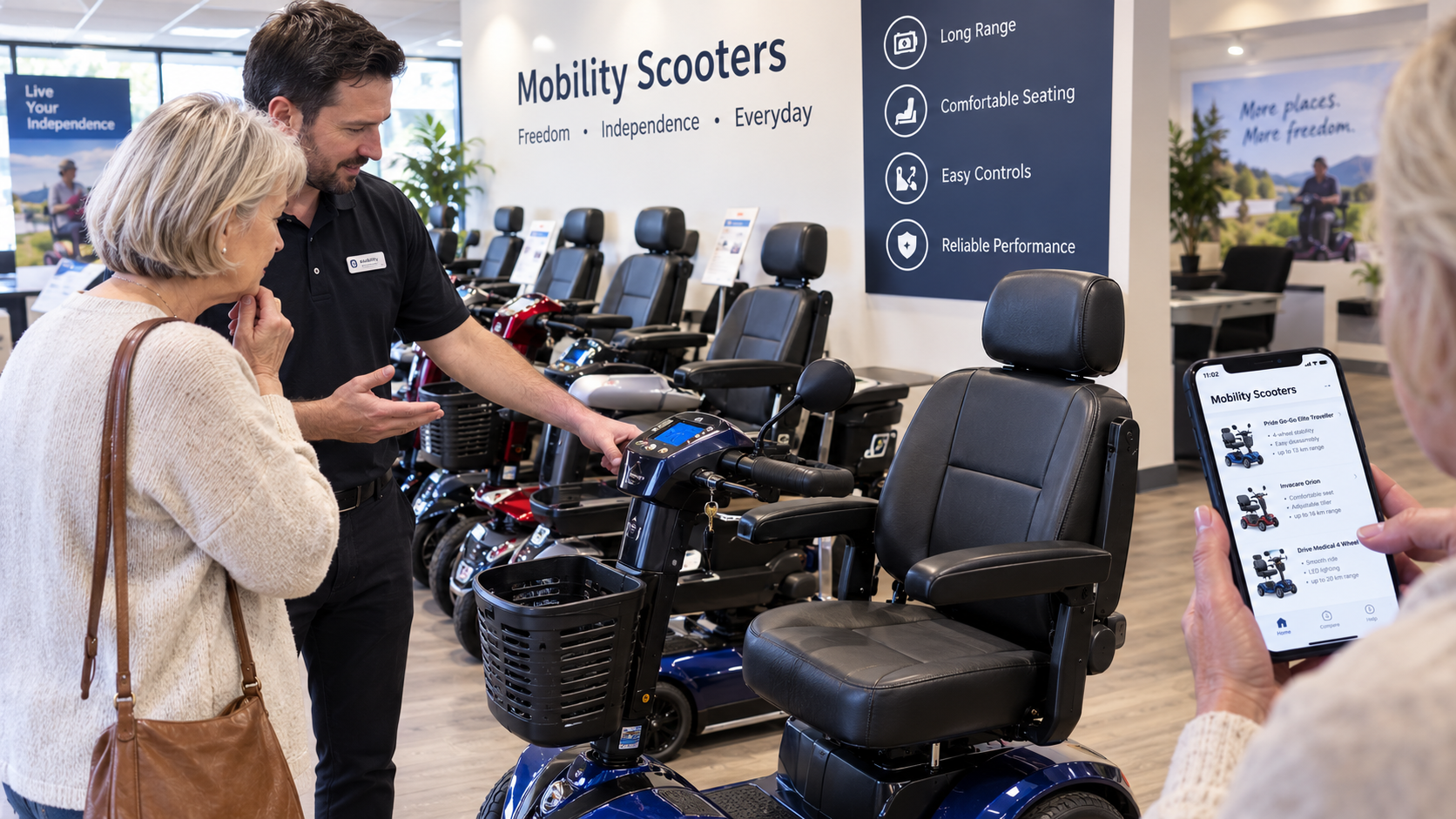
Don't just look at the lights in a showroom. Test them in the conditions you'll actually ride in. Here's a simple sequence:
- The dusk check. If possible, test the scooter at dusk or in a dim area. Turn on the headlight and see whether it illuminates the path edge and any kerbs. A beam that only lights the middle distance is less useful than one that lights the ground ahead.
- The glare check. Face a reflective surface (a window, a wet patch of pavement) and see whether the light bounces back into your eyes. If it does, the beam angle needs adjusting—or the light isn't well-designed.
- The visibility check. Ask someone to stand 10–15 metres away and tell you when they can first see the scooter's lights and reflectors. If they can't see you until you're close, the visibility package isn't strong enough.
- The auto-check. If the scooter has automatic lights, test whether they activate reliably in low light. A system that hesitates or fails to trigger is worse than a manual switch you can control.
- The reflector check. Walk around the scooter and look for reflectors on the sides and rear, not just the front. Reflective panels on the sides catch headlights from angles your lights don't cover.
This sequence is part of a proper low-vision-focused test drive, and it's worth running on more than one scooter so you have a baseline. If you're also weighing up a scooter against a power wheelchair, our comparison of mobility scooter vs power wheelchair for low vision (Coming Soon!) covers how visibility and control differences play out.
A Final Word (Before You Go)
You don't need the brightest lights on the market. You need the right lights for the right conditions—contrast and colour for daylight, wide low beams and reflectors for after dark, and a visibility package that makes you unmistakable to others.
The next time you sit on a scooter, you'll know exactly what to check. And if you want to go deeper on the features that work alongside lighting—controls, displays, and comfort—our parent guide to low vision friendly scooter features is the natural next step.
Stay mobile, stay confident!
Sign up for our monthly Mobility Scooter Newsletter to receive practical guides, expert advice, and inspiring stories that help you make the most of your scooter and download our free "Mobility Scooter Guide for Beginners."
Don't worry — your e-mail address is totally secure.
I promise to use it only to send you our newsletter, "Mobility Matters."
Recent Articles


-
The Low Vision Friendly Scooter Features Nobody Explains
Oct 28, 26 07:03 AM
 Low vision friendly scooter features that reduce risk and restore independence—without jargon, guesswork, or pressure.
-
The Lighting and Visibility Features Nobody Explains Properly
Oct 28, 26 07:01 AM
 Lighting and visibility features for low-vision scooter riders that actually help. Learn day vs night priorities, reflectors, and the demo tests that matter.
-
The Mobility Scooter Control Features Nobody Explains Properly
Oct 28, 26 05:24 AM
Mobility scooter control features that help with low vision—tiller layout, distinct switches, and tactile feedback, explained simply and practically.
Ready to Feel More Confident on Your Mobility Scooter?

My Ebook, The Ultimate Guide to Mobility Scooters, walks you through choosing the right scooter, using it safely, and keeping it in top condition — all explained in clear, friendly language.
Give yourself (or someone you love) the gift of independence.




