- Home
- Funding and Coverage
- NDIS Funding for Mobility Scooters
- Appealing a Refused Mobility Scooter Request
Appealing a Refused Mobility Scooter Request: Internal Review (Your Step-by-Step Guide)
Picture this. You've done everything right. The OT assessment. The report. The quote. You waited weeks — maybe months — for a decision. Then the letter arrives. The NDIS has refused your mobility scooter request. The letter uses words like "reasonable and necessary" and "not satisfied," and you feel a knot form in your stomach. The scooter wasn't a want. It was the difference between getting to the shops and being stuck at home. It was independence. And now it feels like the door has been slammed shut.
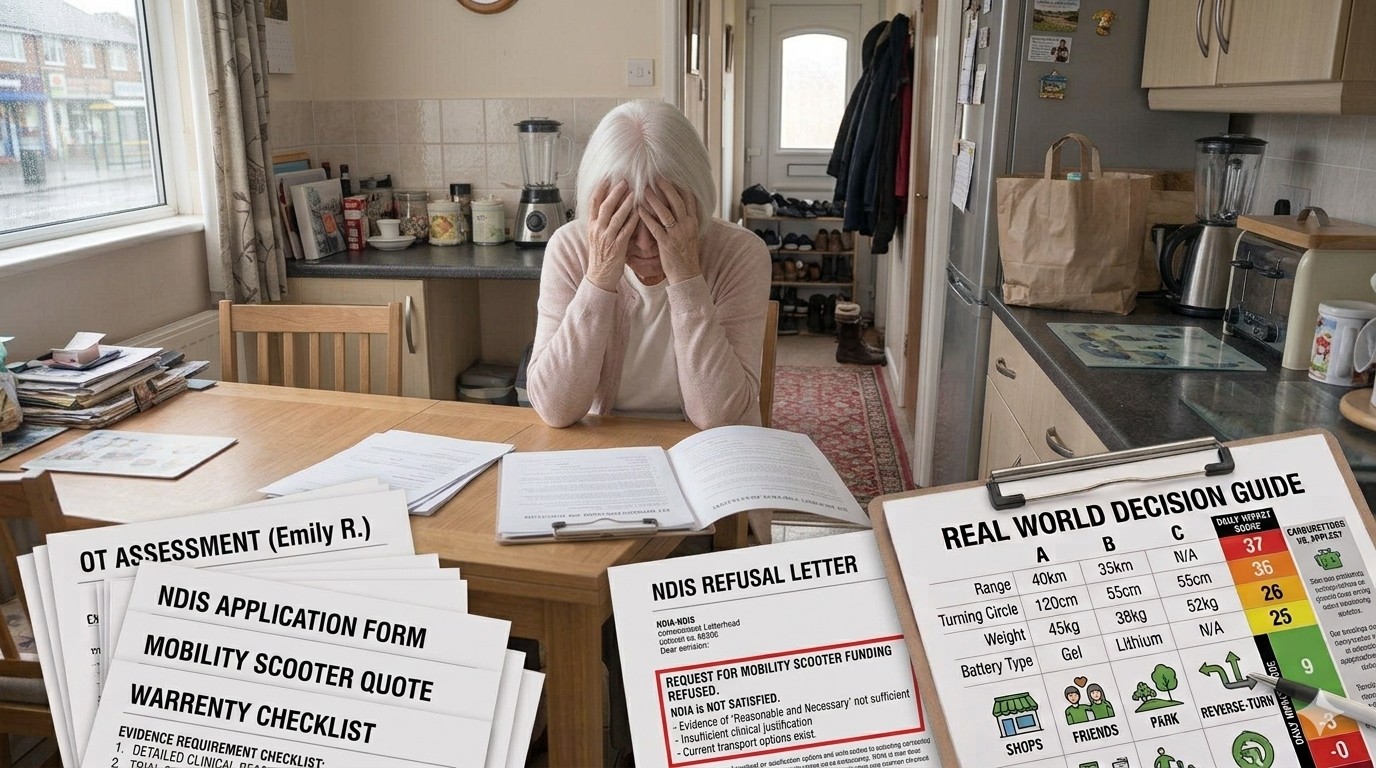
Here's the truth that the refusal letter doesn't tell you: you have rights, you have time, and you have a pathway. Appealing a refused mobility scooter request through internal review is a free, formal process — and it works more often than you might think.
This guide will walk you through exactly what to do, what to include, and how to strengthen your case. By the end, you'll know that a "no" is not the end of your story.
What Is an Internal Review (and Why It's Your First Step)
An internal review is a formal request for the NDIA to reconsider its own decision. A different reviewer — someone who wasn't involved in the original refusal — looks at your case with fresh eyes. They can consider new evidence, and they have the power to overturn the decision entirely. This isn't a favour. It's your right under the NDIS Act.
The best part? It's free. You don't need a lawyer. You don't need to pay a fee. You just need to submit a request within three months of receiving the refusal letter, and the NDIA has 60 days to complete the review. That's the framework. Simple, free, and your legal right.
But before you submit anything, there's one thing you need to check — and it's the thing that trips up more people than anything else.
The 3-Month Deadline: Don't Miss It
You must request an internal review within three months from the day you receive the refusal letter in writing. That's the rule. It's not negotiable. If you miss the deadline, you lose your right to internal review, and your next option becomes the Administrative Review Tribunal (ART) — which is a longer, more formal process.
So the first thing to do is check the date on your refusal letter. Write the deadline on your calendar. Set a phone reminder. Tell someone you trust. Then start gathering your evidence. You have time, but you don't have forever.
And now that you know the deadline, let's talk about what actually goes into your review request.

What to Include in Your Internal Review Request
The NDIA gives you a form — the "Request for a Review of a Decision" — but the form is just the container. The substance is what matters. When you request an internal review, you need to tell the NDIA four things: what decision you were expecting, why you think the decision should be different, what information they already have that you'd like them to reconsider, and what new evidence you're providing.
Here's a simple framework you can use:
Part 1: The decision you were expecting. "I requested funding for a mobility scooter because [specific functional limitation]. I expected the NDIS to approve this request because [reason]."
Part 2: Why the decision should be different. "The original decision did not adequately consider [specific evidence]. My OT report clearly states [quote from report]."
Part 3: Evidence you want reconsidered. "Please reconsider the OT assessment dated [date] and the quote from [supplier]."
Part 4: New evidence. "I am providing an updated OT report / a trial observation record / a letter from my GP that addresses [specific gap in the original application]."
This framework does two things. It tells the reviewer exactly what to look at, and it shows that you've thought carefully about your request.
But the real magic happens when you add new evidence — and that's where the next section comes in.
Strengthening Your Evidence: What to Add (and Why)
The most common reason for refusal is that the original evidence didn't connect all the dots. The OT report might have described your impairment but not linked it clearly to your functional limitations. Or it might have recommended a scooter without explaining why a scooter — rather than a different device — was the right choice.
An internal review is your chance to fill those gaps.
The NDIS looks for evidence that links your impairment to your functional limitations, then to your environment, and finally to the device you're requesting. If your original report skipped a step, your new evidence should complete the chain. A trial observation record is particularly powerful here. If you can show that you trialled the scooter and it improved your mobility, that's concrete evidence.
Your OT can document what they observed: how you managed the controls, whether the seat was comfortable, how you navigated your local environment.
And if you have multiple impairments, there's one more piece of evidence you should include — and it's changed the game entirely.
The Eastham Ruling: Your Secret Weapon for Multiple Impairments
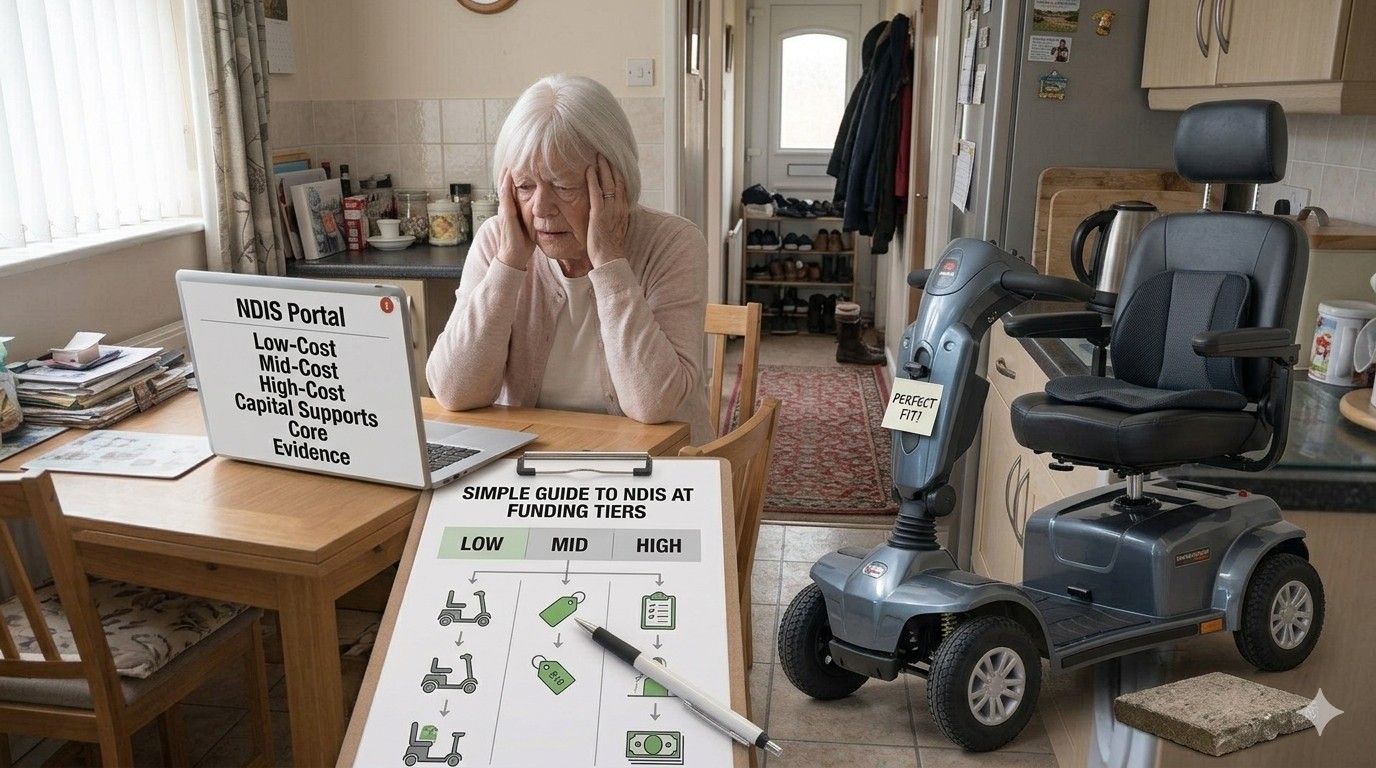
If your refusal letter says your mobility issue isn't your "qualifying" impairment, you need to know about the Eastham ruling. In February 2026, the Federal Court confirmed that a qualifying impairment only needs to be a contributory cause of your need for a support — not the sole or dominant cause. In plain language: if you have multiple disabilities, the NDIA cannot reject your scooter request simply because your mobility issue isn't your "primary" impairment.
Lee Eastham, a man with hearing and vision impairments as well as mobility limitations, was refused funding for a $7,300 mobility scooter in 2022. The NDIA argued that his mobility issue wasn't his qualifying impairment. He appealed. He won. The Federal Court ordered the NDIA to fund the scooter. Your internal review request should explicitly cite this ruling if it applies to your situation. You can say: "The refusal was based on the argument that my mobility issue is not my qualifying impairment. Under the Eastham ruling, a qualifying impairment only needs to be a contributory cause of my need for the support. I request that the NDIA reconsider this decision in light of that ruling."
That single paragraph can transform a refused application into a successful one.
And once you've submitted your review request, there's one more thing you need to know: what to expect while you wait.
What Happens After You Submit Your Request
Once you submit your internal review request, the NDIA aims to complete the review within 60 days from the day after they receive it. But here's the realistic part: the NDIA doesn't always meet that deadline. In fact, recent data shows that only about three in ten reviews are completed within 60 days. That's frustrating, but it doesn't mean you've been forgotten. It means the system is slow. You can call the NDIS Contact Centre on 1800 800 110 to check on your review's progress. And if the wait becomes unreasonable, you can escalate the matter.
While you wait, don't sit idle. If your situation changes — if your mobility deteriorates or your needs shift — contact the NDIA and let them know. They can consider new information as part of the review.
And if the internal review doesn't go your way, there's still a pathway forward.
If the Internal Review Fails: What Comes Next
If the internal review upholds the original refusal, you can apply to the Administrative Review Tribunal (ART) for an external review. You have 28 days from the internal review decision to lodge your ART application. The ART is independent, and it can overturn NDIA decisions. In fact, 98% of ART matters are resolved before a substantive hearing, and the tribunal changes decisions in a significant proportion of cases.
The ART process is more formal than internal review, but it's still free for NDIS matters, and you don't need a lawyer — though legal advice can help for complex cases. The key is to build on the evidence you gathered for the internal review. If the NDIA refused your request despite strong evidence, the ART may see it differently.
FAQs: Appealing a Refused Mobility Scooter Request
How long do I have to request an internal review?
You have three months from the day you receive the refusal letter in writing. Mark the deadline and don't miss it.
Is internal review free?
Yes. There's no fee to request an internal review. It's your right under the NDIS Act.
Do I need a lawyer for internal review?
No. You can submit the request yourself, or with help from a family member, support coordinator, or advocate.
What if the NDIS doesn't respond within 60 days?
The 60-day timeframe is a target, not a guarantee. You can call 1800 800 110 to check on progress and escalate if the delay is unreasonable.
Can I provide new evidence in my internal review?
Yes. New evidence — such as an updated OT report, a trial observation record, or a letter from your GP — can be submitted with your review request and considered by the reviewer.
What if my refusal was based on "wrong impairment" grounds?
The Eastham ruling may apply. If you have multiple impairments, cite the ruling in your review request. It confirms that a qualifying impairment only needs to be a contributory cause of your need for the support.
What happens if the internal review is unsuccessful?
You can apply to the Administrative Review Tribunal (ART) within 28 days of the internal review decision. The ART is independent and can overturn NDIA decisions.

Your Next Step: You Have More Power Than You Think
You've just learned something the refusal letter didn't tell you: you have rights, you have time, and you have a pathway. The internal review process is free, formal, and designed to give your request a second look. You don't need to be a lawyer. You don't need to be an expert. You just need to submit your request within three months, include the right evidence, and cite the Eastham ruling if it applies.
Your next step is simple. Find your refusal letter and check the date. Write the three-month deadline somewhere you'll see it every day. Then start gathering your evidence — your OT report, your trial observations, any new letters from your healthcare team. If you have a support coordinator, ask them to help you submit the request. If you don't, call 1800 800 110 and ask for guidance.
A refusal is not a verdict. It's a hurdle. And you've just learned how to clear it.
Stay mobile, stay confident!
Sign up for our monthly Mobility Scooter Newsletter to receive practical guides, expert advice, and inspiring stories that help you make the most of your scooter and download our free "Mobility Scooter Guide for Beginners."
Don't worry — your e-mail address is totally secure.
I promise to use it only to send you our newsletter, "Mobility Matters."
Recent Articles


-
The NDIS Mobility Scooter Funding Guide I Wish Someone Had Given Me
Sep 29, 26 09:08 AM
 NDIS funding for mobility scooters doesn't have to be confusing. Here's your friendly guide to eligibility, assessment, costs, and approval.
 -
NDIS Scooter Refused? Internal Review Explained (and Why It Works)
Sep 29, 26 09:06 AM
Appealing a refused mobility scooter request — your rights, your deadline, and your pathway to a fair decision. Internal review explained. -
NDIS Mobility Scooter vs Powered Wheelchair: Which One Is Right?
Sep 29, 26 08:06 AM
Mobility scooter vs powered wheelchair for NDIS doesn't have to be confusing. Here's how to decide and how to frame your evidence.



Ready to Feel More Confident on Your Mobility Scooter?

My Ebook, The Ultimate Guide to Mobility Scooters, walks you through choosing the right scooter, using it safely, and keeping it in top condition — all explained in clear, friendly language.
Give yourself (or someone you love) the gift of independence.




